BREAKING NEWS
The Royal Swedish Academy of Sciences has decided to award the 2025 #NobelPrize in Physics to John Clarke, Michel H. Devoret and John M. Martinis “for the discovery of macroscopic quantum mechanical tunnelling and energy quantisation in an electric circuit.”
This year’s physics laureate Michel H. Devoret was born in 1953 in Paris, France. He obtained his PhD in 1982 from Paris-Sud University, France.
He is currently a professor at Yale University, New Haven, CT and at the UC Santa Barbara, USA.
https://t.co/v2imCsnxbL
Huge congrats to Michel Devoret for the 2025 Nobel Prize in Physics, and to Hartmut Neven & all our colleagues at the Google Quantum AI team, proud to be collaborating with them. This is the third Nobel associated with work done at Alphabet / Google in 2 years - not bad! 🚀🔥
Congrats to Michel Devoret, John Martinis, and John Clarke on the Nobel Prize in Physics. 🔬🥼 Michel is chief scientist of hardware at our Quantum AI lab and John Martinis led the hardware team for many years.
Their pioneering work in quantum mechanics in the 1980s made recent breakthroughs possible, and paved the way for error-corrected quantum computers to come.
I was just at our quantum lab in Santa Barbara yesterday seeing the incredible progress, hope they are celebrating today. Feeling lucky this morning to work at a company that has had 5 Nobel Laureates among our ranks - 3 prizes in 2 years!
The pioneering work of Clarke, Devoret, and Martinis showed that very cold electrical circuits behave in ways that exhibit fundamental principles of quantum physics. Building on this achievement, Devoret, Martinis, and many others are constructing quantum computers, powerful tools for exploring quantum science and solving very hard computational problems. Congratulations!
Willow, our next-gen quantum chip, is pushing the boundaries of quantum computing. With 5x improved coherence times, we're unlocking new possibilities in error correction and performance.
Learn more → https://t.co/iI0wec88TA #QuantumAI
Meet Willow, our newest quantum chip. In under 5 minutes, it's able to perform a benchmark computation that would take one of today’s fastest supercomputers 10 septillion years. (That's greater than the age of the universe!) Learn more ↓ https://t.co/6UnDvVt7v2
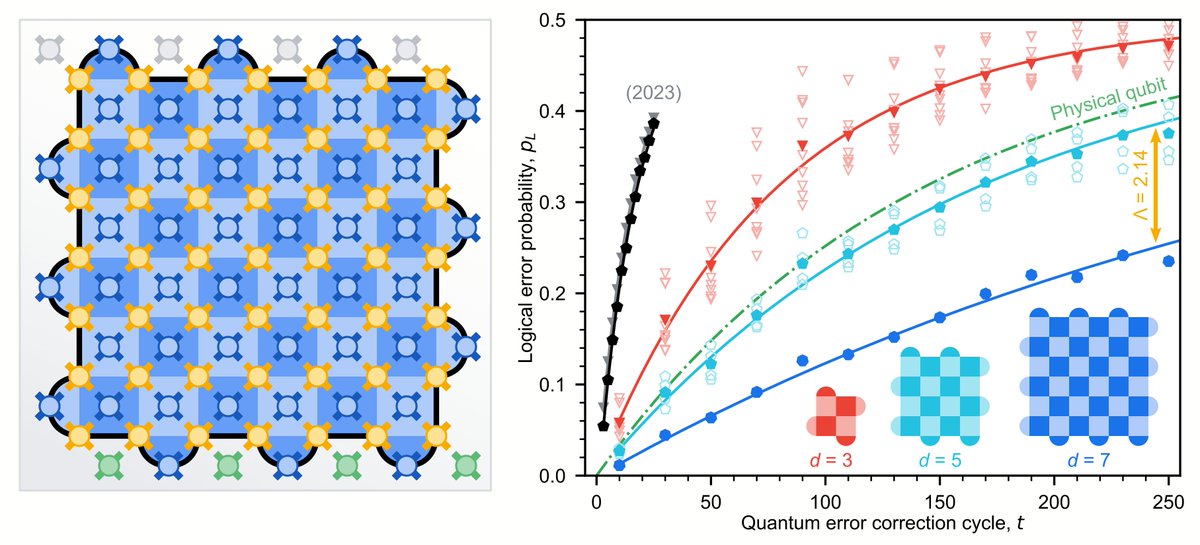
Meet Willow: Our state-of-the-art quantum chip. It's the first quantum chip to show exponential error reduction as qubits scale, paving the way for large-scale, fault-tolerant quantum computers. Dive in → https://t.co/Lr1vkZk1QT
We see Willow as an important step in our journey to build a useful quantum computer with practical applications in areas like drug discovery, fusion energy, battery design + more. Details here: https://t.co/dgPuXOoBSZ
To enable exciting new applications in learning from quantum data and building more modular quantum computers, Google Quantum AI opened a new funding call for PIs in quantum transduction (hardware and theory). Encourage your friends to write and apply! https://t.co/UOY4gNAcrZ
Time flies when you're immersed in the latest physics and connecting with colleagues at @APSphysics March Meeting!
Here's what our researchers will be focusing on today ↓
It was great to see past and current group members last night for our annual @TheSQuaD_IQ#APSMarch dinner. this year, we even had a few guests from @qudev bringing the total to 24!
We’re at @APSphysics March Meeting this week! Attending? Stop by one of our 50+ sessions or swing by our booth to learn more and to chat with our team.
Read more about our presence and event schedule here ↓ https://t.co/Oah9YjB1AM
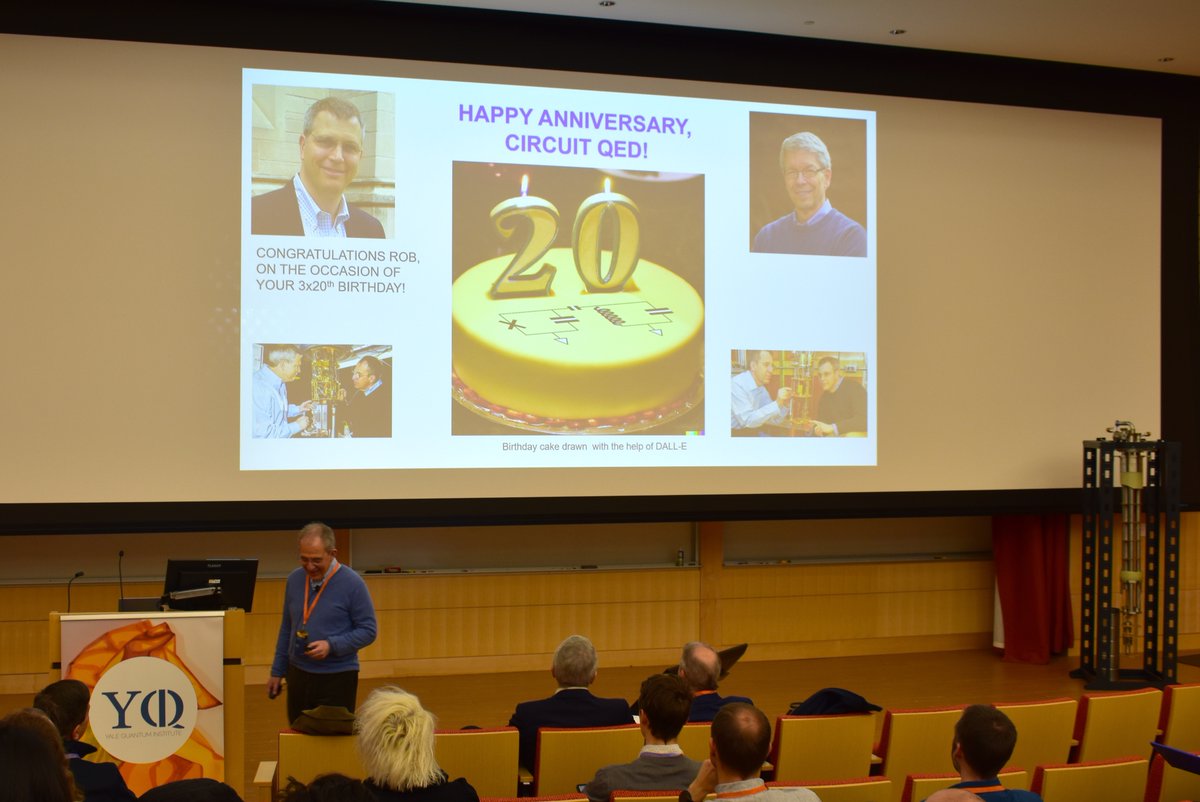
And with this recreation of a 20 year old photo, the #CircuitQEDat20 conference comes to an end. Thank you to everyone who joined us!
@circuitqed@AndreasAtETH