We want to help all companies be secure, working with the USG and the security ecosystem.
*The full version of GPT-5.5-Cyber is here; state of the art performance on CyberGym.
*Patch The Planet and Codex Security will help solve security problems instead of just finding them.
OpenAI just acquired Noam Shazeer one of the original authors of ‘Attention Is All You Need,’ the paper that invented the transformer architecture every major LLM is built on.
Massive heavy hitter.
Very excited to welcome @NoamShazeer to OpenAI as our new lead for architecture research! His work on transformers, MoE, and efficient decoding have shaped modern AI.
He’s extremely AGI-pilled and is super thoughtful about making it all go well. Welcome, Noam!
I’m excited to share that I’ll be joining OpenAI and look forward to working with the exceptional team there.
It was a difficult decision to move on. I’m incredibly proud of the amazing team at Google and everything we’ve built together. It has been an honor and a pleasure to work with all of you.
Two weeks in @OpenAI. Having a blast. Company is in founder mode. Codex is amazing. We're cooking, together with the ecosystem. @gdb@nickaturley@sherwinwu
https://t.co/hZv5a0Gxls
"Today, we’re announcing the OpenAI Partner Network to deliver just that.
The OpenAI Partner Network is a new program for partners around the world to build, sell, and deliver AI solutions with OpenAI.
We’re investing $150 million to support this ecosystem and help partners bring the benefits of AI to more organizations more quickly. The OpenAI Partner Network launches with a select group of global partners with AI leadership across systems integration, management consulting, technology, and data. We also aim to train and enable 300,000 certified consultants by the end of 2026."
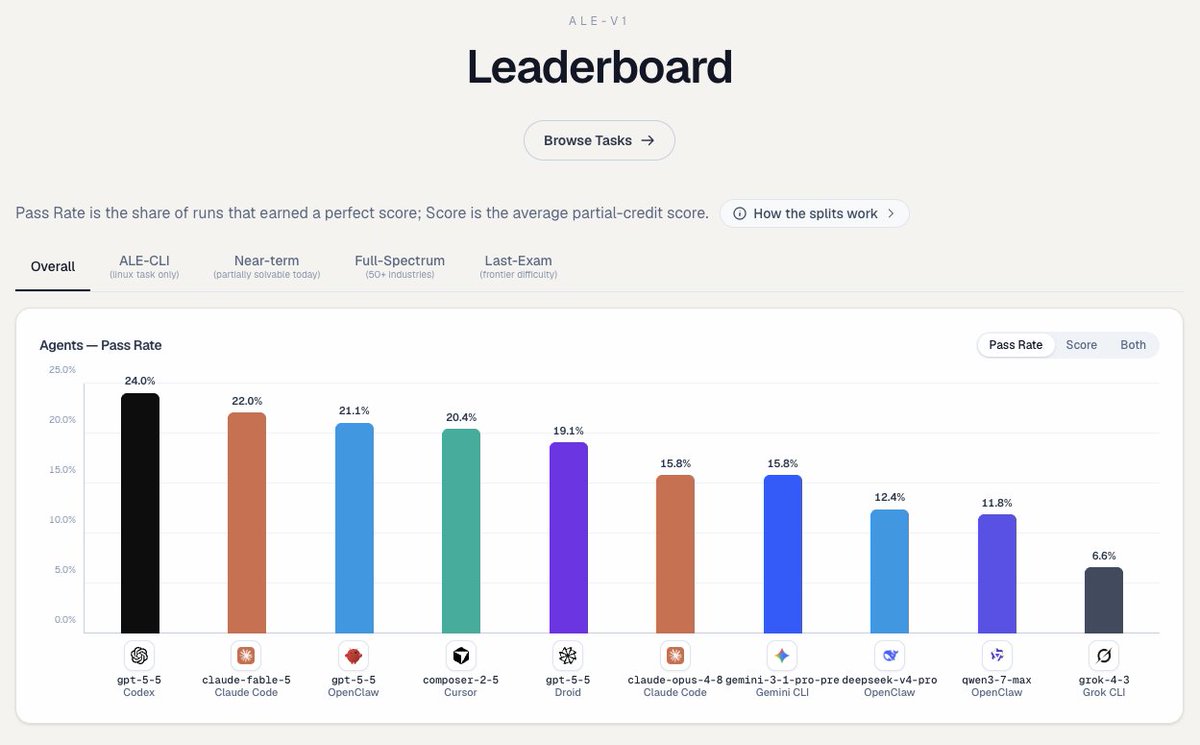
1. This is why @thsottiaux and @OpenAI are feeling good about GPT-5.6 (screenshot is from @datacurve's latest DeepSWE from @theo's video)
2. Most other SWE benchmarks are out the window. Anthropic admitted claude cheat(s) on swe-bench pro. I think DeepSWE might be one of the 5 most important AI benchmarks out right now.
3. GPT-5.5 was released a month before Opus 4.8, and it is still outpunching Anthropic's newest Fable 5.
4. In other words, Anthropic, the company known for their coding models, have had TWO additional shots at creating a coding model that competes with GPT-5.5 on a cost-per-intelligence basis and have failed.
5. A little secret most benchmark watchers overlook? GPT-5.5 xhigh is not even close to being OpenAI's best model. That belongs to GPT-5.5 Pro, which rarely gets benchmarked.
6. This will be very bad for Anthropic when/if Tech Twitter, the mainstream media and Wall Street start connecting the dots.
7. Seems like all the IPO doomsday marketing hype from Anthropic couldn't actually make their models better or more efficient.
8. The above is why Anthropic is now going on a PR tour with national news companies, as they see the writing on the wall: OpenAI's models are better at what matters and its Codex harness is better.
9. Anthropic's best shot at out IPO-ing OpenAI is only:
A) controlling the public narrative via press tours
B) confusing enterprise customers (agentic models running broken loops, tokenmaxxing and companies are none the wiser)
C) Copying Codex verbatim like Google tried to with Antigravity, b/c Anthropic's Caude desktop offering is a disjointed, siloed mess without unified memory.
We heard you wanted to use Codex rate limit resets on your own time.
Starting today, we’re rolling out the ability to save rate limit resets to use later.
We’re starting Go, Plus, Pro, and Business users with one free reset:
Career update: I’ve joined @OpenAI to lead Cyber with @michaelaiello.
Why I joined, and what we’ll be building:
It’s clear that AI is fundamentally changing how software is being written and secured.
Coding agents are writing the majority of code for many developers, software is getting shipped more quickly, and vulnerabilities that were latent for 20 years are being discovered at a rapid pace. The time to bug discovery, and exploitation once discovered, are trending down (H/T @EppSecurity and @gadievron).
I believe we have an unparalleled opportunity to fundamentally 𝘪𝘮𝘱𝘳𝘰𝘷𝘦 cybersecurity in ways that were previously impossible. (H/T @bubblewire’ BSidesSF keynote on reasons for optimism)
Over 6 years at @Semgrep, I had the privilege of working with an amazing team building what has become the most popular open source security code scanning tool in the world, that many companies have built their application security program around.
Now, at @OpenAI, I’m thrilled to be a part of a company helping shape how software is written, and how security work gets done. It is a massive opportunity, and responsibility, and I don’t take that lightly.
Here are my current thoughts about where things are headed:
𝐑𝐞𝐬𝐢𝐥𝐢𝐞𝐧𝐭 𝐛𝐲 𝐝𝐞𝐬𝐢𝐠𝐧. Defenders are not going to win playing bug whack-a-mole. We need to systematically eliminate classes of vulnerabilities, via generating secure code and streamlining the detect → validate → fix process.
𝐀𝐮𝐠𝐦𝐞𝐧𝐭 𝐚𝐧𝐝 𝐞𝐦𝐩𝐨𝐰𝐞𝐫 𝐩𝐞𝐨𝐩𝐥𝐞. We should build models and tools that give defenders “superpowers,” enabling them to be more ambitious in the scope they tackle, shift from being reactive to proactive, and allow them to automate the drudgery so they can focus on the highest leverage work.
𝐒𝐞𝐜𝐮𝐫𝐞 𝐭𝐡𝐞 𝐜𝐨𝐦𝐦𝐨𝐧𝐬. The world runs on open source software. OpenAI has already spent $Ms finding and patching vulnerabilities in the most popular and widely run software, including browsers, operating systems, and core libraries. More on this soon. We’re also working on helping secure critical infrastructure.
𝐂𝐨𝐦𝐦𝐮𝐧𝐢𝐭𝐲 𝐚𝐧𝐝 𝐩𝐚𝐫𝐭𝐧𝐞𝐫𝐬. Securing the world is a community effort. I’m looking forward to partnering with cybersecurity vendors, researchers, practitioners, governments, and more to do together what we can’t do alone.
𝐓𝐢𝐦𝐞 𝐭𝐨 𝐛𝐮𝐢𝐥𝐝. Tactically, here are some domains I’m excited about:
- Finding, validating, and reliably patching software vulnerabilities at scale.
- Eliminating classes of vulnerabilities and making software resilient by design.
- Giving broad access to the best cyber models to empower defenders, not just to a select few.
- Creating and sharing Skills and playbooks that help in many security domains.
- Building platforms that enable defenders to easily orchestrate security work.
- Making enterprise agents safe and reliable.
Time to build 😎
—
What would help you most? What should we build?
Let me know.
If you really think about it, despite being mocked as “ClosedAI,” OpenAI has contributed enormously to the field: GPT, GPT-2, GPT-3, CLIP, the ChatGPT paper, the GPT-4 Technical Report, the Sora technical blog, and even open-sourced Codex.
Anthropic, meanwhile, has contributed far less to the public research ecosystem while increasingly promoting fear-based narratives and restricting access through heavy gatekeeping.
The world I least want to live in is one where the future of AI is controlled by companies that prioritize secrecy, gated access, and centralized control over openness, reproducibility, and scientific progress.
Finally an Arena leaderboard that aligns with my subjective experience of using models for real work (and, I think, many people's experiences right now).
We’re making Codex more useful for your work by expanding plugins beyond individual tools.
These plugins turn Codex into a specialist for a specific role with a single install, no coding required.
Codex can access 62 popular apps and 110 skills for work across sales, data analytics, creative production, product design, and public equity investing.
https://t.co/nunrYP2uMI