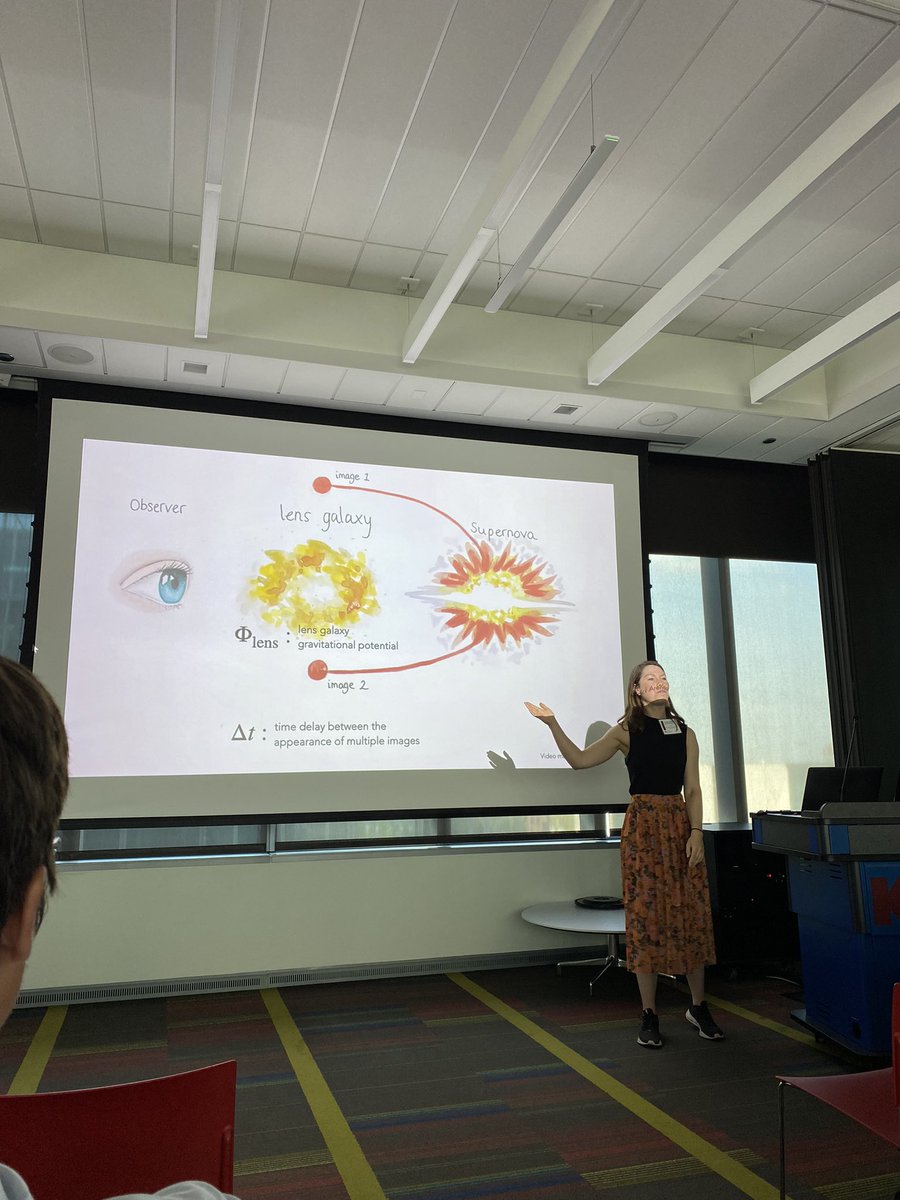
Wow, big congrats to TDCOSMO for their `Milestone’ paper: https://t.co/RPATg36gYA . They analyze 8 strongly lensed quasars and find Hubble constant of 72+-3 km/s/Mpc with supernova prior on Omega_M, and H0=73+-3 with DESI BAO prior. This was one of the two local H0 studies from JWST I was most excited to see this year because the teams and tools are independent of SH0ES (other was the TRGB-SBF Project, got 73.8+-2.4). This was an amazing 6 year (!!) journey by TDCOSMO to get here..Story time..
Excited to share the latest work on measuring the Hubble constant by the TDCOSMO collaboration: https://t.co/f8SKmvvXzy This work was five years in the making by many excellent people
This figure! This is the most complete census of what we, humanity, have learned about dark energy. 6 multinational experiments, decades of work by 1000s of physicists, and petabytes of data later, this's the most we can say about #darkenergy's evolution. https://t.co/AB2aM9KtnQ
Lots of fun discussion in defining the boundary between strong and weak lensing during Scott Dodelson’s talk at #StrongWeakLensing_KICP23 workshop that kicked off today.
@astrosonnen The hashtag breaks up with the “&” sign, that’s on me not being too active here. 😭 Maybe we can use #StrongWeakLensing_KICP23 instead.
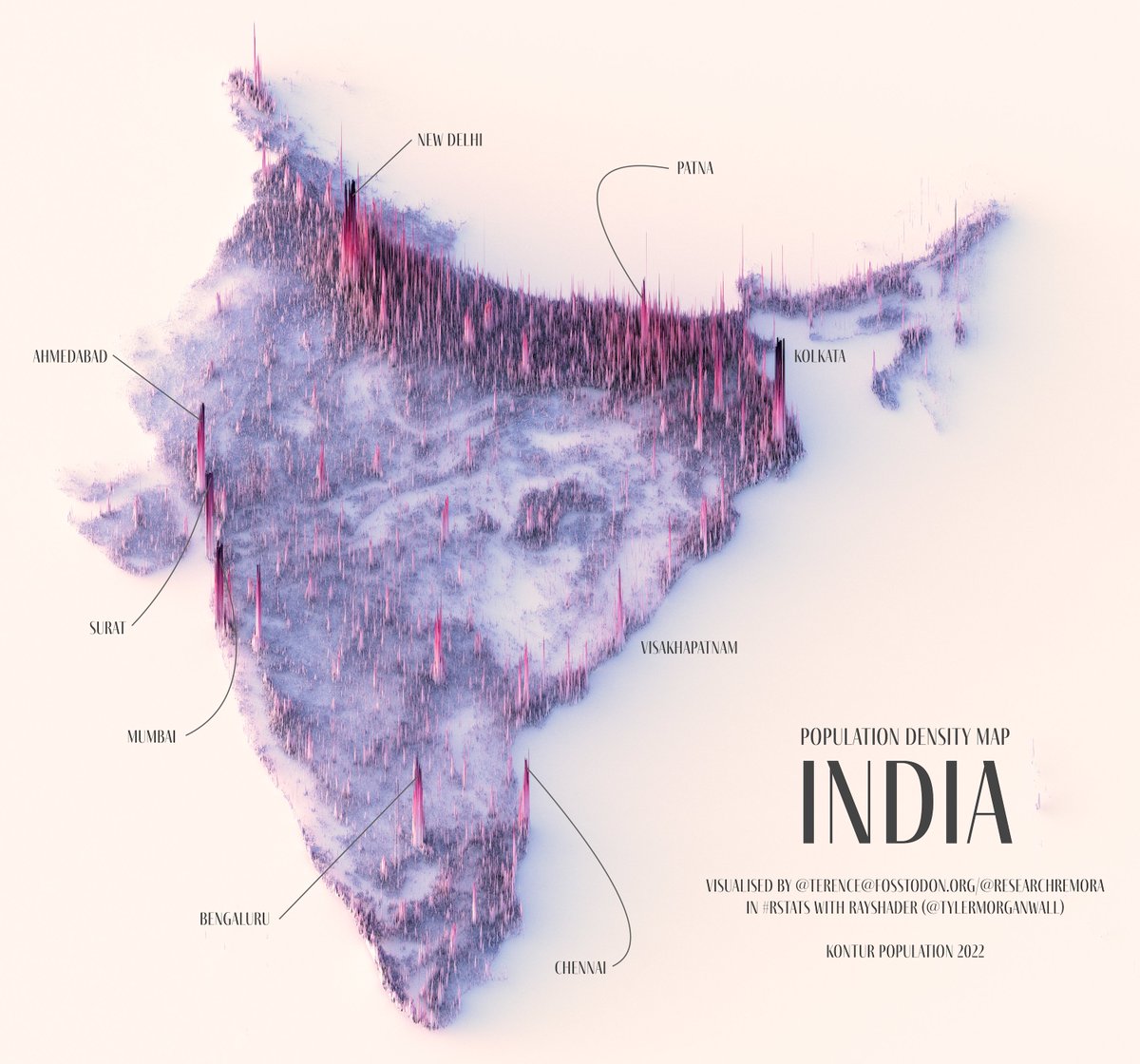
India just passed China as the most populous country in the world. Why?
Because of the biggest accident in history
Look at where people live in India. What's that band up north?
"Strong gravitational lensing is cool, but what about selection effects?" I've heard this question many times, and now we have an answer! You can read about it in our paper https://t.co/XyEAD2azuS
This week’s image is of the Cheshire Cat! Created with imaging data from HST and Chandra, the massive elliptical galaxies (the 👀) bend the light from background galaxies resulting in four stretched-out arcs (face + 🙂). Check out the 🧵for papers on gravitational lensing!
Important result from @ajshajib and TDCOSMO team (https://t.co/nd6C8wKkJA). In short, they were getting high H0 given certain conventional assumptions about the mass-sheet degeneracy. Then two years ago, they took away those assumptions, and H0 constraints jumped all over.
Observing with Keck Telescope tonight in “pajama mode”. My home just became a remote control room for one of the largest telescopes in the world. ✨🔭👈👔🩳
All of our results are consistent with a scenario where halos of massive elliptical galaxies first contract up to z~2 due to baryonic cooling, but then the halos primarily grow through dissipationless mergers while AGN feedback counteracts the initial contraction.
Our new paper is on arXiv today: https://t.co/IUw5yUsdKx.
By analyzing 23 elliptical lens galaxies from SLACS, we find that the dark matter distribution is close to the NFW profile on average at z~0.2 without any contraction/expansion.
A summary with some figures in the thread.