Wow, big congrats to TDCOSMO for their `Milestone’ paper: https://t.co/RPATg36gYA . They analyze 8 strongly lensed quasars and find Hubble constant of 72+-3 km/s/Mpc with supernova prior on Omega_M, and H0=73+-3 with DESI BAO prior. This was one of the two local H0 studies from JWST I was most excited to see this year because the teams and tools are independent of SH0ES (other was the TRGB-SBF Project, got 73.8+-2.4). This was an amazing 6 year (!!) journey by TDCOSMO to get here..Story time..
Excited to share the latest work on measuring the Hubble constant by the TDCOSMO collaboration: https://t.co/f8SKmvvXzy This work was five years in the making by many excellent people
IT'S HAPPENING:
Strongest EVER constraints on the free-streaming length of dark matter from a combination of the first 9 lenses in our @NASAWebb program and 5 previously measured lenses. This work was led by @ucmerced postdoc @RyanEKeeley https://t.co/GcUuGYeMU2
So excited about this paper! https://t.co/MrXhKmU6lh
It's an idea we've had for years but implementing was very challenging. The brilliant @MrGilmanDa led this, with major innovations that will revolutionize our dark matter measurements. With @maverick_sh_oh and @sibirrer
Calling all citizen scientists! DES is looking for YOUR help to look at our images and find gravitational lenses! Anyone can participate in this limited-time scientific project, hosted by @the_zooniverse and @SpaceWarps .
Start now at: https://t.co/4yOlM5G8Em
Announcing the first paper from our JWST lensed quasar dark matter survey. TLDR: We are optimistic we will be able to to use the full survey to confirm the existence of completely dark, dark matter halos if they exist. https://t.co/WUDRArwkIi
A new study published in @ScienceMagazine by researchers including Dept. of Physics & Astronomy Assistant Professor @sibirrer & Associate Professor Anja von der Linden uses supernova images to measure the expansion rate of the Universe. @sbuartssciences https://t.co/ZPq6NLFRt5
Congratulations Victoria Grove, Grants Manager for the Department of Physics and Astronomy, on receiving a College of Arts and Sciences Staff Excellence award!
#stonybrookuniversity#staff#excellence
omg @Stanford already starting with blatant union-busting rhetoric: "Stanford’s relationship with our graduate students is, first and foremost, an educational one."
babe no, grad students are *workers* whose labor props up the university, come on we've been through this
Bonus: We use raytracing in Lenstronomy to enhance the lensing scales of large-scale simulations. Starting with convergence computed on a coarse ~1' grid, we introduce finer fluctuations on galaxy lensing scales of ~1" to generate our training set. https://t.co/ct0NlMQbYD
Paper alert🚨 Proteins are my new dark energy, but my latest paper employs hierarchical Bayesian inference, importance sampling, deep sets – all methods close to my heart! 🧵https://t.co/hwvlBWZDed
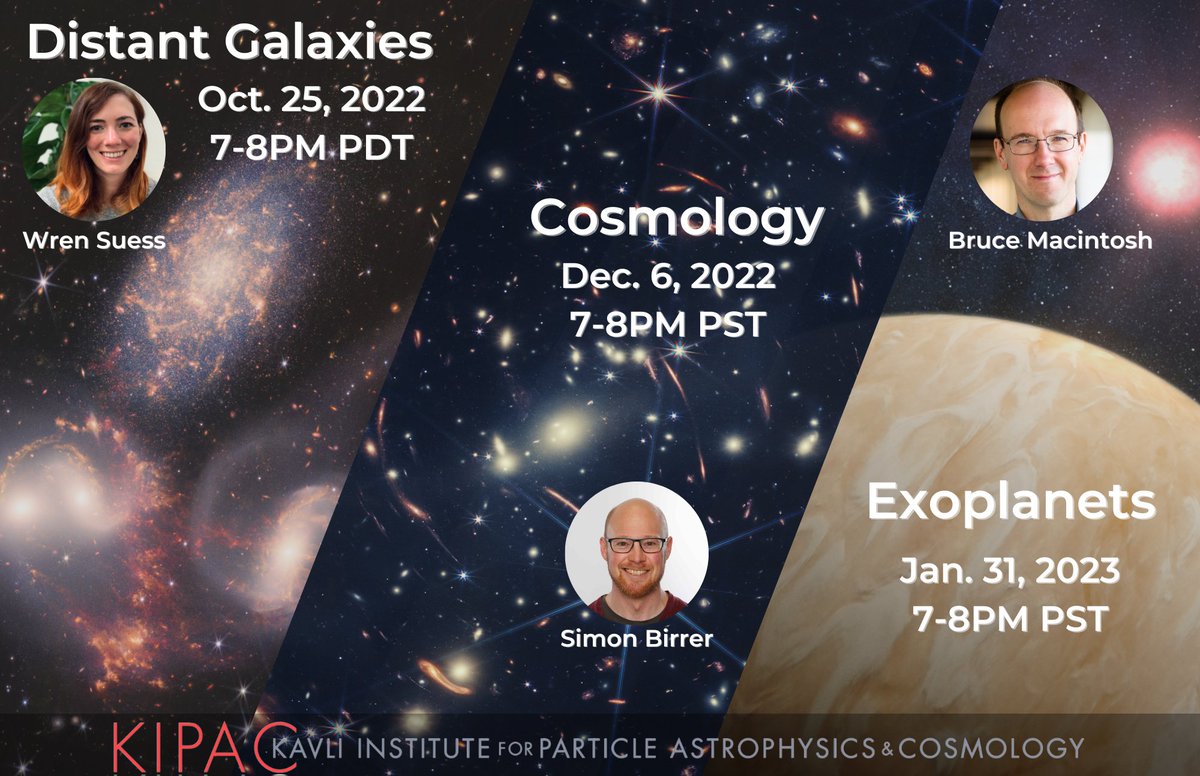
We are super excited to announce a mini lecture series on #JWST early science! How is this legendary telescope changing our understanding of first galaxies, cosmology, and exoplanets? Join us on Oct. 25 for the first talk in the series. 🌌 More info: https://t.co/5GXHDghMJz