Japanese scientists just discovered shocking news about grey hair.
It’s literally your body choosing survival over cancer.
Here’s everything you need to know (& how to keep your hair dark):
🇫🇷 SEMCO TECHNOLOGIES
Une petite pépite française des semi-conducteurs ⁉️
SEMCO Technologies conçoit notamment des composants stratégiques appelés eChucks, utilisés dans la fabrication des semi-conducteurs. Le groupe avait déjà dépassé ses objectifs 2025 et ses résultats semestriels sont attendus le 22 septembre.
Un dossier beaucoup moins connu, mais directement exposé à une industrie stratégique.
Je vous montre pourquoi son graphique mérite selon moi un coup d’œil 👇
▶️ https://t.co/qGVOTK2fwW
🇫🇷💻 𝗖𝗲𝘁𝘁𝗲 𝗲𝗻𝘁𝗿𝗲𝗽𝗿𝗶𝘀𝗲 𝗳𝗿𝗮𝗻𝗰̧𝗮𝗶𝘀𝗲 𝗱𝘂 𝗩𝗮𝗹-𝗱’𝗢𝗶𝘀𝗲 𝗱𝗲́𝘁𝗶𝗲𝗻𝘁 𝟮𝟱 % 𝗱’𝘂𝗻 𝗺𝗮𝗿𝗰𝗵𝗲́ 𝗺𝗼𝗻𝗱𝗶𝗮𝗹 𝗱𝗼𝗻𝘁 𝗱𝗲́𝗽𝗲𝗻𝗱𝗲𝗻𝘁 𝘁𝗼𝘂𝘀 𝗹𝗲𝘀 𝘀𝗲𝗺𝗶-𝗰𝗼𝗻𝗱𝘂𝗰𝘁𝗲𝘂𝗿𝘀 𝗱𝗲 𝗽𝗼𝗶𝗻𝘁𝗲 : 𝗹’𝗲́𝗽𝗶𝘁𝗮𝘅𝗶𝗲 𝗽𝗮𝗿 𝗷𝗲𝘁𝘀 𝗺𝗼𝗹𝗲́𝗰𝘂𝗹𝗮𝗶𝗿𝗲𝘀
Elle ne compte que 121 salariés, réalise une quarantaine de millions d’euros de chiffre d’affaires et travaille depuis Bezons, dans le Val-d’Oise. Pourtant, RIBER contrôle environ 25 % d’un marché mondial hautement stratégique pour les semi-conducteurs.
Sa spécialité : des machines d’épitaxie par jets moléculaires (MBE) capables de déposer des couches de matériaux parfois épaisses d’un seul atome. Une précision nécessaire pour fabriquer certains lasers des télécoms, composants photoniques, capteurs infrarouges ou encore certaines technologies destinées à l’informatique quantique.
Le marché est si spécialisé que seuls quelques fabricants mondiaux sont capables de produire ces équipements à grande échelle. Et la petite entreprise française joue aujourd’hui dans la même cour que l’américain Veeco.
RIBER prépare désormais son prochain coup avec ROSIE, une plateforme capable de travailler sur des wafers de silicium de 300 mm, le format utilisé par les grandes usines de semi-conducteurs. Une évolution qui pourrait lui ouvrir les portes de la photonique intégrée, des datacenters d’IA et du quantique.
Dans notre article, on vous explique comment cette PME française est devenue numéro deux mondial de son secteur, ce que fabriquent réellement ses impressionnantes machines de plusieurs millions d’euros et pourquoi ROSIE pourrait permettre à RIBER de changer complètement de dimension.
Notre article complet :
👉 https://t.co/MuitLhEIXY
#RIBER #SemiConducteurs #france #HighTech #IntelligenceArtificielle
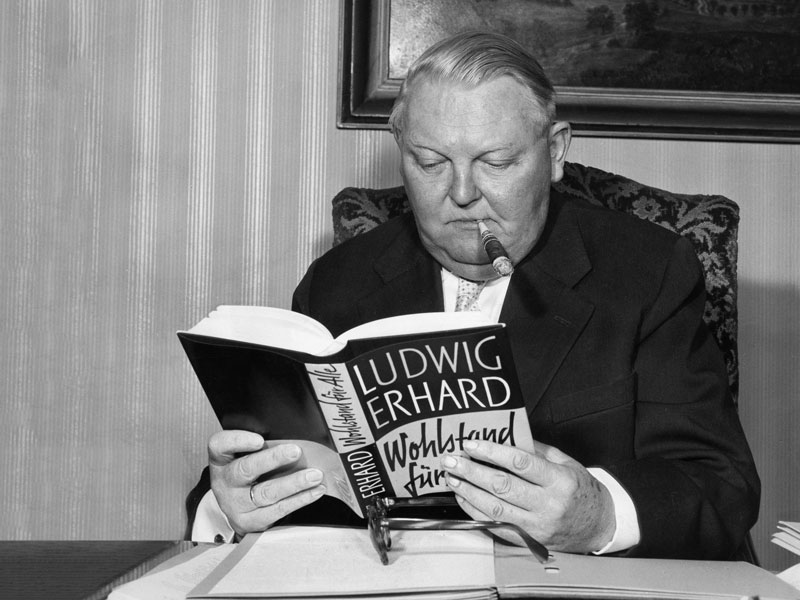
Germany destroyed its own price controls in 1948 and watched an economy resurrect itself inside eighteen months.
Ludwig Erhard did it unilaterally. On June 20, 1948, he abolished the Nazi-era price and wage controls that the Allied occupation forces had maintained, then went on radio to tell Germans what he had done before anyone could stop him. The American occupation authorities were furious. General Lucius Clay demanded an explanation. Erhard told him he had not reformed the controls, he had abolished them.
The results were immediate. Goods reappeared on shop shelves within days. Germans who had been hoarding anything of tangible value started trading again because currency reform and price liberalization made holding marks rational for the first time in years. Industrial output rose 50 percent in the six months following the reform.
The villain in this story is price controls, and the economists and bureaucrats who insist they tame chaos rather than create it. Price controls tell producers to stop producing and tell consumers to hoard. Every time. The postwar German black market proved it: the official economy was starving while the illegal economy fed people. Erhard simply liberated the black market by freeing prices.
You benefit from this history whether you know it or not, because it settled an empirical argument that interventionists have been trying to reopen ever since. Free prices coordinate production without a central planner. Suppress them and you get empty shelves and queues. Germany in 1946 had both. Germany in late 1948 had neither.
The so-called Wirtschaftswunder, the economic miracle, was not miraculous; Erhard applied basic economic logic that Friedrich Hayek had already formalized in 1945 in "The Use of Knowledge in Society." No central authority possesses the dispersed, local, constantly changing information that prices aggregate and transmit. Bureaucrats trying to set correct prices are not just inefficient; they are epistemically incapable of the task. Hayek made the theoretical case, thrn Erhard ran the experiment on a starving nation, and proved it.
West Germany grew at roughly 8 percent annually through the 1950s. East Germany, running Soviet central planning across the same ethnic population with similar prewar industrial infrastructure, stagnated and eventually built a wall to prevent its citizens from leaving. That comparison is about as clean a controlled experiment as political economy ever produces. Same people, same history, radically different institutions.
The lesson: prosperity flows from secure property rights, sound money, and voluntary exchange. Erhard gave West Germans all three in one afternoon.
Nearly five centuries before Johannes Werner, the Egyptian astronomer Ibn Yunus used a trigonometric identity equivalent to {𝟮𝗰𝗼𝘀(𝗮)𝗰𝗼𝘀(𝗯)=𝗰𝗼𝘀(𝗮+𝗯)+𝗰𝗼𝘀(𝗮-𝗯)} in astronomical calculations for determining time from the altitude of the Sun and stars.
Ibn Yunus (1009 CE) was an Egyptian Muslim mathematician. His great-grandfather was a hadith scholar and an associate of Imam Shafi'i.
His methods for determining the time from stellar altitude were equivalent to:
{𝟮𝗰𝗼𝘀(𝗮)𝗰𝗼𝘀(𝗯)=𝗰𝗼𝘀(𝗮+𝗯)+𝗰𝗼𝘀(𝗮-𝗯)}.
That same formula, {𝟮𝗰𝗼𝘀(𝗮)𝗰𝗼𝘀(𝗯)=𝗰𝗼𝘀(𝗮+𝗯)+𝗰𝗼𝘀(𝗮-𝗯)}, was later named Werner's formula, so the credit went to someone else, even though Ibn Yunus had already worked with it centuries earlier.
🧵[THREAD]
@ngeorge00 " Le liban est une civilisation qui n'a rien à voir avec le tiers monde". Dixit Bachir Gemayel, en fait leur discours souverainiste cache un alignement systématique sur l'occident. Ils auraient probablement rêvé d'une base type Al Hudaid en plein Mont Liban pour leur projet.
Legends Die but Are Never Forgotten
America’s first Secretary of Defense opposed rushing to recognize Israel. Not because he hated Jews. Because he thought it would blow up U.S. relations with the Arab world and put Middle East oil, the fuel of the American industrial machine, at risk.
George Marshall agreed with him. The Joint Chiefs agreed with him. That didn’t matter.
What followed was a smear campaign. Drew Pearson and Walter Winchell spent months calling him dangerous, unpatriotic, even a coward. They didn’t debate his policy. They went after his sanity and his manhood.
By the time Truman forced him out in March 1949, the press had already written the ending: Forrestal wasn’t a strategist. He was “crazy.”
Five days later he was locked in Bethesda Naval Hospital. Seven weeks after that, on May 22, 1949, they said he “fell” from a 16th-floor window.
His own brother Henry Forrestal said the nervous-breakdown story was garbage and that James was coherent when they pushed him out.
A hospital corpsman pulled a priest aside that morning and told him Forrestal didn’t kill himself.
Journalist William Bradford Huie wrote that the truth had been suppressed, that Forrestal had been treated like a prisoner, and that his own priest couldn’t even see him.
The Navy’s official Willcutts report, buried for 55 years, never even concluded suicide. It only said he died from the fall and that no one in the Navy was at fault.
Broken glass was later reported on the bed. The scene was cleaned before it was photographed.
They paint you insane. Then they write the obituary. Then they tell you to stop asking questions.
Where have we seen this before?
Never forget what they did to James Forrestal.
The same playbook is still in use.
In 1526, the king of Kongo wrote to the king of Portugal and begged him to stop the slave trade.
The letters still exist. You can read them.
King Afonso I — Nzinga Mbemba.
He was not a victim of ignorance about Europe. He was literate in Portuguese, Catholic, and had welcomed Portuguese traders as partners. Then he watched what the trade actually did.
He writes that merchants are seizing people every day — nobles, family members, free subjects — and that his country is being emptied. He asks for teachers and doctors instead of ships. He asks, plainly, for it to stop.
Portugal's king replied with a letter pointing out how profitable Kongo's trade was and how little else it had to offer.
The trade continued for another three hundred years and helped destroy the kingdom.
An African head of state put his objection in writing in 1526, in the language of the people doing it, and was told the arithmetic did not work in his favour.
"They didn't know" has never been available as an excuse. The correspondence is in the archives.
قالها الملك فاروق للواء محمد نجيب عندما صعد الاخير علي متن المحروسه لوداع الملك قبل التوجه الي منفاه الاخير في إيطاليا...ايه اللي كان يقصده الملك فاروق بهذه الجمله؟


![IslamicSH_'s tweet photo. Nearly five centuries before Johannes Werner, the Egyptian astronomer Ibn Yunus used a trigonometric identity equivalent to {𝟮𝗰𝗼𝘀(𝗮)𝗰𝗼𝘀(𝗯)=𝗰𝗼𝘀(𝗮+𝗯)+𝗰𝗼𝘀(𝗮-𝗯)} in astronomical calculations for determining time from the altitude of the Sun and stars.
Ibn Yunus (1009 CE) was an Egyptian Muslim mathematician. His great-grandfather was a hadith scholar and an associate of Imam Shafi'i.
His methods for determining the time from stellar altitude were equivalent to:
{𝟮𝗰𝗼𝘀(𝗮)𝗰𝗼𝘀(𝗯)=𝗰𝗼𝘀(𝗮+𝗯)+𝗰𝗼𝘀(𝗮-𝗯)}.
That same formula, {𝟮𝗰𝗼𝘀(𝗮)𝗰𝗼𝘀(𝗯)=𝗰𝗼𝘀(𝗮+𝗯)+𝗰𝗼𝘀(𝗮-𝗯)}, was later named Werner's formula, so the credit went to someone else, even though Ibn Yunus had already worked with it centuries earlier.
🧵[THREAD]](https://pbs.twimg.com/media/HSpZO6ybEAA_sn0.jpg)


![IslamicSH_'s tweet photo. Nearly five centuries before Johannes Werner, the Egyptian astronomer Ibn Yunus used a trigonometric identity equivalent to {𝟮𝗰𝗼𝘀(𝗮)𝗰𝗼𝘀(𝗯)=𝗰𝗼𝘀(𝗮+𝗯)+𝗰𝗼𝘀(𝗮-𝗯)} in astronomical calculations for determining time from the altitude of the Sun and stars.
Ibn Yunus (1009 CE) was an Egyptian Muslim mathematician. His great-grandfather was a hadith scholar and an associate of Imam Shafi'i.
His methods for determining the time from stellar altitude were equivalent to:
{𝟮𝗰𝗼𝘀(𝗮)𝗰𝗼𝘀(𝗯)=𝗰𝗼𝘀(𝗮+𝗯)+𝗰𝗼𝘀(𝗮-𝗯)}.
That same formula, {𝟮𝗰𝗼𝘀(𝗮)𝗰𝗼𝘀(𝗯)=𝗰𝗼𝘀(𝗮+𝗯)+𝗰𝗼𝘀(𝗮-𝗯)}, was later named Werner's formula, so the credit went to someone else, even though Ibn Yunus had already worked with it centuries earlier.
🧵[THREAD]](https://pbs.twimg.com/media/HSpZR9raoAEV3gt.jpg)


