By the end of last year, over 50% of GenAI projects were abandoned after the proof-of-concept stage. The main reasons?
➡️ Poor data quality
➡️ Insufficient risk controls
➡️ Rising costs
➡️ Unclear business value
Gartner analyzed hundreds of GenAI implementations and identified the top culprits behind project abandonment. Find out more: https://t.co/9fBrdTzcMU
In the early days of a startup, everyone does everything.
They have to. @ReedHastings and I were doing customer service in the morning, arguing about the website in the afternoon, and stuffing DVDs into envelopes at night.
We knew just enough about everything to be dangerous — which is exactly what you need when you’re scrambling to keep the lights on.
But survive that stage and something changes. Fast.
The business gets complicated. And complicated businesses need people who know exponentially more than you do about their corner of it.
A lot of founders get stuck right there.
They’ve made every important decision since day one. The company is them and they are the company.
Bringing in someone who actually knows more? Someone who might push back? That feels threatening.
What Reed understood at Netflix— and what I didn’t yet — was that one of your most important jobs as a founder is to work yourself out of every job in the company.
One by one.
There are many “simple” features that are more complicated than they look on the surface because of a cascade of dependencies.
For complex, enterprise systems, this is true of most features.
8090’s Software Factory is built to handle this flawlessly. We first help write requirements, expand and frame dependencies and then execute with a more global knowledge of the problem.
You can learn more here: https://t.co/fkfTXgdfXK
Also, I’m completely in love with our visual system. 😍
NVIDIA’s growth is an index on the growth of AI. “Compute revenue grew more than 5x and networking revenue more than 3x from last year.”
Data center revenue totaled $26b, with about 45% from the major clouds ($13b). These clouds announced they were spending $40b in capex to build out data centers, implying NVIDIA is capturing very roughly 33% of the total capex budgets for their cloud customers.
“Large cloud providers continue to drive strong growth as they deploy and ramp NVIDIA AI infrastructure at scale and represented the mid-40s as a percentage of our Data Center revenue.”
NVIDIA has started to highlight the return-on-investment (ROI) for cloud providers. As the prices for GPUs increases, so do NVIDIA’s profits, to a staggering degree - nearly 10x in dollar terms in 2 years. Is this a problem for the clouds?
That may not matter to GPU buyers - at least not yet - because of the unit economics. Today, $1 spent on GPUs produces $5 of revenue.
“For every $1 spent on NVIDIA AI infrastructure, cloud providers have an opportunity to earn $5 in GPU instant hosting revenue over 4 years.”
But soon it, it will generate $7 of revenue. Amazon Web Services operates at a 38% operating margin. If these numbers hold, newer chips should improve cloud GPU profits - assuming the efficiency gains are not competed away.
“H200 nearly doubles the inference performance of H100, delivering significant value for production deployments. For example, using Llama 3 with 700 billion parameters, a single NVIDIA HGX H200 server can deliver 24,000 tokens per second, supporting more than 2,400 users at the same time. That means for every $1 spent on NVIDIA HGX H200 servers at current prices per token, an API provider serving Llama 3 tokens can generate $7 in revenue over 4 years.”
And this trend should continue with the next generation architecture, Blackwell.
“The Blackwell GPU architecture delivers up to 4x faster training and 30x faster inference than the H100”
We can also guesstimate the value of some of these customers. DGX H100s cost about $400-450k as of this writing. With 8 GPUs for each DGX, that means Tesla acquired about $1.75b worth of NVIDIA hardware assuming they bought, not rented, the machines.
“We supported Tesla’s expansion of their training AI cluster to 35,000 H100 GPUs”
In a parallel hypothetical, Meta would have spent $1.2b to train Llama 3. But the company plans to have buy 350,000 H100s by the end of 2024 implying about $20b of hardware purchases.
“Meta’s announcement of Llama 3, their latest large language model, which was trained on a cluster of 24,000 H100 GPUs.”
As these costs skyrocket, it wouldn’t be surprising for governments to subsidize these systems just as they have subsidized other kinds of advanced technology, like fusion or quantum computing. Or spend on them as a part of national defense.
“Nations are building up domestic computing capacity through various models.”
There are two workloads in AI : training the models & running queries against them (inference). Today training is 60% and inference is 40%. One intuition is that inference should become the vast majority of the market over time as model performance asymptotes.
However it’s unclear if that will happen primarily because of the massive increase of training costs. Anthropic has said models could cost $100b to train in 2 years.
“In our trailing 4 quarters, we estimate that inference drove about 40% of our Data Center revenue.”
The trend shows no sign of abating. Neither do the profits!
“Demand for H200 and Blackwell is well ahead of supply, and we expect demand may exceed supply well into next year.”
https://t.co/F3WaMDsqYR
I feel like I'm gonna keep reposting my chat with @OpenAI CEO @sama about AI enabling the first single-person-company to reach a billion-dollar valuation many, many more times ↓
The Forrester Wave Q1 2024, Merchant Payment Providers:
✔️ Adyen $ADYEY excels in payment performance and in omnichannel, but support is hit or miss.
✔️ Stripe, a fast mover, closes the gap between data and insight, with a smaller footprint.
✔️ Fiserv $FI manages an impressive balance of feature breath and quality, but it is slow.
✔️ Checkout[.]com’s tech rivals the best; it has a refreshing approach but a narrower focus.
✔️ PayPal’s $PYPL future and recent launches are promising, but it is midtransformation (again).
✔️ Worldpay $FIS is a feature-rich compliance expertise powerhouse that’s fallen a bit behind.
✔️ JPMorgan Chase’s $JPM strength is also its main weakness: It’s a megabank.
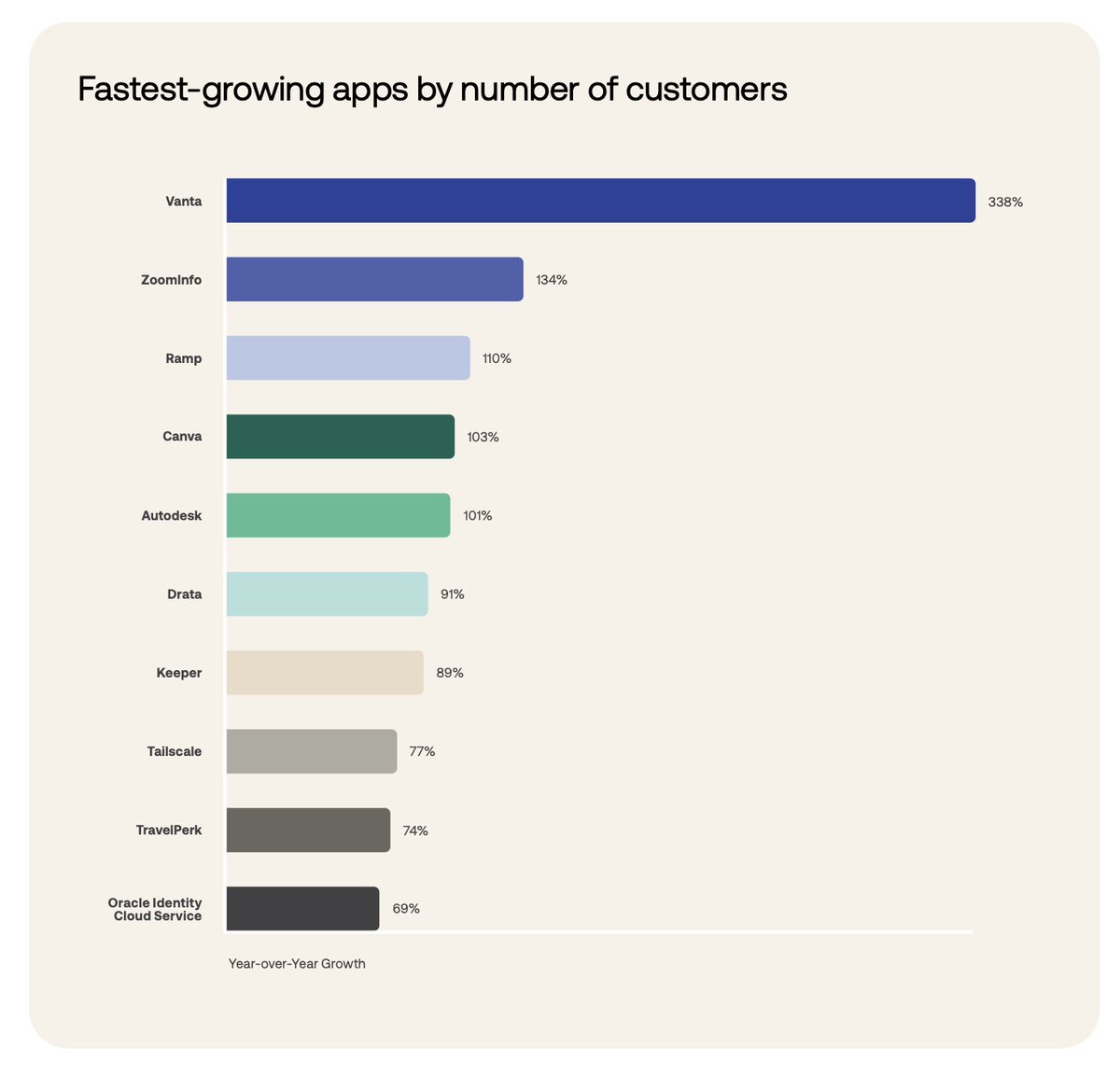
I used to look forward to and read Okta's Businesses at Work report each year (I'm great at dinner parties I promise.)
So it was a surprise to see Vanta at the top of the Okta charts, hitting the highest growth rate Okta's seen *in seven years.* https://t.co/5sZm6Qkf3Z 🦙🚀
This is true. But, also a trap. Successful VCs work extremely hard in their first 10 years which leads to their success. Then in the second 10 years they get confused and think they were successful bc they were smart. Which leads to half of the mtgs with predictable results.
Did you know? Benioff originally owned the ‘App Store’ trademark and domain, but gifted it to Steve Jobs as a gesture of friendship and respect. In turn, Salesforce focused on building the AppExchange, revolutionizing enterprise software. 🌐💼 #TechHistory#Innovation
What I see CEOs at struggling start-ups do:
- Go dark
- Hide
- Lash out
- Tweet about lots of things non-work
- Invest time on tiny expenses
- Argue internally
What should do:
- Be Present
- Be Honest
- Be the Rock
- Be Realistic/Optimistic
You just plain grow faster that way
B2B SaaS leaders like Slack, Zoom, and Shopify demonstrate that strategic adaptability, innovation, and stakeholder engagement aren’t just buzzwords—they’re business imperatives that drive measurable success. #B2BSaaS#Leadership
📢 GitHub’s engagement through community forums and hackathons has strengthened its developer ecosystem, contributing to a 40% year-over-year increase in active users. #CommunityEngagement#GitHubGrowth
🤝 Salesforce’s strategy to integrate its cloud services led to a unified customer experience, driving a 24% increase in annual revenue, highlighting the value of collaborative growth. #IntegrationSuccess#Salesforce
🌟 Adobe’s continuous updates to Creative Cloud, introducing AI-driven editing features, resulted in a subscription growth of over 20% in 2020, showcasing innovation’s impact. #CreativeInnovation#AdobeGrowth
🚀 Slack’s pivot to fully remote work tools saw a surge in user growth, showcasing the power of adaptability. Their rapid response to the new work norm increased user engagement significantly. #Adaptability#SlackSuccess
🔐 DocuSign’s emphasis on data security and compliance, such as GDPR, increased trust among European customers, leading to a 40% uptick in EU market penetration. #Trust#DocuSignSecurity
🔮 Microsoft Azure’s early investment in cloud computing anticipated the digital transformation wave, leading to a 50% increase in Azure’s revenue in FY2020. #FutureReady#MicrosoftAzure
🌍 Asana’s employee engagement initiatives contributed to a 30% faster product development cycle, showing the power of internal stakeholder engagement. #StakeholderEngagement#AsanaInnovation





![jevgenijs's tweet photo. The Forrester Wave Q1 2024, Merchant Payment Providers:
✔️ Adyen $ADYEY excels in payment performance and in omnichannel, but support is hit or miss.
✔️ Stripe, a fast mover, closes the gap between data and insight, with a smaller footprint.
✔️ Fiserv $FI manages an impressive balance of feature breath and quality, but it is slow.
✔️ Checkout[.]com’s tech rivals the best; it has a refreshing approach but a narrower focus.
✔️ PayPal’s $PYPL future and recent launches are promising, but it is midtransformation (again).
✔️ Worldpay $FIS is a feature-rich compliance expertise powerhouse that’s fallen a bit behind.
✔️ JPMorgan Chase’s $JPM strength is also its main weakness: It’s a megabank.](https://pbs.twimg.com/media/GIpt7cZXQAAa_pd.jpg)