Professor Simon Lewis tackles the “fake news” that surrounds Parkinson’s disease and warns viewers to be alert to common myths, hype and misleading claims online: https://t.co/ITZN9pHUs9
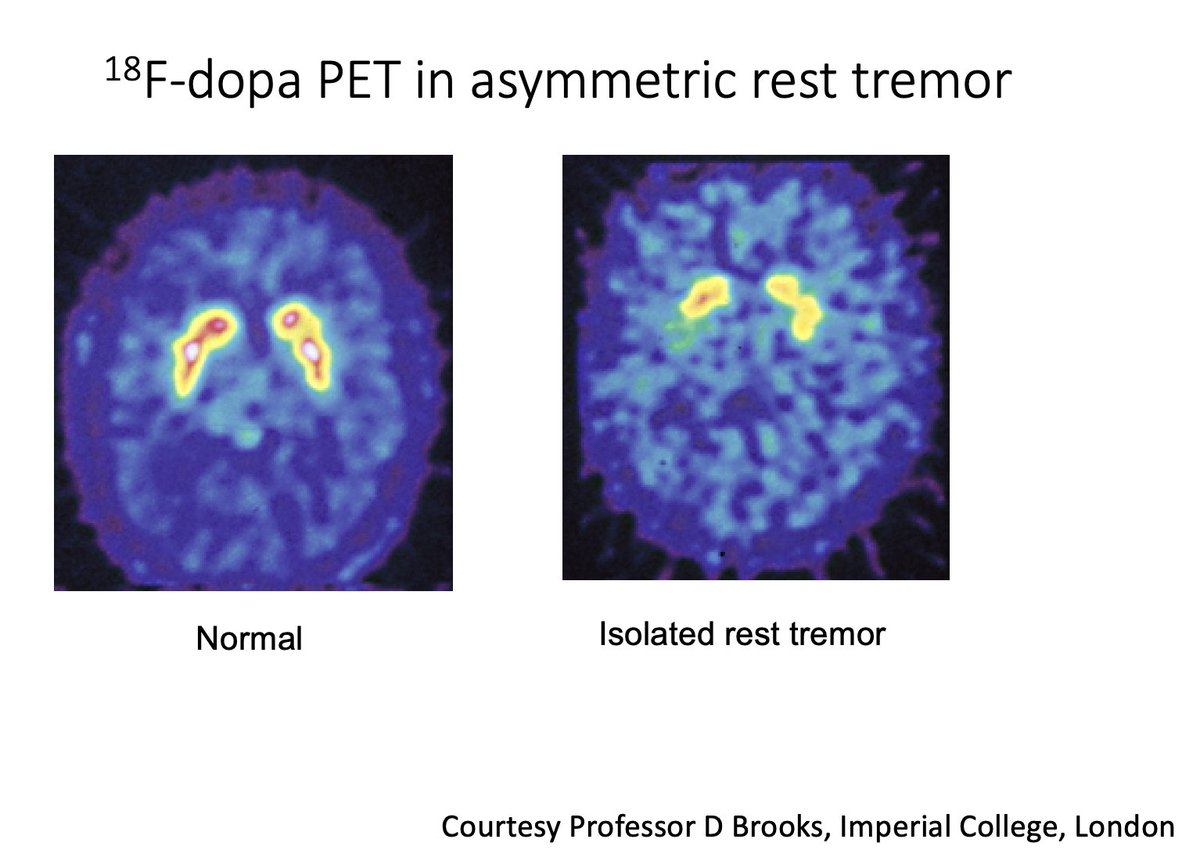
One of the most interesting discussions at the Aspen Movement Course centered on persons with a long-standing unilateral rest tremor, sometimes accompanied by a postural tremor, but without clear bradykinesia. Years ago, Professor David Brooks and colleagues used 18F-dopa PET imaging to show that the vast majority of these individuals already had evidence of nigrostriatal dopaminergic degeneration, supporting a diagnosis of Parkinson's disease rather than essential tremor or a functional movement disorder. Subsequent DaT imaging studies and careful long-term clinical follow-up have repeatedly confirmed these early observations. Another important pearl is that younger-onset Parkinson's disease may present with a fine, rapid tremor that can even appear myoclonic at first glance, creating additional diagnostic challenges. The lesson is simple: not every isolated tremor is essential tremor, and careful longitudinal examination, supported when appropriate by biomarkers, remains one of the most powerful tools in arriving at the correct diagnosis.
Good to see orthostatic tremor covered in the Australian media - a rare neurological disease that can cause severe imbalance and trouble standing.
https://t.co/raSDHIO2NY
@MichaelOkun Interesting study, but worth noting that the authors laudably included a delayed start and washout period in the protocol, with no significant difference in dyskinesias once both groups were off/on amantadine. This weakens the argument for using amantadine preemptively.
@MDJ_Journal Interesting study, but worth noting that the authors laudably included a delayed start and washout period in the protocol, with no significant difference in dyskinesias once both groups were off/on amantadine. This weakens the argument for using amantadine preemptively.
A fantastic comprehensive review article w/ everything you need to know about Idiopathic Normal-Pressure Hydrocephalus just dropped in the NEJM. Hydrocephalus refers to a condition where cerebrospinal fluid accumulates excessively in the brain’s ventricles, resulting in enlarged chambers that contribute to disrupting walking, cognition and bladder control. Johnson and Williams describe in their new New England Journal of Medicine paper that idiopathic normal-pressure hydrocephalus is a common, frequently missed and potentially reversible neurologic condition in older adults.
Key Points:
-Idiopathic normal-pressure hydrocephalus presents w/ a triad of gait and balance changes, urinary urgency and cognitive slowing, however each feature has an extensive differential diagnosis on its own.
- Prognostic testing w/ cerebrospinal fluid drainage or infusion methods improves selection of candidates who are likely to benefit from shunt surgery.
- Programmable cerebrospinal fluid shunt systems remain the most effective treatment and can improve gait quality of life and survival when used in appropriately selected folks.
My take: Nailing the diagnosis is so important in iNPH, and it is frequently a tricky endeavor for even an experienced clinician. One thing I would add to this article is that a fair number of folks with 'big ventricles' actually have Parkinson's disease, so don't forget considering the possibility of a levodopa trial in select persons who present for shunting. Here are 5 points that resonated w/ me: 1- Recognizing the gait pattern is essential because a wide-based slow shuffling walk frequently precedes memory or bladder issues and can be the earliest clue. 2- Imaging matters ,however it is not enough since enlarged ventricles alone do not confirm the diagnosis and this finding needs to be paired w/ symptoms and w/ testing. 3- A large-volume lumbar puncture can help by temporarily improving walking, which usually signals a higher likelihood of responding to a shunt. 4- Shunt surgery can meaningfully improve daily function, especially the gait and fall risk. Importantly, it should be performed at experienced centers using adjustable valves. 5- Delays in diagnosis can worsen outcomes because waiting too long may reduce the chance of symptom improvement and increase long-term disability.
https://t.co/ns7T6p5WUC @NEJM@movedisorder@FixelInstitute@UF@SfNtweets@ParkinsonDotOrg@PdAvengers@DBSThinkTank
@SawyerMerritt Having seen how slowly and carefully my neurosurgical colleagues open the brain lining (dura mater) when operating to avoid 'plunging' the scalpel into healthy brain tissue, I am not sure how safe or sensible it is to have a robot rapidly firing needles 50mm into the brain.
Good to see the TGA is taking action on vitamin B6 supplements. I have seen many patients with peripheral neuropathy (nerve damage) from B6 toxicity, often from taking supplements people did not realise contained B6 (e.g. magnesium supplements).
https://t.co/vxmnFTogLs
@pascal_bornet Great video, but most unlikely that brain signals (EEG) are what are being used to control the robot arm. If it is controlled by the electrodes on the headset, much more likely that muscle movements in the head/neck are bring recorded and used as the input signal.
Calling all people living with Parkinson’s or Parkinson’s Plus: Join our national Patient Activation Measure (PAM®) study. It just takes a few minutes to answer some questions about your confidence, knowledge and ability to manage your health & wellbeing.
https://t.co/mcZmohQk4o
NDIS is seeking feedback on exercise physiology and equipment, assistance animals, and smart home appliance. Consultation closes November 9.
https://t.co/Wt3QOWk6Kx…
NDIS is reviewing Smart Home Appliances & Exercise Physiology for plan funding. If you live with Young Onset Parkinson’s and use these, speak up before 9 Nov! Your voice changed things before (e.g. art therapy), let’s do it again here: https://t.co/vbVxaZCA5X #YOPD#NDIS#YOPX
Young carers aged 12 to 25 who help care for a parent with Parkinson’s may be eligible for a $4,000 bursary to support their education.
Apply by 7 Nov 2025
https://t.co/c6vbKnwp3j
Thanks to the @FragileXAus for inviting me to give this webinar on Fragile X Tremor Ataxia Syndrome (FXTAS), a condition that can cause tremor and imbalance in people in their 50s and 60s carrying a premutation of the Fragile X gene.
https://t.co/lQENIQLNGE
We are concerned about recent US claims linking paracetamol use in pregnancy with autism.
✅ No causal link found – global experts reject these claims
✅ Paracetamol remains recommended when used as directed
Read more: https://t.co/PPDpiQmsHg
TGA: https://t.co/eJkBBOwZP0
Thanks to the Fragile X Association of Australia for inviting me to give this webinar on Fragile X Tremor Ataxia Syndrome (FXTAS), a condition that can cause tremor and imbalance in people in their 50s and 60s carrying a premutation of the Fragile X gene.
https://t.co/DFd97uzAxd
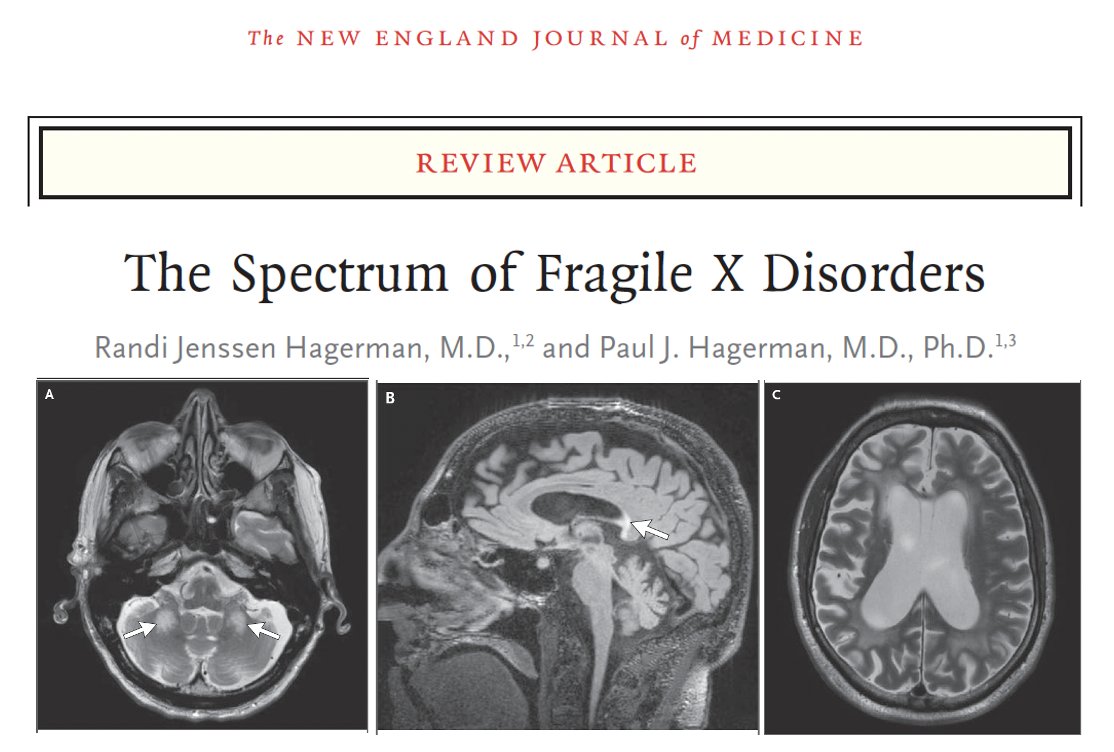
Fragile X isn’t just for kids. How about the adult-onset tremor we frequently blow off? Spoiler alert: Fragile X isn’t one disease, it’s a spectrum. One of its most underrecognized manifestations is a neurological disorder that looks like Parkinson’s or essential tremor, but it’s not. It’s FXTAS or Fragile X–associated Tremor/Ataxia Syndrome and the new NEJM review calls on neurologists to catch it earlier, especially in older adults.
Key Points:
- FXTAS affects men and women with the fragile X premutation which is a CGG repeat expansion in the FMR1 gene.
- It can present in older adults with intention tremor, gait ataxia, neuropathy, parkinsonism and cognitive decline.
- MRI clues like white matter changes in the middle cerebellar peduncles can tip the clinician to the diagnosis.
My take: If you see a presentation that isn’t quite essential tremor and has a flavor of Parkinson’s always check for FXTAS. Here are the 5 points that resonated w/ me about the NEJM review. 1- If your dad or grandfather has tremor and balance issues plus a family history of autism or family members w/ early menopause, it could be FXTAS. 2- This condition is genetic, progressive and frequently misdiagnosed as Parkinson’s or just aging. 3- Women aren’t immune as 8–16% of female carriers develop symptoms too. 4- Genetic testing is simple as the FMR1 premutation can confirm the diagnosis and guide treatment as well as family planning. 5- Medications can help symptoms like the tremor. Consider propranolol, primidone or even levodopa and in some cases FUS or DBS. Let’s rethink the tremor differential as fragile X might be hiding in plain sight.
https://t.co/RQVBgFQFsC @FixelInstitute@NEJM@ParkinsonDotOrg@fragilexuk@fragilexsyndrom@FragileXAus #tremor #Parkinsons