1% of people account for 63% of all violent crimes.
0.2% of people ever commit murder, and **67% of all murders**are committed by people with prior arrests
You can literally just fix crime by not tolerating people who show a history of being destructive to society.
What Midjourney is:
- No investors, fully community-funded research lab
- Revenue from image generation product funds all R&D
- ~$100M in first 9 months, $200M by month 12, still growing
- 8 active projects: 4 hardware, 4 software
----2 hardware products coming to market soon (consumer-purchasable)
----2 are large-scale machines
DAVID HOLZ: Background and Philosophy
- Grew up in Florida, parents in medicine, dad had a dental office on a sailboat
- Physics and math background: drawn to the tension between predicting reality vs. absolute truth
- Core thesis: the interaction between humans and technology is the biggest limitation, not compute power
- Founded Leap Motion at 22: $10M in pre-orders in 48 hours from a website (not Kickstarter)
- Built hand-tracking VR: 600M-parameter mixture-of-experts model, 2015, CPU cluster, pre-TensorFlow
- Also shipped Northstar, an open-source AR headset
- Left Leap Motion wanting a “home,” not a 100x return
- Mentor Bill Warner told him he could bootstrap; he listened this time
- Started Midjourney with ~$200K, called Google for 10,000 GPUs on trust alone
THE SCANNER: Full Body Ultrasonic CT
- First new whole-body medical imaging modality in ~50 years
- Concept: “as powerful as an MRI, as casual as a trip to the spa”
- No radiation, no magnets, no x-rays; safe for unlimited scans
How it works:
- 40 rings, each with 8,960 transducers (200 microns wide), totaling 358,000 elements
- Fires ultrasonic waves at 100M times/second; sound travels through water at 1,481 m/s
- Sensors resolve motion down to picometers (sub-atomic range)
- Captures 17 GB/second of raw data; 806 TB per full scan reconstruction
- 21 on-site servers, 2 petaflops of compute
- Patient lowers into water at 4 cm/second; ~60 seconds for several hundred body slices
- Produces sub-millimeter 3D maps of internal tissue
Already outperforming MRI in some tissue boundary and muscle fiber detail on DAY ONE.
10x cheaper and 60x faster than MRI machines; scan cost effectively near zero.
Gen 2 scanner planned by end of 2026; Gen 3 will use custom silicon.
SCANNER vs. MRI: Key Differences
- MRI: 60-minute tube, loud, requires sedation for children, expensive, radiation-adjacent.
- This scanner: water immersion, 30-60 seconds, no sedation, no radiation, repeatable daily.
- Current limitation: not yet FDA-cleared beyond body composition; no AI layer yet applied.
- Already better than MRI in certain muscle/fiber/vein boundary resolution at day one
THE MIDJOURNEY SPA:
- First location: Union Square, San Francisco
- 25,000 sq ft, 4 floors
- Amenities: hot tubs, saunas, cold plunges, European spa features, gym
- 9-10 full scanners on-site
- Goal: open by end of 2027
Target:
- 50,000 scanners globally, capable of 1 billion scans/month
- 5,000 spa locations needed at ~10 scanners each
- Estimated $20B capex to scale; Midjourney self-funds the first location
- Payback period modeled at ~6 months per location
ROADMAP & REGULATORY PATH:
- FDA discussions already started; body composition on a clear path
- Ascending approval ladder planned:Body composition (near-term, easy)
- Sharing data with physicians
- Doppler / blood flow imaging
- Pregnancy / fetal imaging (ultrasound already approved; this is a natural extension)
- Therapeutic applications (tendon/muscle healing, eventually incisionless surgery)
AI not yet applied to imaging; planned as a layer once data volume grows
LONG-TERM VISION:
- Flag anomalies automatically, substitute some blood tests, enable daily health tracking
PRICING:
- No firm numbers yet; likely spa memberships plus walk-in and scan-only tiers; cost of scan itself is near zero
- Data analysis: day one is body composition only; physician sharing gated on FDA progression
- Form factors: current design is throughput-optimized (up/down elevator); bathtub and gym-sized variants possible later
- Blood test substitution: sub-millimeter daily differentials with AI may eventually replace some tests; acknowledged as frontier science
- Cancer destruction via focused ultrasound: technically possible, not on near-term roadmap
NEXT STEPS:
- Sign up for Midjourney Medical email list for research trial scan invitations
- Visit https://t.co/mWHl3Bj5WC for jobs and updates (page now live)
Gen 2 scanner presentation planned before end of 2026
More secret projects to be announced soon.
Realising Apple went public at under $2 billion and 15 times revenue in 1980.
SpaceX wants you to buy at $2 trillion and 100 times revenue in 2026.
That is not getting in early. That is being the exit for venture capitalists who have held this equity for years at a fraction of what you are being asked to pay.
Almost none of the retail investors buying this IPO will read the 300 pages before the book closes on June 11.
That is your entire competitive advantage right there.
⚡️The deeper signal is youth risk did not disappear.
It migrated inward.
Teen drinking fell because the old physical world of adolescence got dismantled. Alcohol belonged to a social ecosystem: unsupervised time, cars, parties, local jobs, malls, basements, boredom, flirting, older siblings, house gatherings, and the chaotic peer world where teenagers learned who they were by colliding with other people in real space.
That ecosystem was replaced by phones, surveillance, parental tracking, algorithmic entertainment, social anxiety, online status games, and a much thinner physical commons.
So the surface looks healthier. Fewer kids drinking. Fewer kids using weed. Fewer kids doing reckless things in public.
The hidden layer looks worse. The young are less reckless because they are less socially embodied. Less initiation. Less unsupervised friction. Less courage-building. Less embarrassment and recovery. Less real dating. Less independence. Less contact with the physical world before adulthood demands it.
The old teenage world produced damage, stupidity, alcohol abuse, pregnancy risk, fights, accidents, and bad decisions. No need to romanticize it. But it also produced social reps. It forced young people through discomfort. It made them practice attraction, rejection, conflict, reputation, risk, repair, and status in the open.
The new world suppresses visible risk while increasing invisible fragility.
That is the trade.
A teenager can avoid drinking, avoid parties, avoid sex, avoid driving, avoid real confrontation, avoid rejection, avoid shame, avoid danger, and still arrive at 23 emotionally underbuilt. Cleaner behavior does not automatically mean stronger formation.
This is why the marriage chart and the teen drinking chart are the same story at different stages. People are not suddenly failing to pair in adulthood. The whole pathway into embodied adulthood has been slowing for years before marriage even becomes the question.
The real truth: society solved part of the teen vice problem by shrinking the arena where teenagers become adults.
It took away the dangerous commons and replaced it with controlled isolation.
The result is safer kids with weaker initiation into real life.
San Francisco could cut 10,000 government jobs and still have the bureaucracy per capita of Singapore, which has better infrastructure and public service.
Unions are claiming 127 deadweight jobs are somehow existential to the city.
It is quite ridiculous how agile you have to be with your AI agent stack right now. Whatever you spent 6 months perfecting 12 months ago probably is already out of date and you’re better off doing a reset than trying to resuscitate it architecturally.
And what’s interesting is that for every jump in progress that eliminates one part of the stack, generally a new capability becomes possible that you need to build new scaffolding for.
For instance, probably lots of RAG pipelines have had to adjust because of context windows have improved dramatically and you can now just using agentic search due to improve tool use. But that same improved tool use means you probably need to be supporting code execution with sandboxes so the agent can handle more complex work.
So one capability gets bitter lessened, and a new one opens up altogether. This is the cycle we’re going to be in for years. If you don’t have the speed and agility to deal with it, probably going to be in a tough spot.
Let me explain exactly why every new subdivision in America looks like the top photo, because the math is wild.
A mature tree increases a home's value by 7 to 19 percent. On a $400,000 house, that's $28,000 to $76,000. A single shade tree produces the cooling equivalent of ten room-size air conditioners running 20 hours a day. One tree on the west side of a house cuts energy bills by 12 percent within 15 years. The bottom photo is worth more, costs less to live in, and sells faster. This has been documented by the University of Washington, Clemson, Michigan State, and the USDA. The data is not in dispute.
Removing those trees saves the builder roughly $5,000 per lot. Concrete trucks need twice the dripline radius of every standing tree. Utility trenches need flat ground. A bulldozer flattens 200 lots in an afternoon. Preserving trees adds weeks and thousands per home.
So the developer pockets $5,000 in savings and the buyer eats $50,000 in lost value for the next two decades. The person making the decision and the person paying for it have never been in the same room.
The Woodlands, Texas is the proof of what happens when they are. George Mitchell bought 28,000 acres of Houston timberland in 1974 and preserved 28% as permanent green space. He forced McDonald's to build behind the tree canopy. That McDonald's became one of the highest-volume locations in Texas. The first office building, designed to reflect the surrounding forest so you couldn't see it from the street, leased completely.
The Woodlands median home price today: $615,000. Katy, a comparable Houston suburb that clear-cut: $375,000. Named #1 community to live in America two years running.
Fifty years of data. The trees are worth more than removing them saves. Developers clear-cut anyway because they sell the house once and leave. You live in it for 30 years.
⚡️The likely scam is a billing mill built on fake hospice capacity.
The money is in getting a licensed entity, attaching patients to it on paper, and billing the government as if end-of-life care is being delivered. If the offices are empty, that usually means the physical location is just a legal shell. The real operation lives in paperwork, referrals, signatures, claims, and money movement.
Hospice is especially vulnerable because once a patient is enrolled, the provider can bill recurring daily reimbursement while the actual care happens outside the office. That makes it easier to hide thin or nonexistent service behind a legitimate-looking category. The scam is simple at the core. Find patients, or names that can become patients, get them certified as hospice-eligible, attach them to the provider, and keep the billing stream alive as long as possible. Real care can be minimal, outsourced, faked, or absent.
The dirty layer is usually the referral chain. Marketers, brokers, discharge planners, nursing home contacts, home health operators, or community intermediaries feed patients into the shell agencies. Money flows backward as kickbacks. The patient is the asset. Once attached, that patient throws off recurring government reimbursement. The fraud is not one fake invoice. It is a rented revenue stream attached to a human being.
The certification side is where the machine gets laundered into legitimacy. A physician signs eligibility. A chart exists. Diagnoses are coded. A care plan is generated. Visits are documented. If the operation is corrupt, those documents can be copied, templated, backfilled, or signed by people who are detached from the actual patient. On paper, everything can look clean enough to keep the billing moving.
The empty building part matters because shell offices are useful. They satisfy licensure, mail, inspections, records, and corporate formation requirements at low cost. One physical site can anchor multiple nominal companies. If someone says it looks like a motel turned into a hundred organizations, that points to a deeper model: clone the corporate shell, split the revenue across many entities, dilute scrutiny, and keep any single provider from looking too large or too dirty too fast.
That is how the fraud scales.
One entity gets flagged, another keeps billing.
One provider gets paused, the patients get shifted.
One tax ID gets hot, a sister company takes over.
The building is not the business. The entity is the nozzle.
There is usually a labor fiction too. Nurses, administrators, social workers, chaplains, or medical directors may exist on paper far more than in real life. Some may be borrowed across entities. Some may be nominal only. Some visits may be real enough to preserve the illusion, while the bulk of the census is just being monetized.
The ugliest version is patient theft.
People who are not truly terminal get pushed into hospice because they are worth money. Families may not understand what they signed. Patients can lose access to curative treatment because someone turned them into a billing object. That is where the scam stops being abstract financial fraud and becomes human predation.
The real truth is simple:
The scam is turning dying people, or people labeled as dying, into recurring government payment streams through shell companies that exist to bill, not to care.
This cancellation dark pattern is slowly killing Adobe
It turns promoters (customers who love the product and pay for it) into vocal haters
I am an example as well who got tricked into the sub you cannot cancel without a penalty. I will NEVER buy or recommend Adobe again
⚡️He is openly saying the city is driving productive people out, then responding by increasing the incentive to leave.
That means he either does not understand capital flight, or he understands it and thinks moral theater can overpower economic reality.
It cannot.
The phrase “a little bit more” is the tell. Every predatory regime says “just a little more” right before it eats the base. It is never framed as extraction. It is framed as fairness, solidarity, social obligation, community. Meanwhile the actual message to anyone creating wealth is simple: your success is a public utility now, and the city will keep tightening until it finds your pain threshold.
That is called harvest.
He is trying to solve affordability by attacking the residue of productivity instead of attacking the machine that made the city unaffordable in the first place. The zoning rot. The bureaucratic sclerosis. The corruption premium. The service inflation. The governance incompetence. The safety deterioration. The parasitic layers feeding on every transaction.
All of that stays intact. So instead of reforming the system, he threatens the remaining people still generating enough surplus to subsidize it.
That is decline politics.
Once a city starts talking this way, it is admitting that it no longer knows how to create prosperity. It only knows how to redistribute what is left before it moves to Miami, Palm Beach, Greenwich, Nashville, Austin, or Dubai.
And yes, the wealthy will leave. Then the upper middle leaves. Then the ambitious leave. Then the tax base narrows further. Then the city gets meaner, poorer, and more ideological because the people still trapped inside have less exit optionality and more resentment.
That is how urban decline accelerates.
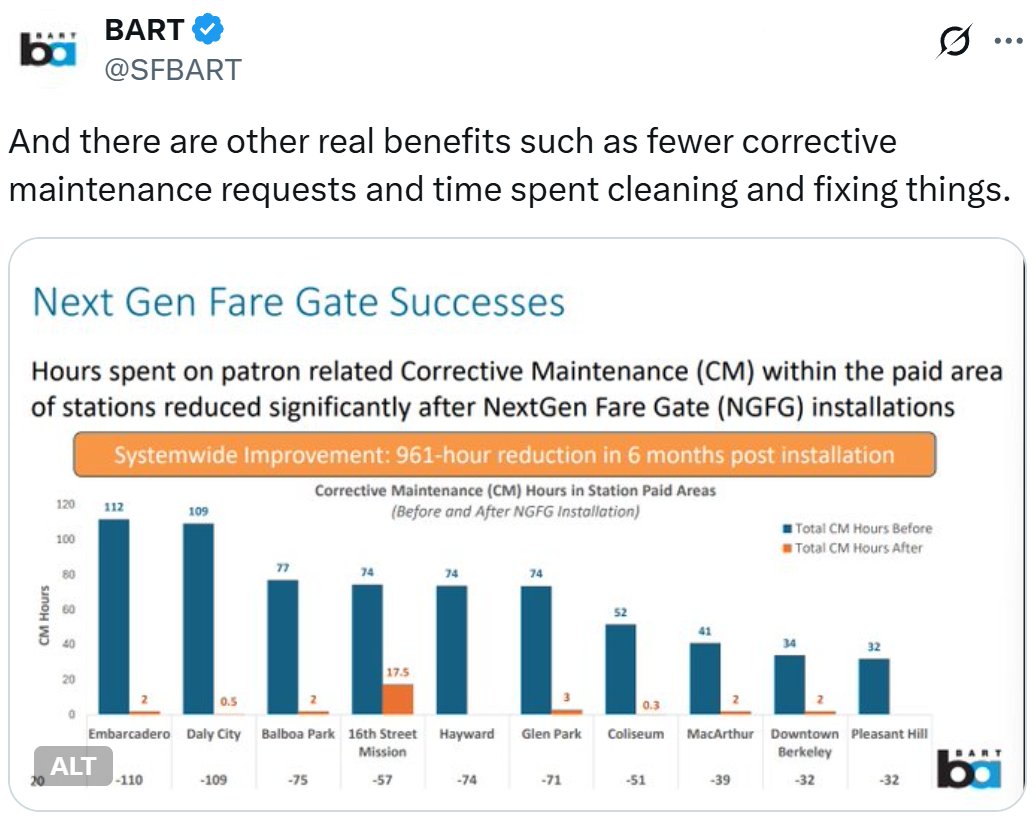
I think it bears repeating that BART installed tall gates to enter the subway and they're gaining $10m in revenue a year plus the need for maintenance is down by
*95.7%*
Passengers who were unwilling to pay a few bucks were causing 96% of the public cleanliness problems!
@johnhelmuth_@JaroslavBeck I understand the privacy and other advantages of local LLMs, but I was also confused about what heavy usage would make them pay for themselves…
Wait, so the founder of Anthropic is "Amodei," as in "loves god"?
And he leads Anthropic, meaning "human-centered," which is being used in military strikes?
And the creator of ChatGPT is "Altman," as in "an alternative to humans"?
And he leads OpenAI, which is completely closed?
And then there's "Gemini," meaning "two-faced," from a company that promised to do no evil?
And the whole global AI arms race is being driven by people who claimed to be worried about AGI taking over the world?
Either the universe is an extremely cliché writer, or has a brilliant sense of humor
LASIK eye surgery cost $2,200 per eye in 2000. Today it's around $1,000 per eye despite 24 years of inflation. Meanwhile, an MRI that cost $1,200 in 2000 now costs $3,000+. The difference? LASIK operates in a free market with no insurance interference and minimal regulation.
When patients pay directly, providers must compete on price and quality. LASIK clinics advertise prices, offer financing, and constantly improve technology to attract customers. Compare this to hospital procedures where prices are hidden, patients never see bills, and insurance companies negotiate opaque rates that somehow always increase faster than inflation.
Cosmetic surgery follows the same pattern. Breast augmentation, rhinoplasty, and other elective procedures have become more affordable and safer over decades. Surgeons invest in better techniques and equipment because they must satisfy paying customers, not insurance bureaucrats or hospital administrators focused on maximizing reimbursements.
The lesson is clear: remove third-party payment systems and excessive regulation, and you get Austrian economics in action. Prices fall, quality rises, and innovation accelerates. Healthcare costs aren't rising because of aging populations or new technology—they're rising because we've destroyed the price mechanism that makes markets work.
California sits at the intersection of two extremes.
On one end is a population of extremely smart, capable Californians that have helped build the 4th largest economy in the world.
At the other end sits the same extremely smart, capable population but who have turned their brains off and have elected, year after year for decades, a group of incompetent and corrupt politicians that have hijacked the governance of the state.
In lockstep, the finances, pensions and livability of California erodes every day: the fire hydrants are empty, the drug addicts get free drugs, the alcoholics get free beer, the criminals get “get out of jail free” cards, the average grades of students are falling off a cliff, you can’t build homes for normal people but you can pretend to build them for the homeless and get taxpayers to foot the bill, you can’t improve health care subsidies unless they are for illegal immigrants, you don’t want to tell the truth about exploding pensions so you change how you report about them to hide the time bomb. And on and on.
The everyday citizens that make California great needs to wake up to the fact that their apathy has created this chaos and we must change direction to undo it.