Amazing to see the work done by the Leaflet team at @mbsi_org_au be featured here!
"That initial thought bubble led Professor Yeung to connect with Drs Edmond Lu, Arkan Youssef and Raymond Wu, ... to develop the new web-based App alongside digital agency TAG."
A revolutionary new App is set to transform #cancer care for patients at @Western_Health. 'Leaflet' has been designed to assist day-to-day clinical practice in one of the most culturally and linguistically diverse areas in Australia.
@mbsi_org_au | @UICC#WorldCancerDay
Over 20 @smh articles say $8 billion is "rorted" from Medicare each year - but what is the evidence behind this figure? @toriberquist & I tried to find it but it was nowhere to be seen. Our piece @theMJA: https://t.co/8bA63dTPIJ @brookmanknight@MJA_Editor @coopesdetat
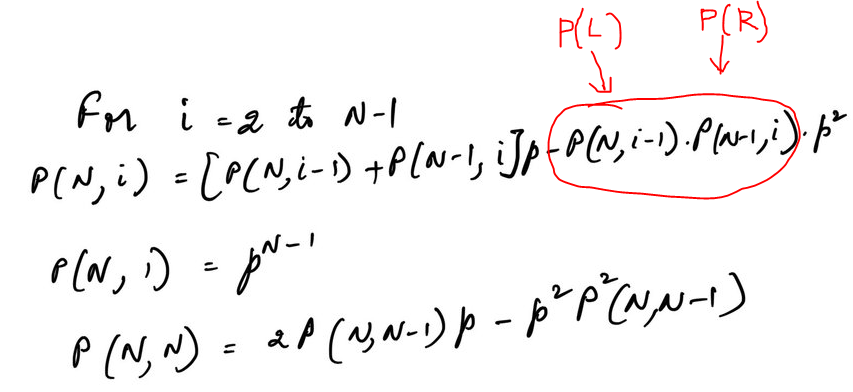
@ptrajeev@xaqwg If L is event where the (N, i-1) pin falls, and R is (N-1, i) falling, can you see why they are not independent? The pins that cause L also potentially cause R, so L and R are highly correlated.
So, you can't use P(L)*P(R). What you want is P(L ∩ R) instead.
@ptrajeev@xaqwg To clarify, I assume that P(N,i) is the prob that the pin at (N,i) falls if the topmost pin at 1 falls
So, "L" is the event that the pin at (N, i-1) falls. Clearly the events "L" and "R" are not independent, since (N, i-1) falling means (N-1, i) was also likely to have fallen.
@ptrajeev@xaqwg Again, the issue is independence. Here you have P(L)*P(R), when instead what you want is P(L ∩ R). These two are only equal if L and R are independent, but they are not in this case.
Also, numerical calculations show that p=0.7 should give ~0.57, and not 0.82.
@ptrajeev@xaqwg I think the issue is that if both R and L happen, then 1-(1-p)^2 isn't right because the red and green rhombi are not independent as they overlap significantly (ie. if the pins cascade through the red rhombus, then chances are it'll cascade through the green one too )
@LaurentLessard@ptrajeev@xaqwg I mean, replacing the sum with an integral is only an approximation... I don't claim that the sequence necessarily converges to the same value as the integral.