🚀Our latest Flavell lab @MIT_Picower preprint is live on bioRxiv! Aligning and annotating diverse cell types in complex tissues is a major challenge. We introduce 3 deep neural nets to automate this process in freely-moving C. elegans. 🧵: https://t.co/RT5SAsUaPf
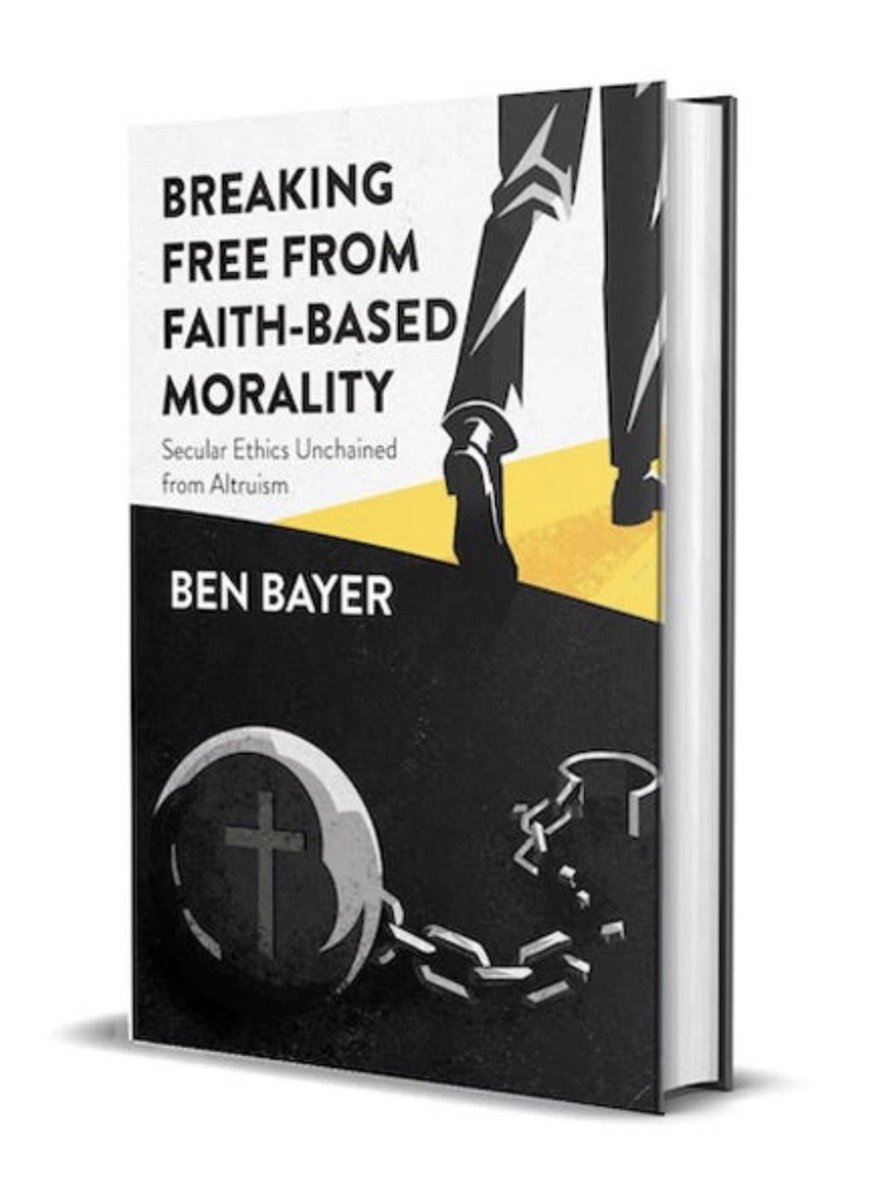
“Richard Dawkins has popularized the idea that most people have no trouble denying the existence of gods for which there is no evidence…. He urges them to go ‘just go one god further.’ This book directs a similar challenge to atheists to reject a final baseless posit of religion: the worship of self-sacrifice.”
BCS is hiring! Search now underway for tenure-track assistant professor across all areas of brain and cognitive science, potentially including computation, cognitive science, or experimental neuroscience. Deadline Dec. 1, 2026. https://t.co/0ua3JXkpIs
@mcgovernmit@MIT_Picower
Episode #433 How Michael Bloomberg Works
0:00 — "I was fired from the only full-time job I'd ever known and from the high-pressure life I loved."
3:43 — "If we're going to eat, someone's gotta sell."
4:21 — "You're always selling. And if you don't like to sell, here's my advice: get over it." — Ken Griffin
4:48 — "It's the doers, the lean and hungry ones, those with ambition in their eyes and fire in their bellies who go the furthest and achieve the most."
13:56 — "It's said that 80 percent of life is just showing up.
I believe that.
You can never have complete mastery over your existence. You can't choose the advantages you start out with, and you certainly can't pick your genetic intelligence level.
But you can control how hard you work. I'm sure someone, someplace, is smart enough to succeed while “keeping it in perspective" and not working too hard, but I've never met him or her.
"The more you work, the better you do. It's that simple. I always outworked the other person (and if I hadn't, he or she would be writing this book)"
15:04 — "I've never let planning get in the way of doing."
15:07 — "Life, I've found, works the following way: Daily, you're presented with many small and surprising opportunities. Sometimes you seize one that takes you to the top. Most, though, if valuable at all, take you only a little way.
To succeed, you must string together many small incremental advances-rather than count on hitting the lottery jackpot once.
Trusting to great luck is a strategy not likely to work for most people.
As a practical matter, constantly enhance your skills, put in as many hours as possible, and make tactical plans for the next few steps.
Then, based on what actually occurs, look one more move ahead and adjust the plan. Take lots of chances, and make lots of individual, spur-of-the-moment decisions."
15:51 — "Don't devise a Five-Year Plan. Central planning didn't work for Stalin or Mao, and it won't work for an entrepreneur either."
16:13 — "A reporter asked me what we at Bloomberg had failed at.
My answer was, "Nothing; but what we accomplished wasn't always what we set out to do."
Often, in the process, things worked that we hadn't planned on; unforeseen uses arose for our products; customers appeared whom we hadn't known existed-and exactly the reverse occurred for those we had been dead sure of. Planning has its place; the actual thought process sometimes leads to great new ideas.
But you can only accomplish what’s possible when you get there."
16:45 — "Whatever your idea is you've got to do more of it than anyone else."
17:07 — "I've always loved my work and put in a lot of time which has helped make me successful.
I truly pity people who don't like their jobs.
They struggle at work, so unhappily, for ultimately so much less success, and thus develop even more reason to hate their occupations.
There's too much delightful stuff to do in this short lifetime not to love getting up on a weekday morning."
17:30 — "Did I want to risk an embarrassing and costly failure? Absolutely.
Happiness for me has always been the thrill of the unknown.
Trying something that everyone says can't be done.
Feeling that gnawing pit in my stomach that says: "Danger ahead."
I want action, I want challenge.
Work was, is, and always will be a very big part of my life. I love it.
Even today, after toiling for 50 years, I wake up looking forward to getting in early, practicing my profession, creating something, competing against the best.
It's a real high to be a participant rather than a spectator."
19:10 — "Banks and venture capitalists can be the worst enemies of entrepreneurs. They create doubt in entrepreneurs' minds. And worst of all, they think that the originator will be helped by their oh-so-insightful views on how he or she should run the new business. Often, they kill off what's different, special, and full of potential."
20:11 — "We've always built the product first. Selling is the only process we run simultaneously with development from the start."
20:22 — "We acted from day one. Others plan to plan for months."
44:32 — "I don't believe that business battles should be even. At Bloomberg, we don't want fair fights. We want to go into contests with an advantage."
45:20 — "Most fortunes are built by entrepreneurs who started with nothing and generally got fired once or twice in their careers.
And throughout history, the vast majority of great writers, artists, musicians, dancers, and athletes have come from the less financially secure families."
48:17 — On never selling his company: "Why swap fun, influence, challenge, and more money than you could ever spend for only a multiple of more money than you can ever spend? Answering to no one is the ultimate situation."
A discussion of what analog cognition and consciousness imply for AI. Spoiler: the brain operates fundamentally differently from today’s AI.
https://t.co/3k4I2VLYQc
#neuroscience
@MillerLabMIT work is getting very close to a distinction we’ve been exploring computationally: the wave may not encode the thought itself. It may provide the changing geometry that determines which latent neural subspaces become addressable, which regions can communicate, and which trajectory becomes the next cognitive state.
That shifts the problem from “where is the thought stored?” to something deeper: what law governs the selection and routing of those transient subspaces?
My suspicion is that cognition emerges from the closed loop between persistent structure, oscillatory carrier dynamics, dynamic selection, transport and feedback, not from any one layer in isolation.
Two leading neuroscientists have built a new framework for categorization, arguing that the brain categorizing concepts like “clown” or “fear” is an ongoing predictive tool that the nervous system uses to keep an organism alive. https://t.co/CNvqITutnc
My son wrote me a bday note.
The sweetness of this is among the greatest life has to offer. You invest heart and soul into these helpless beings, enduring sleepless nights, managing unleashed chaos, and making endless investment into their well-being. Then, in a few simple handwritten lines, they hand all of that love right back to you.
When I start teaching complex analysis on Monday, I've been wondering what to say to my class about why math is still worth studying in the age of AI.
Here is Francis Su's (@mathyawp) answer: studying math develops human virtues like tenacity and creativity.
Ugly is a choice.
@lulumeservey on why we should put effort into making beautiful things again:
“People are allowed to care about objectively beautiful things.
We had the better part of a decade where we had to take this aesthetic, relativistic view that everything is beautiful in someone eyes.
That this piece of art that is clearly trash is just as beautiful as one made by the great masters.
Or somebody who is clearly unhealthy is just as beautiful as someone who takes really good care of themselves.
People are allowed to say a beautiful building is worth creating and a beautiful website is worth creating.
This is what Joe Gebbia and the National Design Studio team are doing. They’re saying, "We believe that a more beautiful experience on the internet reflect the dignity of being an American citizen, and that is what we want. So we're going to put in effort and talent to go make that for you because it's worth something. We're not going to pretend that a website has to be ugly."
Anything big or small or glamorous or pedestrian, like a simple government website, can (and should) be made more beautiful.
And when it is, people appreciate it so much more because we do have this inherent yearning for beauty.“
A student asked me about my habit of bike riding or walking in the forest as a way of gaining inspiration. I thought I'd share my response:
I suspect everyone is different but all of our brains need time to process information. Some of this happens in sleep -- the idea that if you have a hard problem that you should "sleep on it" is very true. I often wake up with an inspiration.
You need to give your brain time to do its thing. You can't control inspiration. All you can do is create opportunities for it to occur.
I often have ideas in a dark conference hall while half-listening to a boring talk. I'll have spent the day at posters and learning about new work. Sitting in the dark and letting my mind drift is when those fragments come together into something new.
I will often do some work early in the morning and hit a snag. Then I go for a bike ride in the forest. I am not intentionally thinking about my problem -- I'm in the moment. My body is moving in the world. But part of my brain must be working on the problem because within 15-20 minutes, I have the solution.
The brain is amazing. Cramming it with information all the time may feel productive. But feeding it information is very different from letting it be creative. You can't force it to be creative and if you are force feeding it, it can't be creative. You need to leave it alone. Let it wander. Let it make connections. Give it space. Trust it.
At ~2 months postpartum, I feel like I've mostly psychologically adjusted to my new role as a mom. But there were 3 things that caught me *completely* off guard and were hard to cope with.
boilerplate: every baby is different, every mom is different, ymmv etc. etc.
1. The emotional bond with the baby
I'm not exactly sure what I was expecting, but I didn't immediately feel a bond with my baby and it was so hard. I think I just made WAY too much of the idea that babies learn their mother's voice and scent and sound in utero.
Also because I thought my baby should know me on some level, I thought it would be apparent she preferred me on some level too. This was not the case and still isn't 2 months in. She is just as happy to be soothed, rocked, fed, played with etc. by her dad, her older half siblings, her grandparents, anyone.
And as incomprehensible as it sounds from the outside, I actually experienced a lot of grief and mourning for "losing" the baby inside of me. The baby I was pregnant with and the baby now in my arms did not feel like the same thing and I really missed the pregnancy-baby and the connection I had with her.
I guess some people will read all this as coming from pettiness or jealousy or possessiveness, but I was just struggling to find my bearings and inundated with feelings that my baby would be better off without me and that I didn't make any difference in her life and it was really hard.
Relatedly:
2. The bond with my husband and step-children
Perhaps as a consequence of expecting an immediate overpowering bond with my daughter, I was expecting (and dreading) a corresponding reduction in bond or investment in the lives of my step-children and husband. This is certainly the picture painted by popular culture.
But it wasn't the case for me. I felt just as invested, if not more, in their lives and wellbeing as before my daughter was born. I found myself thinking about my step-children's challenges and how to help them, planning how everyone could have a good summer, preparing for my step-son's birthday, thinking about how to make my husband feel loved and appreciated . . . and then feel really guilty for not investing the same degree of thought and energy into my daughter's life, but there's just not a lot to think about for a newborn!
I felt like there was something wrong with me. Shouldn't I be so consumed with love for my daughter and so invested in doing what's best for her that everyone else on earth fades into a distant second place?
idk maybe there is something unnatural and wrong with me. Whatever the case, I am emerging from the newborn period 30-50% closer with my husband and step-children and now with an overwhelming bond with my baby, so I think I must be doing something right.
3. Expectations for my own emotions
I've been waiting a really long time to have a baby. I was eager and desperate to have a baby when I got married the first time at 21. When I had a miscarriage at 29 and then suffered a debilitating setback with an autoimmune disease, I feared I never would get to be a mom. When I got divorced at 30 and fell in love with a man who already had kids of his own, for a little while it looked like I might have to choose between staying with the love of my life and becoming a parent.
So because of the long wait, I think I had some expectation that every day with my child would be bliss. I would be so grateful and appreciative for finally having the baby I'd been pining for all my life that I would never feel overwhelmed, or frustrated, or resentful, or bored, or angry. I could just stare at my baby, like a plant turning towards the sun, and be completely fulfilled.
This wasn't an explicit idea, but it was emotionally operative nonetheless. I felt (and still sometimes feel) guilty when I'm tired after a long night or when I feel exhausted at the end of the day. I do get bored and frustrated (and feel guilty for it). I wish I could get more things done and wish I had more freedom to write and think and read and listen to music (and feel guilty that these things still matter to me).
idk, this one is the least resolved. But what I do know is that empty platitudes about "you only get 18 summers, mama" or "you'll miss this time later" don't help at all. Indeed, they make everything worse.
Because guess what? Even if I let everything else fall by the wayside and I just focused on my baby 24/7 and even if I willed myself to (pretend to) enjoy every blessed second, I will *still be old someday* and I will *still miss these days* and I will still wish I could hold her tiny little hands and kiss her squishy little belly again. There will *never* be enough I could do that would ensure I won't feel that way at 80 or 90 ... so it's unhelpful at best and psychologically destructive at worst to use that as a guide to action.
“Why bother with school in the age of AI” is the new “why bother with school in the age of Google”, and has a similar answer, except that now before answering one must first clarify “by AI do you mean an insanely powerful tool or a successor species that annihilates homo sapiens”
53.5% of researchers on DeepSeek's top foundational papers have never held a position outside China. 70% of those who trained abroad returned home. Until this pipeline is better understood, Zegart and Johnston say, the surprises will keep coming.
Read the full white paper: https://t.co/XwBSbSaEwD (2/2)
How often do non-academics take a summer vacation in New Orleans to come to a conference where people spend hours not on Bourbon St, but in lectures, where they line up at mics to ask questions about applying epistemology to real life? Only at #OCON2026
How do brains integrate sensory evidence over minutes to generate adaptive behaviors? A new Flavell lab preprint identifies C. elegans circuits that integrate aversive smells during foraging to control specific behavioral responses. https://t.co/MVybgxcMXv #neuroscience
@BenBayer yes! this point is so frequently ignored, when in fact, scientists don’t just take up a problem. our judgments of what’s worth to pursue are shaped by our values without most of us explicitly knowing it