OK, this is IMPORTANT to understand for any and all software engineers:
Inference engineering 101: reading from the KV cache is very cheap; speculative decoding makes sessions more efficient. Coding use cases make HEAVY use of both.
THIS is why inference is SUPER profitable!!
You can now enable Claude to use your computer to complete tasks.
It opens your apps, navigates your browser, fills in spreadsheets—anything you'd do sitting at your desk.
Research preview in Claude Cowork and Claude Code, macOS only.
Since last year, I've arguably been wrongfully accused in a state corruption case.
To defend my innocence, I spent past 6 weeks building an agentic AI swarm that:
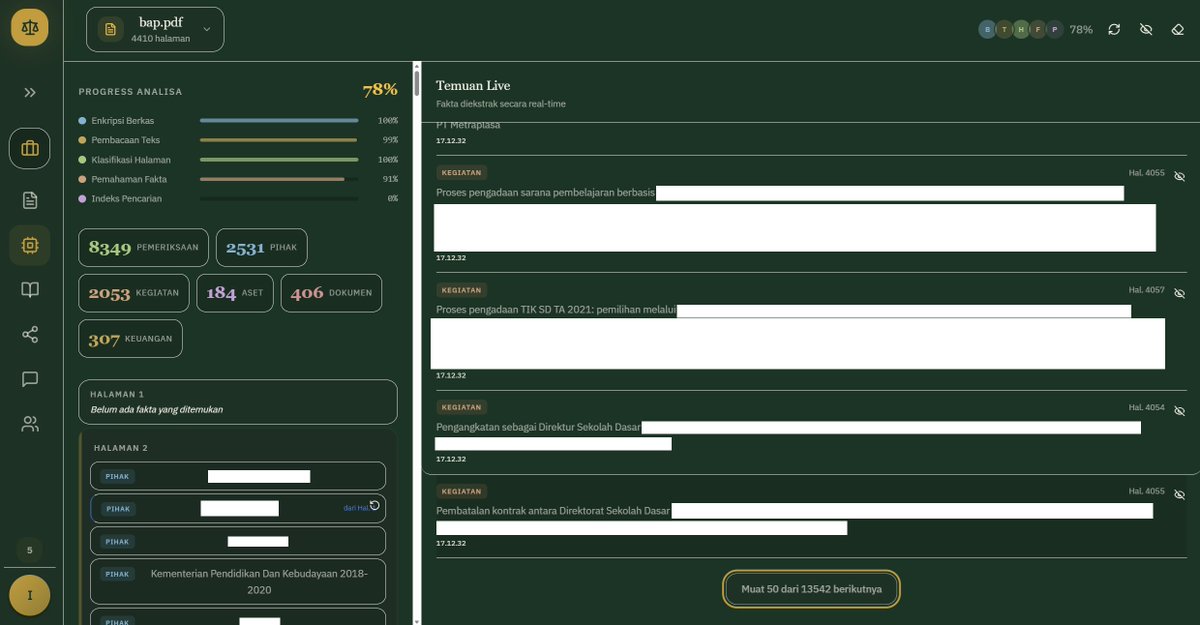
Analyzed 4700+ pages court docs
Mapped 8900+ testimonies
Found dozens of contradictions
This is how I fight 👇🏼
First off, some context may be necessary.
Even though I'm accused in a state corruption case, I'm not a government official. I'm a software engineer. I spent over 15 years building large-scale tech systems across Europe and Indonesia. I've led engineering teams of up to 600 people and helped grow a small tech startup into a unicorn.
In 2016, I moved back from Europe to Indonesia, because I believe technology at scale could make a real difference to the millions of people in the nation.
Six years ago, working as a tech consultant under a nonprofit foundation, I started advising Indonesia's Ministry of Education on building large-scale technology platforms.
Public sector work pays significantly less than private sector, and I took close to a 50% pay cut to make the switch. I was fine with that. Using what I knew to help underserved communities in Indonesia felt like the right trade.
Our mission was to build a user-centric superapp for public education, specifically for teachers and public schools, the kind of work the private sector ignores because there's no money in it.
At some point, officials at the ministry asked for my input on one of their procurement plans. I helped them work through the technical details, shared what I knew, laid out the pros and cons, and recommended a set of tests they should run to determine which options were the most suitable.
By the time they made their final decision and executed the procurement, I had already resigned from the consulting work, so I didn't think much of it.
Fast forward to May 2025. My house was raided as part of a newly opened corruption investigation tied to that procurement. Two months later, I was named a suspect and placed under city detention due to my health.
The trial started in January 2026. We've been through more than a dozen sessions so far, and not a single piece of evidence or testimony has been presented showing I received a single cent from the procurement.
What came to light was the opposite: evidence and testimony that my recommendations were neutral and likely were ultimately ignored by the ministry's own team, who went ahead and made the call on their own.
So why am I the one on trial? Because the ministry officials who did take money from the procurement vendors needed someone to blame for the decisions they made. Blaming an outside consultant is the easy way out.
Witness testimonies in court has shown that the officials actively directed the procurement while claiming it was done on my instructions and even misled their own team within the ministry by saying I held a position of authority.
We needed evidence to dispute those accusations, questions to cross-examine the witnesses, and we needed them fast.
This is where my AI comes in.
A few days before the trial began, we received a 4400-page printed document containing all the witness statements collected during the investigation, plus several hundred pages of other related documents.
The information asymmetry is staggering. Those with deep enough pockets to hire large law firms can throw dozens of paralegals and associates at a document like that and mount a proper defense on short notice.
I didn't have that kind of money. By then, I had been out of work for more than six months. The AI startup I founded had to shut down. Our investors asked us to return their funding. I had to lay off the entire team.
Most of my lawyers are friends of my wife from her college days, who stepped up and waived most of their fees because they could see I was being railroaded.
The whole situation felt hopeless. But somewhere in the middle of the despair, a spark lit up.
Combing through and analyzing thousands of pages of documents is exactly the kind of problem AI was built for.
I've built AI systems before, so I know the key to applying AI to a real-world problem is understanding the strengths and limitations of the available models, and figuring out how to make things not just work, but work efficiently enough to put into production.
I was placed under city detention due to health issues with my heart, compounded by a tumor that has been growing rapidly over the past few months. But it also means I still have access to my dev PC.
So I started with small experiments. My lawyers found a printing service that could scan the thousands of pages in a couple of days. At first, I tried simply uploading the scanned PDF into existing chatbots like ChatGPT, but the file was far too large for anything they could handle.
Even when I managed to get it working through external cloud storage, the results were atrocious. Half of the strategies and "facts" the models surfaced were hallucinations. That wouldn't just be useless in court, it's actively dangerous and can jeopardize my defense.
My experience building complex AI systems told me that the key to reducing those hallucinations is better data preprocessing.
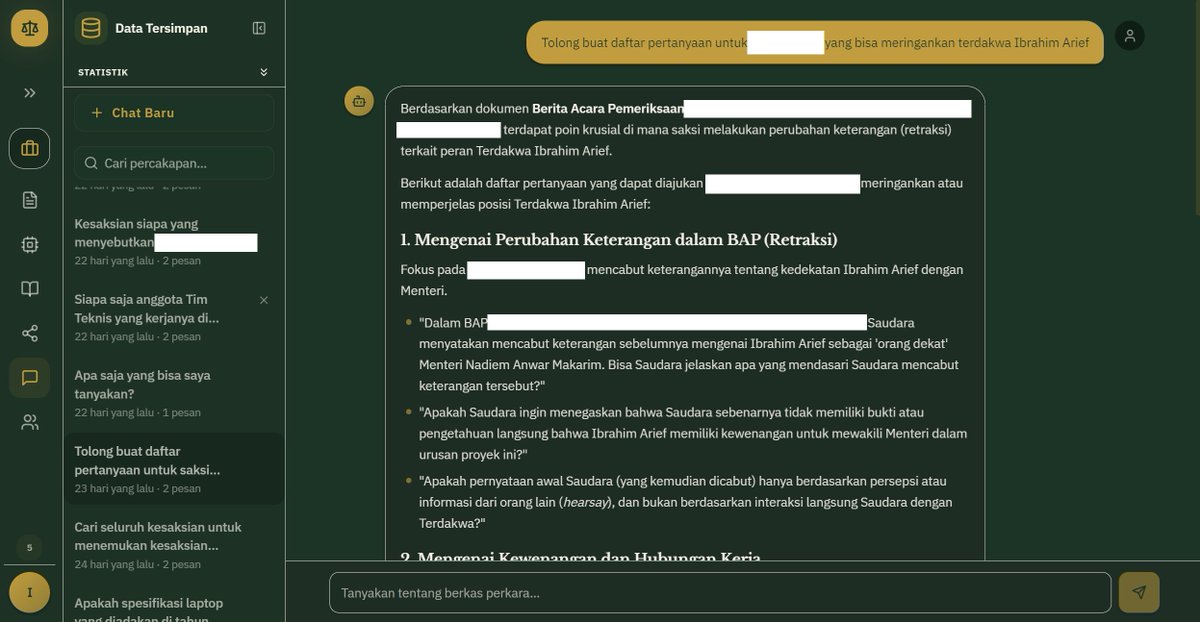
So I spent the first couple of weeks focusing on parsing the uploaded PDFs, running various kinds of text extraction, and eventually settled on building an agentic AI swarm that performs multiple layers of preprocessing and analysis.
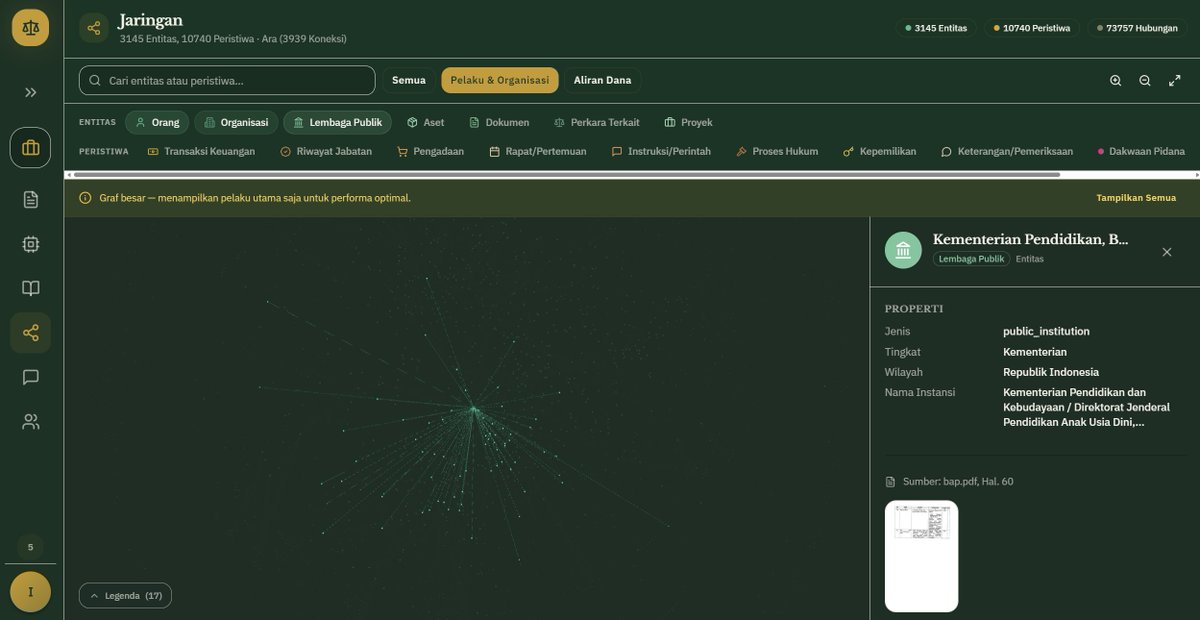
This multi-step analysis by several AI agents that swarm the PDF and extract different aspects of the case produces a dense knowledge graph where we can even trace the flow of money involved.
My lawyers can now easily browse, filter, and search through nearly 9000 witness statements. We even discovered several witnesses with duplicate testimony, raising suspicion of coordinated efforts or tampering among them.
But I didn't stop there. The processing chain includes several higher-level intelligence layers that draw from all the signals in the extracted knowledge graph. These layers add semantic understanding that powers a Chat AI feature, where we can ask specific questions about the case and get grounded answers.
I even built a self-reflective sub-agent that automatically challenges and inspects the results to make sure there are zero hallucinations.
Overall, the AI has helped me and my legal team uncover the big picture of what actually happened, and build questions that span hundreds of separate testimony sessions, giving us an unprecedented ability to cross-examine witnesses in court and significantly improved our defenses.
But I have grander vision than just helping my own legal team. Indonesia's legal system is severely overburdened, with a huge number of cases flowing through the courts every year. This kind of AI could be a useful tool not just for lawyers, but also for judges and prosecutors trying to make sense of their caseloads.
With the cross-examinations we've conducted and the weight of evidence that has come to light, we are aiming for an acquittal.
Should that be the case, my pledge is to keep building this AI platform into something that can meaningfully improve the quality of justice in our legal system: by helping investigators analyze cases more thoroughly and shine a light on any potential crimes, by raising the standard of what prosecutors bring before a judge, and by giving lawyers the ability to uncover the truth in their clients' cases faster than ever before.
Because in the end, I want what I've built to help more than just myself. I believe it can ease the burden on our judges and raise the quality of justice across the system in Indonesia.
New in @ChromeDevTools! Debug an app's full performance trace with Gemini!
After recording a trace, you can now chat with Gemini about the entire trace, related Performance insights, and even connected field data - all without needing to select specific context beforehand!
A non-obvious second effect of the enormous AI capex spend may be that it's masking the deterioration of the US economy under the surface. While the aggregate economic stats may look just fine, economy is becoming ever more K-shaped with the lower half of th economy struggling ever more in terms of keeping up with cost of living increases, young graduates struggling to find jobs, and credit card and auto loan bills pilling up.
The seemingly non-negotiable enormous capex spending has also an underappreciated crowding out effect on the rest of the real economy. First, the AI capex drives up input cost for non-AI manufacturing industries from materials to labor. Indeed, manufacturing has been shrinking while data center capex surges.
Secondly, if companies have to spend more on capex and expect more productivity from AI, they’ll hold back on hiring. It has already eaten into the hiring plans of even the highly profitable large cap tech companies. To rephrase @pmarca, AI is eating the world, but maybe not quite in the way we expected.
I’ve been fortunate to lead the infra and inference work that brings gpt-oss to life. A year ago, I joined OpenAI after building vLLM from scratch — It’s deeply meaningful to now be on the other side of the release, helping share models back with the open-source community.
Introducing Genie 3, the most advanced world simulator ever created, enabled by numerous research breakthroughs. 🤯
Featuring high fidelity visuals, 20-24 fps, prompting on the go, world memory, and more.
Google just released the AlphaEarth Foundations with 64 dimensions of satellite embeddings at 10-m resolution at the global scale! It is very interesting! Check it out
Blog post: https://t.co/RviUl5TRIc
Dataset: https://t.co/mCMafemeE2
Paper: https://t.co/isoE4zOXfZ
#AI #geospatial #remotesensing #geoai
This is my lecture from 2 months ago at @Cornell
“How do I increase my output?” One natural answer is "I will just work a few more hours." Working longer can help, but eventually you hit a physical limit.
A better question is, “How do I increase my output without increasing input as much?” That is leverage.
We hear “leverage” so often that its implication is easy to overlook. My personal favorite categorization of leverage is by Naval Ravikant: human labor, capital, and code / media. Each has powered major waves of wealth creation in history.
However, once a leverage source becomes popular (think YouTube channels today versus ten years ago) competition compresses the margin. So when a new leverage appears, it’s a rare chance for outsized gains.
In this talk, I describe AI as that emerging leverage. An AI agent blends labor leverage (it does work for you and is permissionless) with code leverage (you can copy-and-paste it).
It’s cliché to say AI will create massive wealth. But using this leverage lens lets us interpret the noisy AI news cycle in a consistent way and spot the real opportunities.
Thanks @unsojo for hosting me!
Microsoft is open sourcing Copilot for VS Code (Satya Nadella just announced this on BUILD)
Just like the VS Code open sourcing, this is counter-intuitive on why: now MUCH easier for startups to create “improved clones” of Copilot
BUT it makes VS Code more dominant: (cont’d)
@SumitroYoel It's possible, but I agree it's tough. I got a job as an engineer in Tokyo as a fresh grad, but that was thanks to winning a hackathon, and the company reached out to us. Opportunities exist, but they can be rare
1. Topological quantum computing is here! This thread explains how Microsoft’s Majorana 1 works and what it will mean for a fault tolerant future. I was invited to Azure Quantum Labs and got to hold this amazing new chip!
Boom is supersonic. On Jan. 28, 2025 at 8:31am PST / 16:31 GMT, XB-1 broke the sound barrier.
Chief Test Pilot Tristan “Geppetto” Brandenburg safely and successfully achieved supersonic speed in XB-1, the first civil supersonic jet made in America.
✅New top speed: Mach 1.122 (652 KTAS)
✅New max altitude: 35,290 ft.
✅Flight time: 34 minutes
✅Airspace: Bell X-1 Supersonic Corridor and the Black Mountain Supersonic Corridor in Mojave, CA
XB-1 demonstrates that Boom has the team, technology, and tools to deliver supersonic commercial travel with Overture, cutting travel times in half.
Congratulations to the Boom team on making aviation history!
*Manifesting a LAN party gaming room for my retirement too*
Btw for Gen Zs who are too young to know what LAN is, it's like online gaming today but you play with your friends in the same physical space.
DISCLAIMER: BROUGHT TO YOU BY @dbsbank. DO NOT PROCEED IF YOU ARE A PESSIMIST AND BELIEVE MILLENNIALS WILL HAVE NO FUTURE.
New book I’m starting to read.
This years Spotify Wrapped was surprisingly disappointing and missed the fun in last years. I learned that the person behind much of Wrapped in previous years was let go last year.
His name is Glenn McDonald and he is the author of this book.
"Willow performed a standard benchmark computation in under five minutes that would take one of today’s fastest supercomputers 10 septillion (that is, 1025) years" 🔥 https://t.co/No4qbrrqoZ
It’s been a tough few months for Sonos. A redesign of the app caused outrage. So when a friend tipped me off to the r/Sonos subreddit filled with 261K angry people, I braced for impact. I found the expected complaints—but I also noticed they really liked an employee named Keith.
@basedjensen Entropy handling mitigates hallucination. Hallucination occurs when a model is uncertain but is compelled to output an answer token and continue its answer anyway. Entropy/uncertainty offers a chance to self-correct.
https://t.co/cEkzofpqIg