🏃♂️🛡️ El ejercicio también entrena al sistema inmunitario: una dosis adecuada fortalece las defensas y reduce la inflamación
🔑La clave: intensidad, duración y recuperación ⚖️
https://t.co/Hvjs5Lt6HN
YOUR MUSCLES PREDICT BRAIN AGING
In 506 older adults followed for up to 12 years, greater muscle mitochondrial capacity was linked to better cognition.
The pathways differed by sex:
Men: glucose and HbA1c
Women: blood oxygen and inflammatory markers
Muscle and brain aging are biologically connected.
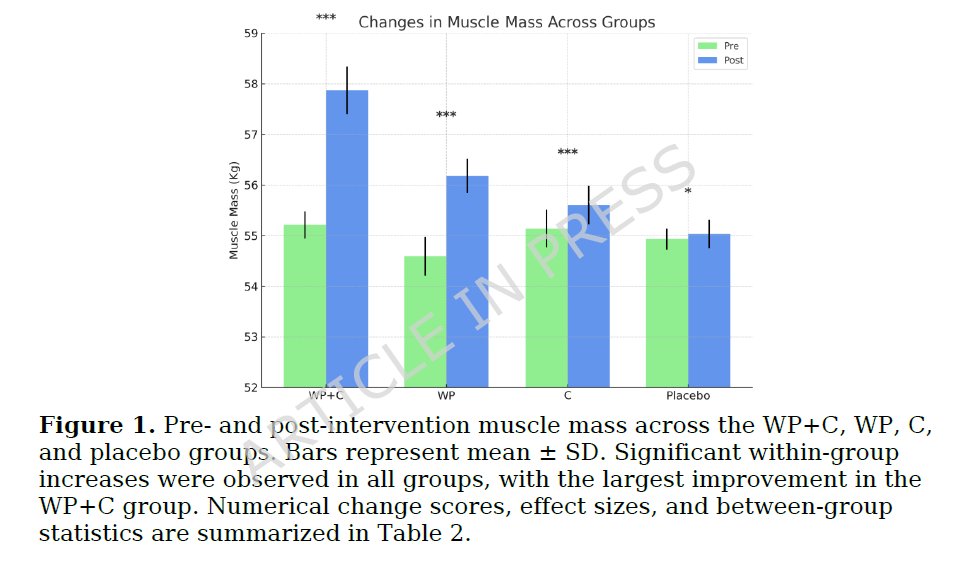
This one's a real head-scratcher. The authors report that resistance training combined with participants' habitual diet produced essentially no gains in lean mass in resistance-trained men over an 8-week intervention. Yet supplementing with 30 g of whey protein resulted in a 3.5-lb increase, and adding 10 g of collagen to the whey nearly doubled that effect to ~6 lbs!
What makes these findings especially puzzling is that participants reported consuming ~1.8 g/kg/day of protein at baseline—an intake generally considered to be at or near the upper threshold for maximizing muscle hypertrophy. Under those conditions, it's difficult to imagine whey supplementation providing such a substantial additional benefit, and even harder to reconcile how adding collagen would nearly double the gains. Would like to see this study replicated...
https://t.co/msZXPxVUcu
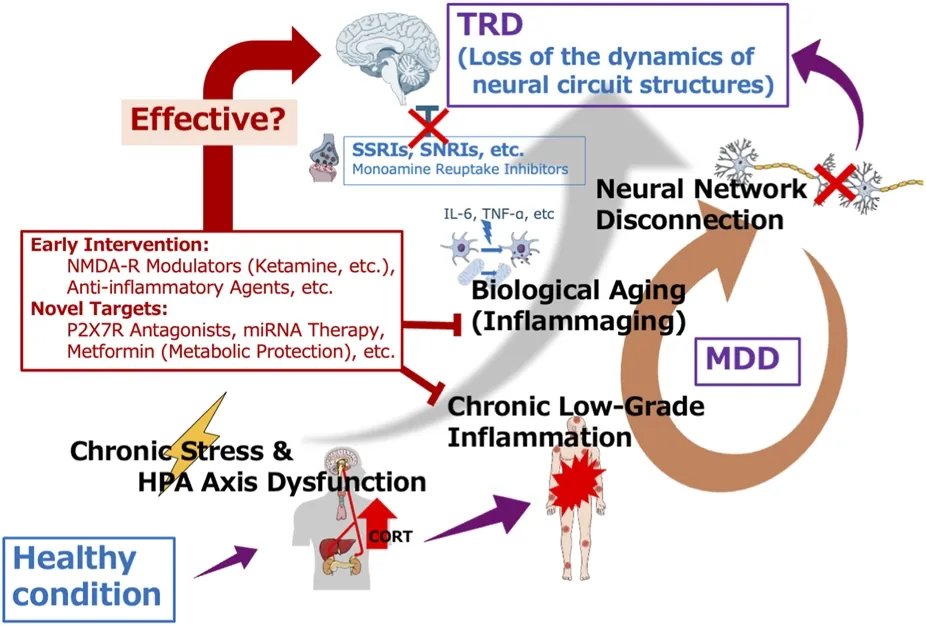
🧠💪 La obesidad no solo afecta al tejido adiposo: también altera directamente el músculo esquelético
La grasa ectópica, la inflamación crónica y la disfunción mitocondrial deterioran su función metabólica y endocrina🔬🔥
https://t.co/Q768a8qaQk
🏃♀️🫀 Vivir más y mejor también se entrena. La actividad física y la aptitud cardiorrespiratoria se asocian con menor mortalidad
Claves: moverse más, incluir entrenamiento de fuerza y considerar la aptitud cardiorrespiratoria un «signo vital» 🔬👇
https://t.co/5fJkbV4E7h
🪑➡️🚶♀️Una nueva revisión sistemática y metaanálisis muestra que interrumpir el sedentarismo con breves pausas de pie o caminando mejora de forma aguda la función ejecutiva y la memoria, especialmente en personas mayores y con sobrepeso/obesidad🧠✨
https://t.co/jXdYBUfno7
🔴 Personas mayores hospitalizadas: el ejercicio no debería ser opcional
Ingresar en un hospital por una enfermedad aguda no siempre significa salir igual que entraste. Para muchos mayores, la estancia supone perder fuerza, autonomía e incluso capacidad mental. El reposo en cama, durante años considerado la mejor medicina, puede convertirse en su peor enemigo. La ciencia nos muestra otra cara de la hospitalización: el ejercicio intrahospitalario, incluso en dosis pequeñas, podría frenar ese deterioro y devolver independencia a quienes más riesgo tienen de perderla.
¿Puede funcionar el entrenamiento en la práctica diaria con personas mayores hospitalizadas por una enfermedad aguda?
A tenor de un pionero ensayo clínico liderado por el catedrático Mikel Izquierdo la respuesta es sí.
En este estudio, realizado con 370 pacientes de avanzada edad (87 años de media), se evaluó el impacto de un programa de ejercicio multicomponente —fuerza, equilibrio y marcha, realizado dos veces al día durante apenas una semana de ingreso— sobre la capacidad funcional y cognitiva.
Los resultados demostraron que esta intervención fue capaz de minimizar e incluso revertir los efectos deletéreos del paso por el hospital.
Mientras el grupo que no entrenó perdió autonomía al alta, quienes participaron en el programa no solo evitaron ese deterioro, sino que mejoraron respecto a su estado previo (+1,9 puntos en el índice de Barthel y +2,2 en la escala de rendimiento físico SPPB).
Estos datos confirman que la inmovilidad durante la hospitalización no debe ser la norma y que la prescripción de ejercicio es una herramienta terapéutica clave para preservar la independencia en las personas mayores hospitalizadas.
✍️ En este artículo, el Dr. Javier S. Morales analiza las consecuencias de un reposo muy prolongado para los pacientes, especialmente los de mayor edad, y cómo el ejercicio intrahospitalario, incluso en dosis pequeñas, podría frenar ese deterioro y devolver independencia a quienes más riesgo tienen de perderla.
Ciencia para mejorar la salud. Esperamos que os guste.
Puedes leerlo o escucharlo pinchando en el link 👇
https://t.co/FKJlGkPw0d
A new analysis in Science of more than 116,000 bird songs has revealed that the astonishing variety of passerine birdsong is built from just eight basic acoustic motifs, like trills, whistles, and harmonic notes.
The findings also reveal that local environments greatly shape how birds communicate around the world. Learn more: https://t.co/3oaQ0sKQfJ
Physical activity counteracts microgravity-induced neural dysfunction via the gut-microbiota-brain axis, suggesting that microbiome-targeted interventions may help preserve cognitive health in extreme environments such as spaceflight.
https://t.co/AmjjR07uvp
Systematic review (16 studies): Moderate exercise boosts beneficial gut bacteria (Akkermansia, Faecalibacterium, Bifidobacterium) & reduces stress. But extreme exercise & chronic stress cause dysbiosis (pro-inflammatory bacteria). Probiotics may help.
https://t.co/XEllN16XPi
RPE is a valuable tool for regulating training intensity, but its usefulness depends on how well it is taught, anchored, and coached.
A recent randomized crossover study found that people reported different RPE values at the same relative force simply because the meaning of “10” changed.
The researchers compared:
• Maximum effort in the exercise being performed
• Maximum effort in a different exercise
• The hardest effort ever experienced or imagined
The same exercise anchor produced the highest ratings, while the self selected anchor produced the lowest. Differences were greatest at 80 and 100 percent of maximal voluntary contraction.
The practical message:
• The language used to define RPE influences the score
• Instructions should remain consistent
• Experience helps people calibrate the scale
• RPE should be interpreted alongside load, velocity, force, pace, or power
Someone who has never trained near failure may not yet have a clear reference for an RPE 9 or 10. That does not make RPE useless. It means the scale must be developed through coaching, exposure, and feedback.
This study used isometric contractions, so it does not invalidate RIR based RPE in dynamic training. It reinforces that RPE is not just a number. It is a skill that must be taught and practiced.
When used well, RPE remains one of the most practical tools for individualizing training intensity.
Exercise Is Brain Medicine
Exercise activates three routes to BDNF
Neural activity
Increased cerebral blood flow
Signals released by muscle and liver
BDNF supports synaptic plasticity learning and memory
One striking finding
In cell culture brain endothelial cells produced 50 times more BDNF than cortical neurons
Your muscles blood vessels and brain communicate every time you move
Exercise belongs at the center of Alzheimer’s prevention
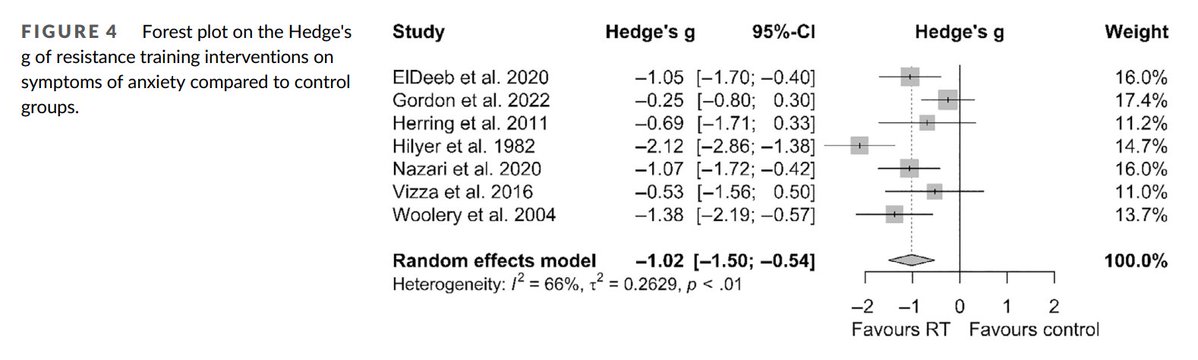
El entrenamiento de fuerza es muy efectivo contra la depresión y la ansiedad.
Son los resultados de un reciente metaanálisis de ensayos controlados aleatorizados que muestra lo mismo que múltiples trabajos anteriores.
Levanta pesos libres y/o practica calistenia.
(Si tienes muy poca fuerza, es recomendable empezar con calistenia y dominar tu propio cuerpo antes de añadir pesos externos).
Nuevo Scientific Statement de la @American_Heart cafeína y riesgo cardiovascular. 🫀 ☕️
Hasta 400 mg/día (3-5 tazas de café solo) es seguro en la mayoría de adultos y se asocia a menos cardiopatía isquémica, ictus, IC, FA, HTA y DM2.
Las energéticas, otra historia.
🔗 https://t.co/xzTHftToPY