Fun fact - A little chaos from a bot can make humans cooperate faster.
In network experiments, researchers inserted bots that occasionally made slightly random choices.
Instead of disrupting the humans, the bots helped groups solve coordination problems faster.
Median solution time improved by 55.6%.
Sometimes the most useful thing AI can do…
is break the pattern everyone else is following.
Source: Nature.
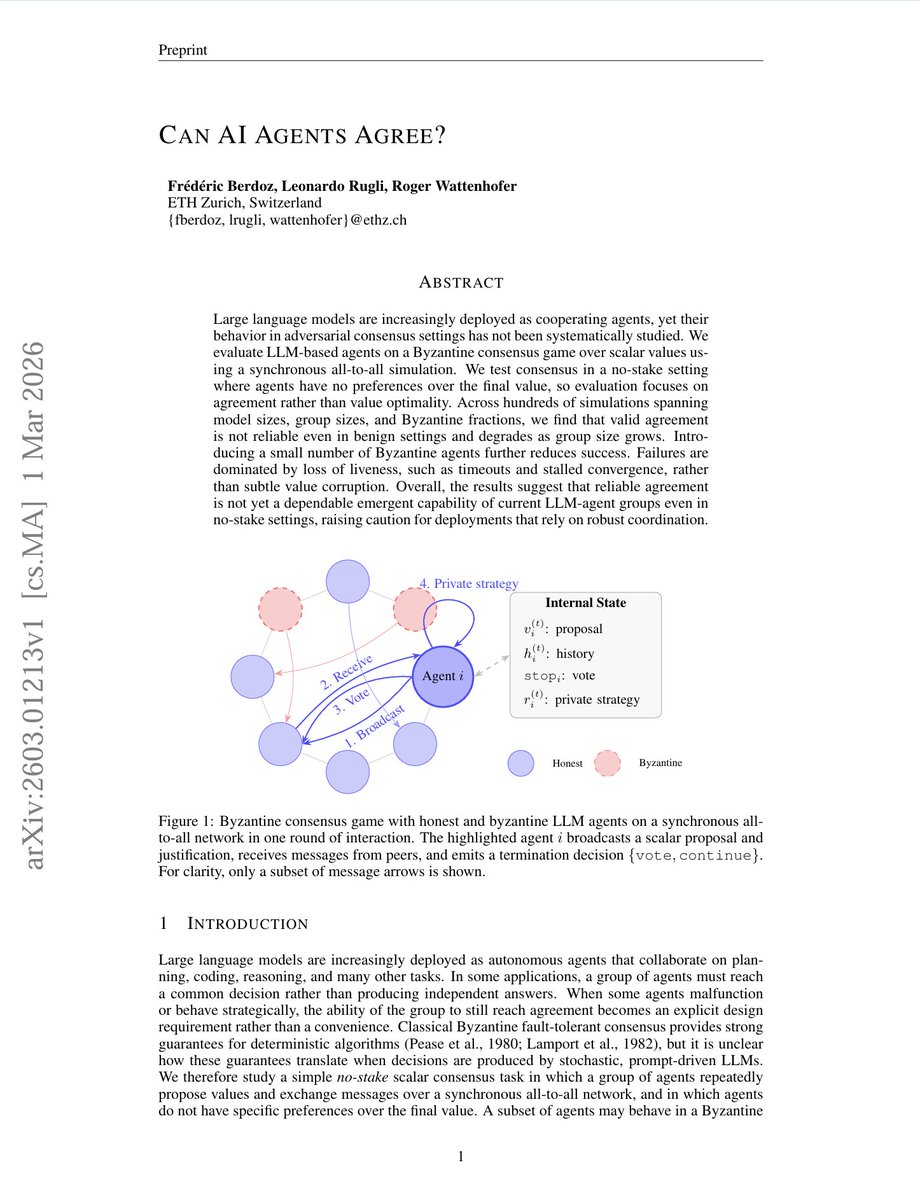
🚨 BREAKING: researchers planted a single bad actor inside a group of LLM agents. the whole network failed to reach consensus.
this is the Byzantine Generals Problem. a 40-year-old distributed systems nightmare.
and it's now your agent pipeline's problem too.
in fully benign settings, with zero bad actors, LLM agents still fail to converge on shared values. and it gets worse as you add more agents to the group.
the failure mode is revealing. it's not subtle value corruption. it's not one agent sneaking in a wrong answer. the models just... stall. they time out. they go in circles. the conversation never lands on agreement.
this matters because the entire multi-agent AI hype assumes coordination works. autonomous agent swarms, collaborative problem-solving, decentralized AI systems. all of it assumes that if you put multiple LLMs in a room and give them a protocol, they'll converge on a shared decision.
Byzantine consensus is one of the oldest, most studied problems in distributed systems. classical algorithms solved it decades ago with strict mathematical guarantees. the question was whether LLM agents could achieve the same thing through natural language communication instead of formal protocols.
the answer, at least for now, is no. and the reason is worth sitting with.
traditional consensus algorithms work because every node follows an identical deterministic protocol. LLMs are stochastic. the same prompt produces different outputs across runs. an agreement that holds in round 3 can dissolve in round 4 as agents revise their reasoning after seeing peer responses.
this is the fundamental mismatch: consensus protocols assume deterministic state machines. LLMs are the opposite of that.
it also means that "more agents = better answers" has a ceiling nobody's measuring. at some group size, coordination overhead and convergence failures outweigh any benefit from diverse perspectives.
the practical implication is uncomfortable for anyone building multi-agent systems for high-stakes tasks. reliable agreement isn't an emergent property of putting smart agents in conversation. it has to be engineered explicitly, with formal guarantees, not hoped into existence.
we're deploying multi-agent systems into finance, healthcare, autonomous infrastructure. and the consensus problem, the most basic coordination primitive, isn't solved yet.
I'm glad this is finally out after several years in the works! I’m also on the academic job market this year and happy to connect with anyone to discuss potential opportunities
Apple just dropped a killer open-source visualization tool for embeddings — Embedding Atlas — and it’s surprisingly powerful for anyone working with large text+metadata datasets.
This reminds me of Nomic's Atlas, but I never got around to using it 😅
We’re talking real-time search, multi-million point rendering, and automatic clustering with labels.
One of their showcase examples visualizes ~200K wine reviews using embeddings + metadata like price, country, and tasting notes. And it is lightning fast even on my browser! No separate code needed!
It nails what most LLM devs need but often hack together:
✅ UMAP projections
✅ Faceted search across metadata (e.g. “country vs. price”)
✅ Hover + tooltip on raw points
✅ Interactive filters, histograms, and cluster overlays
✅ Cross-linked scatterplot + table views
Under the hood:
• Fast rendering using WebGPU (with WebGL fallback)
• Embedding-based semantic similarity search
• Kernel density contours for spotting clusters or outliers
You just upload your .jsonl or .csv with text + vector + metadata. It handles the rest: clustering, labeling, UI layout, everything.
This feels like the LLM-native version of Tableau — but optimized for text, chat and modern data needs
If you’re building RAG evals, search tuning, clustering explainability, or even dataset audits — this could be your new favorite tool.
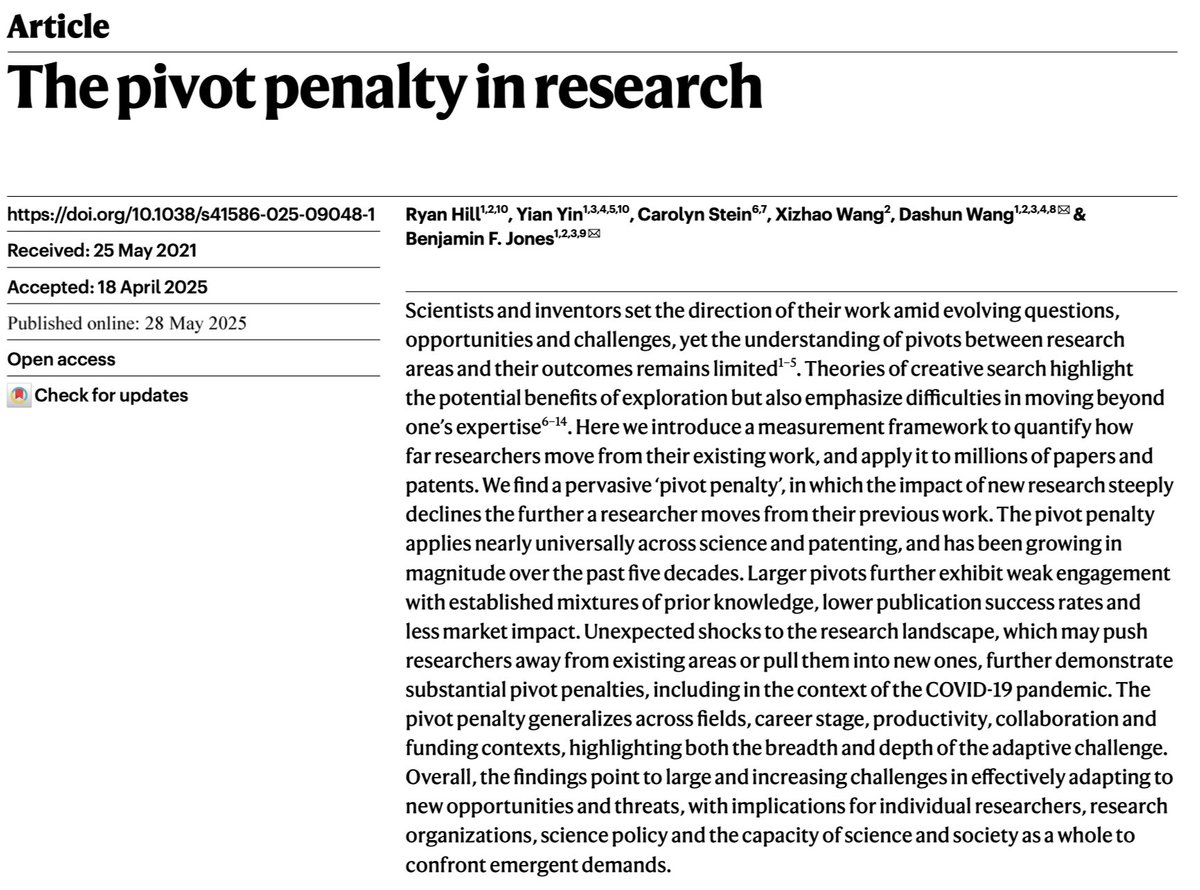
🚨New paper🚨 Excited to share our latest on @Nature today: The PIVOT PENALTY in research. https://t.co/V4ENiGCssY
More than five years in the making. Key finding: The impact of new research steeply declines the further a researcher moves from their previous work.
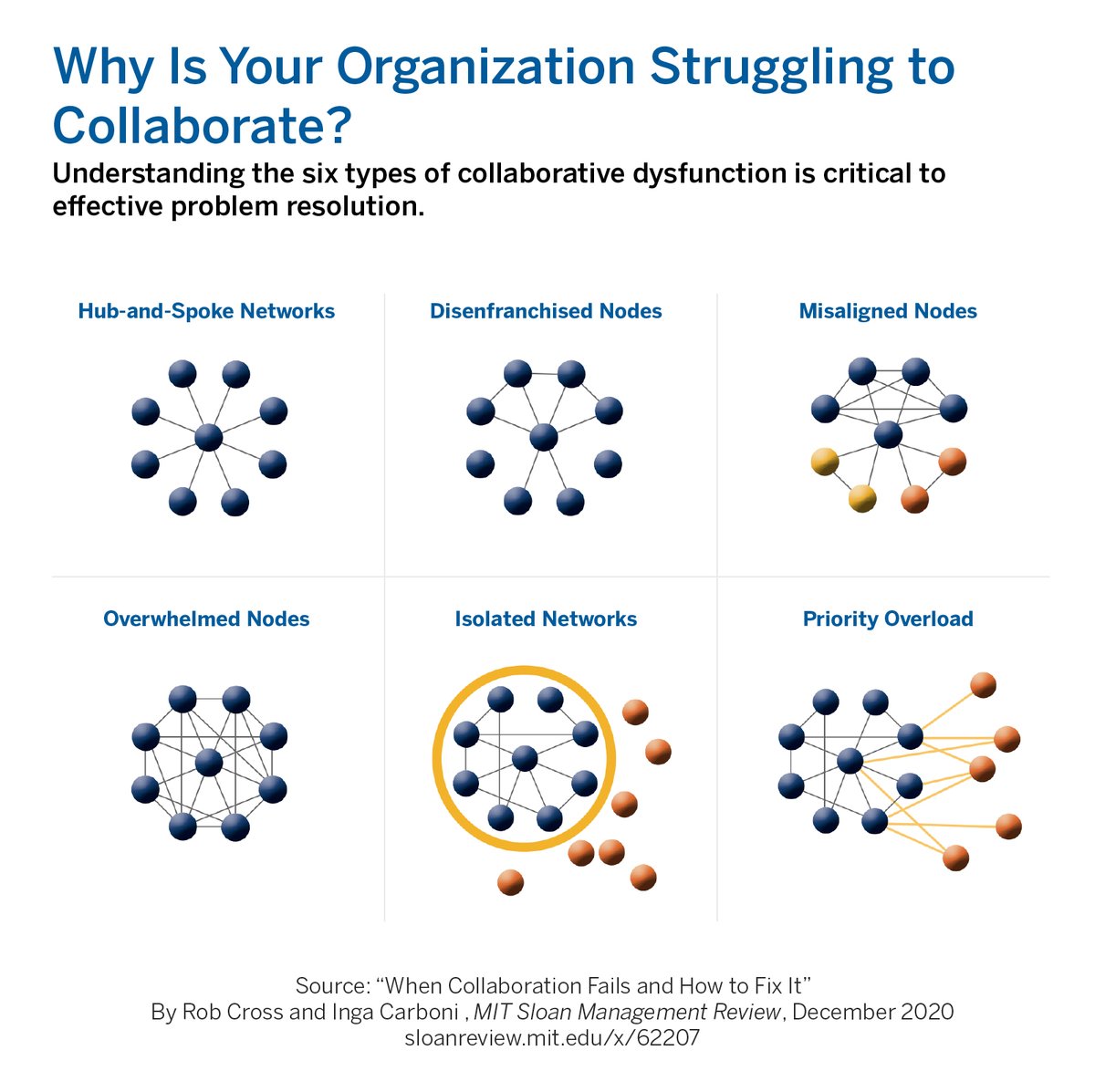
There are six archetypes for how collaboration becomes dysfunctional and negatively impacts performance. Leaders need to understand which problem they're facing to fix the dysfunction. https://t.co/Ds11mPrIEE
LLMs have made exciting progress on hard tasks! But they still struggle to analyze complex, unstructured documents (including today's Gemini 1.5 Pro 002).
We (UC Berkeley) built 📜DocETL, an open-source, low-code system for LLM-powered data processing: https://t.co/VmJ1zyre6m
Job opportunity! We are looking for a postdoctoral researcher at @UniUtrecht to investigate how social networks may impact people’s vaccination decisions: https://t.co/rj6atUjXT1 Come work with us! Deadline: October 4th
If you’d like to spend a few hours this weekend to dive into Large Language Models (LLMs) and understand how they work, I've prepared a 3-hour coding workshop presentation on implementing, training, and using LLMs: https://t.co/wgGIZWFgkh
📢New Publication alert!
What is the role of organisations and their network structure in shaping the emergence of new areas of technological specialisations in regions? Check it out on @industry_innova
🎯https://t.co/u8hKHL3ssO
@IrisWanzenböck @dfkogler @KeungouiKim
Don't miss the opportunity to learn more about biases in #LLM Simulations of people.
Tomorrow, August 22, 11am CEST.
Register to all talks: https://t.co/RPaLI4SyVa
More info: https://t.co/5FqItXNdFk
👇🏽
Hope you are enjoying the Doctoral Workshops at ISDSI Global 2023! The intellectual journey continues with three more insightful sessions:
Doctoral Workshop 3: "Social Network Analysis" https://t.co/URNRruAPqZ
Doctoral Workshop 4: "Structural Equation Modeling (SEM)" https://t.co/J51qwWEn2l
Doctoral Workshop 5: "Advanced Modelling Techniques" https://t.co/Ca8Zc8cYBf
Immerse yourself in these workshops, and let the learning journey flourish! Stay tuned for more updates.
#ISDSIGlobalConference2023 #IIMRanchi #IIM #DoctoralWorkshop
@EduMinofIndia@srideepak1978
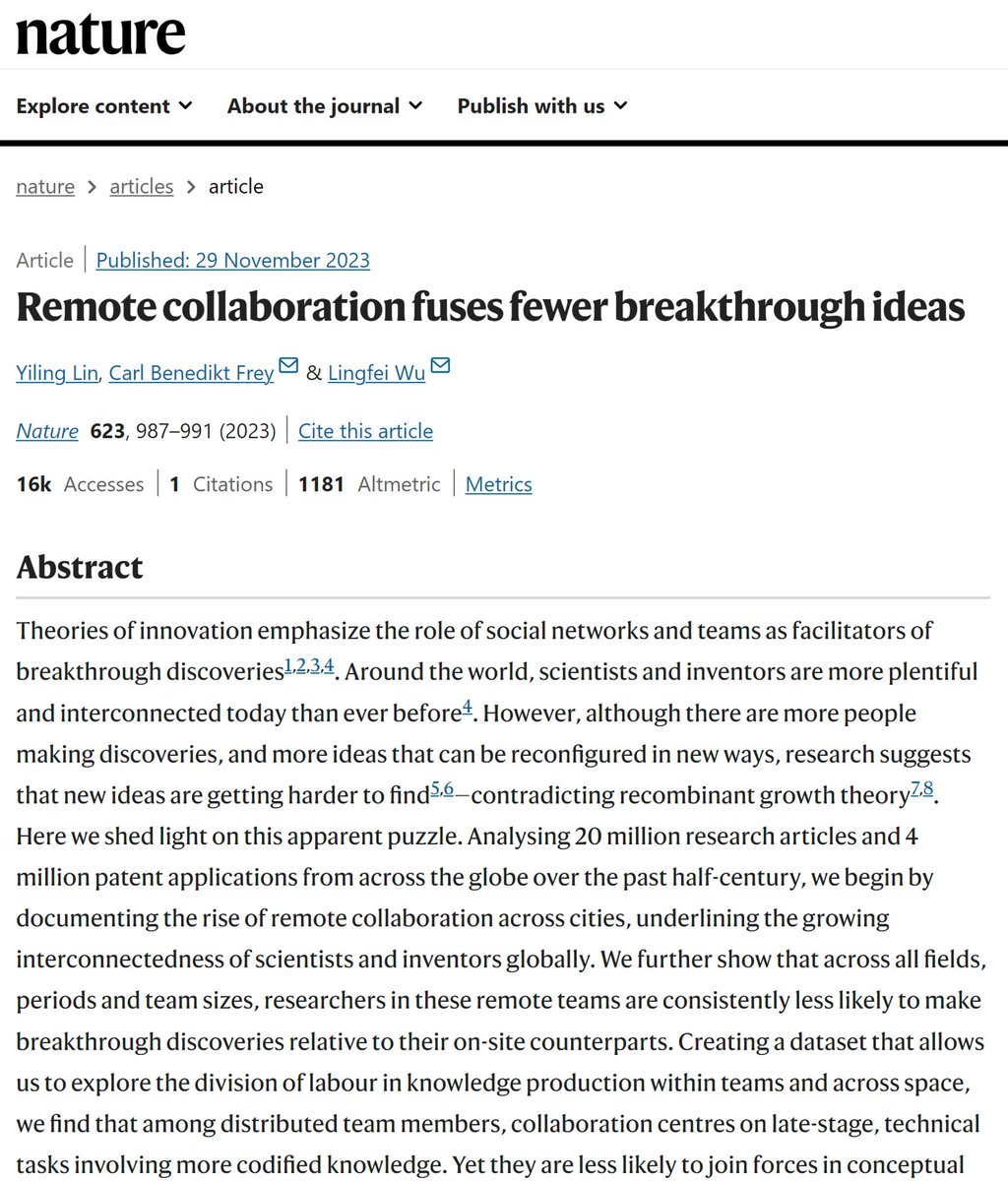
This is a great paper, but it is *massively* misunderstood.
It does not show that WFH reduces innovation. This paper and its follow-up actually suggests by 2023 that WFH increases innovation. To explain:
1) This paper is about *collocation* not *WFH*. They are completely different. If two people share the same office address - even if they are both hybrid or remote - they would be classified as collocated. For example, my co-author Steve Davis and I both work a hybrid schedule at Stanford, coming to the office maybe 2 days a week. We both have a Stanford office address on papers. So, for this paper we would count as being *collocated*. Indeed, almost all hybrid WFH teams would count as collocated.
2) Co-author teams are becoming more dispersed. The paper reports the average distance between team members offices has increased from 100km to 1,000km over the last 60 years. This reveals that tens of thousands of scientists are choosing to work in more global teams, presumably to access a wider network of experts. I co-author with researchers across five continents because it lets me work with great people. If teams of elite scientists, whose entire careers are focused on cutting-edge innovation, are becoming more dispersed it suggests it has major benefits.
3) The results do not hold after 2010. This is critical as Zoom and Dropbox cloud file sharing emerged after 2010. Indeed the follow-up paper by Carl Frey (one of the co-authors) and Giorgio President from Oxford shows innovation is *higher* for remote collaboration after 2010! https://t.co/8MeibM8JeO
So a fantastic paper - it deserves to be published in Nature. But to understand it you need to read beyond the title. You can't judge a book by its cover, nor a Nature paper by its 6 word title.
And please forward this to any mangers or CEOs claiming this implies WFH reduces innovation. It does not - indeed points (2) and (3) suggest exactly the reverse.
It's that time of year again. For all of you that use my Writing Goals Worksheet, here is the Spring 2024 version. Happy Writing everyone!
I'm open to feedback on how to make the worksheet better, and read "The Writing Workshop" if you haven't already!
https://t.co/ZhjrrzRkIx