Over the past few days of my Cloud & DevOps journey, I've worked on IP addressing, MAC addresses, ARP, routing, subnetting, CIDR and VLSM.
I also used Python to validate subnet allocations and check for overlaps.
I'm learning to understand the network, not just memorise commands
I've built a few DevOps projects, but I want to understand what happens underneath the tools.
So I'm starting from the basics of networking.
Yesterday, I explored IP addresses, MAC addresses, routing, DNS and ARP.
Learning how computers actually communicate, one step at a time
Kubernetes is beautiful.
Every Concept Has a Story, you just don't know it yet.
In k8s, you run your app as a pod. It runs your container. Then it crashes, and nobody restarts it. It is just gone.
So you use a Deployment. One pod dies and another comes back. You want 3 running, it keeps 3 running.
Every pod gets a new IP when it restarts. Another service needs to talk to your app but the IPs keep changing. You cannot hardcode them at scale.
So you use a Service. One stable IP that always finds your pods using labels, not IPs. Pods die and come back. The Service does not care.
But now you have 10 services and 10 load balancers. Your cloud bill does not care that 6 of them handle almost no traffic.
So you use Ingress. One load balancer, all services behind it, smart routing. But Ingress is just rules and nobody executes them.
So you add an Ingress Controller. Nginx, Traefik, AWS Load Balancer Controller. Now the rules actually work.
Your app needs config so you hardcode it inside the container. Wrong database in staging. Wrong API key in production. You rebuild the image every time config changes.
So you use a ConfigMap. Config lives outside the container and gets injected at runtime. Same image runs in dev, staging and production with different configs.
But your database password is now sitting in a ConfigMap unencrypted. Anyone with basic kubectl access can read it. That is not a mistake. That is a security incident.
So you use a Secret. Sensitive data stored separately with its own access controls. Your image never sees it.
Some days 100 users, some days 10,000. You manually scale to 8 pods during the spike and watch them sit idle all night. You cannot babysit your cluster forever.
So you use HPA. CPU crosses 70 percent and pods are added automatically. Traffic drops and they scale back down. You are not woken up at 2am anymore.
But now your nodes are full and new pods sit in Pending state. HPA did its job. Your cluster had nowhere to put the pods.
So you use Karpenter. Pods stuck in Pending and a new node appears automatically. Load drops and the node is removed. You only pay for what you actually use.
One pod starts consuming 4GB of memory and nobody told Kubernetes it was not supposed to. It starves every other pod on that node and a cascade begins. One rogue pod with no limits takes down everything around it.
So you use Resource Requests and Limits. Requests tell Kubernetes the minimum your pod needs to be scheduled. Limits make sure no pod can steal from everything around it. Your cluster runs predictably.
Today, I continued learning networking fundamentals, focusing on subnet masks and CIDR.
I learned how to calculate subnet masks using binary, identify network and host bits, and calculate the number of IP addresses in a subnet.
One step at a time. Building solid foundations.
Every backend engineer should build these 15 projects at least once.
Not another CRUD app. Projects that help you understand what's actually happening under the hood.
1. Distributed Rate Limiter — Explore token buckets, sliding windows, Redis atomicity and distributed coordination.
2. High-Concurrency HTTP Server — Understand TCP sockets, event loops, async I/O, connection handling and backpressure.
3. API Gateway — Learn reverse proxies, request routing, load balancing, authentication and circuit breakers.
4. Message Queue (Mini Kafka) — Understand producers, consumers, partitioning, acknowledgements and delivery guarantees.
5. Distributed Job Scheduler — Implement worker pools, retries, exponential backoff, delayed jobs and idempotency.
6. Distributed Cache — Explore cache eviction, TTL, cache invalidation, replication and cache stampede prevention.
7. WebSocket Server — Handle persistent connections, heartbeats, broadcasting and thousands of concurrent clients.
8. Database Connection Pool — Understand connection lifecycle, pooling, resource exhaustion, timeouts and concurrency.
9. Mini Database / Storage Engine — Implement write-ahead logging, indexing, B-trees and crash recovery.
10. Distributed Key-Value Store — Explore consistent hashing, partitioning, replication and failure detection.
11. DNS Resolver — Understand DNS records, recursive resolution, UDP/TCP, TTL and caching.
12. Concurrent Task Scheduler — Work with threads, processes, locks, synchronization and worker pools.
13. Log Aggregation System — Build log ingestion, buffering, indexing, searching and retention.
14. Change Data Capture (CDC) System — Capture database changes and explore event streaming, ordering and checkpoints.
15. CLI Process Monitor — Understand OS processes, CPU and memory monitoring, signals and resource management.
The real learning comes from building these from scratch, testing failure scenarios, benchmarking performance and understanding the trade-offs.
Which one would you add to this list? 👇
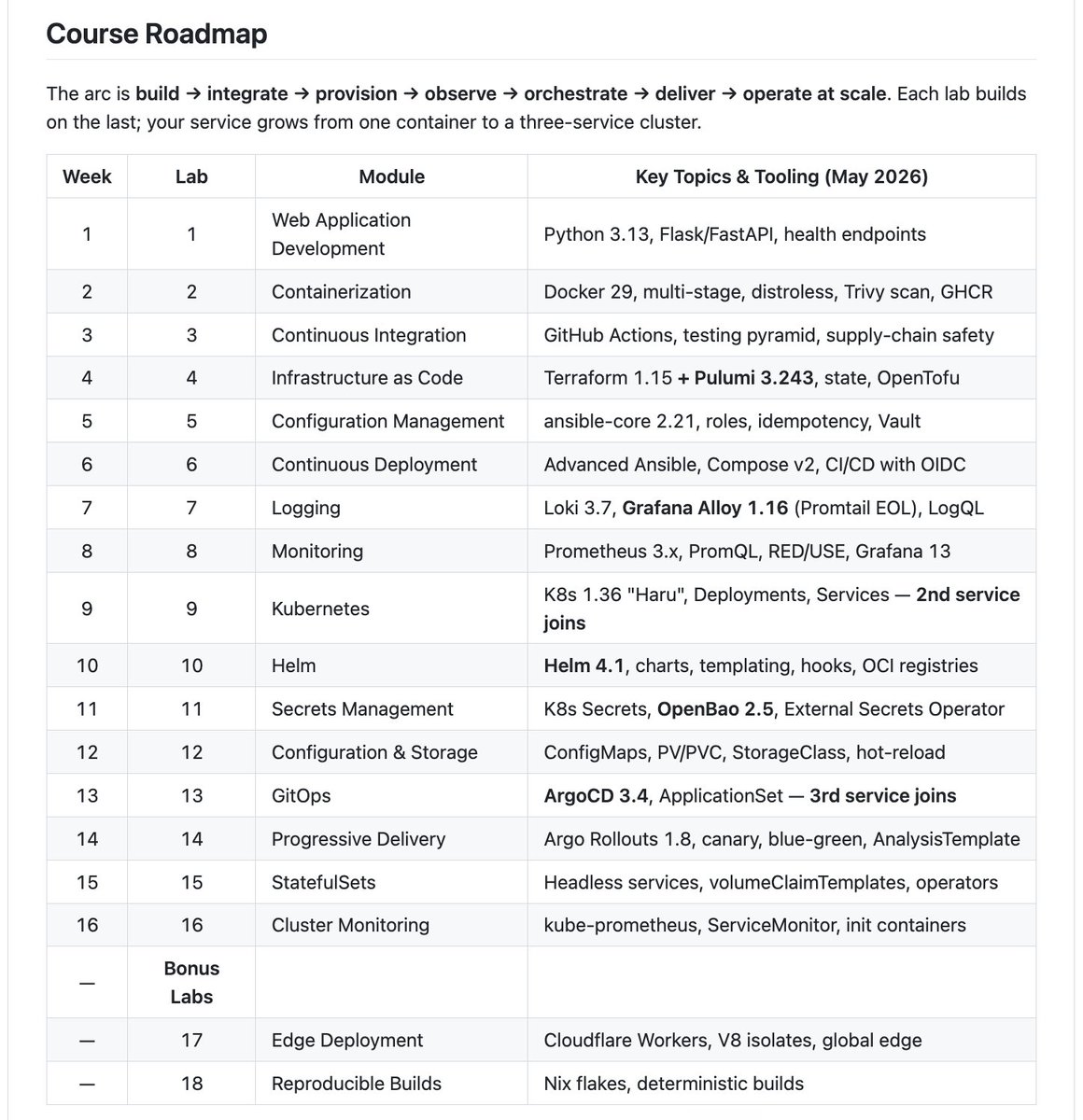
This GitHub repo is an entire production-grade DevOps course.
18 hands-on labs take one application from Docker and CI/CD to Terraform, Kubernetes, Helm, Argo CD, Prometheus, Grafana and progressive delivery.
https://t.co/wlz3iEvQq6
Want to get stand out in your first DevOps job?
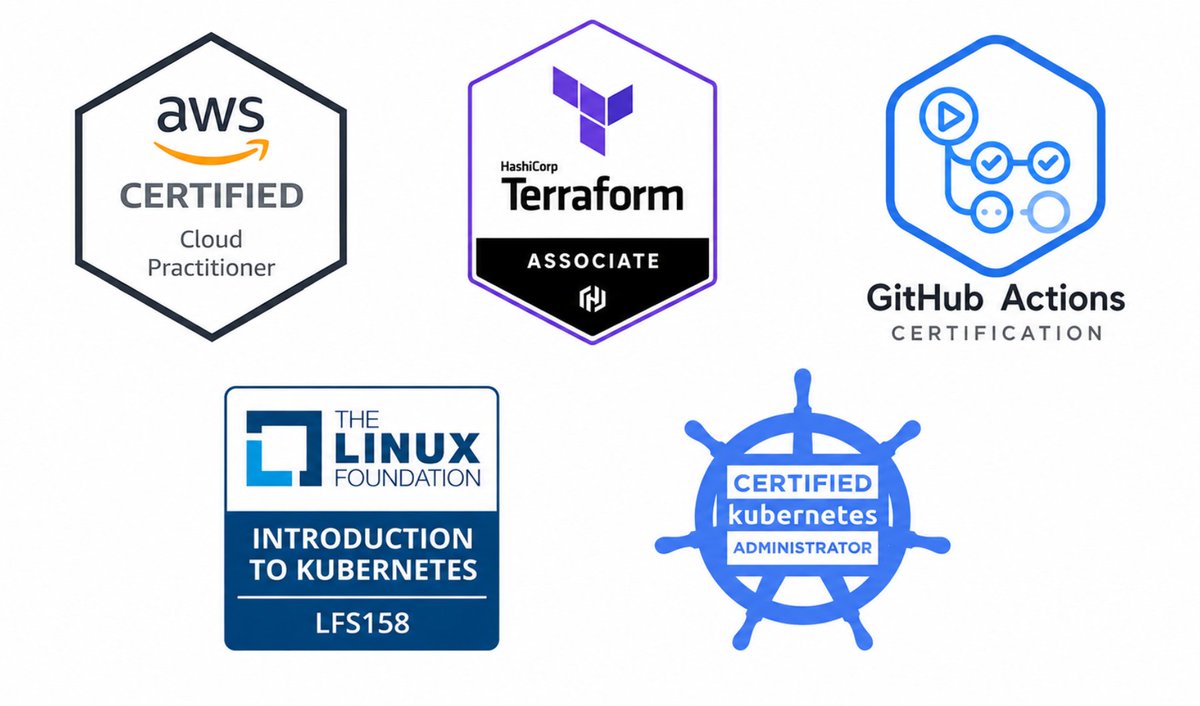
Here are the only 5 certifications worth your time right now.
Yes certificates do help you in shortlisting, But you dont need all try to get atleast one.
1. AWS Cloud Practitioner (CLF-C02)
Entry level. Shows you understand cloud fundamentals.
2. HashiCorp Terraform Associate
Validates IaC skills. Every DevOps job asks for Terraform now.
3. GitHub Actions Certification
Newer cert. CI/CD is everywhere. This proves you can build pipelines.
4. Linux Foundation: Intro to K8s (LFS158)
Good foundation before the paid K8s certs.
5. CKA (Certified Kubernetes Administrator)
Hardest on this list. Most respected.
Do this after 6+ months of K8s experience.
Not before.
Order matters.
Start with Cloud Practitioner and Terraform.
Then CI/CD. Then K8s.
If you design with AI, this is all you need
1. https://t.co/BVLdRK7UqB — cheaper than lovable
2. https://t.co/18k94vwBgP — top notch landings
3. https://t.co/SiyE5sMFEh — 1 prompts 1 website
4. https://t.co/HnfTgTWTw8 — 127 full figma designs
5. https://t.co/GwoiHkfiYN — world best icons
6. https://t.co/bfeoJy1e99 — fonts behind brands
7. https://t.co/3J5MJsvWDD — design community
8. https://t.co/VXNLXhmsoD — award-winning websites
9. https://t.co/7raDCl7bq1 — mobile UI animations
10. https://t.co/Zyngx75BhQ — footer inspiration
11. https://t.co/xTjAWnt4X4 — next level design
12. https://t.co/Q3Fm8mtHNx — backgrounds
save this for later
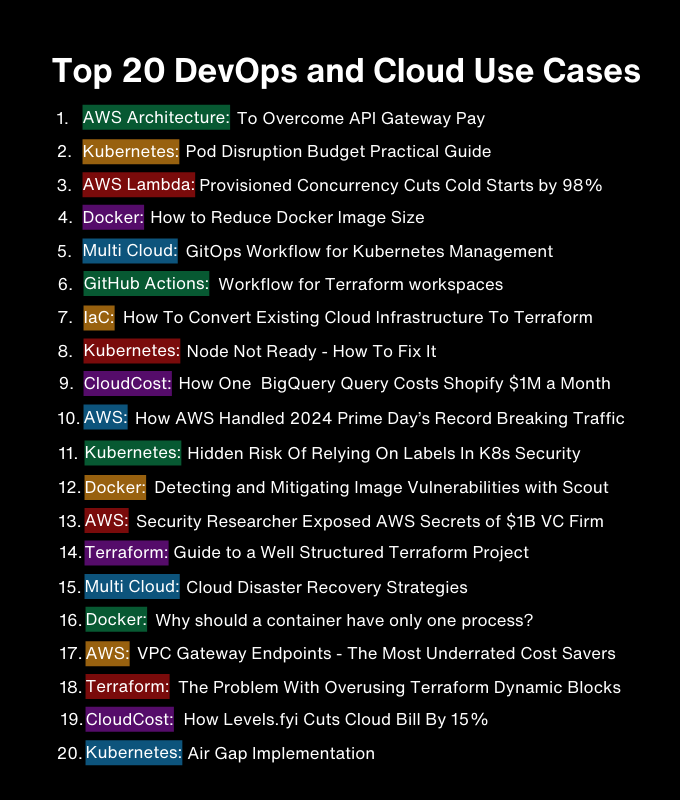
If you are into DevOps and Cloud Engineering.
here are 20 real-world use cases worth studying:
1) Architecture to Overcome API Gateway Pay Load Limit
https://t.co/5OBSP9ykCa
2) Kubernetes Pod Disruption Budget Practical Guide
https://t.co/g1IGnB1r2P
3) How Provisioned Concurrency Cuts AWS Lambda Cold Starts by 98%
https://t.co/ONbTeKQp9O
4) How to Reduce Docker Image Size
https://t.co/jrZU5vwUxt
5) Multi Cloud GitOps Workflow for Kubernetes Management
https://t.co/HiJKQmLtmL
6) GitHub Actions Workflow for Terraform workspaces
https://t.co/ffdIXmjmFY
7) How To Convert Existing Cloud Infrastructure To Terraform
https://t.co/TdZsMV5LQG
8) Kubernetes Node Not Ready - How To Fix It
https://t.co/AxBkdK2qpY
9) How One BigQuery Query Costs Shopify $1M a Month
https://t.co/CSxMV4h3vG
10) How AWS Handled 2024 Prime Day’s Record Breaking Traffic
https://t.co/XLnVQ1TND2
11) Hidden Risk Of Relying On Labels In Kubernetes Security
https://t.co/jIn7dJKG61
12) Detecting and Mitigating Image Vulnerabilities with Docker Scout
https://t.co/TQLV7Nujxt
13) Security Researcher Exposed AWS Keys and API Secrets of $1B VC Firm in 5 Clicks
https://t.co/ea6Wqh0xJ0
14) Guide to a Well Structured Terraform Project
https://t.co/lKJm0ju673
15) Cloud Disaster Recovery Strategies
https://t.co/zy7zSP5XWT
16) Why should a container have only one process?
https://t.co/KmQYCH1DDQ
17) AWS VPC Gateway Endpoints - The Most Underrated Cost Savers
https://t.co/wIU1DuvJbS
18) The Problem With Overusing Terraform Dynamic Blocks
https://t.co/IajNnL61Bo
19) How Levels. fyi Cuts Cloud Bill By 15%
https://t.co/hngD03GvTR
20) Kubernetes Air Gap Implementation
https://t.co/u3dgGHAwY2
50K+ read my DevOps and Cloud newsletter: https://t.co/wwkI6UOSo4
What do we cover:
DevOps, Cloud, Kubernetes, IaC, GitOps, MLOps
🔁 Consider a Repost if this is helpful