🚨En 1986 lo echaron de TODOS los casinos de Las Vegas por contar cartas.
Así que se subió a un avión con 180.000 dólares y aterrizó en Hong Kong. Empezó a apostar a caballos.
Se fue con casi 900 millones.
Se llama Bill Benter.
Descubrió que las carreras de caballos no eran más que otro juego de conteo… solo que con más variables.
Llegó con un socio, 180k y una computadora.
Pasó años entrenándola para una sola cosa: calcular la probabilidad REAL de que cada caballo ganara.
Si su número era mejor que las cuotas del bookie → apostaba.
Si no → pasaba.
Esa es toda la “trampa”:
Valor esperado.
EV = p · b − (1 − p)
Solo apuestas cuando tu probabilidad de ganar (p) a esas cuotas (b) vale más que tu probabilidad de perder.
Esta clase nunca se grabó para hacerse viral.
Nadie pensaba que el profesor Tsitsiklis iba a soltar toda la base en 45 minutos en una pizarra.
Los alumnos de esa sala pagan más de 80.000 dólares al año por escucharlo.
Y aquí está gratis.
Todo quant, todo apostador profesional, todo analista de hedge fund empezó exactamente con esta hora.
Benter solo la vio… y realmente hizo la tarea.
Casi nadie sabe que esta conferencia existe.
Mírala antes de que la bajen.
La respuesta está en el video.
A man spends 50 years teaching at MIT.
He knows his time is running out.
So he records one last lecture — everything he knows, distilled into a single hour.
He died 5 months later.
This is that lecture.
The most important hour you'll watch this week. 👇
Bookmark it for later
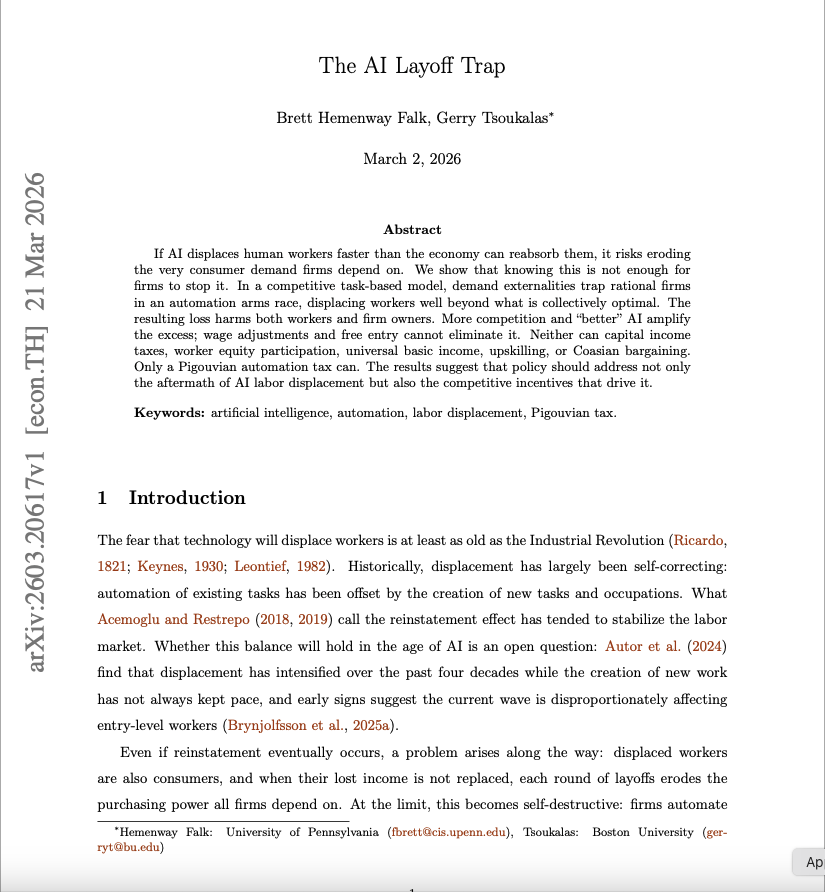
Two economists just published a mathematical proof that AI will destroy the economy.
Not might. Not could. Will — if nothing changes.
The paper is called "The AI Layoff Trap." Published March 2, 2026. Wharton School, University of Pennsylvania. Boston University. Peer reviewed. Mathematically modeled.
The conclusion is one sentence.
"At the limit, firms automate their way to boundless productivity and zero demand."
An economy that produces everything. And sells it to nobody.
Here is how you get there.
A company fires 500 workers and replaces them with AI. A competitor fires 700 to keep up. Another fires 1,000. Every company is behaving rationally. Every company is following the incentives correctly. And every company is building a trap for itself.
Because the workers who were fired were also customers.
When they lose their jobs faster than the economy can absorb them, they stop spending. Consumer demand falls. Companies respond by cutting costs — which means automating more workers — which means less spending — which means more falling demand — which means more automation.
The loop has no natural exit.
The researchers tested every proposed solution. Universal basic income. Capital income taxes. Worker equity participation. Upskilling programs. Corporate coordination agreements.
Every single one failed in the model.
The only intervention that worked: a Pigouvian automation tax — a per-task levy charged every time a company replaces a human with AI, forcing them to price in the demand they are destroying before they pull the trigger.
No government has implemented this. No major economy is seriously discussing it.
Meanwhile the numbers are already tracking the curve. 100,000 tech workers laid off in 2025. 92,000 more in the first months of 2026. Jack Dorsey fired half of Block's workforce and said publicly: "Within the next year, the majority of companies will reach the same conclusion."
Nobody is doing anything wrong. Companies are following their incentives perfectly. That is exactly the problem.
Rational behavior. At scale. Simultaneously. With no mechanism to stop it.
Two economists built the math. The math leads to one place.
Source: Falk & Tsoukalas · Wharton School + Boston University ·
https://t.co/4m8E9jQNYm
Perplexity just gave every retail investor a Bloomberg Terminal. For free.
Watch this demo. It's wild.
@perplexity_ai connects to brokerage accounts via @Plaid and builds a custom investment dashboard in seconds.
Perplexity Computer pulls from 40+ live finance tools like:
- SEC filings
- FactSet
- S&P Global
- Coinbase
- LSEG.
75% of Perplexity's paying users were already asking finance questions monthly. The demand existed before the product did.
But you couldn't DO anything with that information.
---
Now you can connect it to your data for better insights.
Connect your brokerage accounts through Plaid, and suddenly an AI agent can see your actual holdings across multiple institutions — then query institutional-grade data against them.
"Show me my sector concentration risk" or "How exposed am I to rising rates" — answered in seconds with your real portfolio, not hypotheticals.
---
It still can't trade for you, though.
That's a deliberate regulatory design choice that lets Perplexity move fast while every neobank and robo-advisor is still waiting for compliance sign-off.
Fintech companies spent a decade building Plaid as pipes for fintech apps to read your bank data.
But I'm much more interested in when we give them to AI
🧠 Human brain cells in a petri dish just learned to play DOOM. That sentence didn't exist in any scientific paper before 2023.
Cortical Labs calls it DishBrain! 800,000 living neurons on a silicon chip, receiving game signals as electrical stimulation, outputting responses that improve over time.
No code. No training data. No gradient descent.
The cells just... adapted. Because that's what neurons do.
We've spent decades trying to make silicon think like biology. Biology just learned to run on silicon instead.
That's not the direction anyone predicted this would go.
📌 Source: Cortical Labs DishBrain research, Nature Electronics, 2023–2026 follow up studies
🇺🇸🇮🇱🇮🇷 A US stealth pilot departed Ovda Air Base in southern Israel, forgot to switch off his transponder, and handed the entire world via Flightradar24 a live broadcast of the route Washington had just spent weeks diplomatically insisting it wasn’t using. Saudi Arabia had told Iran and told Washington — that its airspace would not be made available for strikes. Iran’s ambassador to Riyadh had personally thanked the Kingdom for that pledge. The ink was barely dry.
The $150 million stealth aircraft whose entire operational premise is invisibility announced itself over Saudi Arabia like a commercial flight to Dubai. Call sign F35LTNG2. Altitude, heading, groundspeed — all of it, public, live, archived, distributed across Telegram channels from Tehran to Moscow before the sortie had even reached its target. The most expensive air force in human history, undone not by an Iranian S-300, not by electronic warfare, not by any weapons system that cost a single riyal to deploy — but by a checklist item a student pilot learns in week one.
The strategic implications land harder than the embarrassment. F-22s flying from Israel would have to traverse Syria, Iraq, Jordan and Saudi Arabia — the very countries that had declared their airspace unavailable for strikes on Iran. What the transponder confirmed in real time is that those declarations were either ignored, circumvented, or quietly negotiated away under pressure and that every government in the region now knows it, and more critically, so does Tehran. Iran does not need to intercept the aircraft. It already intercepted the lie and we'll have to see what comes next for Saudi Arabia.
Introducing Perplexity Computer.
Computer unifies every current AI capability into one system.
It can research, design, code, deploy, and manage any project end-to-end.
ClawdBot is the most important technology to learn in 2026
It gives regular humans the power of 1000 superintelligent agents
If you don't use it the right way tho, it's useless
In this video I cover 5 tips you need to implement IMMEDIATELY to get the most out of ClawdBot: