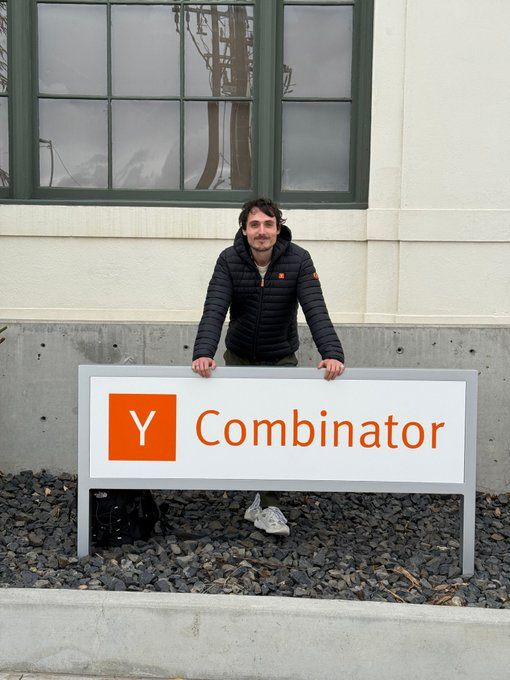
We went from 0 to 2,200 paying customers in under a year by following @ycombinator's 15 rules:
1/ Do things that don't scale. Get your first 10 customers by hand.
2/ Launch now, not when it's "ready". A mediocre product in front of real users teaches you more in a week than 6 months of polishing in the dark.
3/ Charge from day one. If nobody will pay, you don't have a startup, you have a hobby.
4/ Talk to users every single day. The roadmap you need is sitting in your customers' heads, and they'll hand it to you for free
5/ Always hunt the 90/10 solution. For almost any feature there's a way to capture 90% of the value with 10% of the effort.
6/ There are only two real jobs: write code and talk to users. Everything else (conferences, press, VC coffees, corp dev calls) is fake work.
7/ You pick your customers as much as they pick you. 10 users who love you beat 1,000 who kind of like you.
8/ Growth is an output, not a strategy. Grow before product market fit and all you're buying is churn.
9/ Do less, really well. Pick one or two metrics and judge every task against them.
10/ Know if you're default alive. Paul Graham's question: on current growth and current burn, do you reach profitability before the money runs out?
11/ Don't hire until it hurts. Headcount is not progress, it's burn. Every great startup was embarrassingly small for embarrassingly long.
12/ Momentum is the only real moat in year one. Ship something every week, even something tiny.
13/ Every great startup is badly broken at some point. The game isn't avoiding fires, it's how fast you put them out. Again. And again
14/ Ignore your competitors. Startups die of suicide, not murder. In year one, the only company that can kill yours is your own
15/ Startups rarely die from running out of money. They die because the founders fall out. Brutal honesty with your cofounder is the cheapest insurance you'll ever buy
Good luck !
@petergyang@Alphaschool Peter, teach them valuable use cases and how to discover personal use cases not just generic ones. Dont let them just use it as a morning briefing tool.
Would be great if you could film the lesson
Appreciate your content Peter. Im in product design. For the last 4 years I've come to hate it (strong word, I know). It became boring and super routine and I felt trapped. Now I'm not saying I am some wiz-kid or anything and i am sure there are far more skilled and talented people out there than me, but I adapted to AI pretty well, and I have to admit, its made product fun for me again. I have amazed myself with the things I have built and learned. I am actually EXCITED to take on new projects (mostly things I come up with, but that are useful to people nonetheless.
Next part of my journey will be to start making content as well, something I've never considered, I'm pretty private and introverted, but I also enjoy the things I am doing again and want to share it.
You are an inspiration, and I appreciate your content and look forward to following your journey and continue learning with you
if you've been reading about AI and thinking "I should really build a company" for the last 6 months, today is the day.
someone reading this right now is going to build a company this year that changes their life.
it starts the same way every time. brew the coffee. open the laptop. lock in. find the idea. ship. iterate. the secret is there is no secret.
this is the greatest time in history to be building. AI makes it all possible, you know that.
I'm sitting here with my coffee thinking about all of you. rooting for you. will keep sharing everything i know in real time smiling as i get this cappuccino foam on my face.
now go build something and make me proud.
This is the trap AI makes easier to fall into.
You can build a much more impressive machine now, but that does not mean you’re closer to a real user problem.
For product people, maybe the new discipline is using AI to close the loop with users faster, not just build more stuff.
https://t.co/GP6xXd6dOW
My friend went to an indie hacker meetup this week and said this:
"i went to indie hacker meetup
so what’s really interesting is that almost everyone is super focused on development.
they build these whole spaceships that generate code, review it, make all kinds of reports, analytics, and so on.
one guy built an entire factory: he has a list of ideas, and agents generate the landing page, the saas, the analytics, and pull everything into one dashboard. straight-up sci-fi.
and they focused optimize all of it like crazy.
and you can really see how comfortable that is for them.
but the most interesting part is that almost none of them have money or traffic.
and nobody knows where to get either one.
you often hear something like, yeah, i should probably do on marketing, but first i’ll finish my super system and then i’ll start.
or in best i would need to make agent that will post to instaram automatically
before, the classic programmer would spend a year writing code, tests, preparing for scale in the basement, and not show anything to anyone.
now it’s even worse: the amount of useless aislop nobody needs has grown massively."
This is the part I’m most curious about with loops.
Not “can the agent keep going,” but whether the loop can turn mistakes into better future behavior without creating a bigger mess.
Feels like the UX is really about feedback, memory, and knowing when to stop.
https://t.co/O5ljEbgmDc
Putting an 11 pm article out on this then waking up to 300k views is wild. My agent messed up the last30days formatting at the end of the article so I said "/ce-plan learnings from this one so we can do better next time. i was angry that the "everything came back" text looked like crap at the bottom audit the other ones. make tool better". It's reply "You asked me to make the tool better, not just plan it - and this is exactly your "agents work while I sleep" loop. So I'm implementing it now. Firing /ce-work on the plan." It jumped to ce-work without asking me. Amazing.
Seeing a lot of people talk about "loops" for coding agents this week.
I am not going to pretend I fully understand the workflow yet.
But I am going to try it today on a branch copy of a product I am building, mostly to see what changes from a Product Design POV.
My guess is the interesting part is not "can the agent keep working?"
It is:
Can you design the loop so it knows when to stop?
Can it critique its own output in a useful way?
Can it preserve product intent instead of just generating more stuff?
If any engineers, devs, or product people have good use cases for designers experimenting with loops, send them my way.
Is your OpenClaw setup still active and do you still use it or have you switched? My OpenClaw is currently mostly sitting while Hermes is doing all the work and Claude Code is currently my tool of choice for my project I'm on at the moment.
I've been wanting to switch it up and try out Codex for it but I've been kind of knee deep in Claude since the start of it so not sure I should switch it up now
@AnnikaSays I have been meaning to set mine up for a week now but I've been on my laptop so much by the time I get to bed I need like 30min of doomscroll just to switch off or I dont get sleep. So not sure I should get it on mobile