We can only see a short distance ahead, but we can see plenty there that needs to be done. CTO, @LilaSciences
Prof, @Harvard | Cofounder @generate_biomed
Today we’re excited to share additional support in the Series A for Lila: $350M in total for the round and $550M raised to date. I’m grateful for our team, our early partners, and the investors who believe in this mission.
In an earlier post I asked whether science can create the next scaling paradigm for AI. We believe the way forward is to run the scientific method at scale—hypothesize → design → run → measure → update—and let models learn from real experiments.
This financing helps us do that. We’re building the world’s largest verifier for science to train a new kind of AI model.
Thank you to the partners from our first close and to the new investors who joined alongside them.
If you’re excited about creating a model that learns from the scientific method itself—or you’re a researcher or engineer who wants to work on important problems—we’d love to talk.
We’ve closed our Series A. With $550M total raised since launch, we’re ready to scale.
🚀Learn how our Series A is fueling our next chapter: https://t.co/4uXz20ykSS
I got curious about the real story of Ozempic + Gila monster spit people cite when advocating for basic research funding. The truth is more interesting, and shows us more about the stories we tell ourselves about science than it convinces people to maintain the funding status quo
1/ Last week I had the privilege of hooding my PhD student @aashnapshah (now Dr. Shah!) at @Harvard, alongside her co-advisor @chiragjp. She defended her thesis a few weeks ago, excelling while grappling with ambitious & thorny questions that matter for patients👇
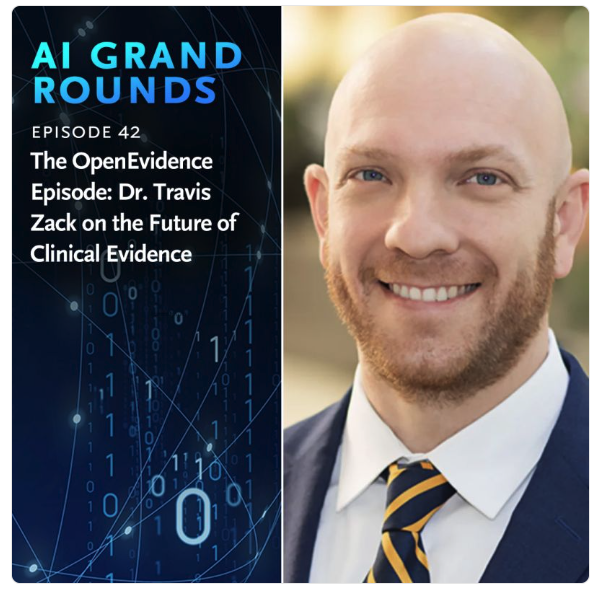
A special @NEJM_AI Grand Rounds is out! @AndrewLBeam and I sat down with Travis Zack, CMO of OpenEvidence, who takes us behind the scenes of building one of the fastest-growing tools in medicine, and where he sees the future of clinical evidence heading:
https://t.co/Tp2Tzc3FUV
For the last few months I've been working on a from-scratch implementation of AlphaGo, a 2016 AI breakthrough that inspired me to get into deep learning. My casual understanding of AlphaGo was "search-augmented deep neural networks trained with self-play", but I wanted to go deeper and understand it by creating it.
Frontier deep learning research has always been expensive, but any given capability gets cheaper very quickly. In 2026, you no longer need DeepMind's resources to train a strong Go AI - you can vibe code all of it yourself for just a few thousand dollars of rented compute.
It was a huge honor to be invited to teach this with @dwarkesh_sp on @dwarkeshpodcast
I am an AlphaGo & Go apprentice, not a master, so all factual errors in the podcast are mine.
Web version of tutorial: https://t.co/Xkf9VsgtuT
Code: https://t.co/rWKOwclPDg
Play the go bot here: https://t.co/aVglJXldVX
@brad_woolf It’s not because of alpha. It’s because their data generation platform isn’t generalizable enough. See recursion and Insitro. Traditional lab automation, very powerful in scaling a protocol over and over again, but brittle and inflexible
🧵1/ Our new study on AI and physician reasoning just came out in @ScienceMagazine. As co-senior author, I'm excited about our findings, and I do think AI will reshape medicine. But after seeing some of the discussions, I'm also worried about how our findings may be misinterpreted.
When I was starting my PhD, I thought distributed optimization was among the most practical topics I could work on using theory. Then I learned the real solution was simply a bigger batch size. Most people working on smart opt algorithms were solving a problem that didn't exist.
Really cool work! I can't tell you how many times I've been asked "So if you went back to the early 1900s and trained a model would you discover {the structure of DNA, general relativity, etc}" so it's cool that there's a model that will let us test some this
New work with @AlecRad and @DavidDuvenaud:
Have you ever dreamed of talking to someone from the past? Introducing talkie, a 13B model trained only on pre-1931 text.
Vintage models should help us to understand how LMs generalize (e.g., can we teach talkie to code?). Thread:
What a privilege for @AndrewLBeam and me to speak with @EvidenceOpen CMO Travis Zack today for @NEJM_AI Grand Rounds. We took a deep dive into @EvidenceOpen and this was easily one of my favorite episodes so far. Episode out soon!