New preprint on optimizing the design of spatial genomics studies! This represents the hard work of @andy_c_jones@dianarycai@didongli
https://t.co/La3WGliJKV
Dr. Andrew Jones presented his PhD thesis research last Friday, "Probabilistic models for structured biomedical data.' So impressed and proud of his work! More of his exceptional papers on the road to publication, and incredible mentorship of two amazing undergrads!
Our paper developing count-based model for association mapping published in #BMCBioinformatics! Great work by amazing undergrad @tianafitz_ & @andy_c_jones
We develop a Poisson reduced-rank regression model to identify low-D associations in high-D data.
https://t.co/egc7tPnFEH
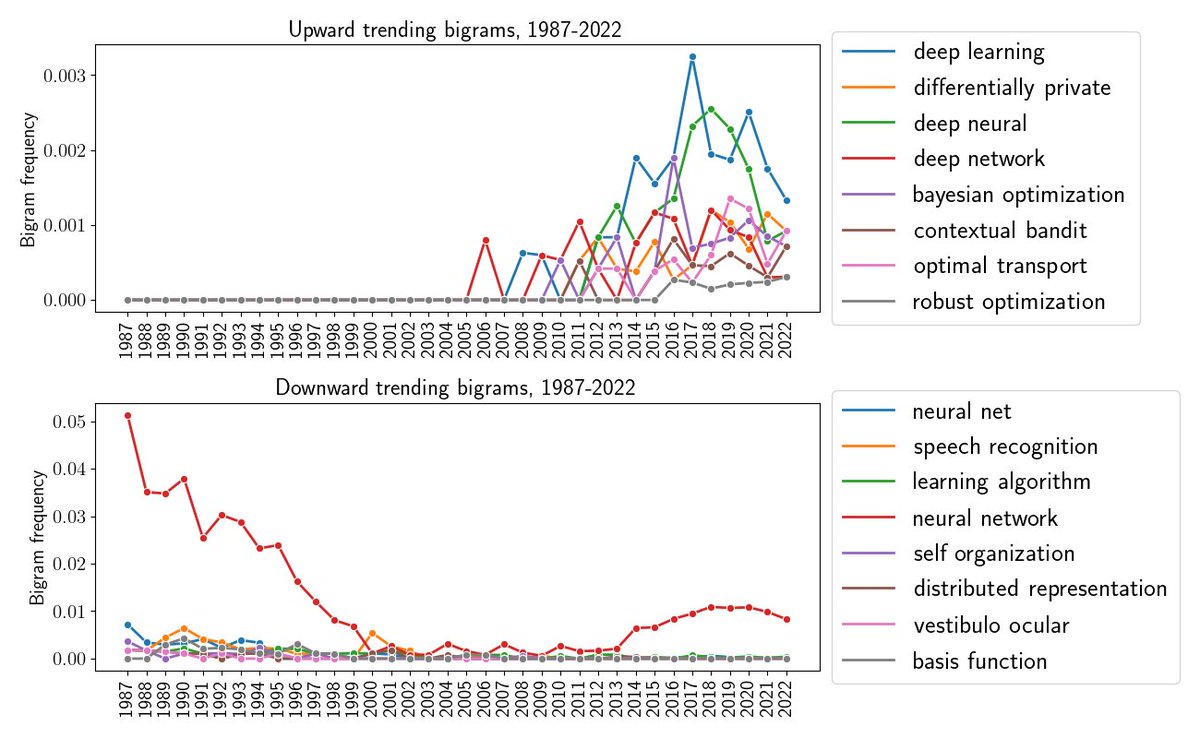
An obvious disclaimer: these are only trends in diction and not the actual methods used. The fact that phrases like "deep learning" are declining is a signal about the way that new ideas are currently best pitched, rather than the methods underlying the ideas.
I did basic text analyses of #NeurIPS paper titles from 1987 to present. Some themes:
- The term "deep learning" is falling out of fashion
- "neural network" resurged in popularity post-AlexNet, but seems to be waning again
- Titles of the form "doing X *via* Y" are popular...
- Sparsity-related titles are declining
- Old(er)-school methods, like LDA, PCA, Boltzmann Machines are declining (as expected)
Easier to see more recent trends with plots truncated 2008-2022:
I am seeking a postdoc (jointly supervised by Dr. Haibo Zhou), focusing on environmental health. US citizen or green card is required, the expected start date is no later than May 2023.
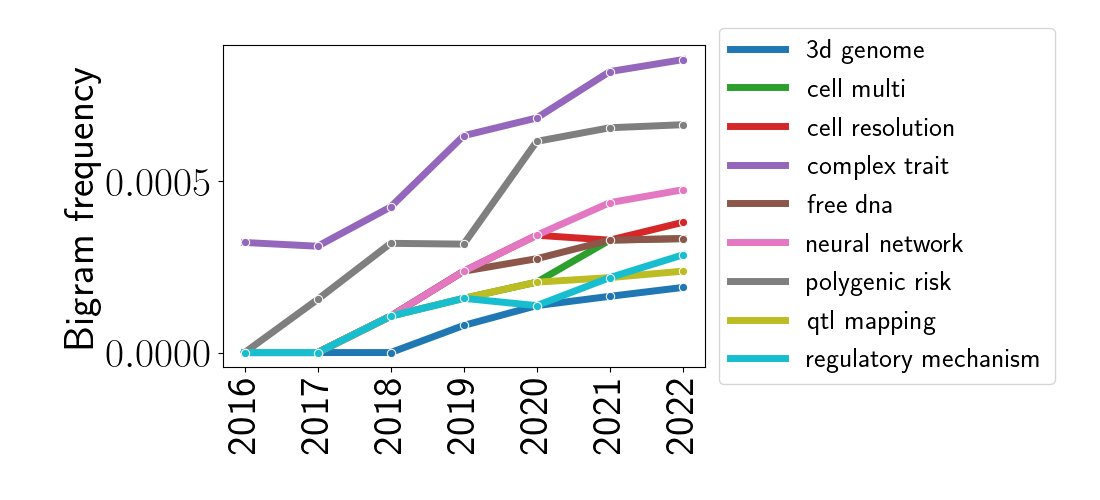
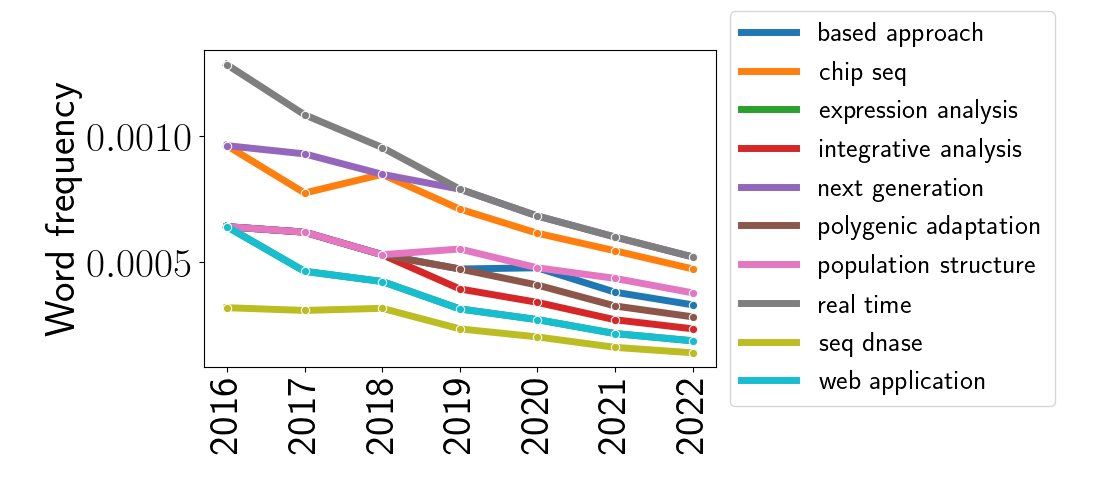
Last week's Biology of Genomes #BoG22 was excellent. I wanted to summarize some of the meeting's themes and trends (past and present), so I did some simple text analyses on BoG abstract titles since 2016. More here: https://t.co/dYtSXpSozN
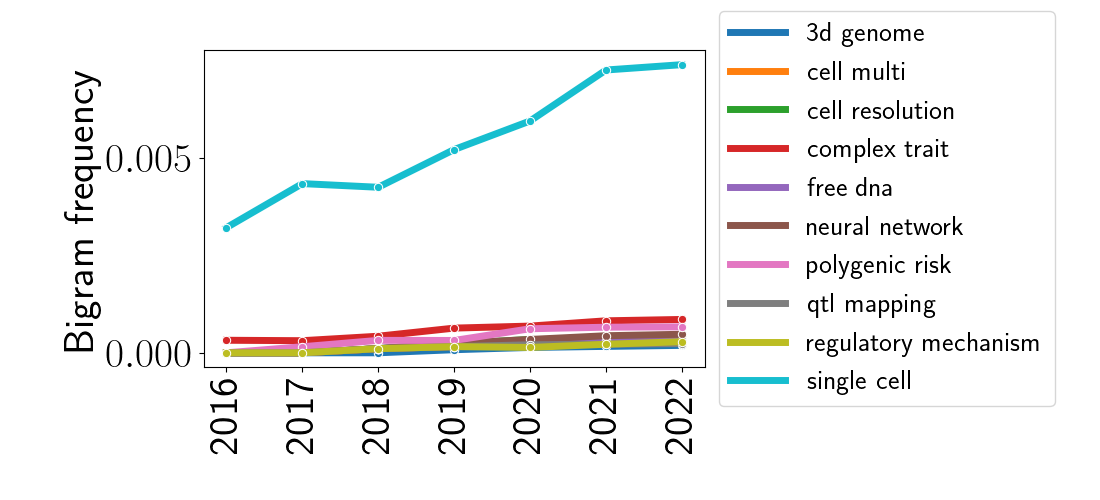
@MarkGerstein Good catch. Here's the full plot (I removed "single cell" from the one posted above to be able to see the trends in the other bigrams). And "neural network" is in there too!
More thorough analysis here: https://t.co/dYtSXpSozN
@MarkGerstein Good catch. Here's the full plot (I removed "single cell" from the one posted above to be able to see the trends in the other bigrams). And "neural network" is in there too!
More thorough analysis here: https://t.co/dYtSXpSozN
The beehive is moving to the Bay Area! As of this summer, I will be Senior Investigator at @GladstoneInst and Professor at Stanford University in @StanfordDBDS! I am overcome with all of the avenues of research this move opens up for me and my group.
Photos containing faces are often posted online w/out consent. These photos can be used in ML algorithms--so how do we protect privacy w/out compromising performance? Check out our latest article by @andy_c_jones covering @KaiyuYang4 & @orussakovsky's work to find out! [1/4]
@SASExperience@BeEngelhardt@will_townes@DidongLi Thanks for posting this! Looks really interesting and yes, absolutely related. On first glance it looks like our model is an extension of this to the spatial domain with extra tricks (non-monotonic warps, templates, etc.) We'll be sure to mention this in next version of the paper
New preprint! @andy_c_jones, @will_townes, @DidongLi, and I introduce Gaussian process spatial alignment (GPSA), a probabilistic model that aligns a set of spatially-resolved genomic and histology slices onto a known or unknown common coordinate system. https://t.co/ccGIO3bn3t
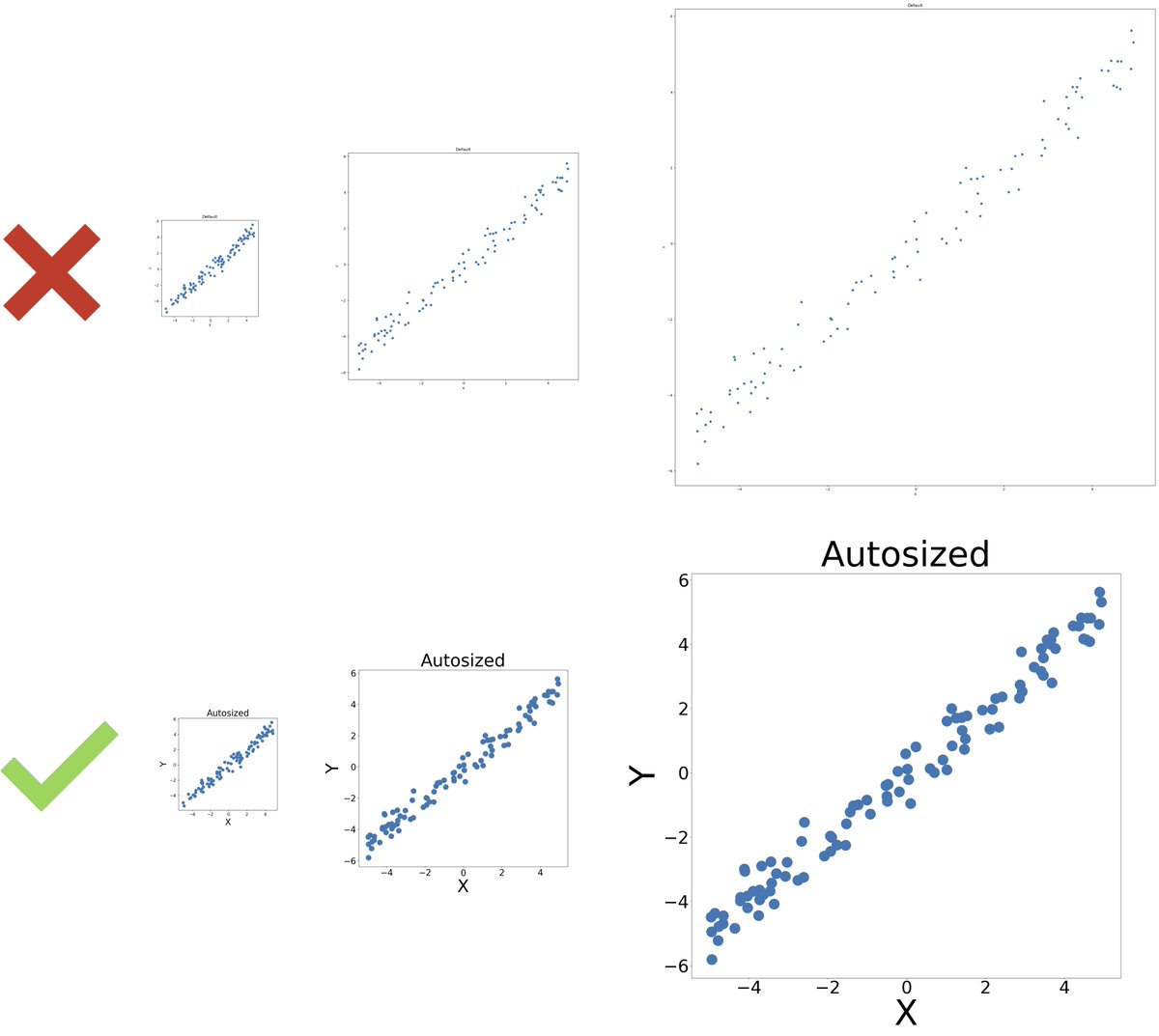
I wrote a simple matplotlib wrapper to automatically adjust the sizes of text, scatter points, and lines to be proportional to the figure size.
from plottify import autosize
plt.scatter(x, y)
autosize() # Auto adjust sizes!
https://t.co/cmpPQzBgO7()
https://t.co/ErjPOCO4Ct
Matplotlib figures can be illegible when using the default settings, and manually tweaking the text/object sizes for every plot can be annoying. The hope is that this package lowers the barrier to making legible plots