NEW: Following President Trump's public comments on attacks on the Pickaxe mountain facility, Iran moved to limit ground access to the tunnel site. In August 2026, it added a series of earthen piles across the roads leading to the Western tunnel entrances. They can be seen in imagery dated August 9, 2026 and are still there as of August 21, 2026. This follows an earlier move to partially backfill the Eastern tunnel entrances to prevent rapid ingress and egress of vehicles and ongoing hardening efforts of all the portals. Whatever internal construction had been underway would have ground to a halt while the road blockades are in place.
The recent CSIS report on Pickaxe mountain missed an important finding in the August 2026 image that contradicts one of its central conclusions. And the lack of citation to our work borders on the comical.
The report by Joseph Rodgers@NonproJoe and Douglas Comstock states that activity at Pickaxe Mountain has “shifted from active excavation toward probable internal construction and continued exterior reinforcement.” That may be true and we pointed out both for more than a year.
But the contradiction is that their image shows, apparently without noticing it, that Iran has more recently moved to limit access to all entrances to the tunnel facility as if the site is preparing against attack. The authors appear to have missed the multiple new earthen piles blocking the road leading to the main western tunnel portal and one pile blocking the road to the auxiliary western portal. Given that the eastern tunnel portals were already partially backfilled in April 2026, this severely limits ground access to the site.
The CSIS report has a serious lack of citation. Readers will be surprised to see that there is not a single direct reference to any ISIS report on the facility, which we have been monitoring since 2020 when construction began. But there is a link to a X post that reposted one of our key findings from a report. We asked for citations to be added last week but have not heard back.
Some examples which should be cited so the reader can understand the publication chronology and public analytical record include the identification of the security perimeter; the hardening of tunnel portal entrances; the blocking of the eastern tunnel portal entrances; the hardening and burial of the nearby 2007 tunnel complex; the operational status of the facility; start of internal construction; identification of potential vulnerabilities; and the possible purposes of the facility. See table below.
We have a much deeper analysis of the lack of citation in this and earlier CSIS reports which we hope is not necessary to publish. Claiming that they did not know about our published reports or use any of our published reports to produce their report would lead to a more serious charge than we are currently making.
Ukraine struck the VNIIR-Progress in Cheboksary again, hitting the sanctioned Russian plant for the second time in 48 hours. Black smoke rose after a FP-5 Flamingo strike on a facility producing GNSS modules for Shaheds, Kalibr missiles and UMPK glide bombs. #Russia
IRAN NUCLEAR UPDATE: Possible NEW Passive Defensive Measures Noted at Pickaxe Mountain
Based upon newly available satellite imagery of the Pickaxe Mountain underground complex, just south of the Natanz Nuclear Complex, it appears that as early as April 22nd, the two eastern tunnel portals have been partially blocked by grey earthen material used to prevent vehicle access to both portals. On April 1, 2026, the portal entrances were clear and unobstructed. Unlike the situation at both the Fordow and Esfahan tunnel entrances, this material does not provide complete tunnel entrance obscuration at either portal. Nonetheless, this material would appear to be sufficient to significantly hinder rapid ingress/egress by vehicles and would require the use of heavy earth moving equipment to gain such access and clear an unobstructed path inside. At present, we do not yet see evidence of such a blockage having been undertaken at the two western tunnel portals. This activity raises significant questions as this is a deeply buried tunnel complex that could be used to protect valuable equipment or materials. To note, earlier in the year, we observed how the old tunnel portals to a complex dating back to 2007 at Pickaxe mountain were buried and hardened with concrete, which suggests that something may have been moved into those tunnels.
NEW: Comprehensive Analysis of Iranian Nuclear Facilities Targeted During the Recent War, the Second Phase of the Iran War
Today we released a comprehensive report detailing and providing high-resolution satellite imagery of the nuclear related facilities that Israel and the United States targeted and destroyed during the Iran war that lasted from February 28 to a ceasefire on April 7/8, 2026. The Institute could identify at least six nuclear sites that were attacked. Three other sites that were attacked could be nuclear-related, but there is not enough information to be certain. In total, six to nine sites were recently attacked that were nuclear related.
The Israeli priority in the second phase of the war appears to have been more on further degrading Iran’s ability to make the nuclear weapon itself, a process called nuclear weaponization. Some of these targeted weaponization sites were revealed publicly for the first time, shedding new light onto the extent of Iran's nuclear weapons related work. Of the six to nine sites mentioned above, four to seven of them, or almost all of them, were directly related to making the nuclear weapon itself or possibly related in that way. A total of five nuclear weaponization-related sites were attacked in June 2025. In both phases of the war, a grand total of nine to twelve sites involved in developing and building nuclear weapons were targeted.
Attacks in phase two have further set back Iran’s ability to make nuclear weapons. Recent media reports of the U.S. intelligence community finding that the second phase of the war did not set back timelines for Iran to build nuclear weapons do not accord with the visible damage of nuclear weaponization facilities and require both more explanation and scrutiny.
The attacks deserve credit for significantly increasing both the time needed to finish a nuclear weapon and the chance of failure if tried. While the new Iranian regime is widely perceived as more motivated to decide to make nuclear weapons, its means to do so are severely degraded as is its confidence in trying. While before the June 2025 war Iran could have broken out and built a non-missile deliverable nuclear weapon with almost 100 percent certainty in less than six months, it will face a much more difficult struggle towards success if it tries in the coming months, and the probability of succeeding, whether it be in nine months, one year, or two years, is now much less technically certain, and significantly less than 100 percent. That real risk of failing to successfully build a nuclear weapon may be a deterrent against deciding to try.
Read the full imagery report here: https://t.co/eJiqkAxyBX
OUR NEW: Comprehensive Analysis of Iranian Nuclear Facilities Targeted During the Recent War, the Second Phase of the Iran War
I want to share our comprehensive report detailing and providing high-resolution satellite imagery of the nuclear related facilities that Israel and the United States targeted and destroyed during the Iran war that lasted from February 28 to a ceasefire on April 7/8, 2026. The Institute could identify at least six nuclear sites that were attacked. Three other sites that were attacked could be nuclear-related, but there is not enough information to be certain. In total, six to nine sites were recently attacked that were nuclear related.
Four of the 33 images in the report are attached. Their figure captions are at the end of this post.
The Israeli priority in the second phase of the war appears to have been more on further degrading Iran’s ability to make the nuclear weapon itself, a process called nuclear weaponization. Some of these targeted weaponization sites were revealed publicly for the first time, shedding new light onto the extent of Iran's nuclear weapons related work. Of the six to nine sites mentioned above, four to seven of them, or almost all of them, were directly related to making the nuclear weapon itself or possibly related in that way. A total of five nuclear weaponization-related sites were attacked in June 2025. In both phases of the war, a grand total of nine to twelve sites involved in developing and building nuclear weapons were targeted.
Attacks in phase two have further set back Iran’s ability to make nuclear weapons. Recent media reports of the U.S. intelligence community finding that the second phase of the war did not set back timelines for Iran to build nuclear weapons do not accord with the visible damage of nuclear weaponization facilities and require both more explanation and scrutiny.
The attacks deserve credit for significantly increasing both the time needed to finish a nuclear weapon and the chance of failure if tried. While the new Iranian regime is widely perceived as more motivated to decide to make nuclear weapons, its means to do so are severely degraded as is its confidence in trying. While before the June 2025 war Iran could have broken out and built a non-missile deliverable nuclear weapon with almost 100 percent certainty in less than six months, it will face a much more difficult struggle towards success if it tries in the coming months, and the probability of succeeding, whether it be in nine months, one year, or two years, is now much less technically certain, and significantly less than 100 percent. That real risk of failing to successfully build a nuclear weapon may be a deterrent against deciding to try.
Read the full imagery report here: https://t.co/hoz4B2OLOq…
Captions of the four images of attacked sites from left to right
1) Min-Zadayi is a previously unknown site suspected to play a key role in Iran’s attempt to reconstitute nuclear weapons capabilities post-June 2025. A close up of the hillside crater and smaller craters on a nearby concrete surface, apparently a roof for a partially buried area.
2) The two newly targeted buildings are close to the previously targeted (June 2025) SPND Mojdeh site and connected by footpaths. All three are involved in nuclear wespons development.
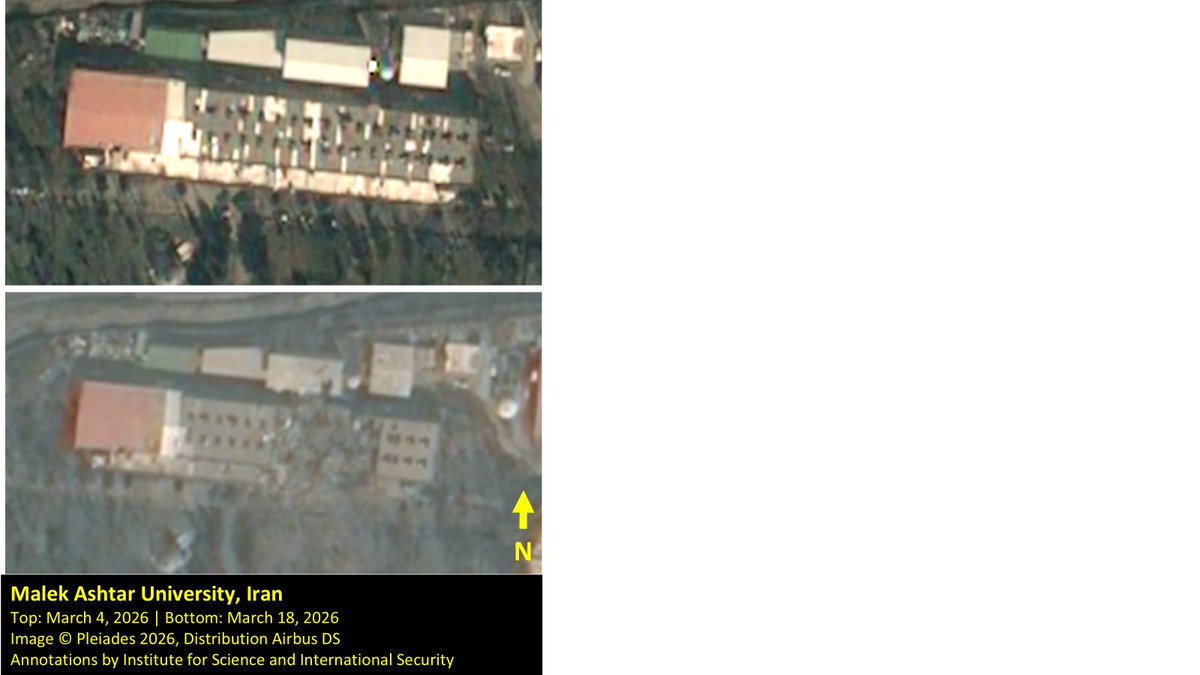
3) Before and after view of the large workshop building at Malek Ashtar University that was destroyed by an Israeli airstrike.
4) Before and after view of the destroyed engineering-laboratory building connected to Malek Ashtar University and the Mojdeh Site.
NEW Policy Brief: The Iran Nuclear Deal the World Deserves Takes Us Back to the Basics
The current nuclear negotiations on Iran need to reflect Iran’s requirement to demonstrate it does not have a nuclear weapons program and secondarily on eliminating the means to enrich uranium and the existing stocks of enriched uranium. The goal should be reestablishing the norms and obligations of nuclear nonproliferation on Iran, not further perpetuating additional exemptions to them or creating new ones.
Too often, nuclear negotiations with Iran have become too bogged down and, in essence, lose the forest for the trees. That focus on individual details overwhelmingly favors Iran. Detailed proposals about nuclear limits and step by step plans are intended to wear U.S. negotiators down and have them get lost in the details of what sanctions are removed when and what nuclear capability limits are sufficient. Reinventing the wheel of nonproliferation limits and monitoring and carving a special, unusual nonproliferation status for Iran is what led us here in the first place. Focusing on limits on nuclear capabilities, while largely deemphasizing the main cause of concern, has got us into the present debacle.
Instead, the United States should focus first on obtaining and verifying Iranian commitments not to build nuclear weapons. That includes Iran providing the IAEA an accurate and complete nuclear declaration and allowing full access to all relevant sites and persons. Iran has never taken the steps necessary to determine compliance with its obligations under the Nuclear Non-Proliferation Treaty (NPT). This effort was essentially abandoned in the Joint Comprehensive Plan of Action (JCPOA). Iran must acknowledge and end upfront its work on nuclear weapons prior to any sanction’s relief. Both Iraq and South Africa did so, the former through a tough cease fire agreement in 1991 and the latter voluntarily. Iran should choose the latter to avoid the former. And that should be the choice offered to Iran.
The status quo favors the United States, with Iran’s ability to make nuclear weapons severely degraded by the war, and its stocks of enriched uranium bottled up in sealed tunnel complexes, easy to monitor from above.
This process will also satisfy current UN Security Council demands and IAEA Board of Governors resolutions on Iran, opening the door for sanctions relief, conditional on the final outcome rather than negotiated to be a step-for-step reward to keep Iran engaged in the process. After all, the Islamic regime is still in power, and it neither wants nor needs all sanctions removed, it needs a lifeline, and it otherwise could decide it got enough at any point. Preserving its nuclear weaponization infrastructure and personnel and its ability to make gas centrifuges has been key to that strategy. The stocks of enriched uranium have taken on special meaning in the present context but in the end, Iran will move to protect the former capabilities rather than the mere products of those capabilities.
To start, Iran would have to provide a complete declaration and access, and dismantle, destroy or render harmless key nuclear weaponization equipment and materials, followed by the IAEA conducting an initial verification of the declaration and dismantlement. The initial verification can be accomplished relatively quickly, and the following verification would be more thorough to ensure the absence of undeclared materials or activities.
The first phase can occur in a matter of months, if Iran cooperates, as South Africa showed. If Iran refuses to cooperate or only partially cooperates, an infinite amount of time is not enough, and no rewards would be given.
The targets Israel and the United States destroyed demonstrate considerable knowledge about Iran’s nuclear weaponization program, which if shared can help the IAEA’s effort and speed it up. In the two wars, Israel attacked and destroyed nine to twelve sites involved in developing and building nuclear weapons. Many of these sites contained elements added only in recent months or years. At least one site held a post-June reconstituted nuclear weaponization capability that Israel somehow discovered. In addition, Israel killed over 20 “oppenheimers” and “groves” essential to a functioning nuclear weaponization effort, eliminating important know-how in the process.
The initial phase of coming into compliance with the NPT would include a full declaration of the locations of the stocks of enriched uranium and go further, mandating their removal or down blending. Stocks of natural uranium should be sold internationally, as unneeded.
In parallel, specific limits on the fuel cycle should be negotiated. The soundest position is that Iran commits to a pledge of no enrichment and no reprocessing for an extended period of time. Iran has no reason beyond building nuclear weapons to do either. Iran has not adhered to the NPT and thus cannot claim NPT privileges. Since Iran has not met the basic demands of the NPT, it does not deserve enrichment or reprocessing. Iranian enrichment and its means of production have been destroyed. The war ended enrichment in Iran, something that no nuclear agreement had accomplished. The end to enrichment is therefore a given, and its continuation does not deserve sanctions relief. It has no ability to reprocess and all its plutonium is in irradiated fuel under international monitoring at the Bushehr nuclear power reactor and unlikely to be diverted.
A compromise on enrichment is possible, if Iran demonstrates, concretely and verifiably, it has exclusively a peaceful nuclear program. But that compromise needs to contain a suspension long enough to matter, and any restart of Iran’s centrifuge program would require the satisfaction of a set of criteria. The most fundamental one is a determination that the program would be economically and commercially viable.
How long is enough? A 20-year time period is often discussed. It is critical that a 20-year suspension does not mean a 20-year preparation for rebuilding; the condition of a spring back was a deep flaw at the heart of the JCPOA. There must be a halt to the current centrifuge program for its entire duration. It must mean, at the beginning of the 20 years, redirecting all employees in the centrifuge program to other areas of work, and dismantling key components and equipment of the centrifuge program under international supervision. This is critical because without any halt, it would likely take Iran more than a decade to rebuild its enrichment capacity anyway, if not longer, given the current sanctions regime and the immense amount of imported, sensitive equipment and materials at the heart of its enrichment industry. A new agreement should not legitimize the reconstruction of a centrifuge program during this suspension, one making no economic sense while posing a grave proliferation risk. When the risk is gone and the economics makes sense, then Iran can recreate a centrifuge program.
Significant sanctions relief would follow the successful completion of the initial verification of the end of Iran’s nuclear weaponization program, the verified dismantlement of its centrifuge program, and removal or downblending of enriched uranium stocks to natural uranium. More sanctions relief would follow the successful completion of the second, more thorough IAEA verification.
Unfortunately, many are willing to make Iran’s case. U.S. negotiators unable and unwilling to discuss details are dismissed as incompetent, although they are correct to hold the line on the latter, and the former helps them with it. Many others continue to say that asking Iran to give up enrichment is a lot, and asking for a lot means the war will continue, when in fact, the war has destroyed so much. What used to be a lot is now a little.
And if Iran moves to rebuild a small enrichment plant sufficient to further enrich its 60 percent to 90 percent enriched uranium, then it is clearly moving to build nuclear weapons and inviting a resumption of military conflict, while likely still needing well over a year to build a nuclear weapon out of the weapon-grade uranium.
So, there is time to accomplish a more fundamental and pressing goal, a simple and straightforward one, with no complicated sequencing, establishing verifiably that Iran is committed to a peaceful nuclear program and, in parallel, to establish a cooling off period of at least 20 years where Iran continues its halt across its entire enrichment program. This approach, focused fundamentally on NPT compliance, is more amenable to gathering international support and justifying further U.S. actions.
https://t.co/HVUUtmrZGz
We are proposing a way to move beyond the JCPOA model, which is poorly suited to address the current Iran nuclear issue. At its heart, it requires Iran to abide by the Nuclear Non-Proliferation Treaty, something it got away with violating under the JCPOA, harvesting rewards along the way. Our approach also enables a way forward in case of on-going Iranian non-compliance with its NPT obligations, both in terms of enforcement and better enlisting support from allies and the international community.
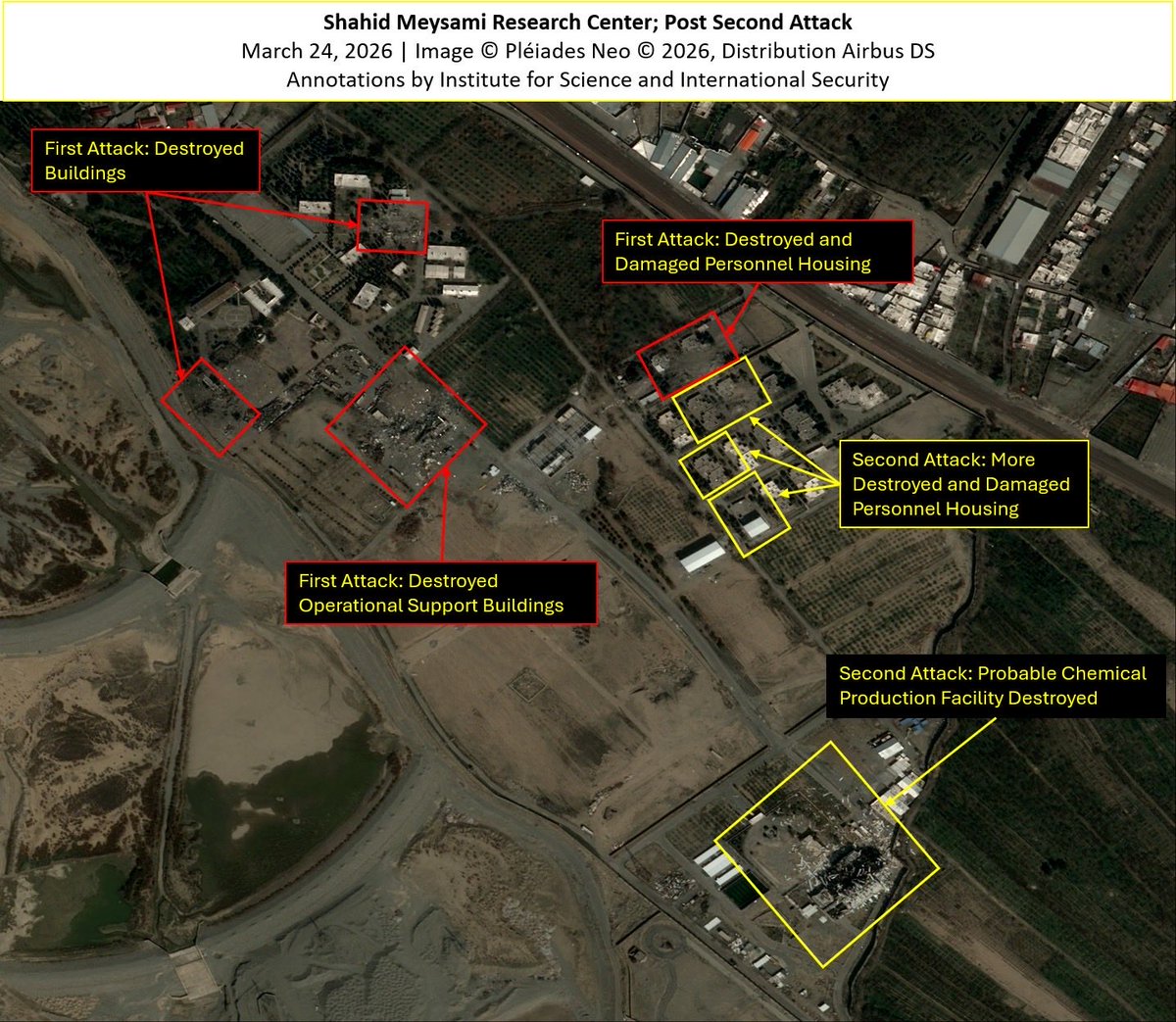
Satellite imagery shows that the Shahid Meysami (or Meisami) research center, located west of Tehran, near Karaj, was attacked twice in March 2026. The site was already heavily attacked in June 2025, tied by Israel to Iran’s chemical and biological weapons development, but also described as holding nuclear weapons related equipment. Imagery from March 14, 2026, shows that several operational support buildings and nearby high-level personnel housing were targeted in the first March 2026 attack. Then, on or before March 24, 2026, imagery shows that a second attack occurred, targeting and destroying a probable chemical production facility in the southern quadrant of the complex as well as several more personnel housing buildings.
No new information on why the site was attacked was released by the IDF, however, recent activity at the site could be one reason. Following the June attacks, we identified significant cleanup and clearing operations at several of the destroyed or damaged buildings, constituting salvaging as a possible prelude to reconstruction. Indeed, a small building that was destroyed in March 2026 was only constructed in recent months, after November 2025, at a location of a building destroyed in June.
In a September 2025 report to the UN Security Council, Israel stated, “The site contained a large amount of metallurgical equipment that served the Advanced Materials Centre, under the Shahid Meithami group, the chemistry group of SPND. This equipment can be used, with modifications, for the metallurgy process for fissile core fabrication.” Additionally, the report states, that the Shahid Meysami site "was one of the central sites in the Iranian Chemical and Biological Weapons program, used for the research and development of chemical materials based on pharmaceuticals."
Link to report: https://t.co/AQRYNDmu7H
Airbus imagery from today shows evidence of the Ukrainian attack on VNIIR Progress in Cheboksary, Russia. The strike, which reportedly involved a Ukrainian FP-5 Flamingo, did not destroy the facility, but rather, only damaged it. Burn char from fires caused by the explosion can be seen in the front entrance to the building, which may contain small workstations suitable for assembling electronic components. The front of the building will likely need to be repaired. It is unclear how much damage was caused to the internal structure, making it difficult to assess how much of an impact this strike will have on operations there. Additionally, reportedly two AN-196 “Lyuty” UAVs struck the building and caused damage. Structural damage and char from the blasts can also be seen in the imagery. Repair operations are already underway. A crane, presumably being used to clear debris, is parked in front of the building, and reportedly, ground photos show scaffolding being installed in other areas of the damaged structure (https://t.co/4R8v29udBR).
VNIIR Progress is an important supplier of Kometa-M anti-jamming modules used in the Shahed 136 (Geran-2) drones produced at the Alabuga Special Economic Zone. Below we have a chart detailing how the vast majority of the electronics in the Kometa-M anti-jamming module depends on Western origin technology and companies. (Note: ST Microelectronics is in the Netherlands, not in Switzerland). A kometa-M anti-jamming module was recently discovered inside a Shahed-136 drone downed in Cyprus.
Don’t Confuse Knowledge with Know-How when Discussing the Killing of Scientists in Iran’s Nuclear Weapon Program
There appears to be a misunderstanding about the difference between knowledge and know-how, as evidenced in some recent media characterizations about the destruction of parts of Iran’s nuclear weaponization program and the killing of its key scientists, some the Oppenheimers of its nuclear weaponization program. Killing knowledge is not possible, but know-how can be eliminated, and that has been an important target of Israel in the wars against Iran.
The difference is important. Knowledge is theoretical understanding. Know-how is the practical knowledge, expertise, or tacit ability required to perform a task, create a product, or build a nuclear weapon effectively. In other words, how to do something. It is acquired through experience rather than formal education. It includes non-public techniques and secrets that offer an advantage.

One can read a book on how to build a bridge, but if that person had only such knowledge, would you hire that person to actually build it?
What Israel did was kill know-how about building nuclear weapons. That is hard to replace.
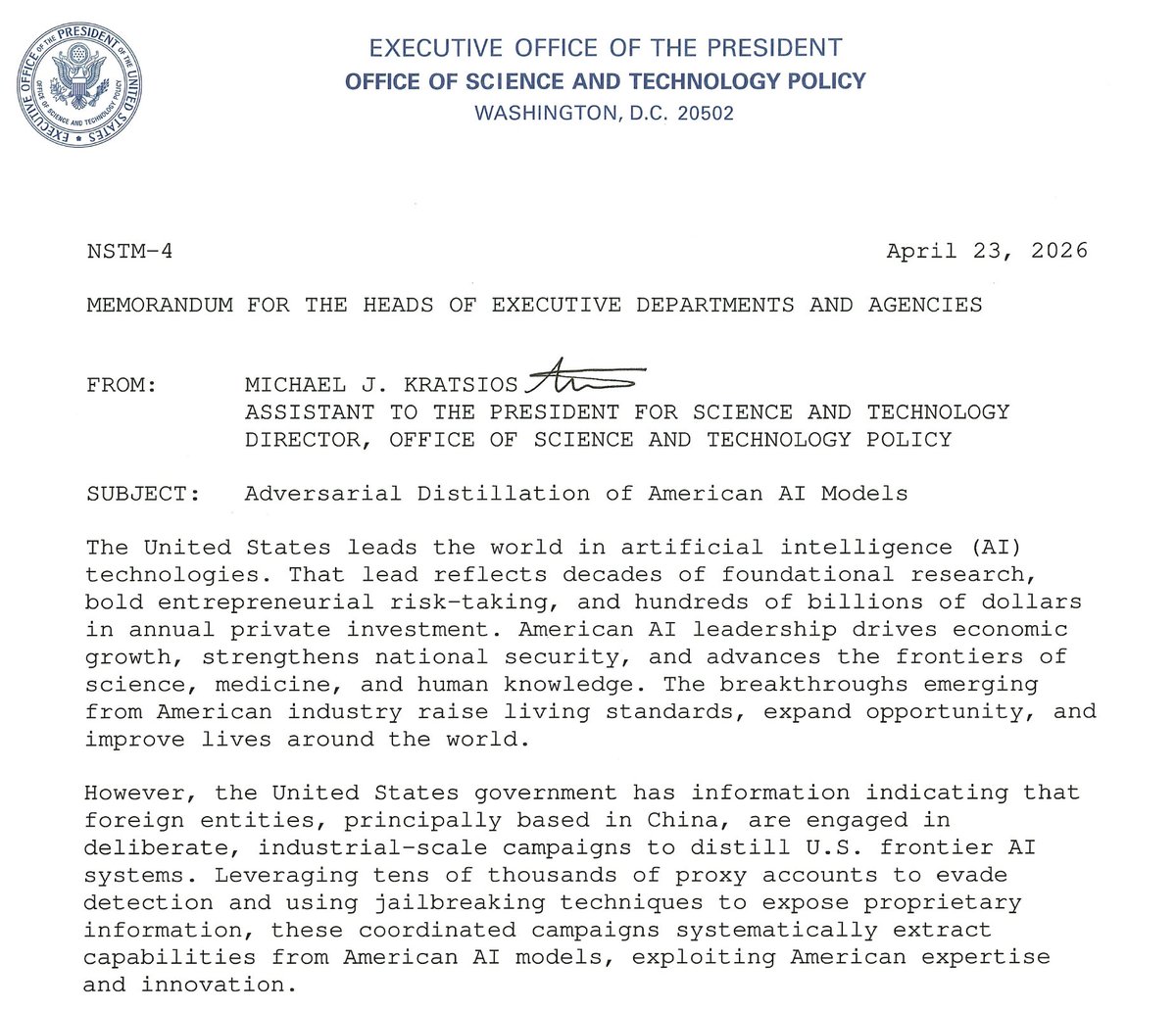
The U.S. has evidence that foreign entities, primarily in China, are running industrial-scale distillation campaigns to steal American AI. We will be taking action to protect American innovation.
These foreign entities are using tens of thousands of proxies and jailbreaking techniques in coordinated campaigns to systematically extract American breakthroughs. Foreign entities who build on such fragile foundations should have little confidence in the integrity and reliability of the models they produce.
The U.S. government is committed to the free and fair development of AI technologies across a competitive ecosystem, from open-source to proprietary models.
Read the memo: https://t.co/w0BWxJdaLn
Institute for Science and International Security President @DavidHalbright1 discusses Iran’s nuclear capability and U.S. demands for Iran to turn over its stockpile of highly-enriched uranium.
https://t.co/QefhtzjWBH