Anthropic found that making AI reason longer can drop its accuracy.
The newer AI models let you turn up how long they reason before answering, and you can also just ask one to work through a problem step by step. More reasoning usually lifts accuracy, so the instinct is to max it out every time.
That instinct has a blind spot, and the clearest case is a simple counting problem wrapped in extra numbers that don't matter. Give the model room to think and it starts leaning on those irrelevant numbers, talks itself in circles, and lands on the wrong answer. A short, direct answer would have nailed it.
The reason is simple. Longer reasoning is more surface area, and every extra step is another chance to grab a detail that doesn't belong and follow it somewhere wrong. On a clean, hard problem that room pays off. On a simple problem padded with noise, it backfires.
So match the thinking to the task instead of maxing it by default. For something quick or full of distractions, keep the prompt tight and let the model answer fast. Save the long reasoning for problems that have real layers to work through.
The takeaway is to stop treating "think harder" as a free upgrade. Past a point, more thinking costs you accuracy on exactly the tasks that looked easy.
@SenSanders Arguably, AI or Agntic AI is more adaptive than any one human's intelligence today. A better question may be how do we use this tool to improve the human condition.
I couldn't make it to Davos this year, but I'm delighted to see that my message has. Here's an enlightening exchange between two of the most successful businessmen in the world, Jensen Huang and Larry Fink, regarding the impact of AI on skilled labor. I watched it lie this morning, as I waited for the coffee to kick in. https://t.co/vpxLETDQkK The entire clip is 30 minutes, but I've attached a short clip wherein Jensen, the CEO at NVDIA, talks about "the greatest infrastructure project in the history of mankind," and the opportunities for those entering the skilled trades today.
Obviously, our workforce is nowhere near ready for what's coming. In fact, we're not ready for what's already here. We're going to need to dramatically rethink the way we train the men and women who will build the infrastructure in question, and the speed with which we do so. I'm heartened and encouraged to see Silicon Valley at the table, along with the current administration, who seems determined to reinvigorate the skilled trades by whatever means necessary.
At this point, it's only a matter of national security...
There are no stationary objects in the Universe: even our Solar System is moving not only around the center of the Galaxy (828,000 km/h) but also relative to its nearest stellar neighbors (70,000 km/h)
[🎞️ starwalkapp]
https://t.co/fXPyMdaBkc
The "8 hours of sleep" rule is based on ZERO evidence.
Ancient humans slept in two distinct phases, not one long stretch.
Here's the shocking truth about how you should really be sleeping:
@chiakokhua Agree Foundry bleeding cash for a cpl years if relying on spin-out Product customer. Does unused Foundry capacity add revenue by avoiding perception of Whole profits funding competitive threats? I wonder if today's competitive Product silos part of the root cause?
Timeline Cleanse.
Since I got serious about photography in the early 2000s, the hobby has exploded. Landscape photography in particular has become ubiquitous, with landscape photography workshops being a serious $$$$ business. As a result, so much of the landscape photography community has coalesced into what are now known as “cliche” shots: the Mormon Barns in Grand Teton National Park; the Maroon Bells in Colorado; Antelope Canyon in Arizona; Horseshoe Bend in Arizona; Tunnel View in Yosemite; Delicate Arch in Utah’s Arches National Park; the “firefall” of Horsetail Falls in Yosemite; pretty much everywhere in Iceland and Patagonia; the list goes on. The joke among serious landscape photographers is that you can just walk up to these cliche sites and put your tripod in the same three holes worn in the ground by the thousands of photographers before you.
I of course am guilty of this—who isn’t? These are irresistible locations of great beauty. But I also pride myself on using my Army map-reading skills to identify beautiful spots that others do not know. That is how you can gain unique beauty that most have not seen.
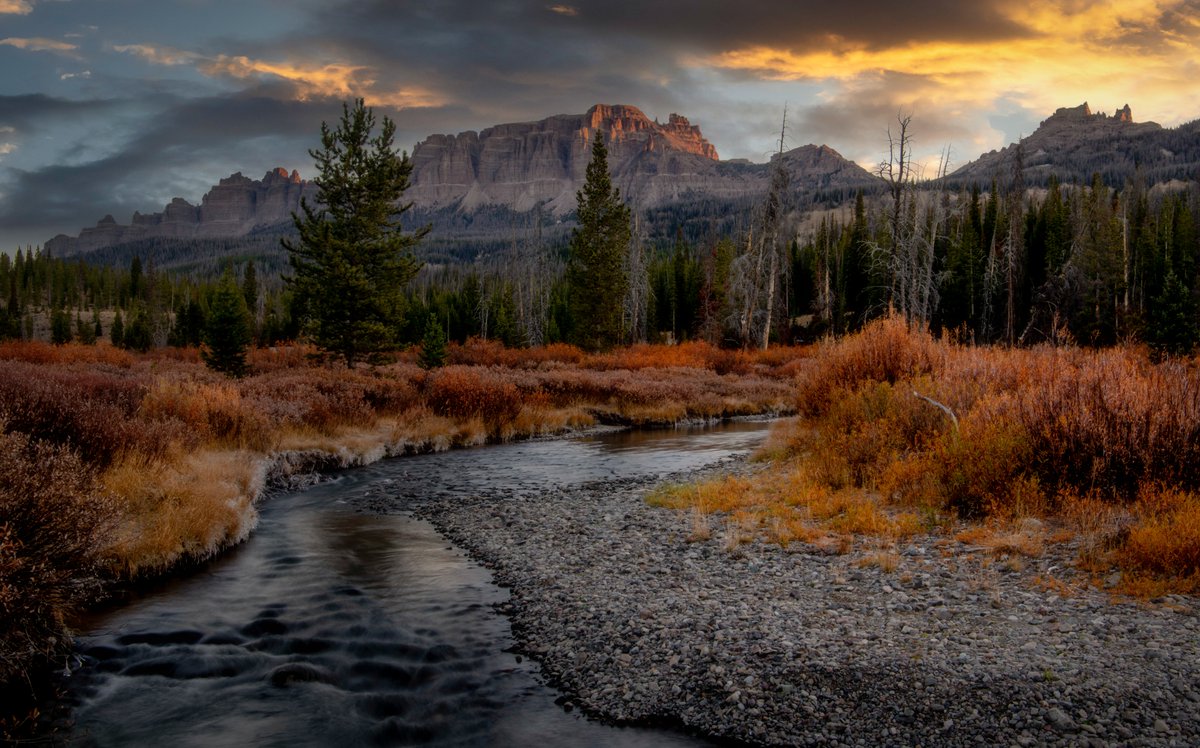
So the last time I was at Grand Teton National Park, I did an extensive map recon (using military-style maps with contour intervals) of the surrounding area looking for unknown spots. I found one, it’s below.
And the location is secret, I ain’t tellin’.
Nikon D850, 32mm on my Nikon 24-70 zoom, Really Right Stuff tripod, f/22 (to let the water blur), ISO 64, 1/8th second.