It’s almost incomprehensible how wide the distance is between someone who’s working at the frontier with AI and basically everyone else right now.
The crazy thing is these lines are not converging, but only growing farther apart. If the curve of AI progress had leveled off, it would certainly have given most people and companies time to catch up or implement their workflows in a standardized way. The technology would have neutralized competitive advantage because everyone would be using it the same way.
But what’s happened is the opposite. The curve of AI progress is basically going vertical right now, which means if you had codified your processes 3-6 months ago you’re likely already behind again. Now imagine most companies that kicked into gear a year ago and thought that they were done. Even further behind now.
I’ve never seen a technology in my life and career that improves at this rate, which consequently means you need to upgrade your expectations at a similar rate. Our brains weren’t wired for this, and our organizational change management processes certainly weren’t either.
With any form of recursive self improvement, things just get wilder. It’s a time when you will need to be constantly reevaluating the things that didn’t work just a couple months ago to see if they now can be solved. AI native companies certainly have a strong advantage due to this right now, so now it comes down to can the bigger companies keep up. Wild times.
@hunter_nft As of right now when access expires, the sitter loses access to the Care Share chat, including past messages, and can’t ask new questions. Your family’s information stays with your family. We can’t erase anything the sitter already read, copied, or screenshotted.
Every family has someone who remembers everything. The school emails. The pickups. What the babysitter needs to know.
What would it look like if AI helped the whole family carry that load?
Today we’re launching Andi: family-friendly AI for parents, kids, and caregivers.
Andi brings your family’s context into everyday conversations:
- Family memory that builds on the routines, preferences, and plans you share.
- Help making plans, setting reminders, and working through scheduling conflicts.
- Age-appropriate guidance for kids exploring questions, interests, and homework.
- Care Share, so grandparents and babysitters can get the details they need for a handoff.
- Parent controls for family values, topic preferences, and visibility into their kids’ AI experience.
A parent planning tomorrow, a child working through homework, and a grandparent handling pickup need different kinds of help. They also need context about the same family.
That’s what we’re building with Andi. We call it Family Intelligence.
We started imagining this a year ago in a Starbucks in Boston. Today, we’re proud to put it in families’ hands.
Andi is available now for iPhone: https://t.co/t4UIF2SnNd
A few examples below 👇
Think about everything you explain before leaving the kids with someone else.
Pickup. Dinner. Bedtime. The little routines that make the evening easier.
With Care Share, you choose the details to share and review the briefing before giving a caregiver access. You control who gets access and for how long. They can then ask Andi what they need to know.
That’s the bigger idea: making family knowledge useful to the people helping, so one person doesn’t have to repeat every detail.
Try Andi with your family: https://t.co/IIxf6gQ6Ak
Kids are already bringing their questions to AI. Homework. Friendships. Whatever they’re curious about that day.
We wanted an experience designed around their age, with a way for parents to stay involved.
Andi helps kids work through questions and understand the next step. Parents can set family values and topic preferences, and choose visibility through conversation views, summaries, or safety signals.
The experience can change as kids grow and become more independent.
A retired NASA engineer who had worked on the Space Shuttle program for 25 years was hired by SpaceX at age 62. He described the first week as the most disorienting experience of his professional life.
At NASA, a design change required 3 meetings, 2 committees, a review board, and 6 to 18 months of documentation. At SpaceX, his new supervisor said "if it works, build it. If it doesn't, change it by Friday."
He sat at his desk after the first day and called his wife. He told her he felt like a man who had been swimming with ankle weights for 25 years and someone just cut them off. He could move. He could decide. He could build something in the morning and test it in the afternoon. The constraint that he had accepted as the nature of aerospace engineering turned out to be the nature of bureaucracy.
Within 6 months he had contributed to more design iterations than he had completed in his last 5 years at NASA. Not because he was working harder. Because the time between having an idea and testing the idea collapsed from months to hours. The same brain. The same knowledge. A different operating system.
He described a specific moment where he proposed a modification to a Raptor engine component. At NASA, the proposal would have entered a queue. At SpaceX, the modification was machined by the end of the day and tested by the following morning. He watched his idea become a physical object in 18 hours. At NASA, 18 hours would not have been enough to schedule the first meeting to discuss whether to schedule a meeting.
He told an interviewer: "I didn't get smarter when I went to SpaceX. I got faster. The intelligence was always there. The system was in the way."
The difference between SpaceX and NASA is not talent. NASA has extraordinary talent. The difference is the time between a thought and a test. SpaceX compresses it. NASA elongates it. The same engineer produces 10x more at SpaceX than at NASA because the bottleneck was never the engineer. It was the meetings about the meetings about the work.
Chamath says IP and software were "effectively rendered worthless" this week, after people decompiled Adobe's core products and published open-source versions, as every service goes headless
"The more important point I want to make though, is I sent this to Nick, there's been a couple things that happened in the last couple days, which I think are incredibly important."
"There have been people that decompiled the entire, the entire big five. What is the big five? Adobe has five very, very important products in their product suite. Freeberg may know them all, but I just know Photoshop. There's like a bunch of others. Okay."
"And these folks decompiled it, distilled it, and published open source versions of these things. And Rust, yeah. And I was so shocked, because I was like, hold on a second, these are like profound products that have existed and have had moats for years, and now they're just open source versions."
"And then Nikita was, I think, trolling, and he was building on that idea, and just talking about GTA, because it's about to get released. I think GTA 6 is about to come out, and we'll reconstruct this."
"Why is this important?"
"I think that IP and software was effectively rendered worthless two days ago."
"Because if you think about it, when everything is headless, so when Elon makes his services headless, Benioff made Salesforce headless a few months earlier, when all of these things are headless, and you can wrap them in agent tools, and you can connect them via MCP to other experiences, the value of IP does no longer exist in software. It doesn't exist."
"And I think that probably is the most profound implication."
"So, like, even in our business, we would argue with some of our customers all the time, because we'll say, oh, we'll build this for you, we'll own the IP. They'll say, no, we want the IP. We don't know how to negotiate it. And two days ago, I walked into the 8090 guys, I said, who cares? Who cares? But before, it was always a negotiation and a set of trade-offs. Now it's a who-cares thing, where, like, the IP is irrelevant."
"It still takes a while for the machinery of a business, and frankly the market, to understand. But that is the most important thing that happened this week in AI, in my opinion."
Math, or any other field of science for that matter, does not exist, nor is it funded by citizens or taxpayers, simply to provide people with careers!
Society has generously granted us scientists with prestige, status & resources in return for our responsibility to advance knowledge, contribute to humanity & move civilization forward. If AI or super-intelligence is able to do that better than our mission has been completed or we can now change our role to help steer it as long as we are able to add value.
Unfortunately, academia has built ivory towers guarded by gatekeepers who have taken advantage of society’s generosity. Superintelligence is now challenging these gatekeepers and throwing the gates wide open. That is precisely why they are so upset.
🚨 side project alert 🚨
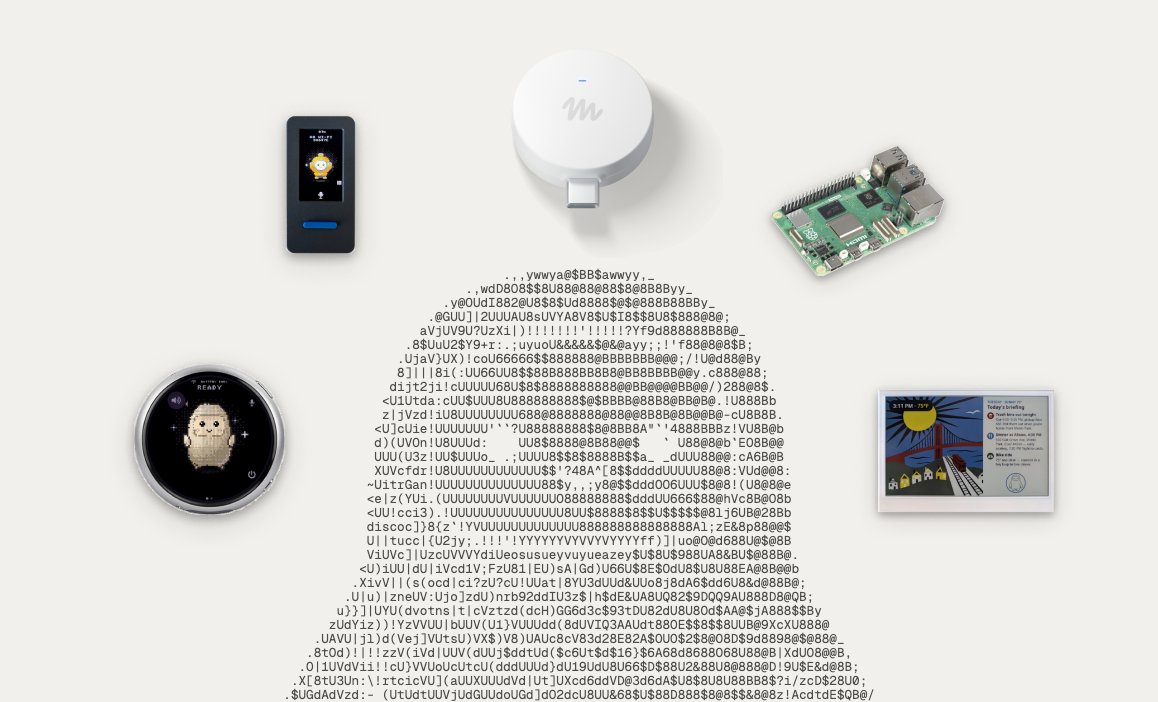
Announcing Muse Gadgets, an open source ESP32 firmware and Linux sdk so that you can make hardware devices that work with Muse.
Grab an API token from https://t.co/Q0dE0cYnCs and point your favorite coding agent at the github repo to build your own peripherals for Muse.
This is really cool. It makes sense that automation requires a separate type of model and can be done faster. I am not sure if this replaces the "reasoning" part but looks amazing for a lot of applications.
After co-inventing ChatGPT, I kept asking myself: why have superhuman chat models not led to AGI?
I’ve spent the last 2 years in stealth building a new way to train models (RLCD), and a new type of frontier AI model that we are releasing today: Jev
• 20-200x faster
• 40-400x cheaper (w/ output tokens free)
• Frontier composable intelligence optimized for decisions
AFAICT the shortest path to AI-based economic revolution
JUST IN: NVIDIA's $12,930,300,000 acquisition of Hugging Face contains an easter egg. The number 129,303 is the decimal conversion of Unicode point U+1F917.
The 🤗 emoji.