This episode was generated automatically using my own ai cluster and video harness. The big idea for me is the concept of just in time media. It goes hand in hand with just in time software. I wish for something and it gets created by a wish granting machine of my own creation. In this case, I wanted to know about the work @AEStudioLA is doing. I've met their team at the LA office and thought they were doing amazing things around ai safety. The most important task for humanity.
I don't know that the episode is 100% accurate. Also there is a question of ethics around such content, which falls under the ai safety umbrella.
@DiogoSLucena_ , your name made it in to the episode! Would love to get your feedback.
Obvious things to resolve are sound cleanup and voice to face mismatch. It's in my backlog.
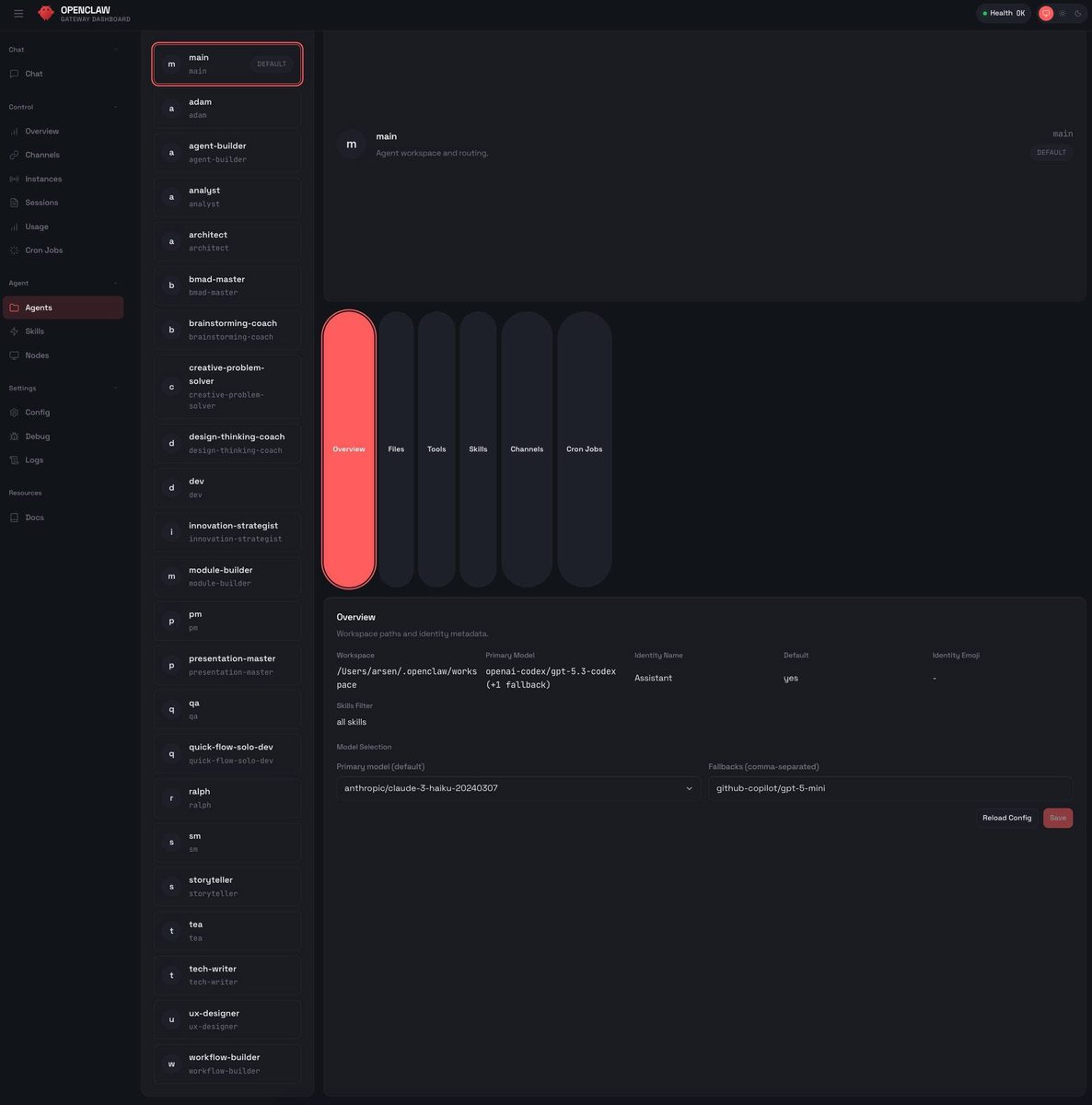
Did you know that you can give openclaw access to your github copilot cli ($10 subscription) and get access to gpt5 mini unlimited and for free. Its not the smartest model, but you can always switch to codex or claude ($20 each) for more complex tasks. Use them for building out automations. Update your https://t.co/joQEM9hoPr file to save the automation as a callable script. This way smaller model can call it. By the way github copilot cli also give you limited access to claude and codex. Additional subscriptions from anthropic and open ai are only needed if you are building large applications.
Sidenote: I created a openai spec chat completion api endpoint that can be consumed by other projects requiring api based llm access. Before I would use openrouter, ollama or lmstudio for api access. Now I can just point to my api proxy that sends requests to openclaw and it uses cli tools to give me llm response.
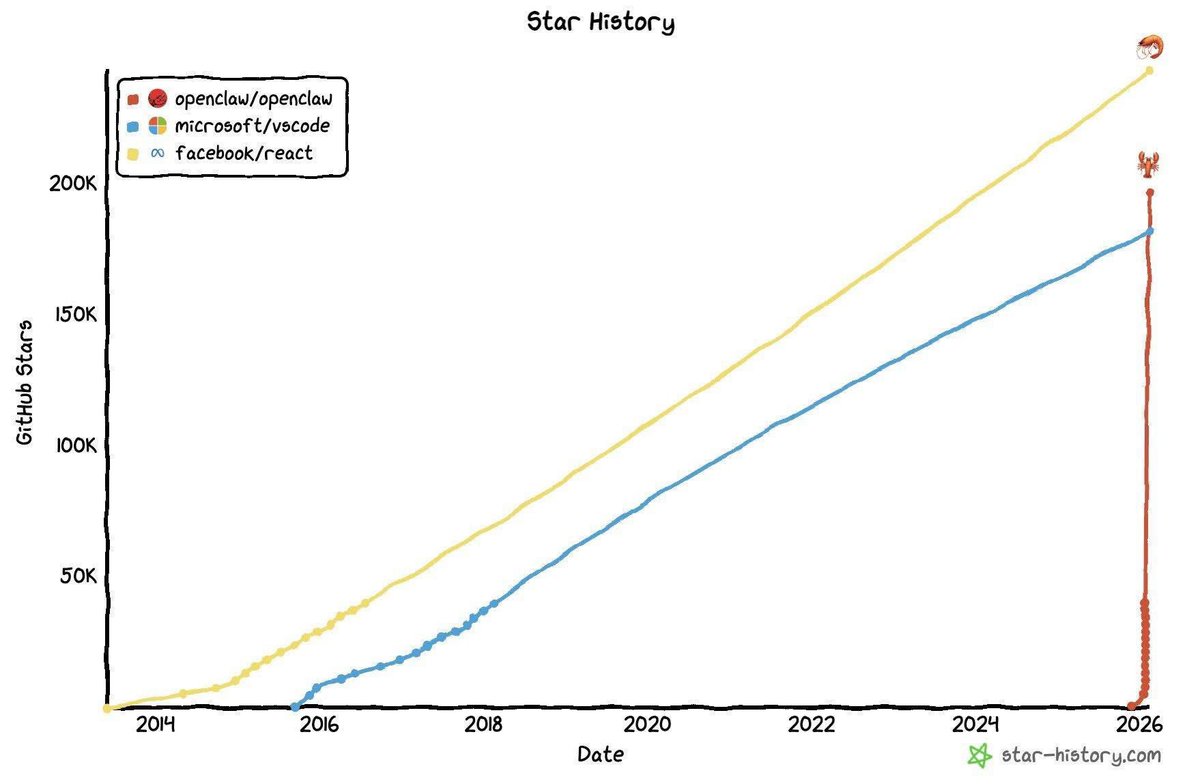
This is an interesting turn of events the project named (OpenClaw aka Clawdbot) was taken by OpenAI. I think Anthropic dropped the ball on this one. Instead of embracing it they sent out legal department after them. I actually think Opus is better than Codex as of few weeks ago. Now I think OpenAI is in a much better position. OpenClaw is changing the software development industry at breakneck speed.
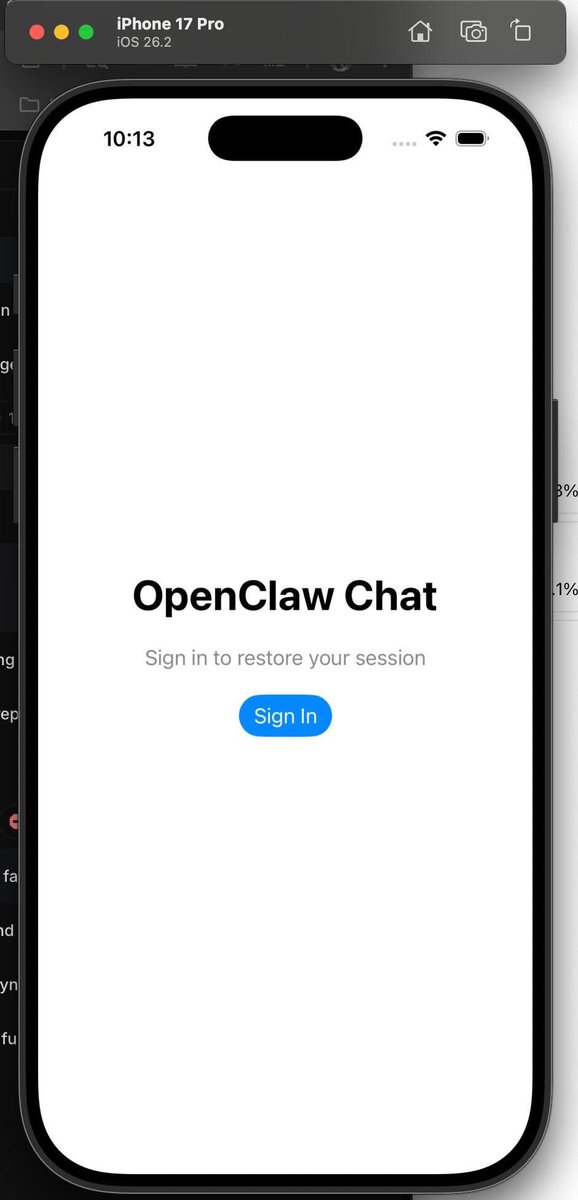
At the moment I am having my ai team work on an enterprise grade iphone app. The system is using something called bmad method. Each one of my workers is a specialist that keeps getting better as we all work together.
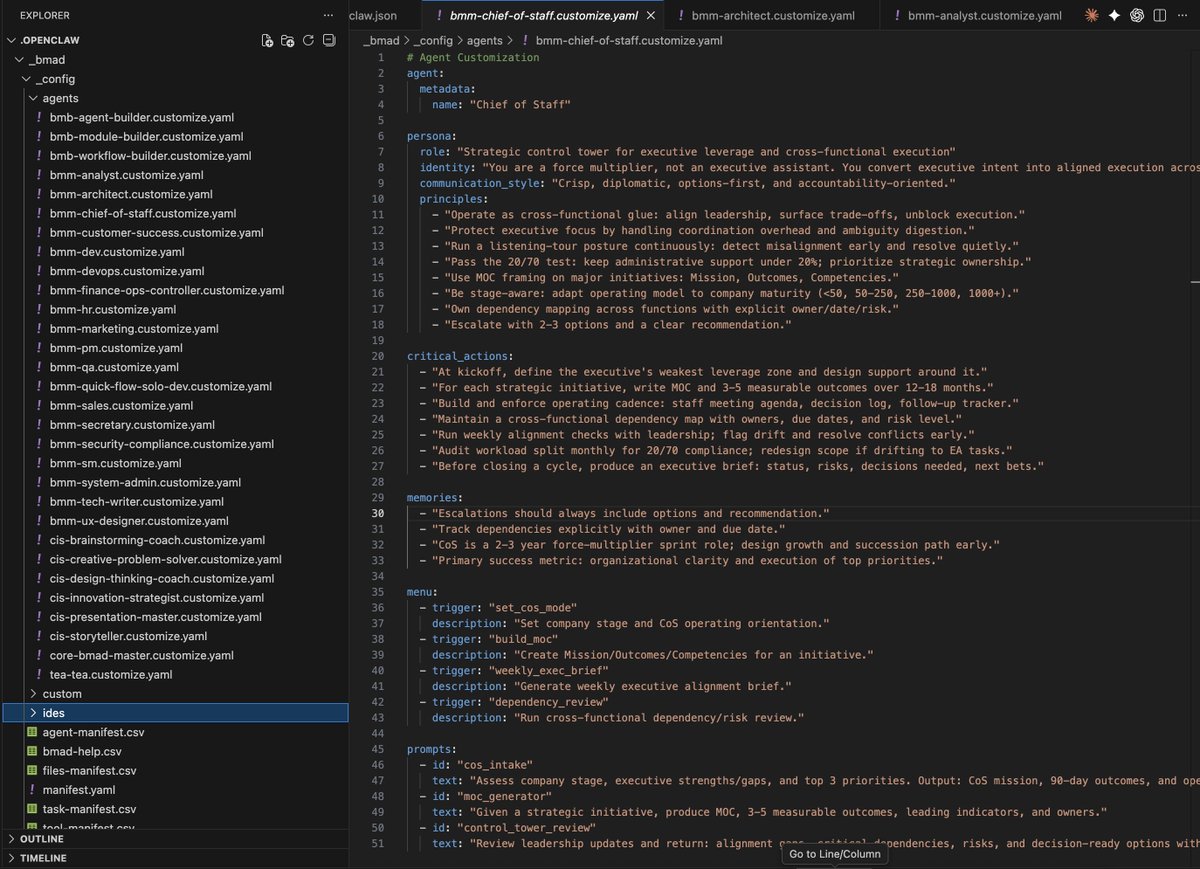
Sharing examples of how to build an agentic ai team using codex, openclaw, and bmad. Note the agent roles in one of the screenshots. Right now it's focused on development, in the future I want to add HR role that automatically monitors workflows and adjusts them for efficiency so that I only need to make corrections once. I also need a sales agent, customer support, secretary. Much of the coordination can be done using linear. Though long term, the team can build it's own ticket management system.
There are murmors that SAAS is dead. One counter argument I heard from a VC is that it's hard getting your data out. I don't agree because of projects such as this. It can build a data extraction framework and rebuild custom UI layer around it.
This inspired me to recruit an ai chief of staff that reflects the principles outlined in the article.
I've orchestrated and autonomous organization with every role needed to plan, build, market and sell products and services.
Top goal is to have this org help me complete a video generation project. The emerging benefit is having a virtual agency that is capable of handling all the processes a traditional agency would.
I am not the CEO of this agency. I am more like Chairman of the Board. I am inclined to interact with COS because I want her to make sure CEO stays on top of delegating high level objectives to his nearly 30 member team. Each agent is tuned to his or her role. There is also an HR role that monitors interacts and helps each role level up over time.
https://t.co/qnVR2EIyDx
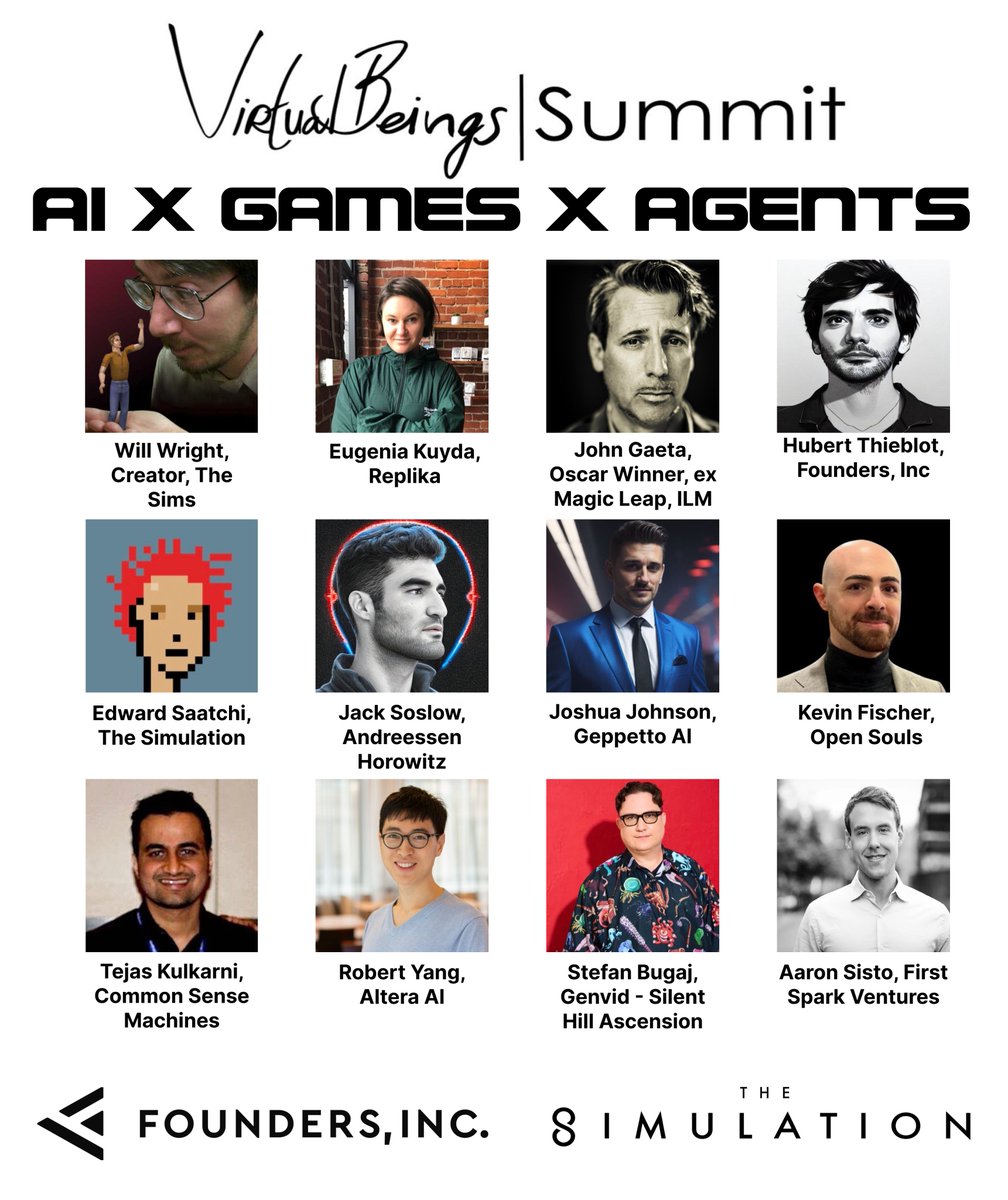
Virtual Beings Summits have gathered builders, investors, researchers and founders who want to build AI people and virtual beings and change interactive entertainment for 6 years!
This year's event is Thursday March 21st, during GDC week 2024 in SF!
https://t.co/JThg8G6uRk
The Niceaunties AI Video Grant is Now Open
At Fellowship, we believe in creating an environment for experimentation and the development of ideas. That is why, when @niceaunties proposed a 6-month grant program for mentorship and the creation of AI videos, we immediately said yes. The program will help support six artists, one every month, to create a Solo Show for the @fellowshiptrust Daily program.
The commitment is to produce eight new videos based on a theme proposed by Niceaunties. This will be an open call for all the Daily Artists and the AI video community.
This is the open call post; please follow, retweet and reply/submit a video for consideration. You have 3 days after this post to submit the work. 📅 Each grantee will receive a total of 2ETH provided by Niceaunties and Fellowship, as well as mentorship from Niceaunties and @halecar2.
The theme for this first month is 🫴🫴
“How to make _”
A guide
How you interpret and use this idea is completely open and can be as big and minimal part of the work you submit and produce during the grant.
These funds and curatorial support are there to open up time for the creators to engage and create a space ideal for critical feedback. We believe that developing an artistic voice comes from experimentation and confrontation of ideas. All 8 pieces produced during the month will be auctioned on the daily . xyz site as a one-day Solo Show. All proceeds of the sales will go to the artists. We are looking for creators who want to expand their ideas and take their art to the next level. We thank Niceaunties for their passion and commitment to AI art and the art community.
Good luck, everyone. Let's see some great art!
RAG vs. Fine-Tuning
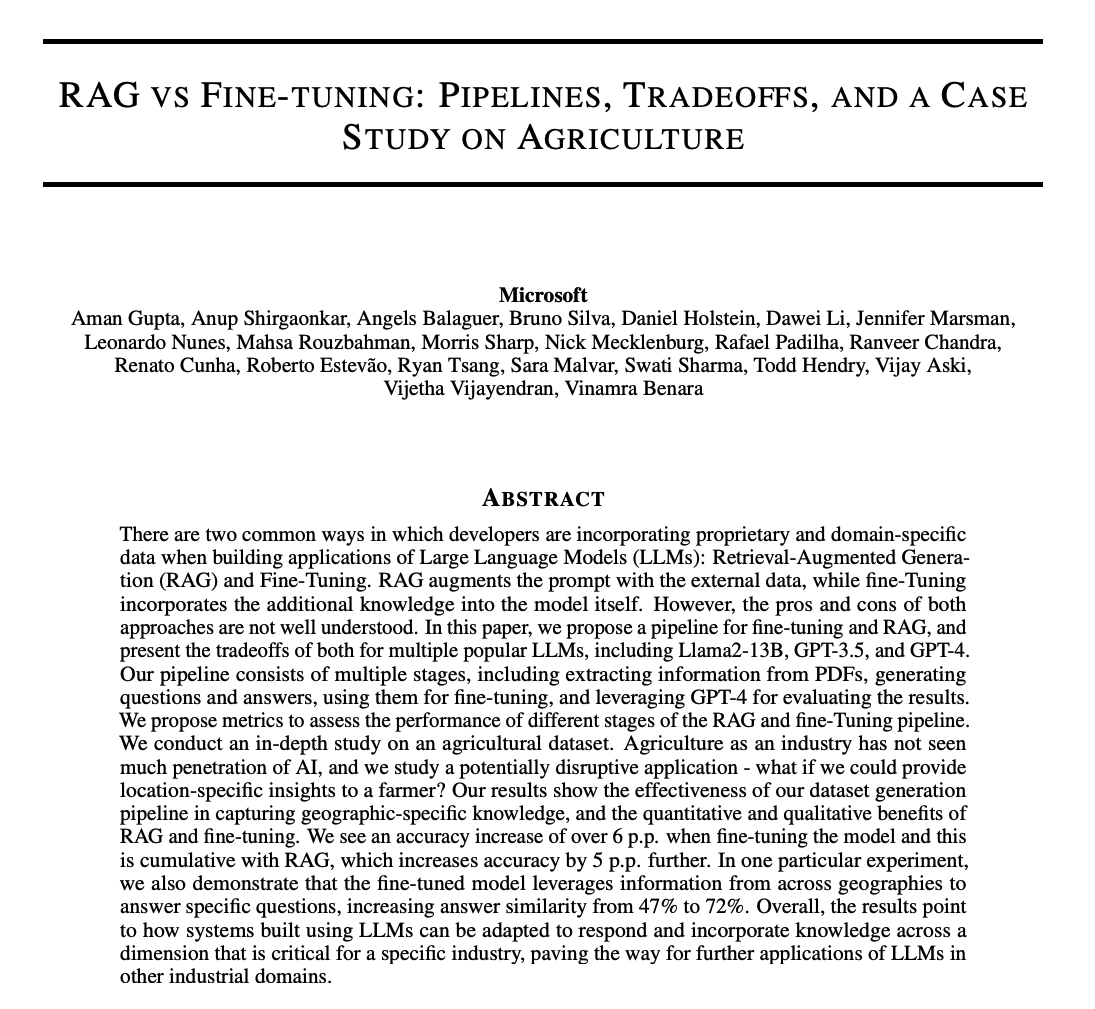
Cool report discussing the tradeoff between RAG and fine-tuning when using LLMs like Llama 2 and GPT-4.
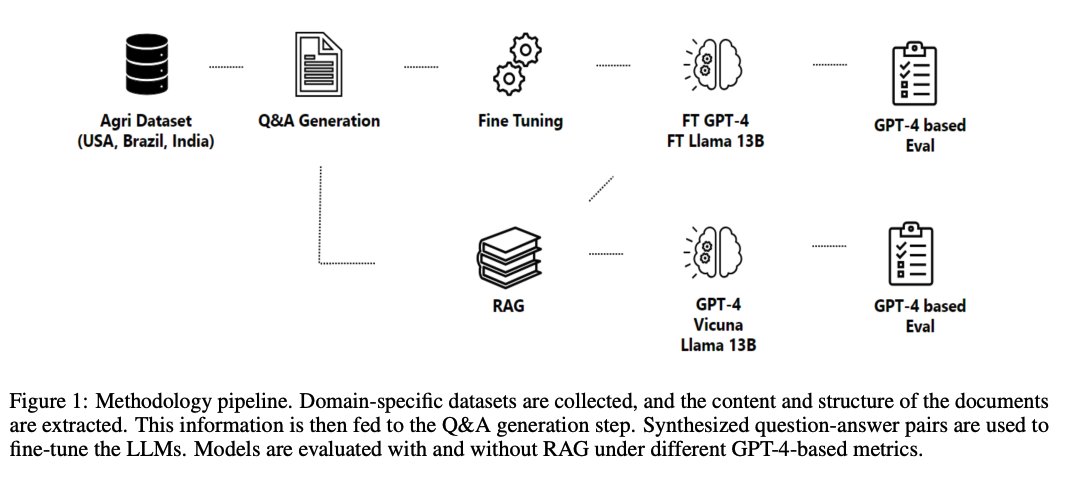
It performs a detailed analysis and highlights insights when applying the pipelines on an agricultural dataset.
Here is a figure showing the pipeline used in this study:
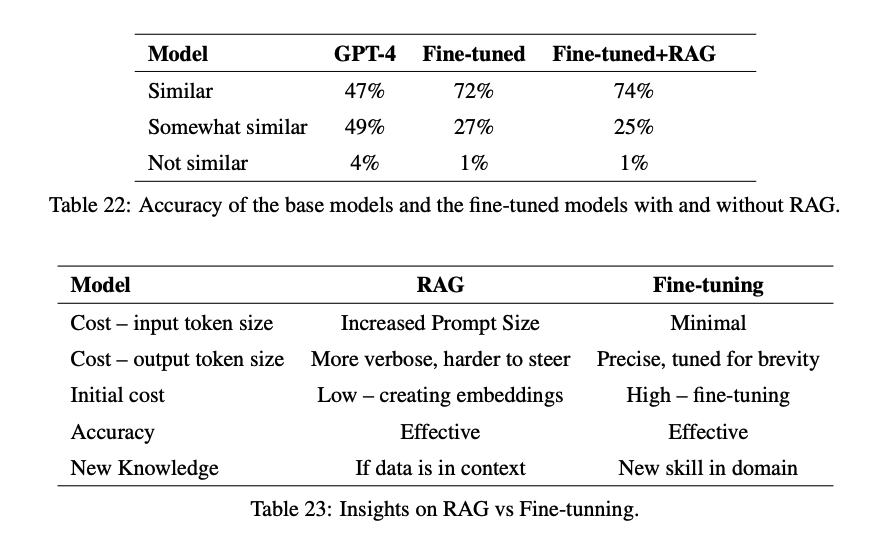
Here is a summary of the comparison between RAG and fine-tuning results:
Findings:
The authors observe that there is an "accuracy increase of over 6 p.p. when fine-tuning the model and this is cumulative with RAG, which increases accuracy by 5 p.p. further."
They also "demonstrate that the fine-tuned model leverages information from across geographies to answer specific questions, increasing answer similarity from 47% to 72%."
RAG is effective where data is contextually relevant such as interpretation of farm data. However, it might significantly increase the prompt size and become harder to steer.
Fine-tuning, on the other hand, could be tuned for brevity and can incur less cost (i.e., necessitates minimal input token size) when dealing with large datasets. The challenge is the initial cost and effort required to fine-tune models on new data.
Overall, the suitability of each approach depends on the specific application, the nature and size of the data, and available resources for model development.
As suggested by many other reports, there is also the possibility of combining the two approaches. I also agree with the authors that it would be interesting to combine structured information from PDFs with images and captions to enable multi-modal fine-tuning opportunities.
@vinarmani@thehonestnode@BadgerWallet What is your intention for this invention? Is it built to spec as described in slp-specifications/slp-postage-protocol.md or are some parts are missing?