When people are blaming @Apple as a totalitarian dystopia builder, they just miss how business and evolution cycles work. That's a pretty bold privacy move to put all user's interactions with the "keyboard" into Secure Enclave blackbox.
A very important point in today’s Apple #VisionPro announcement was that eye tracking is processed in the M2 Secure Enclave (like keys are). This is because it can be a huge risk to security and cognitive liberty…
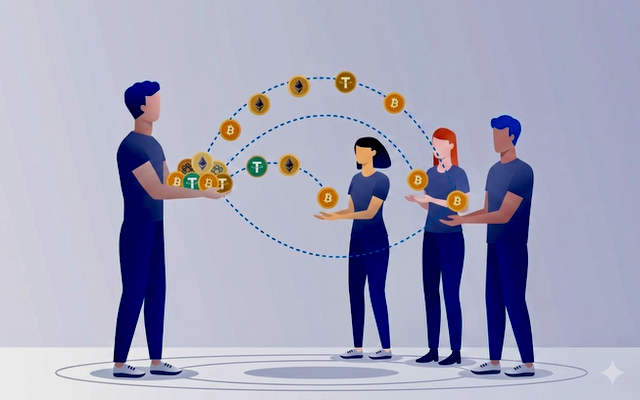
What happens to your Bitcoin when you die? This is the great Crypto Inheritance crisis, with over $6 trillion in crypto, and almost none of it has an inheritance planWhat happens to your Bitcoin when you die? This is the great Crypto Inheritance crisis, with over $6 trillion in crypto, and almost none of it has an inheritance plan.
I think it is incorrect to frame Canton stuff as “tokenization” or “crypto”. It is so far from how what we build on EVM works that it probably cannot work with our trust assumptions even in theory.
It is more serving a modern replacement of some of the old cobol/db2 infrastructure completely rethought in a different way. But it is not a reinvention of money or finance in any way.
@ben_jay18@ramozemmy smart-contract wallets are chain-specific, could NOT be use for long term tasks of backup and inehritance, and not working with Bitcoin it all. The only chainagnostic and naturally self-custodial solution to date is still @vault12
The most important thing about the Clarity act is that it ushers in an era of 100 million retail crypto consumers led by retail banks - this changes everything.
@wasima and @girlintheverse#bitcoin2026
@Vault12 re-introduces VGT Guardian incentive rewards. Guardians will now be incentivised to guard inheritance Vaults and ensure crypto assets are protected and passed onto beneficiaries.
https://t.co/SxqDcp2HYK
@Vault12 re-introduces VGT Guardian incentive rewards. Guardians will now be incentivised to guard inheritance vaults and ensure crypto assets are protected and passed onto beneficiaries.
https://t.co/qkQMlc7Sij
@SebVentures@bgilliam1982 "just a month after the Bank Note Scandal was revealed — the Portuguese republic was overthrown in a military coup."
Haha fun fact, that coup also just happened in the most suffered defi bank. But let's see what goes after..
So let me start. DeFi is the future of the World Financial System. That's my belief, and this is why we are here.
This amount of absolutely preventable hacks we see in DeFi (with root causes attributable to CENTRALIZED points of failure) is enormous recently. This damages out industry, and I build for this industry. So I cannot remain silent.
Imagine an average grandma (mass adoption is here?) putting her life savings on Aave. And then BOOM, she cannot withdraw her funds on Monday. Aave (the biggest DeFi protocol btw) said it's operating as intended - just rsETH got exploited. rsETH said that all code is safu - just LayerZero bridge got hacked. LayerZero (the biggest bridge securing quarter of a trillion $) said that everything operating as intended. Yet, she cannot withdraw here funds. WTF? Are we industry of clowns?
But here's the thing. All issues like this should be prevented BEFORE they happen, not AFTER. Number of single points of failure should be reduced, not increased. When these points of failure are unavoidable - trust should be split. If there's a reliance on infrastructure - we should share best practices how to configure it. Not to mention that code should be very well checked - everyone gets that already.
We should probably come together and develop safety standards for DeFi. How to build safely, and how to verify safety. Probably everyone should bring their best practices, and the projects, auditors and risk assessment groups should know them. Maybe we need @ethereumfndn and @SolanaFndn bringing all the ecosystem projects to participate and come up with principles, rules and recommendations of safe building. And, perhaps, we can even learn something about protecting the few remaining centralized points of failure from traditional finance who have many more of those.
DeFi will win
@tayvano_ Honestly, Arbitrum is smart to market themselves as decentralized "enough" but having a "cry uncle" window. What bothers us is how the 1/1 bridges will thrive further after no damage other than a popcorn nite left in a history. Those nine should've been sitting on that bridge..
Those who say "crypto is dead" or "DeFi is dead" don't know what they are talking about.
Banks never operated in such harsh conditions, and they always get saved by the Big Printer. As a result, their infra is horrifically bad.
In DeFi, we have to make sure that our stuff is solid, and only the fittest survives
@VRogojin@mgault Yes and no. No traceability for anyone creates space for scaled-capital to fraud p2p like we all know is in private fiat finance. While on the other hand for minor peers - selective disclosure, zkproofs and claims, that’s what can help fix generational informational asymmetry
Two companies bought every tool brand on the shelf. One invested $626 million and built an empire.
The other spent $900 million and couldn't stamp its own name on a socket.
Techtronic Industries bought Milwaukee and left it alone. Kept R&D in Wisconsin. Dumped $206 million into product development in a single year. M12, M18, FUEL, PACKOUT, MX FUEL — all came after the acquisition. Revenue hit $8 billion. Wisconsin headcount went from 300 to 5,900. Net debt: $44 million.
Stanley Black & Decker bought everything else. DeWalt, Craftsman, Irwin, Lenox, Porter-Cable, Bostitch, MAC Tools. Over $6 billion in acquisitions. So many brands they were cannibalizing themselves on the same store shelves.
Then they started cutting.
$2 billion cost reduction program. 7,000 jobs eliminated. Plants closed in South Carolina and Texas. The CEO who ordered all of it stepped aside in October 2025 with the stock down 50% from its peak. They're carrying $6.1 billion in long-term debt.
The Craftsman factory in Fort Worth was supposed to be the comeback story. $90 million. 500 jobs. Ratchets came out of the press misshapen. Sockets went through heat treating without the brand name stamped on them. Retailers canceled orders. The executive who launched it left. Got replaced by four people in four years. They shut it down in 2023 with 175 workers. The socket sets that factory produced are now collectors' items on eBay. Collectible because of how awful they are.
Porter-Cable is worse. Founded in 1906. Invented the portable belt sander. The Smithsonian collected their history as part of the American manufacturing record. SBD bought them in 2004 and started cheapening internals immediately. Service centers closed within six months. The reps who built the brand got fired. Router line discontinued. Social media went dark for years. A 118-year-old company reduced to clearance bin filler.
Every industry I look at, the story is the same. A private equity firm or a conglomerate acquires a brand people trust, strips out the thing that made it worth trusting, and sells you the corpse at the same price. Nobody tells you it happened. You just notice your stuff doesn't last as long as it used to and assume you're imagining it.
You're not imagining it. It got worse on purpose.