🚀 Our new paper “QDD-MM: A Simple and Compact Open-Source Muscle Module with Quasi-Direct-Drive Motor for Tendon-driven Robots” is accepted at #Humanoids2026!
Fast, backdrivable muscle modules with no dedicated force sensors. Open-source!🔧
https://t.co/W2V5qoatYz
Brain Computes Motion Direction Independently From the Eye: UCSF researchers mapped nearly 46,000 brain cells to discover that neurons in the superior colliculus compute motion direction on their own—separating local object tracking from global self-motion sensing.
https://t.co/WQIuALOgd6
#Neuroscience #VisualNeuroscience #BrainMapping #SuperiorColliculus #UCSF
A light-sheet microscope built from off-the-shelf components enables high-resolution clear tissue imaging https://t.co/jlhIwo8dDQ
https://t.co/KJP2a2em3t
Our work on wave attractors emerging in irregular cavities carved in hyperbolic media has appeared in Nature Physics, accompanied by a nice News and Views article from J. Velasco.
https://t.co/rpnV6FhDwm
"Latent Lattice Language Models"
What if each transformer layer could maintain its own memory that evolves as new tokens arrive?
This paper introduces Latent Lattice Language Models (LLLMs), which add a recurrent hidden state to each Transformer layer. These states persist across tokens and help control attention, memory updates, and MLP computation, giving the model another way to process information without adding more layers or KV-cache entries.
With 406M parameters and matched compute, LLLM reduces validation perplexity from 15.41 to 14.40 after training on 20B tokens, matching a conventional Transformer with 50% more parameters.
https://t.co/wuTGZsPAQD
Mitochondrial quality control goes inter-organellar! GRP75-dependent protein condensates coordinate mitochondria–ER communication to protect mitochondrial integrity….and split-GFP comes to the rescue again! Beautiful cell biology!
https://t.co/GIydE7IWGj
구글 연구팀이 아이디어 메모랑 실험 기록만 주면 논문 초안을 통째로 써 주는 AI를 공개함
목차, 참고문헌, 그래프, 본문, 퇴고를 AI 다섯이 나눠 맡음
AI 연구자 11명 비교에서 다른 AI보다 참고문헌 품질이 50~68%p 앞섬
사람이 쓴 원본보단 아직 못함
코드는 무료, 제미나이나 챗GPT 키로 돌림
대학원생이면 인용을 실제 논문 검색으로 확인해 주는 게 제일 쓸 만할 듯
🚨 SCIENTISTS JUST MADE QUANTUM LEVITATION POSSIBLE
Researchers have discovered how to reverse the mysterious Casimir Effect — a strange quantum force that normally pulls objects together. By turning attraction into repulsion, tiny objects can now “hover” without touching anything.
This breakthrough could lead to frictionless machines, advanced nanotechnology, and futuristic quantum levitation systems once thought impossible. The wildest part? The force comes from the invisible energy hidden inside empty space itself.
Source: Munday, J. N., Capasso, F., & Parsegian, V. A. Nature. University of Science and Technology of China. Nature Physics.
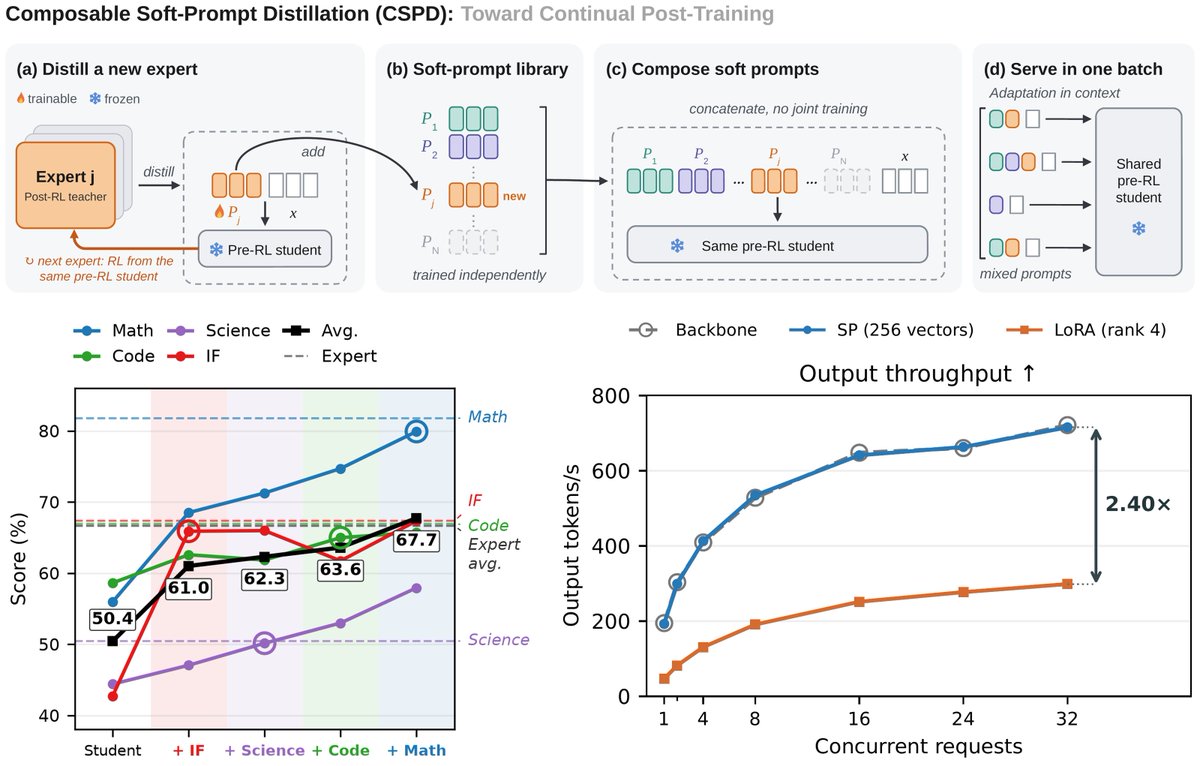
We think we’ve found a better path to continual post-training: merging models in input space.
🔹 A 256-token soft prompt (~0.01% of params) matches full-parameter RL
🔹 Plug-and-play composition: prompts trained separately just stack, with no joint training, and the combo beats the experts. No more MOPD!
🔹 Better OOD generalization, almost no forgetting
🔹 ~0 inference overhead, even with a different prompt per request. Built for personalization.
So now a small 300MB adapter makes your local 27B coding model dramatically better!
Hugging Face released an RL-trained LoRA adapter for Qwen3.8-27B, specifically optimized for OpenCode.
And the reported results are impressive!
SWE-bench Pro (hard 51 tasks):
🔴 Original → 35.3%
🟢 With LoRA → 51.0% 👈
Terminal-Bench 2.1:
🔴 Original → 46.4%
🟢 With LoRA → 52.4% 👈
Median agent turns on tasks both solved:
🐌 Original → 48 turns
🚀 With LoRA → 13 turns 👈
That's a 15.7% improvement on the selected SWE-bench Pro tasks and 73% fewer agent turns on shared solves.
With thinking disabled, the adapted model reportedly approaches or exceeds the original model running at maximum reasoning effort, using 6–8× fewer generated tokens per task in the team's comparison.
The best part?
💾 Adapter → ~300MB
🧠 Base model → Qwen3.8-27B
🔓 License → Apache 2.0
💻 Local inference → llama.cpp
🛠️ Coding harness → OpenCode
📦 GGUF adapter available
Just a small adapter teaching an existing model to use coding tools more effectively.
Video source: @HuggingFace
13/ We think AI can widen what scientists are able to test while they keep authority over the questions and the standard of evidence. Check out our paper and code here!
Paper: https://t.co/HUZiTqHOpT
Code: https://t.co/g6I1ygbMNw