Very sad news today, Alan Hale has passed away. Legendary comet observer and co discoverer of Hale-Bopp. Alan and I chatted online a lot over the years about comets, esp T-ATLAS, so down to earth and a great guy. He will live on in the hearts of all us comet observers.
After several years of discussion within the IAA SETI Committee, we have reached an international consensus and published a new SETI post-detection protocol.
Its core principle is simple: extraordinary claims require extraordinary evidence.
Any potential detection must be independently verified, transparently communicated, and supported by data that can be preserved, shared, and trusted.
In an age of AI-generated misinformation, deepfakes, and instant global rumors, preparing for discovery is more important than ever.
Le module Zvezda de l'ISS a des fissures qui s'aggravent avec le temps.
Une tentative de réparation plus importante que les précédentes a lieu aujourd'hui, et les astronautes occidentaux sont priés de se mettre en sécurité dans leur capsule Dragon au cas où ça se passerait mal.
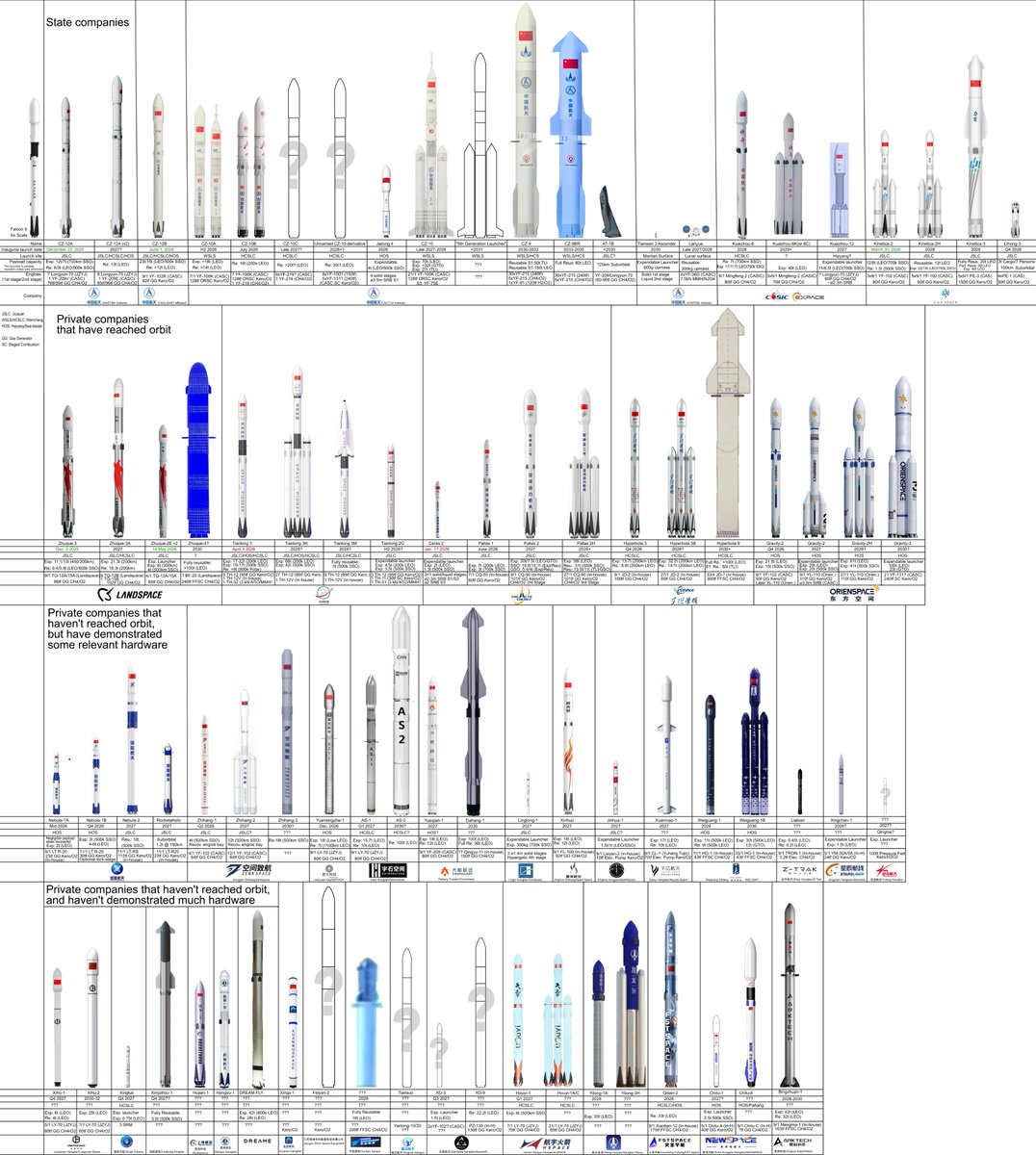
List of recent and upcoming new Chinese launch Vehicles as of June 2026.
Chinese launch companies organised 8 maiden launches in the past 6 months, and dozens more are planned over the next few years, this list gives an overview of the various current project.
Map of all active & planned Solar System missions and their destinations as of June 1st 2026. Moon Base is the new Commercial Lunar Payload Services(CLPS). #keepExploring
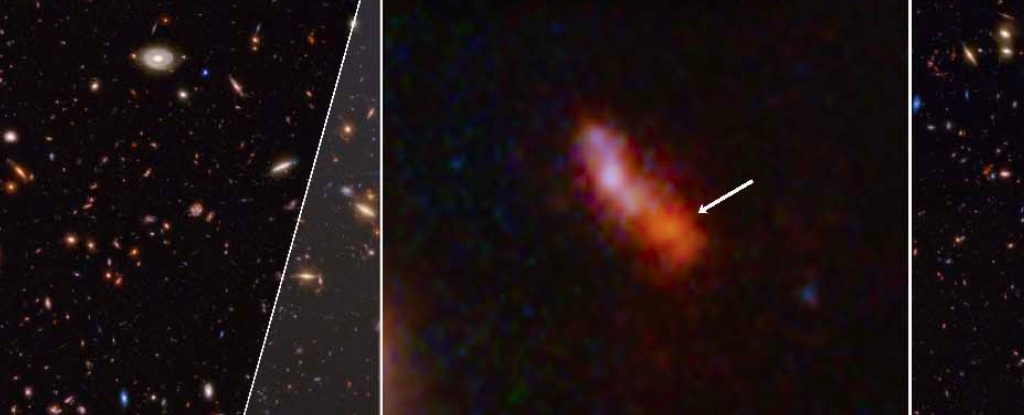
The #JWST has identified the most distant galaxy ever observed, named MoM-z14, dating back to just 280 million years after the Big Bang. This discovery pushes the boundaries of our understanding of the early universe and challenges existing theories of galaxy formation.
Record-Breaking Distance: MoM-z14 exhibits a redshift of z = 14.44, surpassing the previous record-holder, JADES-GS-z14-0, which had a redshift of 14.32 and was observed at 290 million years post-Big Bang.
Unexpected Brightness: Contrary to prior expectations, JWST has uncovered a surprising number of bright galaxies at redshifts greater than z = 10, indicating that such luminous galaxies were more common in the early universe than previously thought.
Stellar Composition: Spectroscopic analysis reveals that MoM-z14's light predominantly originates from stars rather than an active galactic nucleus. Its chemical composition, particularly the nitrogen-to-carbon ratio, resembles that of ancient globular clusters in the Milky Way, suggesting similar formation environments.
This groundbreaking discovery not only sets a new benchmark for the earliest known galaxy but also provides valuable insights into the conditions and processes that prevailed during the universe's infancy.
👉 https://t.co/eZFsMcVBHy
This is probably the best look at the shockwaves I’ve seen from the latest Starship flight.
Captured from a GoPro I clamped onto a proper camera to record simultaneous video. (I’ll show you the photo the better camera took in the reply)
Researchers from University College London found that atmospheric pollution from satellite launches and them burning up on reentry offsets a small amount of global warming.
They modelled rocket launches and satellite re-entries up to 2029 by extrapolating current numbers and find that soot from kerosene rockets absorbs sunlight in the stratosphere. After the atmosphere adjusts, this reduces the energy reaching the lower atmosphere by 6.40 milliwatts per square metre.
That is not much; it offsets roughly 0.2% of current human-made warming. It also comes with a small amount of ozone loss, though at levels far below the roughly 2% from chemicals regulated under the Montreal Protocol. The big open question is how much these numbers will increase as the number of satellites go into the hundreds of thousands.
When Starship test flights began three years ago the US space industry still had a somewhat tentative view of its future. Now much of the industry is being bet on rapid, low-cost, super heavy lift. This evening's test flight is really, really important to validate this future.
☄️ Bólido 15/05/2026
* Velocidad: ~ 106.000 km/h
* Altitud: 98 → 39 km
* Tipo: Asteroidal
🧭 Mar Mediterráneo
Proyecto S.M.A.R.T de @jmmadiedo
📹 Puedes ver los vídeos y toda la información en la nota de prensa del CAHA.
🔗https://t.co/n0D8u08FGD
Solar corona behind the Moon (350mm) 🌏☀️🌑🛰️ (Apr 7)
Camera setup by #ArtemisII@astro_reid
Raw photos courtesy of the ESRS @NASAEarth @NASA_Johnson
ID ART002-E-10703 to 10947
(only 350 mm focal length - 196 photos stacked 4 by 4 - stabilized - linear interpolation)
Edit by Riccardo Rossi (ISAA)
Enjoy!
@Astro_Christina@AstroVicGlover@Astro_Jeremy@NASAAdmin
The #Psyche spacecraft acquired these 12 #Mars images using its Multispectral Imager Camera B and the Clear filter (515)
https://t.co/ZllYa2yNfv
NASA/JPL-Caltech/ASU/j. Roger
POV: You’re coming home after a journey around the Moon. 🌕
Before reentering Earth’s atmosphere at the end of Artemis II, the Orion spacecraft’s crew module — carrying the astronauts — separated from the service module that provided propulsion and power throughout the mission.
We live at an extraordinary moment in science history: We're the first generation able to see a meaningful map of the entire visible universe.
This new view across billions of light years is based on JWST data, as part of the COSMOS-Web survey.
https://t.co/MtgBQGXAAS
A lot of discoveries begin with "huh, that's weird."
Astronomers noticed a weird dark patch at the center of this galaxy. Now it seems the void is caused by a record-breaking pair of ultramassive black holes that cleared out all the surrounding stars.
https://t.co/9ZgfHq4Ixl
⭐️🌀 L’effet papillon galactique : une seule étoile peut remodeler toute une galaxie !
🔹 Des astronomes de l’Université de Leiden ont découvert que le destin d’une galaxie entière peut basculer à cause d’un infime détail : la position ou la présence d’une seule étoile.
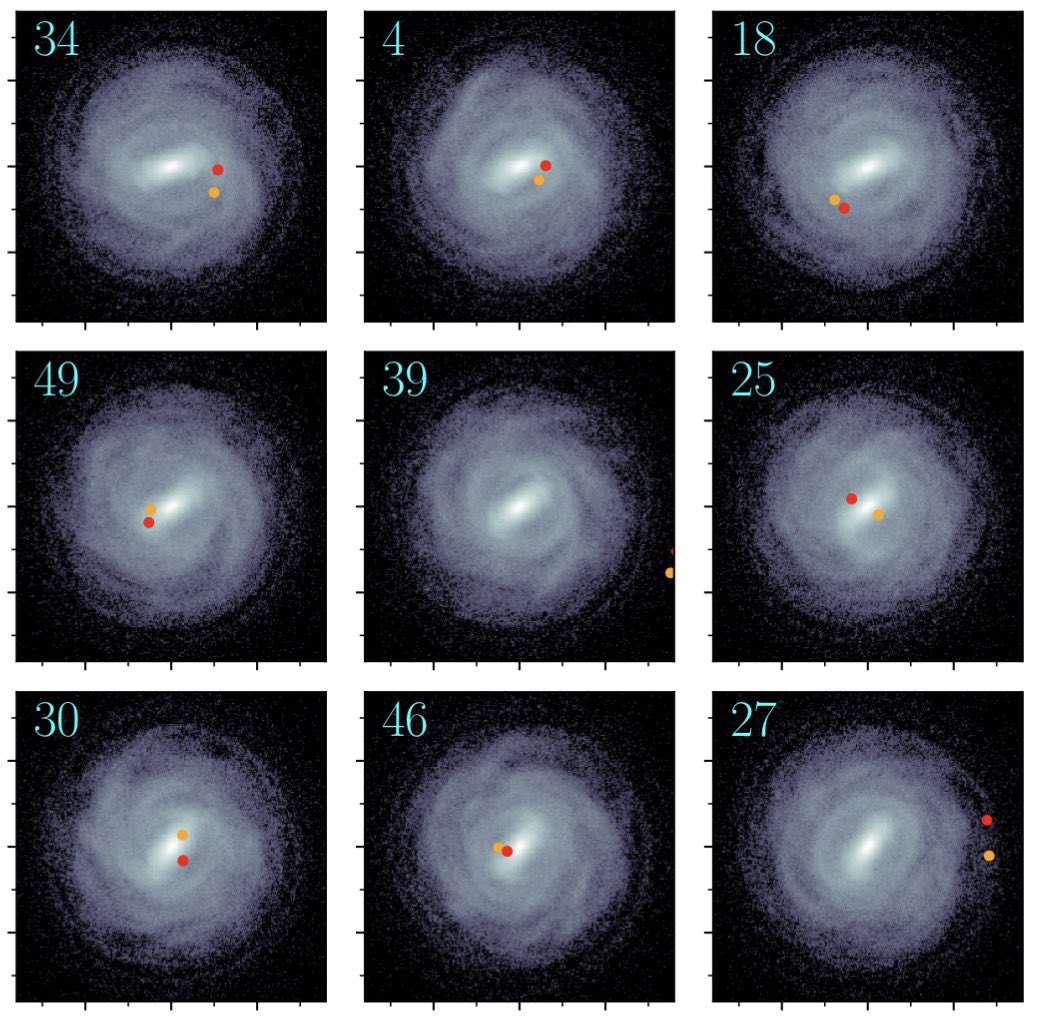
🔹 Dans des simulations précises de galaxies semblables à la Voie lactée, les chercheurs ont comparé des modèles presque identiques, ne différant que par un minuscule décalage dans la position d’une étoile. Au fil du temps, cette petite variation s’amplifie et modifie profondément la structure des bras spiraux ainsi que la rotation de la barre centrale.
🔹 Ce phénomène rappelle l’effet papillon : une cause minuscule entraîne des conséquences majeures dans un système chaotique. Contrairement à l’idée classique selon laquelle les centaines de milliards d’étoiles s’équilibreraient en un comportement fluide, la galaxie se révèle hautement sensible aux perturbations initiales.
🔹 Les simulations montrent que la galaxie modélisée devient imprévisible après environ un million d’années seulement, un laps de temps infime à l’échelle cosmique.
👉 L’étude révèle toutefois que ces différences ne s’amplifient pas à l’infini : l’effet papillon rencontre bel et bien des limites. Les galaxies conservent leur forme globale de spirale malgré les variations de détails.
📄 : T. Asano et al, The exponential growth of infinitesimal perturbations in the long-term evolution of simulated galaxies, Astronomy & Astrophysics
📷 : Visualisation de plusieurs simulations presque identiques d’une galaxie. Le point orange et le point rouge représentent systématiquement la même étoile dans deux simulations qui ne diffèrent que très légèrement l’une de l’autre. Crédit : UL, Portegies Zwart, Asano.
Geoscientists have uncovered a 2.4-million-year cycle in deep-sea currents, influenced by Earth's orbit around the Sun and its interaction with Mars. 1/
👉🏻 https://t.co/4ufccDS0LN