If you conduct backward-looking monetary policy and condition a 50 basis point hike in December on stale October data, this is what happens. This turmoil in financial markets shouldn't be happening. It's the result of a tone-deaf and backward-looking Fed.
https://t.co/n2tM5uD1Xp
Bloomberg Price Project data is now available for @TheTerminal users.
Downloadable at
ECAN US BPI <go>
A super granular look into the US CPI - alternative data version.
October reading now available and refresh daily.
If you love ECAN US CPI, you will love this.
A huge thanks for the amazing work done by the ECAN team: Shivam Swarnkar, Kristina Holcombe, @denicomc Mike DeNicola, Richard Howard, Divya Shah and Ivan Pavlov— And the amazing Kosuma Kornkanitnan.
💸🗳️Affordability will be one of the biggest issues on voters’ minds today.
And while we wait for the vote counts to start coming in, our colleagues at @economics just released a fascinating new way to look at it: the Bloomberg Price Project.
It uses millions of alternative-data price points to break inflation down into nearly 700 categories — more than 3x the detail of the official CPI.
And maybe best of all, the full dataset is available to all Bloomberg Terminal clients via ECAN US BPI <GO>.
The big picture: inflation is still too high, but the pressure looks much less broad-based than it did in 2022. A relatively narrow group of categories — particularly energy and AI-exposed goods — is doing much of the heavy lifting.
And at least one bit of relief at the grocery store: the surge in beef prices appears to be reversing. 🥩📉
A very cool dataset to explore — read more about it here, and dig deeper on ECAN US BPI <GO>:
https://t.co/yy7FfxjswX
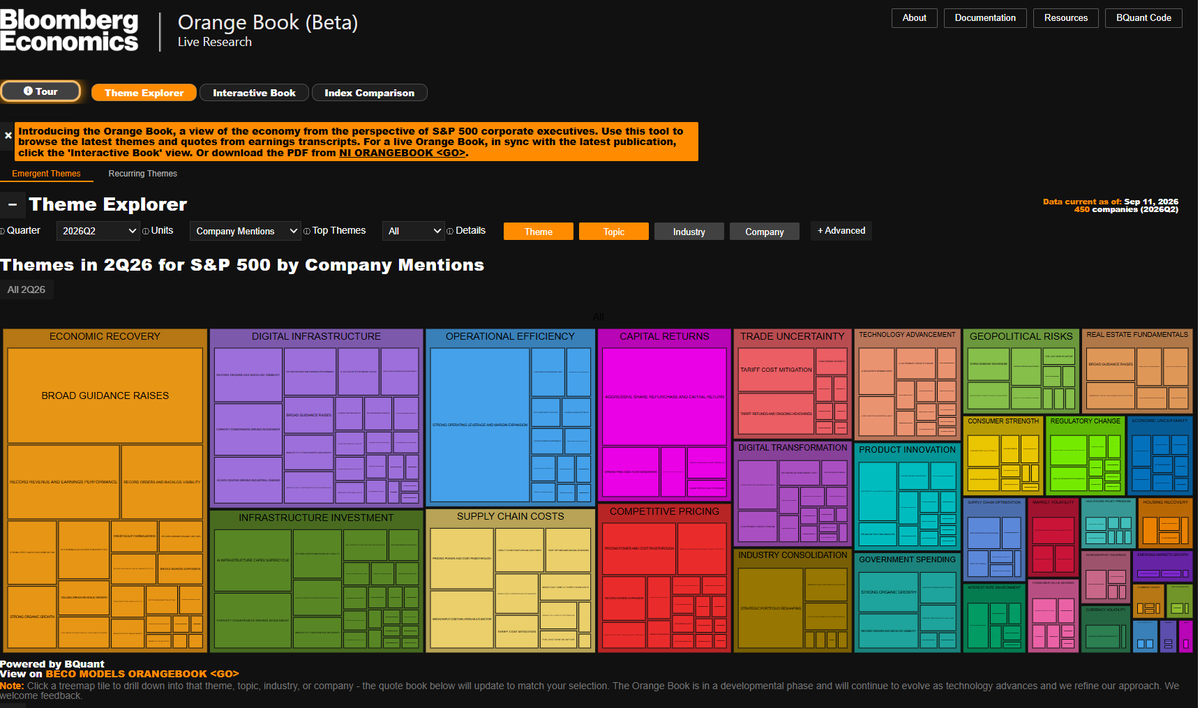
Now that over 100 S&P 500 companies are through 3Q26 earnings, we’ve updated the Orange Book’s AI-identified themes. Economic recovery remains the top signal. Interest rates have jumped in significance, lifting bank margins and squeezing consumers. BECO MODELS ORANGEBOOK <GO>
We identified over 900 supply bottlenecks from the earning season last quarter. Many persist into the ongoing earning season.
The problem is that tightening financing conditions (yes it is tight and tightening, contrary to what Fed says) + rising and surprised new construction costs and delays will create more cases like Oracle.
@TheTerminal I write about what needs to additionally happen to turn the AI wobble to AI bust.
https://t.co/XT85fS8JtL
I'm increasingly partial to the argument that increases in the fed funds rate will do little to lower inflation, and may be counterproductive.
- AI investment is unlikely to slow because interest rates are slightly higher
- Energy is highly inelastic and rate changes can't alleviate the current supply shock
- Higher rates hurt supply-side solutions in housing, energy, autos, and other capital intensive industries
- Higher borrowing costs raise business operating expenses, some of which is passed along to consumers
- A large percentage of debt is fixed-rate, dampening the feedback loop but hurting new homeowners, small businesses, and investment
- An economy increasingly dominated by services is less sensitive to rate changes
- This century has repeatedly demonstrated how blunt interest rate policy can be, both in stimulating inflation when it's low and suppressing it when it's high
February 10, 1975: 18,800 fans packed the Capital Centre for Led Zeppelin, 20+ arrests were made, and Robert Plant opened with a line you won't forget.
https://t.co/SoQYieMs6S
There are many details from the Federal Reserve IG report that didn't make it into our story:
For example, its building renovation includes underground space equivalent to 9 football fields. Underground construction is expensive but there are height limits in DC. (p. 18) 1/x
@sonalibasak A $400,000 mortgage at a 6% interest rate meant a monthly payment of about $2,350. Today that same house might be $750,000 and that mortgage is easily near $4,000 and insurance on the house is way up along with property taxes, energy bills etc
We also now have an interactive version of the book no the terminal, at BECO MODELS ORANGEBOOK <GO>. There, you can explore any additional macro themes from the season -- i.e. biotech product innovation was a key theme, but didn't make it into the book. Lots of interesting earning commentary there.
The latest Orange Book is out @theterminal!
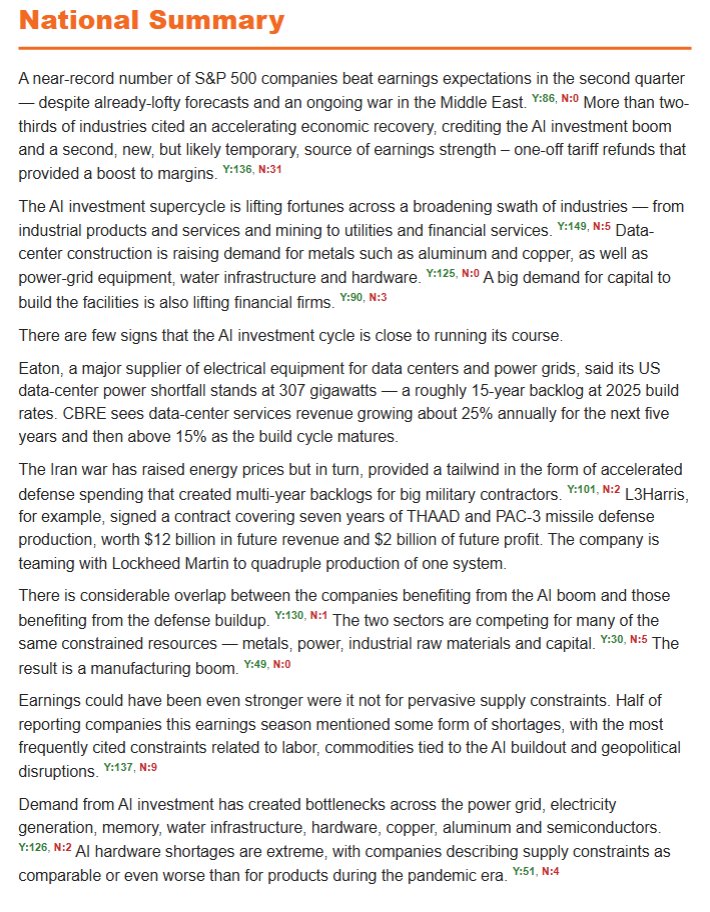
The major macro themes from the latest earning season:
-Tariff refunds juicing earnings (may turn to headwinds next season)
-Half of S&P 500 companies mentioned some form of shortages (we identified those).
-Truck-driver shortages have raised freight rates, which in turn is driving up cost of moving physical goods
-the AI super investment cycle has left almost no parts of the economy untouched.
-US is going through a manufacturing boom.
Read the details on NI ORANGEBOOK <GO>
I have a very-out-of-consensus view: The Federal Reserve is unlikely to raise interest rates this week.
My baseline:
1. As demonstrated in the July Federal Open Market Committee (FOMC) meeting, the center of gravity of the committee was to hold, not to hike.
2. Several FOMC members seem to share the view of Governor Barr, who said: “At the September FOMC meeting, if trends in the data give me some confidence that inflation is moderating on a path to two percent, then I think we can take a bit more time to assess our policy stance. However, if inflation appears not to be moderating sufficiently, then I think we should act decisively to raise rates.”
So the question is whether the August CPI report moved the center of gravity of the FOMC from holding to hiking.
It is certainly possible that it did, and I wouldn’t be shocked if the Fed does raise rates this week. But my expectation is that the Fed will hold.
Five points:
1. A HIKING CYCLE IS DIFFERENT THAN A ONE-AND-DONE HIKE
The Fed rarely does one-and-done hikes. So the right question is not, “Should the Fed raise rates next week?” Instead, the right questions are: “Should the Fed begin a hiking cycle next week?” and/or “Should the Fed do a one-and-done hike, which the Chairman will have to explain as a one-and-done hike?”
Viewed this way, the odds of a hike next week should be a lot lower than the 87 percent current priced in by the bond market.
The August CPI report might have been enough to move some FOMC members from favoring holding to favoring a one-and-done hike. But the August report would have had to have done a lot more work to move the center of gravity from holding to a *hiking cycle*. (More on the August CPI report below.)
Moreover, a one-and-done hike is unlikely due to Chairman Warsh’s approach to communications, which suggests that he would not be eager to explain why the Fed did its first one-and-done hike in decades.
I very well might be wrong. It is worth noting that Governor Waller, who is very influential with other committee members, might have signaled support for a one-and-done hike when he said the following on September 3rd: “If there is evidence that progress toward two percent inflation reversed in August, a small adjustment in our stance would help ensure that it resumes.”
2. NOT ROCKING THE MARKET IS A REAL CONCERN
Not rocking the market by holding is an argument that many analysts take seriously. If the Fed does hike, then the desire to avoid the market reaction that would follow from holding could be the decisive factor behind the hike.
* But the bond market thinks there’s a 75 percent chance of two or more hikes in 2026. So a one-and-done hike would still go against the overwhelming consensus of the market, and a one-and-done hike would still find the Fed rocking the market by going against its pricing.
* If Chairman Warsh is looking for an opportunity to signal to the market that the Warsh Fed is different than its recent predecessors, then this is that opportunity.
3. WAS THE AUGUST CPI REPORT THAT TROUBLING?
* Based on the August CPI, I'm expecting August monthly core PCE inflation to have accelerated a bit relative to the June and July. But even so, I expect August monthly core PCE inflation to be around 3.1 percent annualized. I am expecting the August six-month change in core PCE to be around 3.2 percent annualized.
I am guessing that the majority of the FOMC would view this as evidence of ongoing disinflation (3.1 < 3.2). Or, if not, I am guessing at least that the majority would not view it as evidence of reacceleration that requires a hiking cycle to begin this week. Instead, I suspect that they would prefer to see how the next few months of data unfold.
* I suspect that the August CPI print did not change the view of the center of gravity of the committee that, without higher energy prices and tariffs, underlying inflation would be closer to 2.5 percent than to 3 percent. For example, the August CPI report did not show strong evidence of inflation creeping into core services (at least relative to July). In August, core services CPI printed at 3.0 percent over the year. In July, the same measure was 3.0 percent.
So if in July you thought that the economy was experiencing some disinflation, and that above-target inflation was largely driven by supply shocks, then the August PCE report we are likely to get would likely not be enough to move you off that view.
4. FINANCIAL CONDITIONS ARE TIGHTENING
Over the past couple weeks, financial conditions have tightened, which Chairman Warsh and others on the committee could argue is doing the work that a potential increase in the funds rate was meant to do.
5. TO BE CLEAR, I WOULD RAISE RATES
To be clear, my core argument is that not enough has happened since the July FOMC meeting that views should move in either direction. In July, if you thought that the federal funds rate was too low, then you should still think the federal funds rate is too low. And in July, if you thought the federal funds rate was at the appropriate level, then you should still think it is at the appropriate level.
My own view is that the federal funds rate is too low and that the Fed should increase the funds rate this week. I would have voted for a rate hike in July (and earlier; I was opposed to the cuts in 2025).
The center of gravity of the FOMC has not agreed with that throughout 2026 — including as recently as July. I suspect the data that have come in since the July meeting have not changed their view. I am expecting the Fed to hold this week, though I would not be shocked if I turn out to be wrong.