@paraschopra@_hiteshbandhu Hey @paraschopra, happy to see you're using searchthearxiv! You may have noticed the site broke recently, so just wanted to let you know it's back up and running, with a few new features to boot :)
I just updated https://t.co/e9O11AysBt with 1) citation counts in search results, 2) option to sort by similarity, citation count, or publish date, and 3) 100 results per query. Try it out next time you're doing research.
@pinecone I just sent you an email at [email protected] with subject line "Pinecone and https://t.co/e9O11Az0r1." I'd appreciate a non-bot response. Thank you 🙏
Finally had some spare time to push a much needed update to Sidekick: It now supports GPT-4 as well as the new GPT-4o. You can switch between them (as well as GPT-3.5) in settings. https://t.co/h1IZ3ichkV
@MLStreetTalk You guys should speak with @DavidDeutschOxf. He makes more sense than anyone else I've heard on this topic. If you can get @yudapearl to join in, it would be a true meeting of the minds 😄
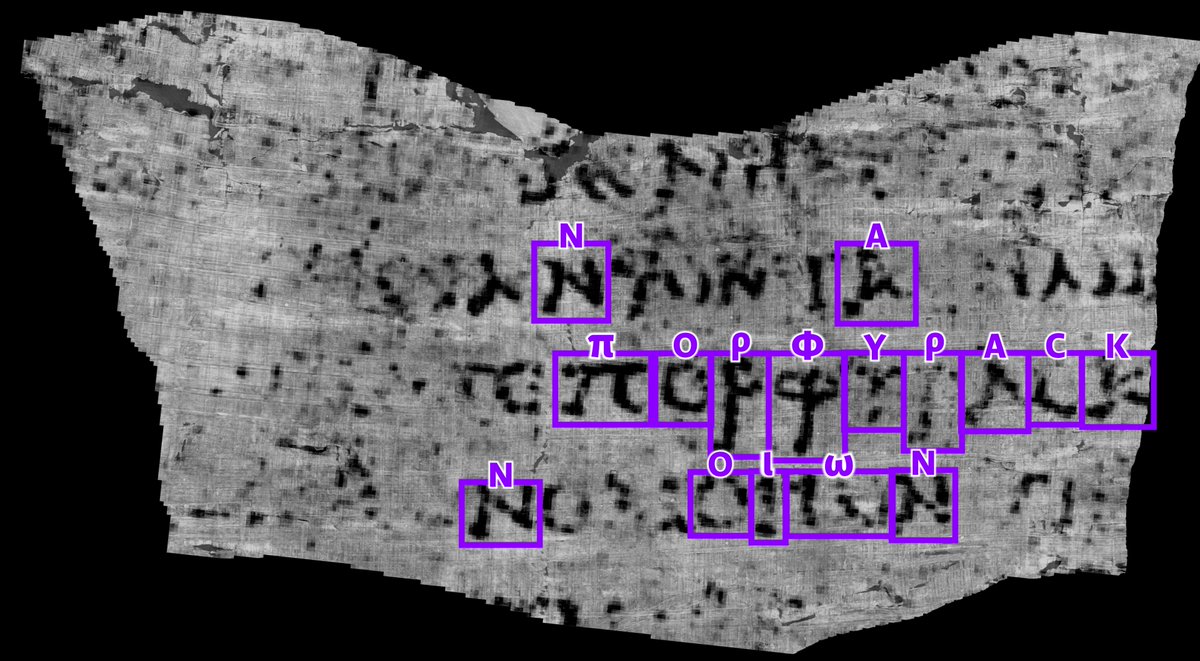
Today we are announcing a major breakthrough in the Vesuvius Challenge: we have read the first word from an unopened Herculaneum scroll.
The word is "πορφυρας" which means "purple dye" or "cloths of purple."
https://t.co/mSbHtzNbAl
Congratulations to 21yo computer science student @LukeFarritor who is the first person to see this handwriting in nearly 2000 years. He has won the $40,000 First Letters prize for this world-historical achievement.
We are also awarding a $10,000 First Ink prize to @CJHandmer who was the first person to see ink and multiple letters within an unopened scroll. His work was the basis of Luke's ML model.
And @Youssef_M_Nader has won a $10,000 second-place First Letters prize for producing the clearest and most comprehensive images from inside a scroll yet.
This has been the dream of many people since the scrolls were first discovered in the 1750s. It is also the result of 20 years of work from Dr. Brent Seales and his team at EduceLab, whose years of dedicated work have made this last mile possible.
The $700,000 Vesuvius Challenge Grand Prize is now in sight. Who will claim it?
Does GPT understand the world?
Here is what @ilyasut, co-founder of OpenAI, says during a discussion with Jensen Huang, CEO of Nvidia:
(1) When we train a large neural network to accurately predict the next word in lots of different texts from the internet, the AI is learning a world model.
(2) On the surface, it may look like learning correlations in text, but it turns out that to 'just learn' statistical correlations in text, to compress information really well, what the neural network learns is some representation of the process that produced the text.
(3) This text is a projection of the world...what the neural network is learning is aspects of the world, of people, of the human conditions, their hopes, dreams, motivations, their interactions...the situations we are in. The neural network learns a compressed, abstract, usable representation."
Do you think learning representations = understanding?
Are large language models simply stochastic parrots, or are they much more?
@rveulacia@techwraith@IamtheWay13@tshddx@Sam070770@arvandhassan@DavidDeutschOxf@kmett Yes, when serving as a stepping stone to the concept of explanatory universality. Computational universality is a property of hardware, *including* the computers running the LLMs. CU is a necessary but not a sufficient condition for AGI (in case anyone is wondering).
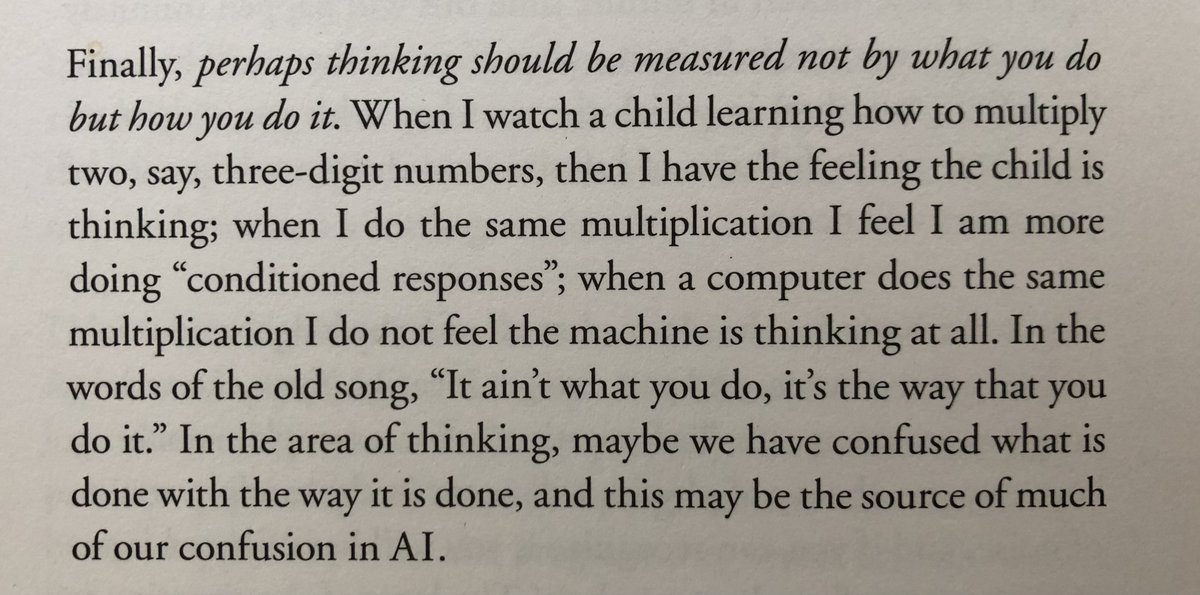
This paper by @mpshanahan is a breath of fresh air in the usual doomsday talk. It reminds me of this quote from Hamming, which seems more relevant than ever. https://t.co/y8poLCK2Ba