The American Heart Association mourns the passing of the legendary cardiologist Eugene Braunwald, M.D., widely recognized as one of the most influential figures in the history of cardiovascular medicine. Over seven decades, his work reshaped the understanding and treatment of heart disease, leading many to call him the father of modern cardiology.
Braunwald was a lifelong contributor to the American Heart Association, helping advance its research and scientific mission, and was honored with some of the Association’s highest honors for his lasting influence on cardiovascular care and research. His influence extended well beyond his own discoveries, as generations of Association‑supported investigators, clinicians and academic leaders were trained by Braunwald or guided by the clinical trial standards and mentorship models he helped establish.
https://t.co/ieZuHYMyOP
A simple way to see the 12-lead ECG
Color-coding helps pattern recognition:
🟢 Inferior: II, III, aVF
🟡 Lateral: I, aVL, V5–V6
🔵 Anterior/septal: V1–V4
🔴 Right: aVR (± V1)
Instead of memorizing 12 leads individually, think in territories.
This makes STEMI localization faster, cleaner, and harder to miss.
Brugada Syndrome: A Silent Threat to the Heart 🚨
What is Brugada Syndrome?
A potentially fatal genetic disorder affecting the heart's electrical system, leading to an increased risk of sudden cardiac death, especially during sleep. It is caused by mutations in the SCN5A gene, affecting sodium channel function and cardiac conduction.
Brugada Pattern vs. Brugada Syndrome
👉 Brugada Pattern:
- An incidental ECG finding without symptoms.
- Can be triggered by fever, medications, or electrolyte imbalances.
- Management: Monitor and avoid triggers.
👉 Brugada Syndrome:
- ECG changes + symptoms (syncope, palpitations, sudden cardiac arrest).
- High risk of sudden death, requiring urgent intervention.
- Management: ICD implantation, quinidine therapy.
Types of Brugada ECG Patterns:
1️⃣ Type 1 (Diagnostic): Coved-type ST elevation in V1-V3.
2️⃣ Type 2: Saddleback ST elevation.
3️⃣ Type 3: Features of Type 1 or 2 but less pronounced.
Differential Diagnosis
Brugada pattern can mimic other conditions:
🔍 Right bundle branch block (RBBB)
🔍 Early repolarization
🔍 Acute pericarditis
🔍 Arrhythmogenic right ventricular cardiomyopathy (ARVC)
🔍 Hyperkalemia or electrolyte imbalances
🔍 Ischemic heart disease
🔍 Pectus excavatum (chest wall abnormalities affecting lead placement)
Key Features of Brugada Syndrome:
🩸 Sodium Channelopathy: Autosomal dominant with familial clustering.
⚠️ Symptoms: Syncope, VT, VF, and sudden death during sleep.
🩺 ECG Clues: Coved-type ST elevation + T wave inversion in V1-V3.
Source: @MayoClinic@ClevelandClinic
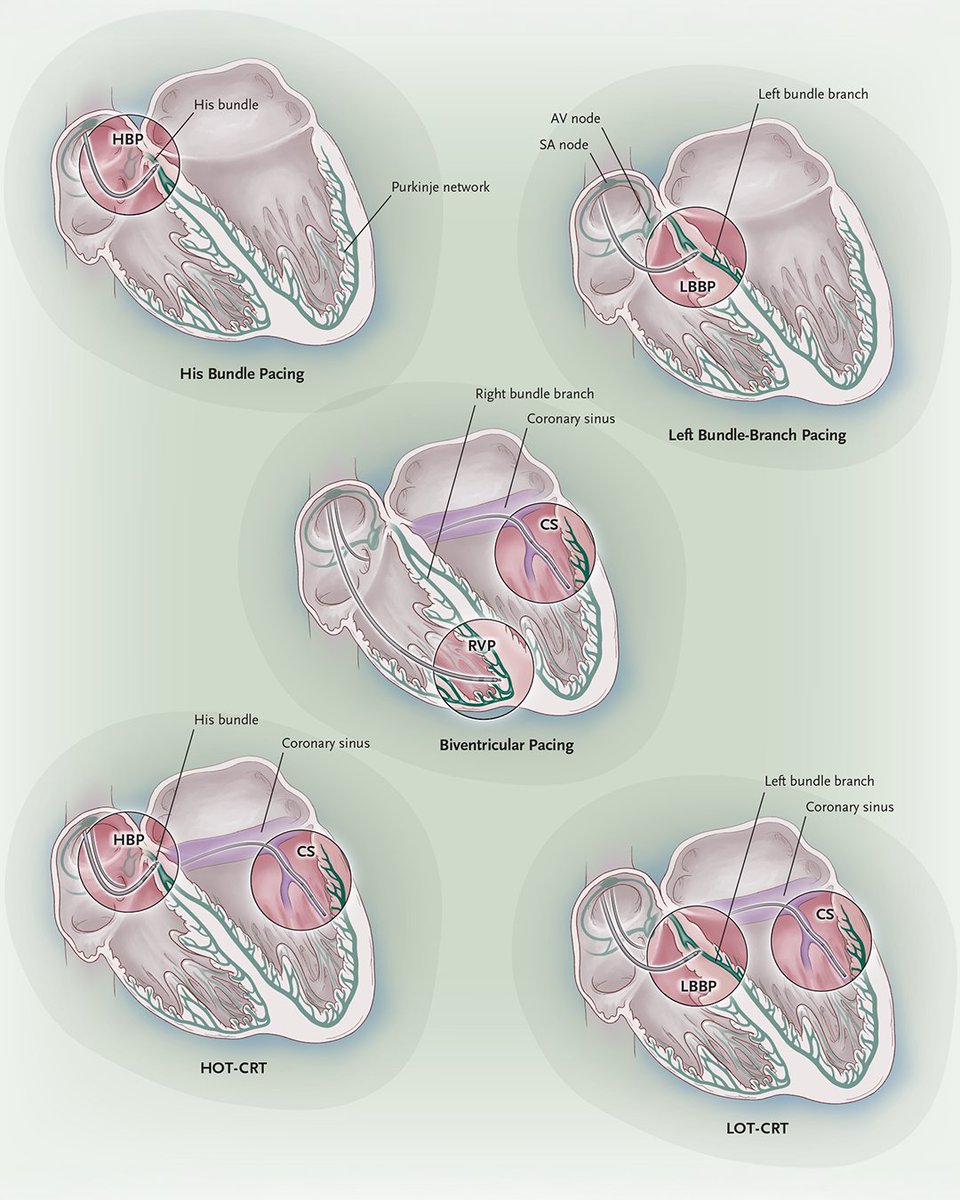
Cardiac physiologic pacing, also known as cardiac resynchronization therapy, is indicated in patients with heart failure, reduced left ventricular ejection fraction (LVEF) of 50% or less, and either a high (or anticipated high) ventricular pacing burden or a wide QRS complex. Traditionally, physiologic pacing has been achieved with biventricular pacing with a right ventricular lead and a coronary sinus branch lead. Randomized trials involving more than 10,000 patients with heart failure have shown clinical, exercise, and quality-of-life benefits associated with biventricular pacing, as well as improved LVEF and reduced mitral regurgitation and ventricular volumes. These benefits are greatest in patients with left bundle-branch block and a QRS duration of 150 msec or longer. Recent studies support targeting the His bundle or left bundle branch as an alternative cardiac physiologic pacing strategy. Ongoing randomized trials are expected to more clearly define the comparative efficacy and safety of conduction system pacing as compared with biventricular pacing.
Read the Review Article “Physiologic Pacing in Heart Failure” by @MihailChelu, MD, PhD, Jeanne E. Poole, MD, and Kenneth A. Ellenbogen, MD (@KennethEllenbo1), from the Baylor College of Medicine (@bcmhouston), University of Washington (@UW), and Virginia Commonwealth University School of Medicine: https://t.co/RuLZCpYUXn