Heartened by @FDA_KyleD and @FDA leadership who are enacting changes to help #raredisease communities.
You've accepted refiled BLAs for #huntingtons and #Duchenne. Now is the time to respond to the #NurOwn Citizens Petition containing data showing a five-year survival benefit compared to #ALS natural history.
@FDAdrugs and Karim Mikhail, invite @BrainstormCell to refile the BLA.
#EndALS #mnd #StemCells #CitizenScientist
For the 95% of rare disease patients still without an approved treatment, FDA is working for you.
Acting Commissioner Kyle Diamantas shares how FDA is transforming rare disease drug development through the new Rare Disease Framework Initiative. Because every family deserves answers, action, and hope. https://t.co/HgMjUNqF0a
Agree. Use of drugs on children must be better regulated.
I had a 5 yr old high risk foster child who endured significant abuse and neglect (ACES 10/10). A psychiatrist -- who spent ZERO time with him -- prescribed a BP medicine to "calm" his PTSD even though he didn't have high BP. I asked for studies and there were none. I asked if they had considered that he was African American and if there were studies about how it might effect him later in life if he developed high BP. Of course there were none. I asked if anyone was tracking the RWE of how children were responding on those meds and the L/T safety & efficacy. No.
As a foster mom, I had no rights to decline the meds, only DCS did. Their answer to his childhood abuse was to drug him. What he needed was more trauma-informed care, stability, food, and a loving home where he felt safe.
#fostercare #trauma #pediatrics #Childrenshealth
For 27 years, the Pediatric Brain Tumor Consortium worked to save kids with brain cancer. But just before 5-year-old Ryleigh Schecter was diagnosed, the government shut it down.
A child with diagnosed D.I.P.G. will usually get six weeks of radiation five days a week. After that there is no proven treatment, no standard of care. The average time between diagnosis and death is nine to 12 months. Knowing this, parents will consent to anything. They will move. They will quit their jobs. They will sign forms acknowledging that under experimental treatment, their child may suffer painful or debilitating side effects. Yet even under the care of the most brilliant oncologists, the disease is likely to progress.
Diffuse intrinsic pontine glioma usually strikes between 4 and 10 years old, with about 300 children a year diagnosed in the United States. It grows in the brainstem, which controls the primary functions of human life: breathing, balance, the heartbeat. There, it meshes with the tissue, “like sand in grass,” clinicians say. For these reasons, it is inoperable.
No one wants their child to become “a human guinea pig,” as Amanda Schecter put it to me, but when the choice is between that and nothing, there is no choice. Of course, the Schecters want to help science. But first they want to save their child.
When the Schecter family went looking for clinical trials, one avenue of hope had recently been closed. In August 2025 the National Cancer Institute, part of the National Institutes of Health, terminated the Pediatric Brain Tumor Consortium, long a cornerstone of the government’s pediatric brain cancer effort. When the government did not renew the consortium’s $4 million annual grant, eight ongoing trials were closed or paused. Described publicly as a consolidation to improve efficiencies, the closure was part of the Trump administration’s sweeping moves to upend the government’s approach to federal research funding.
The Pediatric Brain Tumor Consortium — 16 elite pediatric hospitals in the country working together to test novel treatments for D.I.P.G. and other brain cancers — usually ran six to eight active clinical trials a year. Most were Phase 1 trials, a drug or therapy’s first step toward government approval. When the government defunded the consortium, researchers at its member hospitals were testing a promising immunotherapy and were about to test a laser therapy. For D.I.P.G., they were experimenting with a skull cap that sends electricity directly into the brains of patients; they were also testing a vaccine.
The D.I.P.G. trials were once available through the consortium at multiple sites within half a day’s drive of Ryleigh’s home, according to Kara Buente, who helps families like the Schecters find trials through her nonprofit, The Bella Project. Both were paused. Ryleigh does not have access to either of them.
https://t.co/SxQryhaVHf
30M Americans with #RareDiseases often have NO HEALTHCARE. As chair of @HELPCmteDems please pass new legislation related to @FDA:
1️⃣ Codify a new FDA Conditional Approval Pathway for terminal rare diseases that mirrors the urgency and post market confirmation of Emergency Use Authorization pathway.
2️⃣Ensure FDA acts consistently with 21st Century Cures Act passed in 2016. FDA has ignored real world evidence and patient experience for the past decade.
FDA CBER has repeatedly refused to advance cell therapies with little safety risk. That office is well-known to be the most conservative despite CURES' mandate to advance "regenerative medicines."
See @SenGillibrand's 2026 statements at @SenateAging hearing.
3️⃣Enact legislation to ensure FDA "shall" consider opinions of top rare disease experts who were PIs or treating specialists -- important as FDA posesses no equivalent rare disease expertise. The "substantial evidence" definition in FDCA specifically requires experts to "EVALUATE & CONCLUDE" whether a therapy works.
Yet past FDA frquently IGNORED opinions of expert PIs from Mayo, Stanford, Cleveland Clinic, MGH, Vanderbilt, Dana Farber, MSK, U Chicago, Northwestern and National Childrens Hospital etc
4️⃣ Codify standards for risk-benefit analyses that FDA shall consider: irreparable harm from Type II error of delay or denial; of patients' tolerance for risk; of benefit from P4 post-marketing study.
5️⃣Mandate FDA "shall" act consistently across divisions. It has violated due process & the Administrative Procedures Act requirement to "treat like things alike," applying different standards to terminal rare disease therapies than cancer therapies.
6️⃣ Codify regulatory flexibility and fit-for-purpose efficacy standards. FDA has ignored and inconsistently applied their own regulations to exercise the broadest of "regulatory flexibility" in terminal diseases despite this being a long-standing mandate (snce 1988) in Subpart E (312.80 & 314.05) and in its own guidance documents.
7️⃣Codify standards for AdComms in rare diseases.
#rarediseases #HealthCare #Medicare #MedicareForAll
@SenSanders@BernieSanders@PattyMurray@SenatorBaldwin@ChrisMurphyCT@SenTimKaine@SenatorHassan@AndyKimNJ@SenLBR@AnnieAndrewsMD@AbdulElSayed@lisamurkowski@SenMarkey@RandPaul
Powerful story on how the Trump administration killed the Pediatric Brain Tumor Consortium https://t.co/EgF733mQiw which was so crucial for children with DMG/DIPG (rapidly fatal brain tumors) & their families. My lab studies DMG & more efforts are needed on it, not less
30M Americans with #RareDiseases often have NO HEALTHCARE. As chair of @HELPCmteDems please pass new legislation related to @FDA:
1️⃣ Codify a new FDA Conditional Approval Pathway for terminal rare diseases that mirrors the urgency and post market confirmation of Emergency Use Authorization pathway.
2️⃣Ensure FDA acts consistently with 21st Century Cures Act passed in 2016. FDA has ignored real world evidence and patient experience for the past decade.
FDA CBER has repeatedly refused to advance cell therapies with little safety risk. That office is well-known to be the most conservative despite CURES' mandate to advance "regenerative medicines."
See @SenGillibrand's 2026 statements at @SenateAging hearing.
3️⃣Enact legislation to ensure FDA "shall" consider opinions of top rare disease experts who were PIs or treating specialists -- important as FDA posesses no equivalent rare disease expertise. The "substantial evidence" definition in FDCA specifically requires experts to "EVALUATE & CONCLUDE" whether a therapy works.
Yet past FDA frquently IGNORED opinions of expert PIs from Mayo, Stanford, Cleveland Clinic, MGH, Vanderbilt, Dana Farber, MSK, U Chicago, Northwestern and National Childrens Hospital etc
4️⃣ Codify standards for risk-benefit analyses that FDA shall consider: irreparable harm from Type II error of delay or denial; of patients' tolerance for risk; of benefit from P4 post-marketing study.
5️⃣Mandate FDA "shall" act consistently across divisions. It has violated due process & the Administrative Procedures Act requirement to "treat like things alike," applying different standards to terminal rare disease therapies than cancer therapies.
6️⃣ Codify regulatory flexibility and fit-for-purpose efficacy standards. FDA has ignored and inconsistently applied their own regulations to exercise the broadest of "regulatory flexibility" in terminal diseases despite this being a long-standing mandate (snce 1988) in Subpart E (312.80 & 314.05) and in its own guidance documents.
7️⃣Codify standards for AdComms in rare diseases.
#rarediseases #HealthCare #Medicare #MedicareForAll
@SenSanders@BernieSanders@PattyMurray@SenatorBaldwin@ChrisMurphyCT@SenTimKaine@SenatorHassan@AndyKimNJ@SenLBR@AnnieAndrewsMD@AbdulElSayed@lisamurkowski@SenMarkey@RandPaul
New AL Lambda light chain #amyloidosis study being launched by sponsor who developed tafamadis for people with #ATTR amyloidosis.
Lambda is a subtype of AL amyloidosis. It is ~3x more common than kappa subtype and has slightly worse survival. It has more frequent kidney and neurological involvement. But at diagnosis, patients have lower creatinine and lower baseline dFLC and Free Light Chain ratio.
Amyloidosis is a hetereogeneous rare disease affecting ~80k Americans. AL amyloidosis is only 1 of 42 types of amyloidosis. Appx 18k people are living with AL amyloidosis. Of the 4k new AL diagnoses in the US each yr, appx 75% are lambda AL and 25% are kappa AL subtype.
Thx to Protege Bio for investing in our community.
Mom had amyloidosis for nearly a decade before being diagnosed then died 7 months later because there were no disease modifying treatments.
#hematology #clinicaltrials #rarediseases
Potential game-changing oral stabilizing treatment for lambda light chain amyloidosis coming to clinical trial early 2027 by ProtegoBio nder Shield-AL. These are the folks who developed the ATTR stabilizer tafamidis.
Russ Hudson, the man who appeared in Scott Colom’s “pick another protein ad,” was once a homeless veteran who struggled with substance abuse.
He appeared in this news segment from 2019
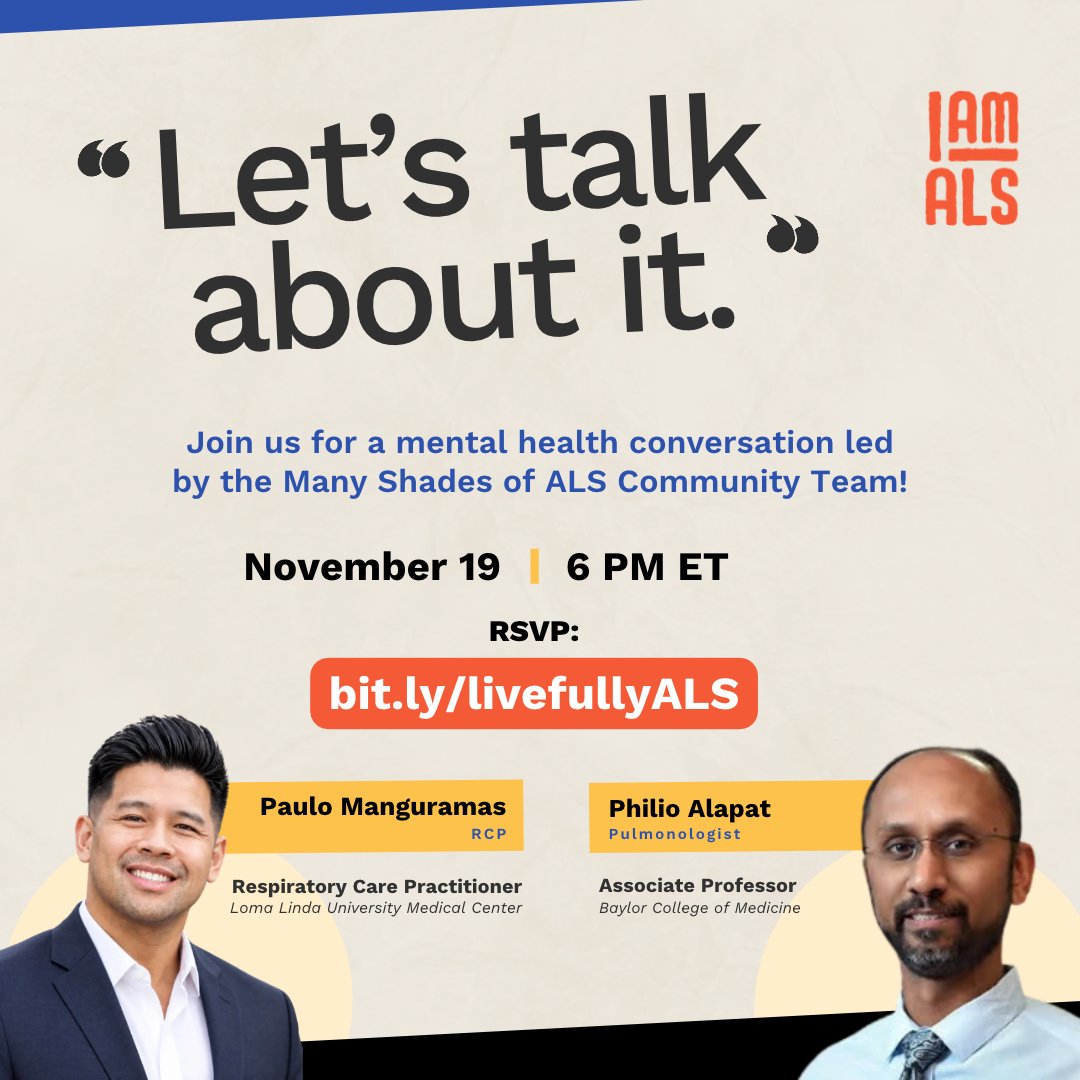
Join us for Talk About It: A Mental Health Series! The Many Shades of ALS Team hosts a session on respiratory changes in ALS and what they can mean emotionally, with Philio Alapat, MD and Paulo Manguramas, RCP.
📅 Nov 19, 6pm ET / 3pm PT
https://t.co/UijvhvO2uz (case-sensitive)
Wish the new govt and all MDs in Congress would use March-in Rights to license production of inexpensive #BladderCancer immunotherapy #BCG.
BCG is the gold-standard immunotherapy that prevents recurrence and progression in high-risk non-muscle-invasive bladder cancer. Because NCI funding supported BCG trials, and because the single Merck plant has repeatedly failed to meet public health needs, march-in rights under the Bayh-Dole Act let the government step in, license the technology, and expand production.
My 88-yr-old Dad has been battling high-risk NMIBC for 10 yrs. When first dx'd he received BCG induction + maintenance that successfully prevented recurrences. Then the BCG shortage changed the standard of care and Dad has had 3 recurrences.
Merck makes both BCG and Keytruda. Keytruda's cost is ~$12,500 per dose every 3 weeks (~$200k/year) versus BCG’s low cost of ~$200 per vial ($20k/yr) The new VOLGA regimen (durvalumab + enfortumab vedotin) is estimated to cost $250,000–$300,000. Both cost Medicare tens of millions more than BCG.
Reliable BCG access preserves the proven, low-cost, minimal side-effect standard instead of letting bladder cancer advance into far more expensive, painful and invasive treatment.
Hope the new 2027 Congress will commit to use march-in rights so supply can meet demand in this very treatable cancer so that less people must endure chemo or have their bladders removed... and Medicare can save tens of millions.
#healthcare #MarchInRights #Oncology #Cancer #BladderCancer #clinicaltrials #immunotherapy
@DeionSanders@chrisparente@PGA_JohnDaly@AnnieAndrewsMD@AbdulElSayed@DrAmishShah@DrPanMD@HamawyForNJ@RepKimSchrier@RepHerbConaway@herbconaway@RepDexterOR@DoctorMaxine@KellyMorrisonMN@Morrison4MN@RepRaulRuizMD
@MajorityDems@AndyKimNJ This is my family with a Dad with #dementia. I moved in to take care of him. But our situation is easy comparatively. It's exponentially harder and more expensive for families with #ALS#Huntingtons and other diseases where people are trached and on ventilators.
A Texas veteran who is wheelchair-bound just had her VA-funded home care cut from 58 hours a week to 14 — her caretaker helps her shower, use a lift to get in bed, and change her. Her home health company says it's the same story for all 30 veterans they serve.
. @DrAmishShah I am a lifelong Dem and patient advocate. My biggest disappointment is how our party has repeatedly deferred to the FDA in rare diseases -- ignoring the 30M constituents who have no viable treatments.
We desperately need your help with several things related to healthcare:
1️⃣ Pass a new FDA Conditional Approval Pathway for terminal rare diseases that mirrors the urgency and post market confirmation of Emergency Use Authorization pathway.
2️⃣ Ensure FDA acts consistently with 21st Century Cures Act passed in 2016. FDA has ignored real world evidence and patient experience for the past decade, disregarding terminally ill patients' tolerance for risk.
And FDA CBER has repeatedly refused to advance cell therapies. That office is well-known to be the most conservative despite CURES' mandate to advance "regenerative medicines."
3️⃣ Enact legislation to ensure FDA considers opinions of top rare disease experts who were PIs or treating specialists -- important as FDA posesses no equivalent rare disease expertise. Past FDA has COMPLETELY IGNORED opinion of expert PIs from Mayo, Stanford, Cleveland Clinic, MGH, Vanderbilt, Dana Farber, MSK and National Childrens Hospital et al. In #ALS they ignored Mayo's Tony Windebank & Nathan Staff.
This is even more unacceptable when the "substantial evidence" definition in FDCA specifically requires experts to "EVALUATE & CONCLUDE" whether a therapy works.
4️⃣ FDA has ignored and inconsistently applied the mandate to exercise the broadest of "regulatory flexibility" in terminal rare diseases despite this being a long-standing mandate in Subpart E (312.80 & 314.05) since the AIDS crisis.
5️⃣ FDA has violated due process & the Administrative Procedures Act requirement to "treat like things alike," applying different standards to terminal rare disease therapies than cancer therapies.
6️⃣ Triage NIH funding of research for 10,000 rare diseases affecting 30M Americans -- most of which have a critical unmet need.
7️⃣ Implement a VAERS like reporting mechanism at CDC so people with rare diseases can report clusters that match EPA databases of Superfund sites and TRI locations. We've found 100+ in the ALS community but CDC's ALS Registry has no mechanism to capture and investigate that data.
8️⃣ Ensure CDC immediately implements new ICD10 Codes for heterogeneous rare diseases so we can populate RWE-natural history studies with EMRs.
Expanding health care access and lowering costs are both important priorities. But when you have a terminal rare disease with no disease modifying treatments, health care is non-existent. Please prioritize our lives.
If any Dem physicians serve on @EnergyCommerce
or @HELPcmteDems, I pray you'll immediately work with @GOPHELP & @HouseCommerce to help the 30M Americans with #rarediseases.
We have NO HEALTHCARE.
@DrAmishShah@RepBera@DrPanMD@HamawyForNJ@RepKimSchrier@RepHerbConaway@herbconaway@RepDexterOR@DoctorMaxine@KellyMorrisonMN@Morrison4MN@RepRaulRuizMD@AbdulElSayed@AnnieAndrewsMD@HouseDemocrats@SenateHELP
#ALS #Huntingtons #Duchenne #EndALS #amyloidosis #EndDuchenne #EndHD #musculardystrophy #ataxia #healthcare #patientadvocacy
. @DrAmishShah I am a lifelong Dem and patient advocate. My biggest disappointment is how our party has repeatedly deferred to the FDA in rare diseases -- ignoring the 30M constituents who have no viable treatments.
We desperately need your help with several things related to healthcare:
1️⃣ Pass a new FDA Conditional Approval Pathway for terminal rare diseases that mirrors the urgency and post market confirmation of Emergency Use Authorization pathway.
2️⃣ Ensure FDA acts consistently with 21st Century Cures Act passed in 2016. FDA has ignored real world evidence and patient experience for the past decade, disregarding terminally ill patients' tolerance for risk.
FDA CBER has repeatedly refused to advance cell therapies. That office is well-known to be the most conservative despite CURES' mandate to advance "regenerative medicines."
3️⃣ Enact legislation to ensure FDA considers opinions of top rare disease experts who were PIs -- important as FDA posesses no equivalent rare disease expertise. Past FDA has COMPLETELY IGNORED opinion of expert PIs from Mayo, Stanford, Cleveland Clinic, MGH, Vanderbilt, Dana Farber, MSK and National Childrens Hospital et al.
This is even more unacceptable when the "substantial evidence" definition in FDCA specifically requires experts to "EVALUATE & CONCLUDE" whether a therapy works.
4️⃣FDA has ignored and inconsistently applied the mandate to exercise the broadest of "regulatory flexibility" in terminal rare diseases despite this being a long-standing mandate in Subpart E (312.80 & 314.05) since the AIDS crisis.
5️⃣ FDA has violated due process and the Administrative Procedures Act requirement to "treat like things alike," the FDA has applied different standards to terminal rare disease therapies than cancer therapies.
6️⃣ Triage NIH funding of research for 10,000 rare diseases affecting 30M Americans -- most of which have a critical unmet need.
7️⃣Implement a VAERS like reporting mechanism at CDC so people with rare diseases can report clusters that match EPA databases of Superfund sites and TRI locations. We've found 100+ in the ALS community but CDC's ALS Registry has no mechanism to capture and investigate that data.
8️⃣ Ensure CDC immediately implements new ICD10 Codes for heterogeneous rare diseases so we can populate RWE-natural history studies with EMRs.
Expanding health care access and lowering costs are both important priorities. But when you have a terminal rare disease with no disease modifying treatments, health care is non-existent. Please prioritize our lives.
If any Dem physicians serve on @EnergyCommerce
or @HELPcmteDems, I pray you'll immediately work with @GOPHELP & @HouseCommerce to help the 30M Americans with #rarediseases.
We have NO HEALTHCARE.
@DrAmishShah@RepBera@DrPanMD@HamawyForNJ@RepKimSchrier@RepHerbConaway@herbconaway@RepDexterOR@DoctorMaxine@KellyMorrisonMN@Morrison4MN@RepRaulRuizMD@AbdulElSayed@AnnieAndrewsMD@HouseDemocrats@SenateHELP
#ALS #Huntingtons #Duchenne #EndALS #amyloidosis #EndDuchenne #EndHD #musculardystrophy #ataxia #healthcare #patientadvocacy
I am a lifelong Dem and patient advocate. My biggest disappointment is how our party has repeatedly deferred to the FDA in rare diseases -- ignoring the 30M constituents who have no viable treatments.
1️⃣The #raredisease communities need Dems to ensure FDA acts consistently with 21st Century Cures passed in 2016. FDA has ignored real world evidence and patient experience for the past decade, disregarding terminally ill patients' tolerance for risk.
2️⃣FDA CBER has repeatedly refused to advance cell therapies. That office is well-known to be the most conservative despite CURES' mandate to advance "regenerative medicines."
3️⃣FDA has ignored expert PI opinions even though FDA has no similar expertise in rare diseases -- even more unacceptable when the "substantial evidence" definition in FDCA specifically requires experts to "EVALUATE & CONCLUDE" whether a therapy works.
4️⃣FDA has ignored the mandate to exercise the broadest of "regulatory flexibility" in terminal rare diseases despite this being a long-standing mandate in Subpart E (312.80 & 314.05) since the AIDS crisis.
5️⃣Violating due process and the Administrative Procedures Act requirement to "treat like things alike," the FDA has applied different standards to terminal rare disease therapies than cancer therapies.
Expanding health care access and lowering costs are both important priorities. But when you have a terminal rare disease with no disease modifying treatments, health care is non-existent. Please prioritize our lives. Over 30M are #DyingWaiting.
@RepBera@AnnieAndrewsMD@AbdulElSayed@DrAmishShah@DrPanMD@HamawyForNJ@RepKimSchrier@RepHerbConaway@herbconaway@RepDexterOR@DoctorMaxine@KellyMorrisonMN@Morrison4MN@RepRaulRuizMD
If any Dem physicians serve on @EnergyCommerce
or @HELPcmteDems, I pray you'll immediately work with @GOPHELP & @HouseCommerce to codify FDA's proposed Rare Disease Framework, pass CURES 2.0 and most importantly pass a Conditional Approval Pathway for Rare Diseases that mirrors the urgency and flexibility of the EUA pathway.
#ALS #Huntingtons #Duchenne #EndALS #EndDuchenne #EndHD #musculardystrophy #ataxia
@BU_Amyloidosis I so wish these scientific conferences would have virtual access for #Amyloidosis patients and families involved in advocacy. We cant advocate effectively if we aren't involved in understsnding the cutting edge science.
Read this compelling 11-pg letter to @FDA CBER from #deramiocel's trial investigators, who are renowned #Duchenne experts.
The legal standard for approval of an investigational therapy is "substantial evidence” of effectiveness, which is defined as evidence from adequate and well-controlled clinical investigations….
"(b) conducted by “experts qualified by scientific training and experience to EVALUATE the effectiveness of the drug involved, on the basis of which it could fairly and responsibly be CONCLUDED by such experts that the drug will have the effect it purports to have.”
21 U.S.C. § 355(d) (emphasis added).
Not only does the statute require the FDA consider expert opinions but in all diseases but especially in #RareDiseases where the FDA possesses no equivalent expertise, it is critical to heed the opinions of the expert neurologists and cardiologists who know #Duchenne the best.
@FDA_KyleD@FDAdrugs and Karim Mikhail
Please apply the principles of the new proposed Rare Disease Framework and urgently grant accelerated approval of @Capricor's cell therapy before these boys and young men suffer more irreparable harm.
Thank you to Craig M. McDonald, MD and the other PIs for fighting so vociferously for your patients' lives.
#EndDMD #Neurology #neurologist #pediatrician #MuscularDystrophy #orphandisease
👇🏽Link to letter in comments
$CAPR