GPT-6 Astra is here.
We hope it will begin to enable a new generation of entrepreneurship, scientific discovery, and building.
We believe it is the best model in the world for computer use, professional work, science, coding, cybersecurity, and more.
It took us some extra time to ensure that we could meet the safety and alignment standards required for this capability level, but we think you’ll find it worth the wait.
It scores 98% on FrontierMath Tier 4, 99.9% on ARC-AGI 3, and 100% on ExploitBench.
We’re in the unsexy phase of AI right now.
It’s no longer about the flashy bet that sounds good on an earnings call, and all about having a thoughtful rollout strategy that doesn’t lead to more false starts.
Here’s the way we’ve built AI roadmaps for 100+ companies, that you should copy:
Step 1: Interviews at the top
- Ideally start with the CEO. If not possible, prioritize the most senior person with the widest aperture and clearest sense of goals/challenges
- Focus the interview on the companies biggest goals (OKRs, Rocks, etc) and the biggest blockers standing in the way of those goals
- Those blockers will always boil down to some combination of people, process, and technology
- Finish interview by asking who else you should interview to get valuable perspective on goals, blockers, and business context
Step 2: Complete first round of interviews
- If you’re doing an organization-wide AI audit, interviews are typically focused on ELT
- If you’re doing a functional audit (I.e Engineering, Data, Marketing), interviews typically include highest ranking functional leader and all N-1’s
Step 3: Gather survey responses + data
- Based on goals/gaps, that will inform survey questions and data requests
- Examples: financials for ROI studies, ERP data for supply chain processes, GA/customer data for marketing workflows
Step 4: Conduct second round of interviews
- Focused on specific opportunities called out above. If steps 1-3 were about figuring out where the treasure is buried, step 4 is about filling out the entire map
- Where you go deeper on process mapping, org chart/people dynamics, tech stack
- Pro tip: people, process, data, and technology are equal blockers. Most people get data obsessed and neglect the others
Step 5: Draft first round recommendations + roadmap
- Should include a list of opportunities with ROI estimate inclusive of all costs (people, process, technology, financial)
- Should include governance frameworks like start/stop/continue/edit on existing initiatives
- Sequence by the business’ appetite with a bias for highest expected ROI. Translation: prioritize initiatives that have a high success rate and high ROI. Cultural momentum building is the most important initial priority.
Step 6: Final presentation
P.S. This is the high-level approach. If you want the full AI diagnostic process (with interview and survey questions) we’ve used at @tenex_labs with 100+ enterprises, comment “DIAGNOSTIC” below.
If you’re getting started with ChatGPT Work or Codex, I recommend checking out our new training page.
There are many walkthroughs on how to best use it for general or technical work.
Even if you’re a regular user, I’m sure you’ll learn a thing or two!
https://t.co/Yi6PakASK5
My biggest takeaways from @tarstarr, @OpenAI's ChatGPT Work product lead:
1. The future of work is steering, not rowing. As AI agents take on more of the execution work, humans will shift toward “steering”: making the call for where to go next. In particular, the taste-driven dimension of steering—choosing a direction because you believe the world should look a certain way.
2. “Are you mainlining it yet?” OpenAI’s product culture runs on three internal questions: Are we being as ambitious as possible? Is this maximally accelerated? And are you mainlining it yet (i.e. using your own product all day, every day)? Tara credits the Codex vibe shift over the past few months to this long-held discipline: the team’s user obsession, tight iteration loops, and adjusting quickly once they see how the market reacts.
3. Build for where the models will be in two to three months. Build for current model capabilities, and your product will be outdated by the time it ships. Build for capabilities 12 months out. Tara’s heuristic is to “build for two to three months ahead of the model.”
4. PMs are now in the business of elevating ambition. Tyler Cowen has noted how powerful it is for a leader to look at someone’s work and ask, “Could you do this faster? Could this be 10x bigger?” Tara sees this as a core function of the product role now. When engineers, designers, or stakeholders propose a scope or timeline, a key PM intervention is raising the possibility ceiling: “How could we 10x this? Couldn’t we try this faster?” The OpenAI internal memes (Is this maximally accelerated? Are you mainlining it?) encode the same instinct.
5. Most knowledge work can’t be verified like code, which means it won’t be replaced anytime soon. Coding is output-oriented—you can run tests and see if it works—but with knowledge work, the process itself is how you discover (and trust) the solution. Talking to customers, trying out ideas, seeing the market’s reaction. This is also why it’s important for AI products to surface in-progress work, citations, and chain of thought—so users can go on the journey with the model and actually believe the end result.
6. AI makes clear thinking even more important. Building faster is a gift and a risk. The gift is the ability to iterate at much greater speed. The risk is that you can now travel very far in entirely the wrong direction before anyone notices. If ideation and hypothesis quality do not keep pace with execution speed, teams “blow off course way quicker” than they ever would have before. Speed without a clear hypothesis will just compound errors faster.
7. Empirical beats theoretical. At Stripe, Tara spent tens of hours writing rigorous strategy documents because the market was established enough to reason from first principles. At OpenAI, the market changes too fast for a 12-month roadmap to be meaningful. The right response is to move from academic to empirical: identify your sharpest hypothesis, then test it with users as quickly as possible. Long reasoning documents rarely make sense anymore. Instead, get to something real people can try as quickly as you can.
8. Never automate writing-as-thinking. Instead, automate writing-as-reporting: status updates, email summaries, etc. But never outsource the writing you think with: start the doc yourself and end it yourself, using AI in the middle only for research, data, and pushback. Share docs at 70% complete so collaborators can poke holes and polish with you. At OpenAI it’s now “mocks, not docs”—prototypes and A/B results communicate better than long documents, because AI has made a long doc a meaningless signal of rigor. Tara still writes hundreds of docs—but for herself, not as the shareable artifact.
9. Someone still has to be the DRI, even when roles dissolve. Tara has always liked almost no boundaries between engineer, PM, and designer. Everyone can pick up the work now. But someone needs to be accountable. Someone still has to own the outcome.
Two more ships this week for the ChatGPT Desktop in-app browser!
Media Tabs: Find your music or meeting without hunting through threads! All tabs with audio/video activity are now grouped in one menu in the side pane. (s/o @ngu_khoi@schwa23)
Zero-state autocomplete: Jump back into your browser work faster. Just click the empty URL bar to see your most recently visited pages. (s/o @olivertepman)
Let us know what you think, especially if you’re using the IAB as your daily driver.
We are still working on bringing extension support safely to the IAB, thanks for your patience!
astra is a powerful model and we are working to make it generally available.
we do not think it is a good strategy to keep powerful models to a chosen few.
given its cyber capabilities, we need a little big longer to do do this safely. but hopefully not too long!
ChatGPT Work can now use its computer and browser to sign in to websites on web and mobile, without ChatGPT ever seeing your username or password.
That means you can ask it to:
• Set up utilities for a new apartment
• Book a DMV or passport appointment
• Check reimbursement costs through your insurance
• Find and book an in-network doctor around your availability
• Check when your car registration expires and prepare the renewal paperwork
• Compare your rental insurance policy with an issue you’re emailing your landlord about
• Find and save apartment listings that match your criteria
• Restock something just by uploading a photo
• Schedule a package pickup for a return
• Cancel tickets for a rescheduled trip
• Book a vet appointment
• Submit reimbursement paperwork for medical treatments
• Check resale sites for new drops and save things you might like
• Find candidates with specific experience and draft outreach
• Take invoices from your email and submit them to your accounting software
• Draft replies to rental property inquiries
• Fill out permit applications for your small business
• Add action items to a vendor portal based on a recent client call
• Analyze the latest ad campaign for your small business
Time for an AI update for those who are curious. This is how I use Claude CoWork and ChatGPT Scheduled
All it takes is very simple requests
"check hourly for meaningful developments in the Mark Walter investigation, and similar scrutiny involving Apollo/Athene, KKR/Global Atlantic, Brookfield, Blackstone, Carlyle/Fortitude Re, Ares, Sixth Street, and other PE-linked insurers. Email me when there is a material change "
"Prepare a detailed PBM briefing covering major regulatory, legal, market, payer, manufacturer, wholesaler, employer, transparency, rebate, formulary, and Cost Plus Drugs developments from the prior week. Verify material claims with current sources, distinguish confirmed facts from analysis, identify implications, open risks, and decisions to watch, then email the briefing to me"
*search for all PBM ASO and TPA contracts, that have been fully executed since Jan 1, 2024, and are available for you to access and analyze just like we did for the city of Denver
it can be a government entity or a commercial entity
provide a list , and links for each.
then every week, I want you to look for new contracts and email me the new ones"
You can imagine it can be used to keep up with almost anything. It's also simple to modify as you learn from the output.
This is a productivity hack that will only get better.
Is it always right. No. But it's far more accurate than half the links we used to waste time clicking on from a Google search.
DoorDash just published how their AI agents automated 130,000 engineering tasks in a single month, and it reads like a spec for a job that did not exist two years ago
The work itself is unglamorous. Reviewing pull requests, triaging broken builds, clearing on-call tickets, and the routine maintenance. 25,000 code reviews a week on its own.
An agent on your laptop shares the CPU with everything else, stops when you close the lid, and holds every credential you hold.
So they moved it off the laptop, into four pieces.
A sandbox: a Firecracker microVM per task, loaded with the repos, tools and secrets that task needs. Cold VM to ready in under five seconds at p95.
A gateway: one door to CI, tickets and monitoring. The task declares what it needs, gets exactly that, and every call is logged.
A playbook: one YAML file holding the task, its tools, its permissions and its expected output.
Surfaces: that same playbook fires from Slack, GitHub, cron or the CLI.
Teams wrote the 300 playbooks themselves.
Nobody is short of agents. The scarce thing is somebody who can build the place to put one.
Obsidian CEO actually released the skill that lets your AI agent run your entire vault for you.
It's called obsidian-skills.
Install it into Claude Code, Codex, or OpenCode, and your agent can read, create, search, and organize notes directly, plus handle Markdown, Bases, and Canvas files without you touching a thing.
This is the missing piece for an AI second brain. Your notes live in Obsidian, and now the agent actually knows how to work them.
Want the full picture? We broke down how to build a complete AI second brain from scratch in the article below.
get addicted to neuroplasticity, subconscious reprogramming, delusional optimism, game theory, and quantum physics. i promise it will change your life.
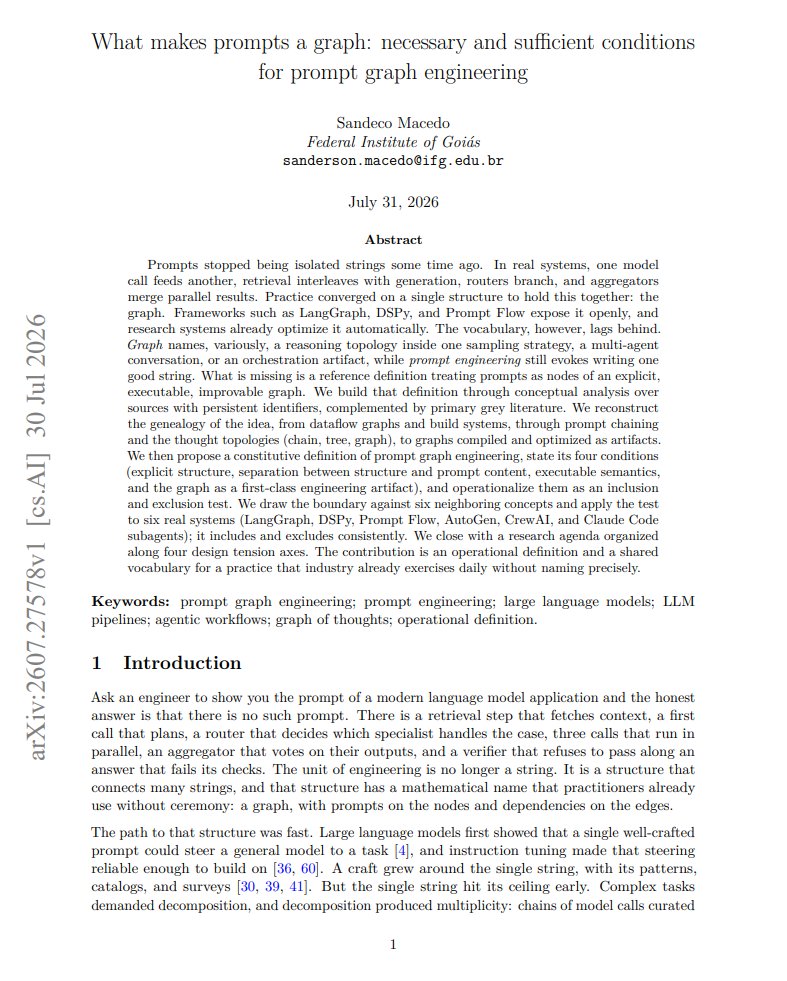
This paper is f*cking insane.
Prompt Engineering just got replaced by Graph Engineering.
A new 20-page paper formalized what the best AI builders are already doing:
Stop writing one giant prompt.
Build a graph of agents instead.
Planner → specialists → verifier → feedback loop.
The authors test this definition against LangGraph, DSPy, AutoGen, CrewAI, Prompt Flow, and Claude Code subagents.
The prompt is no longer the system.
The graph around it is.
Bookmark this, then read the full Graph Engineering guide below.
Google just released a free 2-hour+ course on full agent engineering.
How to go from one prompt to a system that runs while you sleep:
38:46 - Build your first AI agent
54:46 - Connect MCP tools
1:12:43 - Run agents with four loop patterns
1:20:57 - Turn agent loops into graphs
2:22:31 - Build the complete autonomous system
Most people are still building one agent and stopping there.
Google is already teaching the full stack:
Agents → Tools → Loops → Graphs → Autonomous Systems
Single agents are the old workflow.
Systems that run without you are the new one.
This course is worth more than most paid agent engineering bootcamps.
Bookmark and watch it today
Then read the full graph engineering playbook below
The greatest AI skill you can learn right now is Reverse Prompting
It’s simple: ChatGPT5.6, Fable, and Grok 4.5 are now smarter than humans. That means you need to have your agent prompting YOU more than you prompt it
You have your AI ask YOU questions to see what it can do for you
Makes every AI agent you use so much more powerful
An exercise you can do right now:
Open up any AI/OpenClaw/Hermes. Brain dump everything about yourself and your career/goals/ambitions. Then use this reverse prompt:
"Based on what you know about me and my goals, what is more information I can provide to you in order for you to be able to help me achieve my goals faster and take as much off my plate as possible"
Then once you enter that, prompt this:
"What tasks can you do for me right now to get us closer to our ambitions and goals?"
Guarantee you come up with 100x more things to do with your AI than you thought of before
The more questions you ask your AI, the more you'll learn and the more you'll get done.
You don’t prompt. You give information, then allow your agent to guide you to somewhere interesting.
This is how you use AI in 2026
Google just released free 2-hour course on full agent engineering: 1 prompt → agent teams → loops → graphs from 0% to 100%:
10% → 38:46 - build your first agent
30% → 54:46 - connect MCP tools
55% → 1:12:43 - Loop engineering: 4 ways to run agents
70% → 1:20:57 - Graph engineering
100% → 2:22:31 - the full system that works while you sleep
most people build one agent and stop there - this is the full path to a system that runs without you from scratch
watch it today - then read the full graph engineering playbook below ↓