Every device is more useful when it can work with the devices around it.
Offline Protocol lets machines find each other, securely share data, and request capabilities they don’t have themselves, even without internet. A robot can ask a nearby camera to inspect something. A technician’s device can retrieve equipment history on site. A fleet can share updates locally and sync back to central systems when connectivity returns.
We give developers the infrastructure to build these interactions into their products: identity, discovery, secure communication, reliable delivery, and shared state in one stack. The demo below brings that together: agents authorizing, purchasing, and delivering a real hardware capability entirely over local connections.
Let's go offline.
I just made an agent on my computer pay for an image capture and processing session on a connected hardware device that was authorized to provide this capability by another agent on another device. I accomplished all of this without any internet connections between these devices.
The possibilities this opens up are endless, autonomous vehicles can coordinate with drones for route guidance, connect to sensors to receive weather updates, or coordinate with each other to exchange skills in a swarm. Productivity robots can talk to personal assistants to understand user preferences, or receive outage data from field technicians to perform repairs, all without the need for an active internet connection or expensive backhaul solutions.
Useful intelligence has moved onto devices; autonomous systems are expanding from isolated machines into fleets; and connectivity continues to fragment across Bluetooth, Wi-Fi, cellular, satellite, and specialized radios. Those networks extend reach, but none supplies the shared application contract required to decide who may act, what capability is available, which route should carry the request, how state converges after disconnection, and what evidence proves completion.
Offline Protocol packages the missing contract as one integrated stack and abstracts multiple transports with automatic failover; OfflineID provides device-owned identity that peers can verify locally; Messaging Layer Security protects sessions; serverless discovery lets a device advertise, find, and invoke a capability without DNS or a cloud directory; reliable delivery adds acknowledgment, retry, deduplication, retention, and replay; and the shipped CRDT data layer synchronizes application state through compact deltas and deterministically merges concurrent offline edits.
Our protocol has reached 350,000+ cumulative deployed device instances, with 11,500+ network clusters active in the trailing 30 days, and 12,000+ SDK package installs. Within a month of starting our commercial motion, we've already signed 4 LOIs, 2 paid pilots, 6 more in technical scoping, and have several enterprise level distribution partnerships in negotiations.
I have historically been too quiet and not outspoken enough about our work, a VC recently told me I am too humble about our trajectory and technology, and so for once I want to really share how confident I feel about the progress we're making and the brand new paradigm of machine coordination our technology opens up.
This is a good opportunity to announce IntelligenceMesh by Offline Protocol.
Our stealth offline AI product that lets you install local models to run offline, train your own models with others without internet, build specialized personas for assistance, provides emergency resources tailored to your location, connects you in emergencies to other nearby users over mesh, and a whole lot more coming.
For those who bought our sold out hardware run, this is also where you manage companion devices and inference partners.
IntelligenceMesh is our way to open up an offline network into the endless possibilities of frontier innovation, and it’s FREE forever!
The likelihood of #Internet access being shut down at the cable and ISP levels is increasing year by year, including in the #EU and the #US .
It’s better to be prepared in advance.
an incredible amount of work from the entire team.
fernweh v2 took on some genuinely difficult technical problems, and seeing it finally out in the world feels special.
proud of everyone at @OfflineProtocol for making this happen. onwards.
Super excited to finally bring this out into the world!
After amazing feedback and validation for V1 over the past year, we set out to build an experience that accommodates your daily life. Now, you don't need to switch between messaging apps everytime the internet disappears.
Just use Fernweh everyday, everywhere.
DM me on Fernweh (@sxtvik) to receive memes and dog pics.
Your world doesn’t end where the signal does.
Introducing Fernweh V2: a private messenger that works online and off-grid. When the internet disappears, encrypted messages and files move through nearby devices; when it returns, Fernweh seamlessly shifts to an encrypted online relay.
V2 also brings high-quality voice and video calls, private group chats, nearby discovery, device-owned identity, profiles, and a dynamic reputation system, all without a central cloud inbox holding your conversations.
Fernweh V2 is live on iOS and Android. Experience the everywhere messenger.
Download iOS: https://t.co/dWW8TxDrxv
Download Android: https://t.co/wa6eBYZ8Ek
Learn more about the technical architecture and features: https://t.co/5G0sO0O5YA
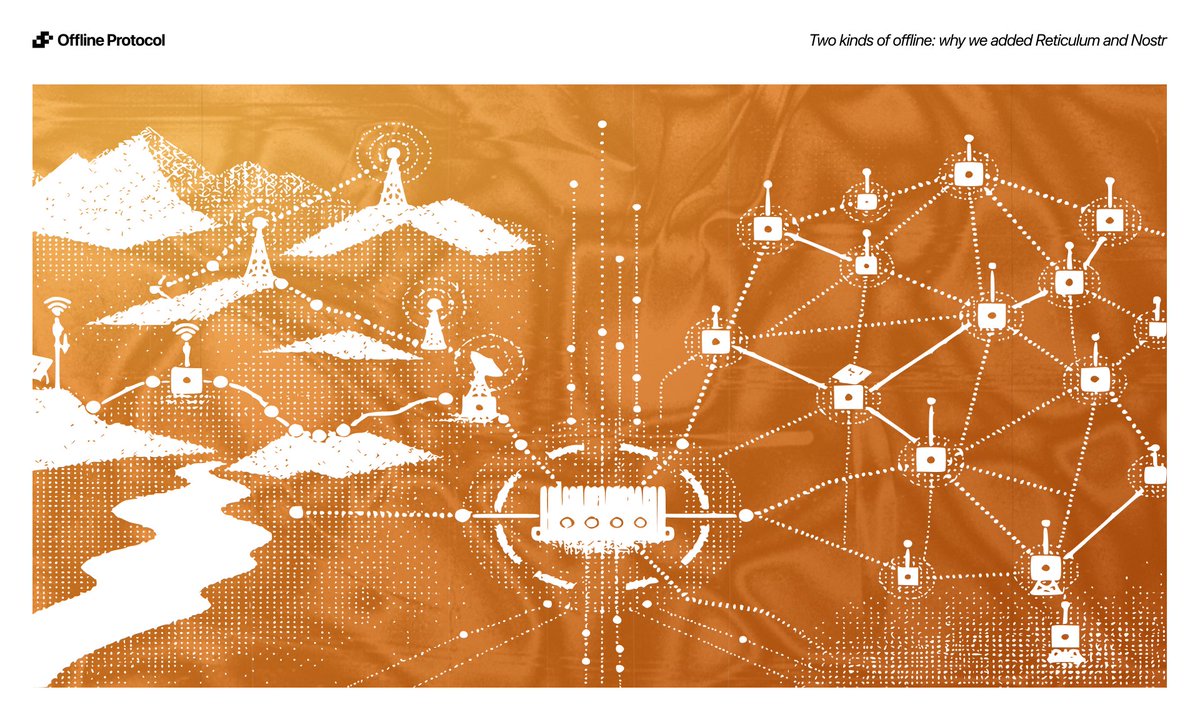
Not every form of disconnection looks the same. Sometimes there is no conventional network at all. Devices are separated by kilometers, infrastructure is damaged or absent, and short-range radios cannot close the distance. Other times, internet access exists, but the available route is filtered, fragile, centrally observable, or dependent on infrastructure the application does not control.
We added Reticulum and Nostr to our Mesh SDK to address both conditions.
Reticulum extends Offline Protocol into long-range and infrastructure-sparse environments through LoRa, serial, TCP, UDP, I2P, and other interfaces. Nostr adds a decentralized relay path across reachable internet infrastructure without requiring every application to depend on one central endpoint.
Together with Bluetooth LE, Wi-Fi Direct, and internet transport, applications now have five network paths behind one coordination layer for identity, routing, reliability, security, service discovery, and telemetry.
This infrastructure serves the systems being deployed today, but it is also built for what comes next. Agents, robots, drones, vehicles, sensors, and on-device models will need to discover, authenticate, exchange data, and coordinate across networks that change underneath them.
Read the technical deep dive: https://t.co/TRb5LB8ju0
Explore the open source SDK: https://t.co/SfxxKL7n1B
We are also opening a limited number of design-partner engagements for teams building with long-range radios, decentralized relays, remote telemetry, field systems, and bandwidth-constrained infrastructure: https://t.co/ubxWTDQp48
Seeker Summer cruises into Round 4 ☀️
Seek rewards with MINE by @OfflineProtocol ⛏️
The first Seeker Summer R4 Quests:
↳ Signal Found: Connect Seed Vault Wallet
↳ Start Digging: Mine the Mesh Network for 10 minutes
Live now in the Solana dApp Store.
A year ago, Offline Protocol was a thesis: software should not stop working when the internet disappears.
Currently, that thesis runs across 350,000+ devices in 80+ countries and 10,000+ active mesh clusters. Our SDK has crossed 9,000 downloads this year and now supports deployment paths across iOS, Android, Linux, macOS, and Windows.
Today, we are open sourcing the Mesh SDK behind it.
This is infrastructure for the present, but also for what comes next. As agents, robots, drones, vehicles, sensors, and on-device models multiply, billions of new peers will need to discover, verify, communicate, and coordinate without routing every local interaction through the cloud.
The disconnected edge needs a programmable peer layer for identity, privacy, transport, trust, and coordination. Offline Protocol is that layer, and now our infrastructure is open.
Read the full announcement: https://t.co/cNY7PvTHDU
Explore the SDK: https://t.co/SfxxKL7n1B
For companies looking to build with us, we are opening scoped design-partner evaluations for teams building mobile applications, wallets, logistics systems, remote telemetry, industrial devices, DePIN hardware, and bandwidth-constrained infrastructure. Reach out here: https://t.co/gHxe52fHyD
We internally announced a new round of funding today, and along with that a reminder for why we do what we do at Offline Protocol.
I can’t think of a better way to describe it:
Statement : The blocking of BitChat's code on GitHub is unconstitutional and authoritarian.
New Delhi, 24 July 2026
The Internet Freedom Foundation (IFF) condemns the order issued by the Indian Cyber Crime Coordination Centre (I4C), Ministry of Home Affairs, directing GitHub to remove the code repositories of BitChat.
The order, Notice No. 11072601011432, was issued at 11:16 pm on 23 July 2026 under Section 79(3)(b) of the Information Technology Act, 2000 read with Rule 3(1)(d) of the IT Rules, 2021. The order directs GitHub to disable access to three repositories, including the Android application and its release files, within three hours. It threatens the platform with loss of safe harbour and criminal prosecution. No copy was published by the Government of India. The public learnt of it from a post by @jack, whose team develops BitChat. Censorship in India now comes to light through disclosure by the censored.
Since 17 July 2026, the Ministry of Home Affairs has suspended mobile internet around Jantar Mantar as per public reports about five times, most recently within a 1.5 kilometre radius from 4 pm until midnight on 23 July. That radius takes in Janpath and parts of Connaught Place. Reports describe signal jammers at the protest site and people walking two kilometres before their phones work. Inside that zone a student separated from her group during a detention drive cannot send a message to say where she is. Thousands of students and young people have camped at Jantar Mantar since June, seeking accountability for examination irregularities. Permission for their march to Parliament was refused. Metro stations were shut and also internet connectivity has been blocked.
BitChat is an open source application built for exactly this situation. It passes messages from phone to phone over Bluetooth, without mobile networks or a central server. It is striking that the order does not identify a single unlawful message. It objects to what BitChat is. In its own words, the application is dangerous because it enables communication "even during network restrictions" and can "circumvent lawful restrictions" during "internet shutdowns". Hence, the government's objection is that citizens can speak to one another while it has switched the internet off.
The order is illegal on at least four grounds.
1. Section 79(3)(b) is not a blocking power. In Shreya Singhal v. Union of India (2015) 5 SCC 1, the Supreme Court read down the provision. Intermediaries may be required to act only on a court order, or a government notification confined to the grounds under Article 19(2) of the Constitution. Blocking is governed exclusively by Section 69A and the Blocking Rules, 2009, which require a hearing and reasons recorded in writing, subject to review. Directions issued under Section 79(3)(b), Rule 3(1)(d) and the Sahyog Portal evade these safeguards, and constitutional challenges to this parallel regime are pending before High Courts.
2. The reasons in the order are circular. The order asserts that the repositories contain "information which is prohibited under any law" without naming any such information, and rests on what the application is "capable of" enabling. Anticipated misuse of a communications tool is not a lawful basis to prohibit the tool. By this logic a telephone exchange could be sealed.
3. The order cites Section 43 of the IT Act, a civil compensation provision, alongside conspiracy and abetment offences under the Bharatiya Nyaya Sanhita, 2023, against a platform that hosts code.
4. A three hour deadline issued close to midnight forecloses legal assessment and recourse, and fails the proportionality standard in Anuradha Bhasin v. Union of India (2020) 3 SCC 637.
The order also fails on its own terms as deleting a repository does not delete the application from any phone that carries it, and the mesh keeps functioning without servers. What the takedown actually prevents is scrutiny of the underlying code.
IFF demands that the Government of India:
1. Withdraw Notice No. 11072601011432 dated 23 July 2026 issued to GitHub.
2. Publish every takedown direction issued under Section 79(3)(b), Rule 3(1)(d) and the Sahyog Portal, with the reasons recorded for each.
3. Restore full connectivity around Jantar Mantar, publish all suspension orders, and disclose the legal authority for the deployment of jammers.
We stand with the developers and the young protesters whose speech this order seeks to silence.