https://t.co/qNaGG5Ix1T
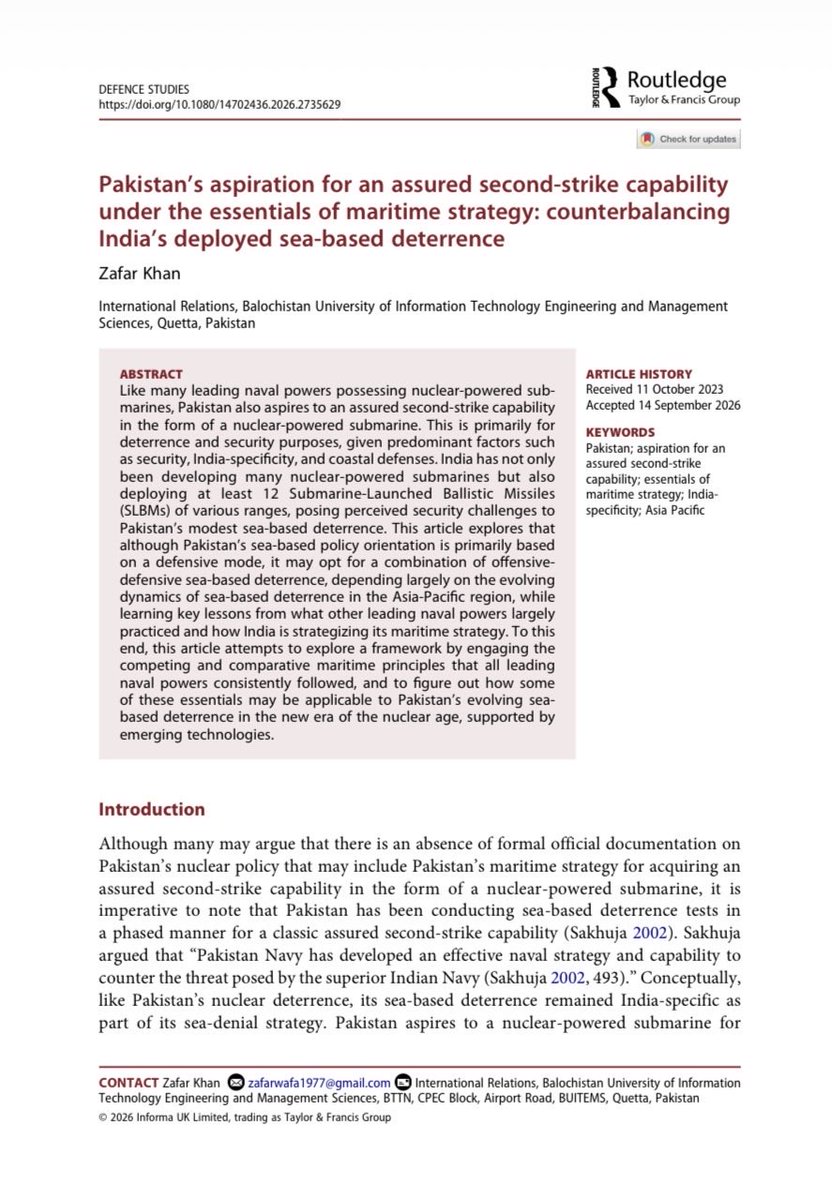
My new research article published in Defence Studies research journal. Of anyone's academic/ research interest?
"Pakistan’s aspiration for an assured second-strike capability under the essentials of maritime strategy: counterbalancing India’s deployed sea-based deterrence"
ABSTRACT
Like many leading naval powers possessing nuclear-powered submarines, Pakistan also aspires to an assured second-strike capability in the form of a nuclear-powered submarine. This is primarily for deterrence and security purposes, given predominant factors such as security, India-specificity, and coastal defenses. India has not only been developing many nuclear-powered submarines but also deploying at least 12 Submarine-Launched Ballistic Missiles (SLBMs) of various ranges, posing perceived security challenges to Pakistan’s modest sea-based deterrence. This article explores that although Pakistan’s sea-based policy orientation is primarily based on a defensive mode, it may opt for a combination of offensive-defensive sea-based deterrence, depending largely on the evolving dynamics of sea-based deterrence in the Asia-Pacific region, while learning key lessons from what other leading naval powers largely practiced and how India is strategizing its maritime strategy. To this end, this article attempts to explore a framework by engaging the competing and comparative maritime principles that all leading naval powers consistently followed, and to figure out how some of these essentials may be applicable to Pakistan’s evolving sea-based deterrence in the new era of the nuclear age, supported by emerging technologies.
#Defencestudies #security #research #academic #India #Pakistan #SLBMS #SSBNs
New publication | Defence Studies (Routledge)
Prof. Dr. Zafar Khan, Executive Director of BTTN, examines how Pakistan's sea-based deterrent may evolve as India expands and deploys its SSBN force.
📍The article develops a framework based on five essentials of maritime strategy used by leading naval powers: the security imperative, coastal defence, commerce warfare, power projection ashore, and the pursuit of an assured second-strike capability. It then assesses how each applies to Pakistan.
Key arguments:
📍Pakistan's aspiration for a nuclear-powered submarine rests on survivability and stability within Full-Spectrum Deterrence, a linchpin of credible minimum deterrence.
📍Coastal defence remains Pakistan's current posture. Indian advances in sea-based missiles, ASW and counterforce capabilities may push it toward a mixed offense-defense posture.
📍Commerce warfare carries escalation risks between nuclear-armed rivals that outweigh its potential gains.
📍The article attempts to explore a framework by engaging the competing and comparative maritime principles that all leading naval powers consistently followed, and to figure out how some of these essentials may be applicable to Pakistan’s evolving sea-based deterrence in the new era of the nuclear age, supported by emerging technologies.
Read the article: https://t.co/mV6PyKWbjX
#NuclearDeterrence #MaritimeStrategy #SouthAsia #Pakistan #AssuredSecondStrike #SSBN
🌍 Webinar| CISSAJK
CISS- AJK is inviting you to a scheduled Zoom meeting.
Topic: Arms control and Disarmament at a Crossroads
Time: Sep 17, 2026 10:00 AM Islamabad, Karachi, Tashkent
Join Zoom Meeting
https://t.co/YiOssM43Oa
Meeting chat link
https://t.co/oYMlseZuv1
Meeting ID: 861 9885 3881
Passcode: 611978
---
One tap mobile
+13863475053,,86198853881#,,,,*611978# US
+15074734847,,86198853881#,,,,*611978# US
---
Join by SIP
• [email protected]
Join instructions
https://t.co/SWG6m5M1XI
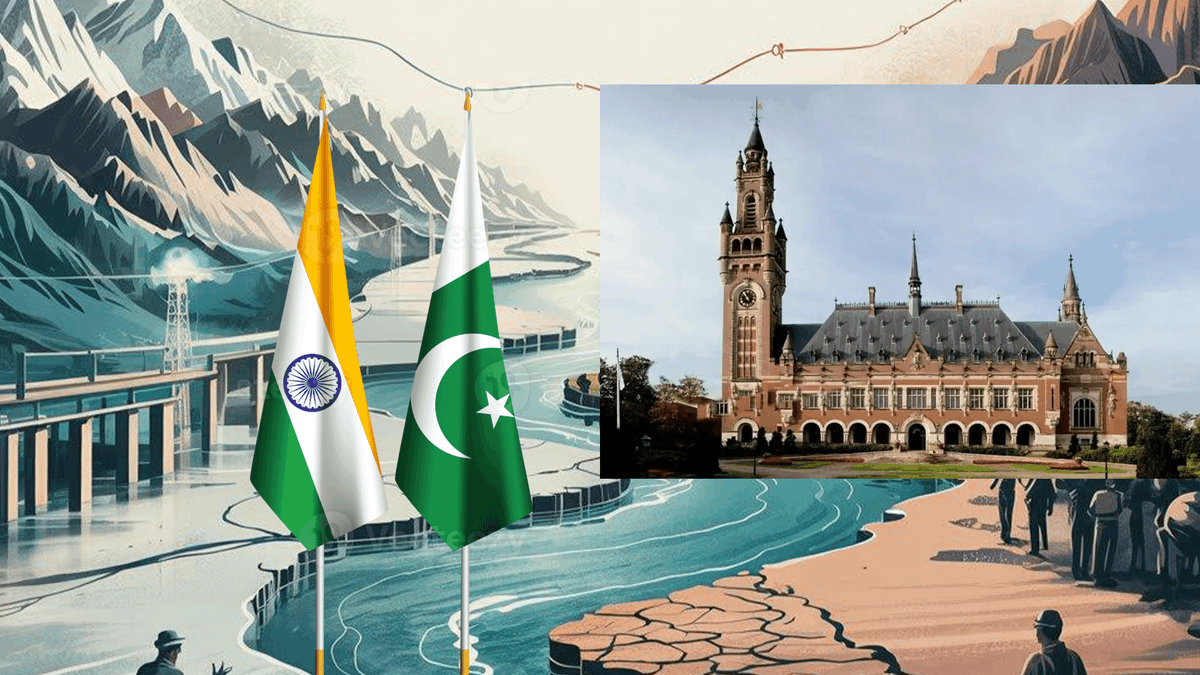
"Hubris and Revisionist India - Rejecting International Court of Arbitration Ruling on the IWT"
That said, this reflects India’s hubris and its power projection and dominance over others in the region, while undermining the credibility of other sovereign states, international treaties, obligations, etc.
Setting a bad precedent for international community.
India does not realize that it cannot simply withdraw from the IWT unilaterally, which could have grave geopolitical and geostrategic consequences in the broader region.
This may trigger the inevitability of another conflict between the South Asian nuclear rivals.
We have already the longstanding unresolved issues of Kashmir that has been a critical “nuclear flash point.”
IWT is becoming yet another “nuclear flash point.”
What is much more needed for India is to accept the international court ruling on this and rescind the unilateral abeyance of the IWT while moving forward to re initiate a dialogue process to help manage and resolve all outstanding issues including the core issue of Kashmir. There is no other way out between the two in the region.
#IWT #India #Water #conflict #risk #escalation
https://t.co/lG5xMaakZw
The article appears to be convincing, suggesting the US should not amass its nuclear weapons against both the perceived threats from Russia and China.
Along with other major nuclear weapon states, the US is not only modernizing its nuclear forces but also increasing them.
Nuclear weapons, advanced conventional forces, and emerging technologies, all inclusive, also trigger an arms race, crisis instability, and risk of escalation between the rivals. It may be wrong to assume that if the US does not increase its nuclear forces, others will stop as well.
If the US increases and modernizes its advanced conventional force capabilities, bolstered by emerging technologies, as this article suggests, it will also increase the chances of triggering an arms race between the US and others in the perceived-threat cycle.
The US advanced conventional force capabilities may be considered equivalent to the use of nuclear weapons and could make Russia and China more worried. This, in turn, could enable both China and Russia to develop asymmetric force capabilities to maintain a deterrence balance against the US. A strategic challenge to the US deterrent forces.
In any case, the evolving global nuclear order is not free from threat perception, rising deterrent forces, and the acquisition of emerging technologies that threaten one another in the system.
@CFR_org@ForeignPolicy
#Russia #China #US #technologies #nuclear #conventional #war #conflict
https://t.co/OgP7S7dDlz
“The Illusion of an Arms Control Regime between Great Competing Powers"
Since all major nuclear weapons states are engaged in the modernization of their conventional and nuclear forces across the full spectrum, it is hard to imagine the establishment/ institutionalization of an arms control regime between them very soon.
This article discusses the US's newer, broader arms-control negotiations that may include the US, Russia and China. These are the two nuclear states that the US perceives as security threats. Others are missing from the room.
The UK and France aren't even discussed, even though they're gearing up for deterrent-force modernization as well.
In such an evolving scenario, talks/ negotiations for robust arms control between these great powers, which possess large numbers of modernized conventional and nuclear forces, may not materialize soon.
Such, in turn, will have broader strategic implications for other nuclear weapons states, including aspirant nuclear weapon states in the system.
The evolving global nuclear order surely confronts challenges until all are level up for a robust arms control institutionalization.
@ForeignAffairs
#arms #races #US #Russia #China #regime #stability #nuclear
“India at the Peak of Its Hubris”
India simply cannot unilaterally abrogate the Indus Water Treaty (IWT).
India simply cannot escape reality.
Along with Kashmir, the IWT has now become a “nuclear flash point,” risking escalation out of control in South Asia.
The viable option for India will be to rescind its so-called and unacceptable unilateral abeyance of the IWT and move ahead with a grand dialogue process to help resolve all outstanding issues, including that of the core issue of Kashmir.
#India #IWT #Indus #river #Pakistan #Kashmir #nuclear #conflict #escalation
https://t.co/KKkGoDCbJJ
"A False Sense of Victory in South Asia"
My opinion analysis highlights both the false sense of victory of Pakistan's arch-rival India and the value of nuclear deterrence playing in the background of all crises and conflicts between India and Pakistan.
A few key points from the piece are presented below:
"Herman Kahn escalation ladder, where he placed nuclear escalation near the end. This may not apply to the South Asian nuclear dyad for several historical and geographical reasons.
Many wrongly perceive the essence and value of nuclear deterrence in an increasingly asymmetric strategic condition such as the classic case of India and Pakistan. Nuclear deterrence works. It often lurks in the background of all international and regional conflicts between the nuclear rivals. Nuclear rivals almost always remain cautious to avoid escalating a crisis to a dangerous level when credible forces are present."
While closely analyzing the competing views between conventional and nuclear deterrence, we often learn that conventional deterrence, in most cases, fails. The failure of conventional force deterrence remains dangerous and lethal in the nuclear dyad. One may recall John Mearsheimer’s seminal work “Conventional Deterrence,” where he argues, with convincing theoretical and empirical evidence, that conventional deterrence fails in most cases. Nuclear deterrence holds despite the risk of miscalculation and inadvertence. But fear of such accidental imperatives keeps two rivals cautious about crossing perceived red lines."
#India #Pakistan #SouthAsia #limitedwar #conflict
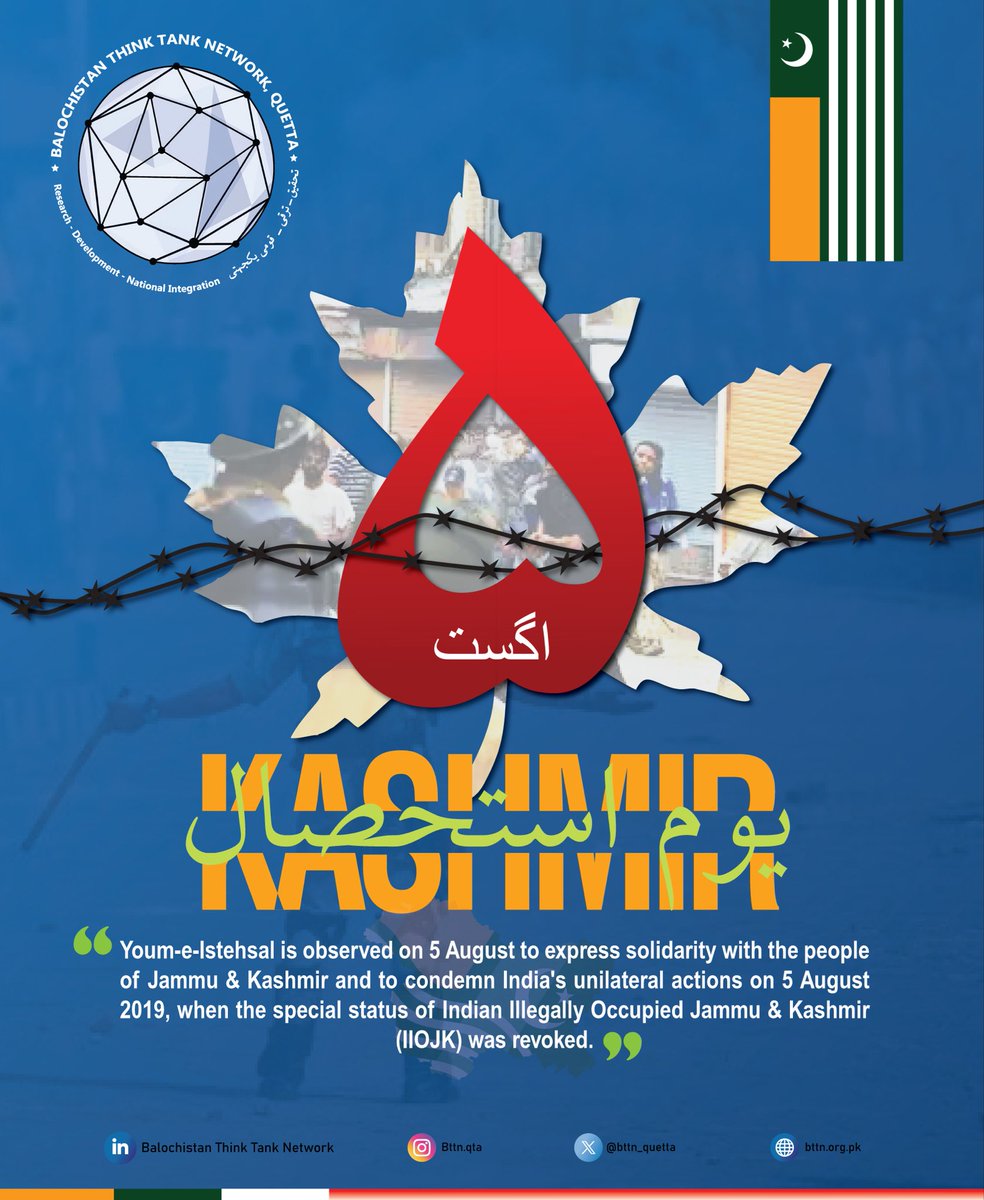
On 5 August 2019, the Indian Government unlawfully revoked the special status granted to the Jammu and Kashmir territory, which has remained under illegal Indian occupation since 1948.
Article 370 of the Indian Constitution granted Jammu and Kashmir a distinct constitutional arrangement under which the state had its own constitution, its own flag, and autonomy over all internal subjects.
Article 35A, added by a 1954 Presidential Order, was the companion provision. It empowered the state legislature to define “permanent residents” and reserve for them exclusive rights to immovable property, government employment, and state scholarships; effectively barring outsiders from acquiring land.
Both were hollowed out on 5 August 2019 by India in a move to consolidate its hold over Kashmir by force. The people of the Indian Occupied Kashmir continue their opposition to this unilateral move by India.
Pakistan's position on Kashmir is principled on the will of the Kashmiri people. A plebiscite, based on recurrent UNSC resolutions, reflecting the true aspirations of the people of Kashmir, should be held. That is the only peaceful way of resolving the dispute over Kashmir permanently.
#Kashmir #YoumEistehsal
On 5 August 2019, the Indian Government unlawfully revoked the special status granted to the Jammu and Kashmir territory, which has remained under illegal Indian occupation since 1948.
Article 370 of the Indian Constitution granted Jammu and Kashmir a distinct constitutional arrangement under which the state had its own constitution, its own flag, and autonomy over all internal subjects.
Article 35A, added by a 1954 Presidential Order, was the companion provision. It empowered the state legislature to define “permanent residents” and reserve for them exclusive rights to immovable property, government employment, and state scholarships; effectively barring outsiders from acquiring land.
Both were hollowed out on 5 August 2019 by India in a move to consolidate its hold over Kashmir by force. The people of the Indian Occupied Kashmir continue their opposition to this unilateral move by India.
Pakistan's position on Kashmir is principled on the will of the Kashmiri people. A plebiscite, based on recurrent UNSC resolutions, reflecting the true aspirations of the people of Kashmir, should be held. That is the only peaceful way of resolving the dispute over Kashmir permanently.
#Kashmir #YoumEistehsal
The reported #Kudankulam data breach raises serious questions about the cybersecurity of India's critical nuclear infrastructure. In the digital age, responsible nuclear stewardship requires strong cyber resilience—not just strategic rhetoric. #NuclearSecurity#CyberSecurity
Another reported breach. Another blow to India's #NuclearSecurity credibility.
If sensitive Kudankulam NPP documents can surface on the dark web, serious questions must be asked about the security of India's critical nuclear infrastructure.
#NationalSecurity#India#DarkWeb
Prime Minister of Pakistan Muhammad Shehbaz Sharif and Field Marshal Syed Asim Munir, NI (M), HJ, Chief of Army Staff (COAS) and Chief of Defence Forces (CDF) visit stalls at exhibition in the Indus RAS Expo 2026, Islamabad
#IndusRASExpo2026#ISPR
General Selçuk Bayraktaroğlu, Chief of the General Staff Türkiye, welcomed Field Marshal Syed Asim Munir, NI (M), HJ, Chief of Army Staff (COAS) and Chief of Defence Forces (CDF) of Pakistan, who is on an official visit to Ankara, #Türkiye
On arrival COAS & CDF was presented with a guard of honour by a tri services contingent of the Turkish Armed Forces
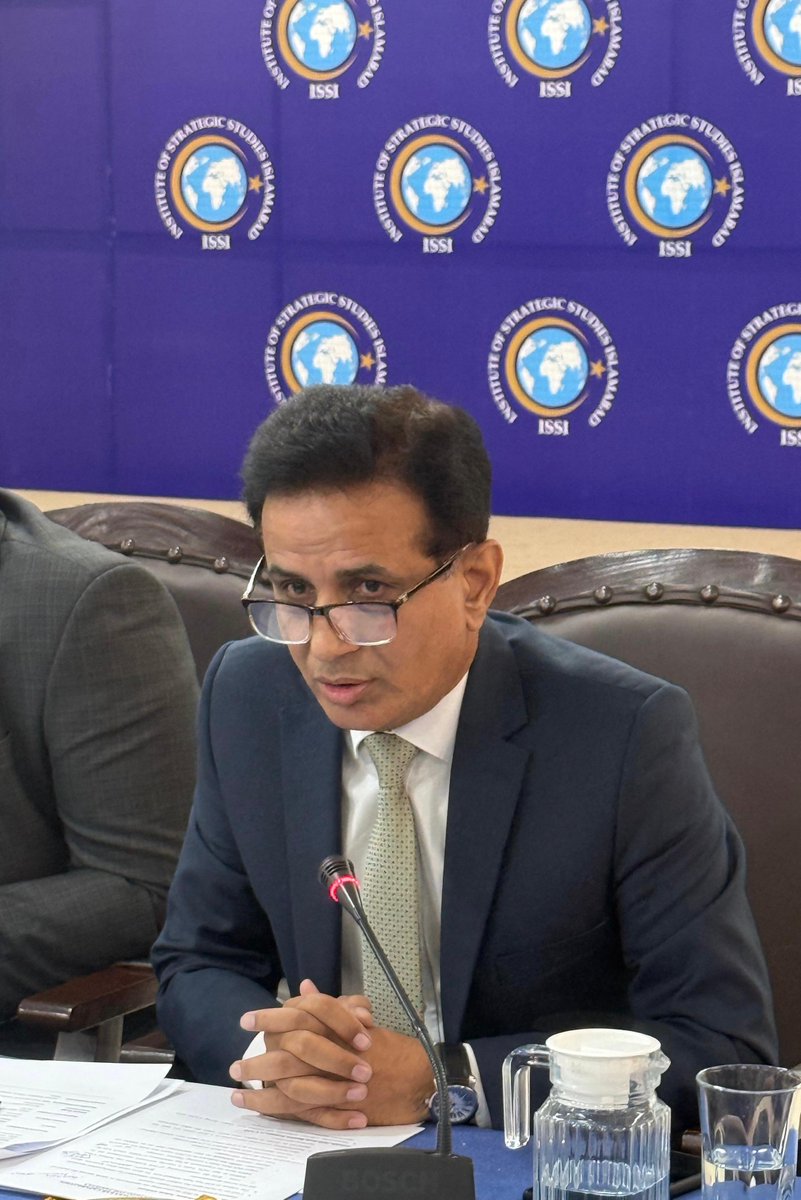
The Roundtable Discussion on "India's Sea-Based Nuclear Capabilities: Implications for Pakistan" has commenced at ISSI. Distinguished experts and policymakers are deliberating on the strategic, deterrence, and security implications of emerging maritime nuclear capabilities.
Dr. Aqeel Akhtar discussed the security dilemma of sea-based nuclear deterrence, highlighting challenges to command and control, crisis communication, and strategic stability. He emphasized strengthening secure communication systems preventing inadvertent escalation.
“Obsessed with the UFO Dream”
Obsessed with the same dream, she will find herself and tweet on the same day; there is no UFO at all.
No UFO, at least in her lifetime.
Since Brazil will beat Scotland, UFO stories will remain just a dream.
#Brazil #Scotland #FIFA #UFO #FIFAwourldcap2026
𝐂𝐈𝐒𝐒 𝐒𝐭𝐫𝐚𝐭𝐞𝐠𝐢𝐜 𝐅𝐨𝐫𝐞𝐜𝐚𝐬𝐭 | “𝐌𝐀𝐑𝐊𝐀-𝐄-𝐇𝐀𝐐” 𝐎𝐧𝐞 𝐘𝐞𝐚𝐫 𝐎𝐧: 𝐒𝐭𝐫𝐚𝐭𝐞𝐠𝐢𝐜 𝐋𝐞𝐬𝐬𝐨𝐧𝐬 𝐚𝐧𝐝 𝐄𝐦𝐞𝐫𝐠𝐢𝐧𝐠 𝐏𝐚𝐭𝐡𝐰𝐚𝐲𝐬
𝐄𝐬𝐜𝐚𝐥𝐚𝐭𝐢𝐨𝐧 𝐑𝐢𝐬𝐤 𝐌𝐚𝐭𝐫𝐢𝐱
The forecast highlights key escalation drivers and their risk-impact on occurrence of crisis in the region. From Kashmir as a nuclear flashpoint to use of dual-capable cruise missiles (BrahMos), the report highlights several important escalators. The matrix highlights how probability and strategic impact intersect to influence regional stability and escalation risks.
𝐑𝐞𝐚𝐝 𝐓𝐡𝐞 𝐅𝐮𝐥𝐥 𝐒𝐭𝐫𝐚𝐭𝐞𝐠𝐢𝐜 𝐅𝐨𝐫𝐞𝐜𝐚𝐬𝐭: https://t.co/9aZkjbBKHM
#MarkaeHaq #SouthAsia #Pakistan #India #Deterrence #StrategicStability #May2025Crisis
•
•
🔗𝐡𝐭𝐭𝐩𝐬://𝐜𝐢𝐬𝐬.𝐨𝐫𝐠.𝐩𝐤
🏛 𝐂𝐞𝐧𝐭𝐞𝐫 𝐅𝐨𝐫 𝐈𝐧𝐭𝐞𝐫𝐧𝐚𝐭𝐢𝐨𝐧𝐚𝐥 𝐒𝐭𝐫𝐚𝐭𝐞𝐠𝐢𝐜 𝐒𝐭𝐮𝐝𝐢𝐞𝐬
📘𝐅𝐨𝐥𝐥𝐨𝐰 𝐂𝐈𝐒𝐒: 𝐟 | 𝐗 | 𝐢𝐧 | 📸 | 📱
🚨 A cheap drone can produce an expensive crisis.
Drone warfare is now ecosystem warfare. Cyber + electronic warfare + disinformation turn strikes on energy grids, ports, refineries, and even nuclear perimeters into fast-escalating strategic crises, especially in nuclearized regions.
I explain why critical infrastructure has become the central arena of strategic competition and what it means for stability.
Fresh from @Valdai_Club 👇
https://t.co/KbULxfvSVn
#StrategicStability #CriticalInfrastructure #DroneWarfare #NuclearRisk #Geopolitics
@KomissarWhipla@dratiaalikazmi@RadioactiveFrnd@CSIS@ArmsControlWonk