Long range career advice. (Won't help you get a job tomorrow, this is a ~10-20 year thing)
You want to run two processes. Your main loop:
1. Knock on doors, many outside your league, and get yourself in a room with the most competent people who will have you.
2. Work your ass off to be reliably useful to them. Like, really, _really_ hard. However hard you think you're working to be reliably useful, work ten times harder. Also, be cheerful.
3. Every once in a while pop your head out and go to step 1.
Your background loop: look around for weird asymmetric opportunities. A startup to found/join, a project to hack on, an angel investment into a friend's company, whatever. When your heart sings, jump on it. (You will fail a lot but that's fine so long as you handle failure well, I'll cover that in another post)
In exchange for working really hard you get two things. First, knowledge/experience-- you learn a ton. Second, relationships-- ppl will remember how great it was to work with you. Knowledge and relationships with competent ppl create crazy asymmetric opportunities. You then jump on those. (There is a lot of twitter slop about compounding, well this is what career compounding looks like.)
---
Now some failure modes. Do _not_ do this:
"I deserve much better than this company/role, I'm just going to begrudgingly collect a paycheck" --> first, you deserve what the market clears and that's that. Second, if you act this way you'll only hurt yourself. Your colleagues will remember you as a grouch and it will wreck the compounding loop. Third, it's a very unpleasant state to be in, and you should choose not to be in it.
"But I work at Home Depot, what's there to compound?" --> that's extremely shortsighted. Maybe you do a super good job helping a customer who then has an open spot and remembers you. Maybe your store manager becomes a regional manager and calls you. Maybe years down the line your quiet peer is looking for a partner to start their own store. Maybe none of this happens, but it doesn't matter because empirically ppl who try hard to be useful wherever they are tend to do great, and people who don't, don't. (Home Depot is a metaphor, obviously)
"I hate this place, I quit! And anyway they're a faceless corporation that will lay me off any time." --> don't do that. The company may be a faceless corporation, but your colleagues are not faceless. They bet on you, hopefully you did a great job, and now they depend on you. Leaving is never easy, but do it in a way that respects the trust ppl put in you.
"Everyone around me is an idiot, I hate this!" --> maybe they are, or maybe you're not ready and some day will discover you were wrong about this. In any case you can learn from everyone and everything. So do that and be useful, don't break the compounding loop because opportunities will surprise you and things are often not what they seem.
“_I_ should have been promoted not that other guy/why is my manager layering me, screw this!” --> every time that happened i eventually understood I deserved it, you probably do too. Don’t hold grudges, do your best to figure out how to learn from this and move on, it will make sense eventually.
P.S. it helps if you’re a little talented.
The future of money is not paper. It is Digital Gold and Silver. Central banks will hoard the physical metals and issue 1:1 digital tokens for daily global transactions.
Physical vault ➔ Digital token ➔ Everyday transaction.
Prepare for fiat to lose all its value.
AI adoption is no longer a tech problem, it is a finance problem. The companies that figure out cost control and unit economics early on are the ones that will actually scale. #AI
LLM Knowledge Bases
Something I'm finding very useful recently: using LLMs to build personal knowledge bases for various topics of research interest. In this way, a large fraction of my recent token throughput is going less into manipulating code, and more into manipulating knowledge (stored as markdown and images). The latest LLMs are quite good at it. So:
Data ingest:
I index source documents (articles, papers, repos, datasets, images, etc.) into a raw/ directory, then I use an LLM to incrementally "compile" a wiki, which is just a collection of .md files in a directory structure. The wiki includes summaries of all the data in raw/, backlinks, and then it categorizes data into concepts, writes articles for them, and links them all. To convert web articles into .md files I like to use the Obsidian Web Clipper extension, and then I also use a hotkey to download all the related images to local so that my LLM can easily reference them.
IDE:
I use Obsidian as the IDE "frontend" where I can view the raw data, the the compiled wiki, and the derived visualizations. Important to note that the LLM writes and maintains all of the data of the wiki, I rarely touch it directly. I've played with a few Obsidian plugins to render and view data in other ways (e.g. Marp for slides).
Q&A:
Where things get interesting is that once your wiki is big enough (e.g. mine on some recent research is ~100 articles and ~400K words), you can ask your LLM agent all kinds of complex questions against the wiki, and it will go off, research the answers, etc. I thought I had to reach for fancy RAG, but the LLM has been pretty good about auto-maintaining index files and brief summaries of all the documents and it reads all the important related data fairly easily at this ~small scale.
Output:
Instead of getting answers in text/terminal, I like to have it render markdown files for me, or slide shows (Marp format), or matplotlib images, all of which I then view again in Obsidian. You can imagine many other visual output formats depending on the query. Often, I end up "filing" the outputs back into the wiki to enhance it for further queries. So my own explorations and queries always "add up" in the knowledge base.
Linting:
I've run some LLM "health checks" over the wiki to e.g. find inconsistent data, impute missing data (with web searchers), find interesting connections for new article candidates, etc., to incrementally clean up the wiki and enhance its overall data integrity. The LLMs are quite good at suggesting further questions to ask and look into.
Extra tools:
I find myself developing additional tools to process the data, e.g. I vibe coded a small and naive search engine over the wiki, which I both use directly (in a web ui), but more often I want to hand it off to an LLM via CLI as a tool for larger queries.
Further explorations:
As the repo grows, the natural desire is to also think about synthetic data generation + finetuning to have your LLM "know" the data in its weights instead of just context windows.
TLDR: raw data from a given number of sources is collected, then compiled by an LLM into a .md wiki, then operated on by various CLIs by the LLM to do Q&A and to incrementally enhance the wiki, and all of it viewable in Obsidian. You rarely ever write or edit the wiki manually, it's the domain of the LLM. I think there is room here for an incredible new product instead of a hacky collection of scripts.
If the man had even a little bit of brain, he would not have done what he did.
🚨 Power Cut on Wedding Day — For Refusing a Bribe? 🚨
Shubham Chauhan was dressed as a groom, his wedding procession just minutes away — when electricity officials allegedly arrived and cut off power to his home.
In front of guests and relatives, the family was left humiliated in darkness.
Shubham says he took a legal electricity connection two months ago and has paid every bill on time — with no dues pending.
His allegation: A local colonizer demanded a ₹30,000 bribe for the connection. When he refused, the power supply was disconnected on his wedding day.
⚡ The incident has sparked outrage across the colony, with residents protesting against the electricity department.
If true, this isn’t just corruption — it’s cruelty.
No family should face this on one of the most important days of their life.
Where is the rule of disobeying and harassing a person? You all must give your opinion.
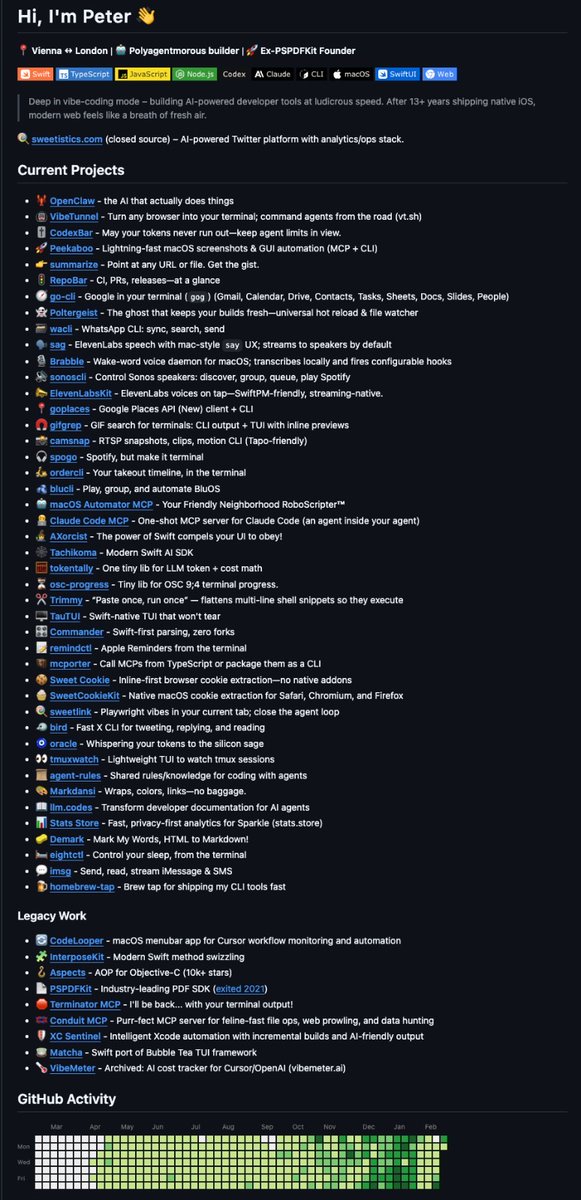
Ever wondered why OpenClaw went viral but many other similar projects didn’t?
Well, just look at the number of projects by OpenClaw’s creator.
Virality is a function of number of attempts. It’s so rare and unpredictable that your best bet is to maximize taking shots at it.
Same is true with tweets/videos. You’d see that the fastest growing accounts are those that produce a ton, and not those that keep perfecting a single thing that they hope to go viral.
@ShivAroor This is a terrible precedent. The Supreme Court of India is regarded as the final pedestal of justice and the ultimate interpreter of the Constitution.
Our Gen-Z is taking to Bhajan Clubbing...it is spirituality and modernity merging beautifully, particularly keeping in mind the sanctity of the Bhajans.
#MannKiBaat
I had put out a post at 2.43 PM on Jan 19th requesting CM Madam @gupta_rekha ji to take action against the reckless driver.
Within 24 hours, the culprit has been arrested and the CM madam has personally responded to my post.
Power of Social Media and our Voice. Thanks to everyone who helped amplify this.
Thanks madam & @DelhiPolice@dtptraffic sincerely for taking action.
Credit where due.
#FI
@whiskyy___818 While Basic Pay will change immediately, the hike to 25K is still a proposal likely to be taken up by the EPFO board in Dec/Jan. It was not part of the 21-Nov notification. Until that ceiling is officially raised, companies will continue to "cap" PF contribution at current limit.