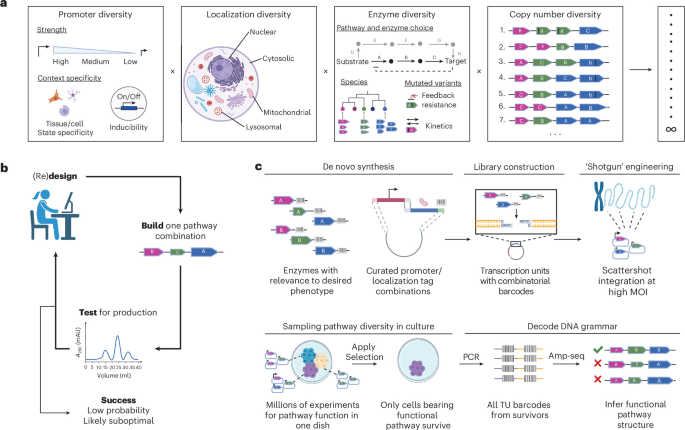
We are pleased to share a paper from our lab out in this week’s issue of @Nature, where we show that HT + ML can dramatically speed up the synbio DBTL cycles, profiling gene circuit design spaces at unprecedented scale: https://t.co/7FwDVN4259 (1/16)
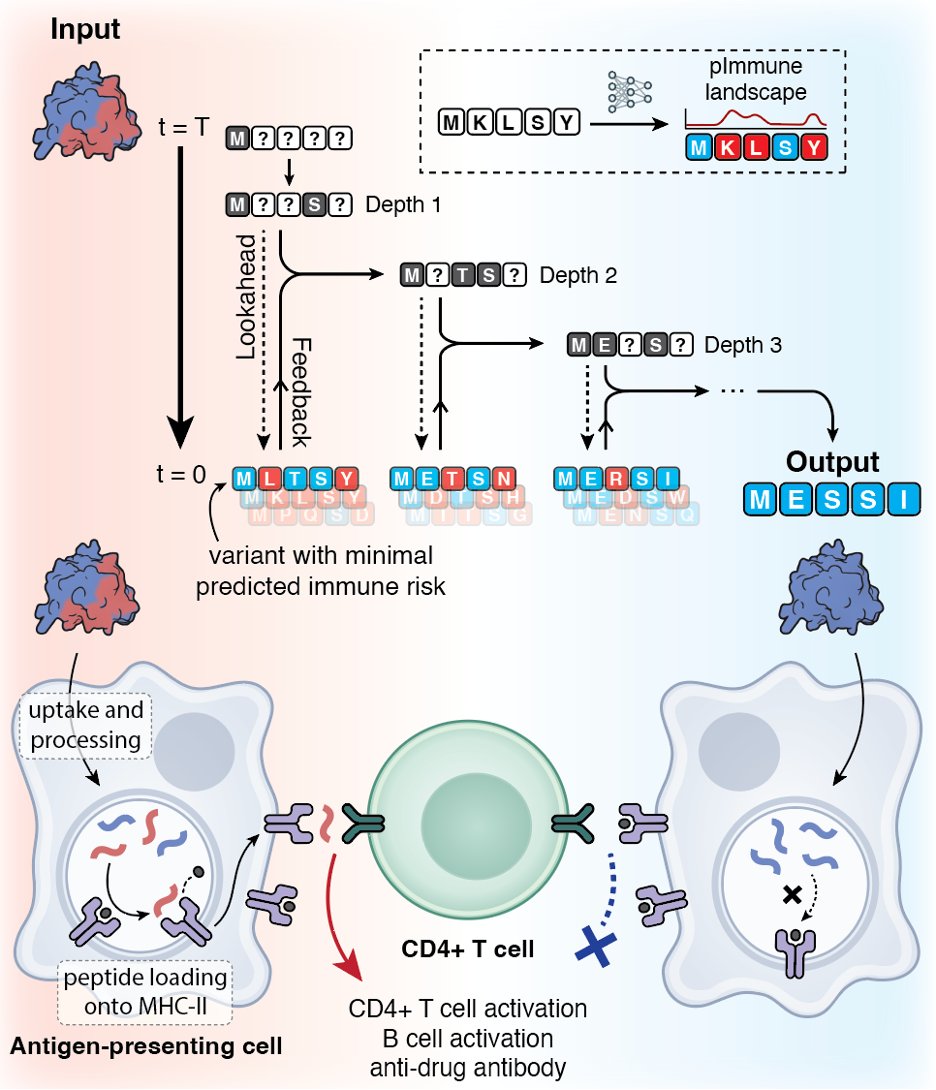
Generative protein design is transforming macromolecular drugs, but de novo designed therapeutics could still be hindered by immunogenicity in the clinics. Excited to introduce MESSI, a discrete diffusion model for generative protein deimmunization.
1/ Even bacterial communities can get caught in a bad romance they just can't get over.
A brief encounter with antibiotics can leave a lasting ecological memory of resistance plasmids persisting for weeks after the drug is gone. @DukeBiodesign@DukeUBME
https://t.co/3ONZLErPiu
There's going to be so much cheap lab automation equip. on LabX in 2 to 3 years, when either all these new self-driving AI wetlabs fold, or they realise that current lab automation equip. sucks for what they need to do.
AI in biology may have a data problem before it has a model problem.
It’s easy to use AI to make drug discovery faster & more efficient. The much harder challenge is discovering impactful medicines humans would never have found.
AI models are only as useful as the data they learn from, and it’s especially hard in biotech. The biggest and most valuable goals in AI in biotech are to cure diseases we haven’t been able to cure and design therapeutics capable of doing things that haven’t been possible before. By definition, these goals aren’t represented in our training data.
For our second essay at Waypoint Bio, we wrote about the data we think we’ll need to build out-of-distribution medicines: https://t.co/ewf9Gu4l53
Cell–cell interactions are key to all biological processes, but there hasn't been a good way to perform inter-cellular screens for genetic regulators of these interactions in vivo.
We developed match-seq (multiplexed associative tagging of cell interaction histories) - using engineered virus-like particles to transfer barcoded mRNAs from 'sender' to neighboring 'receiver' cells, so you can reconstruct cellular interactions with sequencing alone, no imaging required.
We coupled match-seq with CRISPR + scRNA-seq in cancer, revealing cancer-immune interaction neighborhoods at scale, and new cancer genes that can be targeted for tumor rejection via immune cell interactions.
Led by the brilliant @peterdu_ with Bassik lab!
https://t.co/qI2XQxId94
Excited to share our latest work, led by Surbhi Sharma! We study the kinetics of RNA localization to the outer mitochondrial membrane (OMM), building on our 2019 APEX-seq work showing that hundreds of RNAs go to the OMM for local translation. https://t.co/VyOlJedS3t
Excited our ratiometric transcriptional activation (RTA) work led by @Melissa_Gray234 is out online today @CellCellPress! Measurements determine what we can discover in biology; we use RTA to turn protein abundance changes into amplified signals.
https://t.co/3rRhr2pjhu
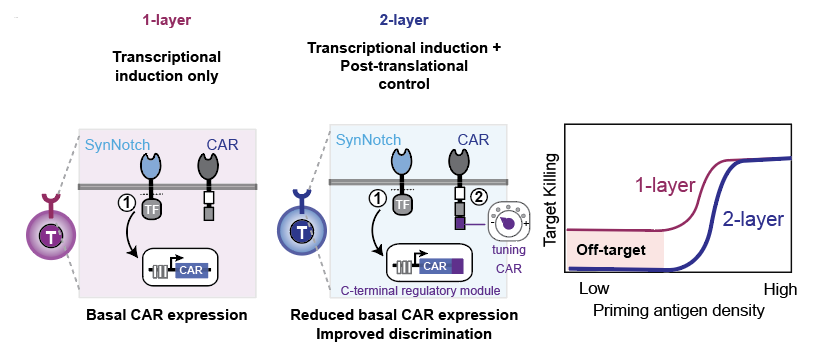
Excited to share our new preprint!
We asked how inducible SynNotch-CAR circuits can better discriminate on-target from off-target cells when they share similar antigens.
https://t.co/dhyD268yax
Congratulations to Daniel Hoces, Jaclyn Ng and Julian Perez!
1/ Let’s face it: we synthetic biologists are control freaks. We want every component to do exactly what we intend and nothing else.
Our new paper asks what happens if we stop fighting biological “messiness”.
@DukeBiodesign@DukeUBME
https://t.co/qpYqUt2pZ6
Controlling the transcription with the DNA… that stays outside of the cell? Introducing LUNAR, a chemogenetic receptor gated by DNA for sensing applications. This complex project was led by @BoaoXia with collaborators @aliceyting and @nkalogriopoulos.
https://t.co/b7lPBdFy2v
Excited to share our new preprint: RegFM, an interpretable context-aware foundation model for human transcriptional regulation. 🧬
There are already a lot scFMs and DNA FMs in the field. We ask: Can a genomic FM understand both DNA sequence and the underlying cellular context?
We've long wondered what gives NETs their branched architecture. Working with @SCWestLab, @DArmstrongJames we found that RAD51—a protein involved in DNA repair—promotes NET branching & stability, spatially restricting NETs to control type-2 inflammation.
https://t.co/BzYiRDW3kJ
Thrilled to post thread re: new single-cell lineage of mouse embryo reconstructed w/ DNA Typewriter. One animal, zygote to late organogenesis (E13.5). Tree has 1,340,794 transcriptionally profiled, annotated tips (cells), 1,142,588 dated internal nodes, rooted at zygote
1/n
Our review is now published in @NatureGenet! We cover all aspects of modeling regulatory genomics, from loss landscapes to OOD generalization to model interp to fixing generalization issues using perturbation data via active and continual learning!
https://t.co/ahYUsc2Gah
New Toettchlab paper alert! Harrison Oatman just published his beautiful work combining software design for "smart" microscopy+optogenetics and some really beautiful work understanding EGFR-driven collective cell migration.
https://t.co/fxniABYoFS