Economist and applied statistician.
Passionate about Python | BigData | MachineLearning | DeepLearning.
Believes in #Bitcoin.
Builds webapps with Streamlit.
We should first establish what the difference is between a blazer and a sport coat.
A sport coat is a tailored jacket made without a pair of pants cut from the same material. A blazer is a type of sport coat, typically solid navy (but not always) and always featuring metal buttons. All blazers are sport coats, but not all sport coats are blazers.
When can you wear a tie with a sport coat or blazer?
I think it helps to zoom out and consider what you're trying to communicate with the outfit.
In the first photo, we see John Updike in 1984, wearing a gray tweed sport coat, charcoal flannel trousers, a striped oxford cloth button-down, and an ancient madder tie. Each of these items derives from English country dress but has been filtered through American dress traditions (here, Ivy Style). Back in the day, this was considered a casual outfit for men who wore tailoring on a regular basis, as it was a step down from dark worsted suits.
Since our dress culture has become even more casual, men often want to dress down a tailored jacket with jeans. There are, of course, better and worse ways to do this. In the second photo, we see a common modern iteration: a gray suit jacket, a white dress shirt, a bright red tie, blue jeans, and sneakers. To me, this does not look as good as Updike's outfit, largely because the wearer here has created a sartorial mullet: all business up top, casual down bottom. It looks like one of those children's flip books where you mix and match random tops and bottoms for humorous effect. Or like the person spilled something on their dress pants and had to change out of them.
In the third photo, we see an improvement. Instead of wearing a gray worsted suit jacket (which requires suit pants), the person here has chosen a more rustic gray tweed, which is one step down in terms of formality. By choosing a more casual jacket, he's reduced the gap in formality between the top and bottom halves of his outfit. And in doing so, the outfit looks more coherent and harmonious.
However, for me, the tie dampens the success. Since a tie is a more formal accessory, you've once again created a sartorial mullet.
If you wear a sport coat or blazer with jeans, I think it's best to forgo the tie. There are two reasons for this.
First, I think it looks more effortless and less contrived. A man who walks out of the house in jeans may grab his tweed sport coat. But putting on the tie betrays effort and thus suggests contrivance.
Second, I think you create a more harmonious whole between the top and bottom halves of your outfit. Everything is made more casual: the tweed jacket, light blue shirt, blue jeans, and no tie.
Thus, to answer the question, I think ties look natural with suits and sport coats (which includes blazers). Also fine if a man arrived to an event wearing a suit and tie, but took off his jacket. But using a tie with a sport coat and jeans strikes me as creating two competing halves (the sartorial mullet). In other settings, such as denim jackets or whatever, a tie also strikes me as a fashion magazine contrivance.
🚨 Hoy ha pasado algo que casi nadie está explicando bien, y conviene que lo entiendas porque dice mucho de hacia dónde va esto.
Se ha lanzado Open USD (OUSD), una nueva stablecoin. Pero lo importante no es "otra stablecoin más"... es QUIÉN está detrás.
Más de 140 empresas que normalmente se pelean a muerte entre sí, juntas en el mismo proyecto: Visa, Mastercard, American Express, BlackRock, Google, Samsung, Stripe, Coinbase... y sí, Ripple también.
¿Y por qué se juntan todos? Aquí está la jugada, y es brillante.
Hasta ahora el negocio de las stablecoins funcionaba así: tú le das tu dinero a Circle (los de USDC), ellos emiten el token, y con TU dinero compran deuda de EEUU y se quedan ellos casi todo el rendimiento. Dinero gratis para el emisor.
OUSD le da la vuelta a la tortilla: el rendimiento se reparte entre las empresas que participan. La stablecoin deja de ser el negocio y pasa a ser solo la tubería. Un estándar compartido en vez de un emisor que se lo queda todo.
¿Y a quién le sienta esto como una patada? A Circle.
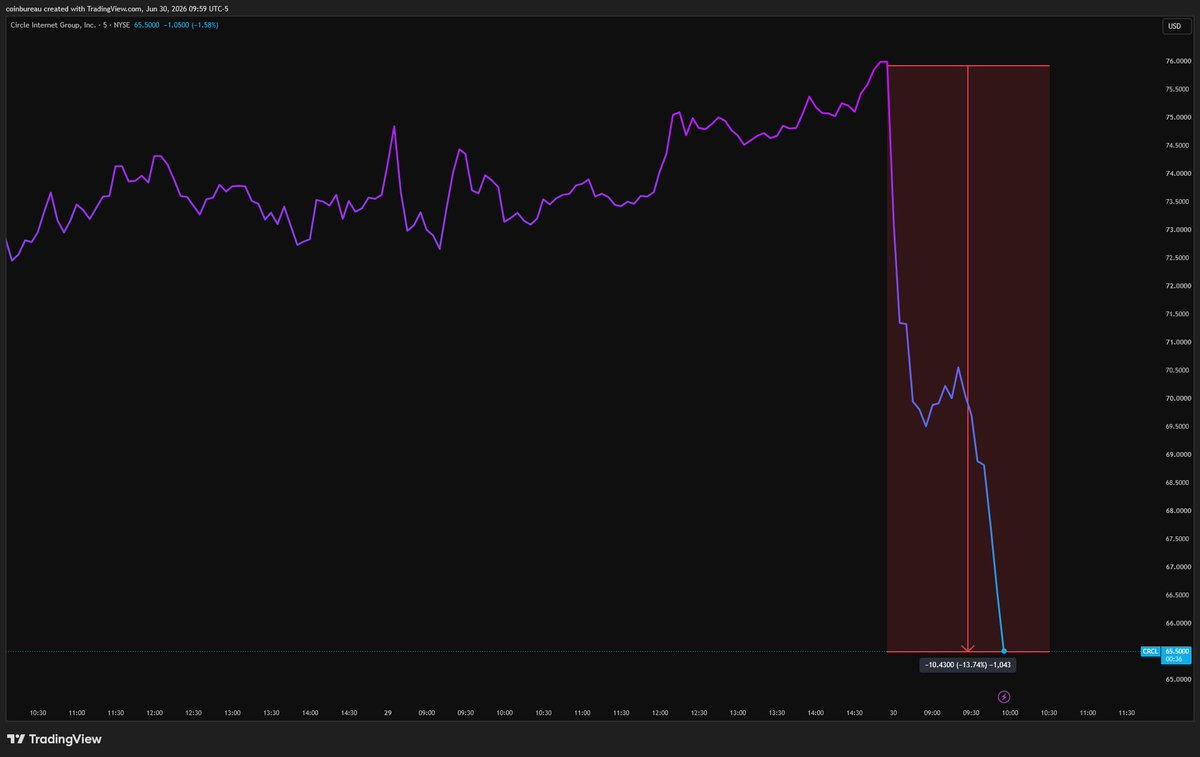
Hoy mismo sus acciones cayeron casi un 16%.
Ni Circle, ni Tether, ni PayPal están invitados a la fiesta. Normal.
Y ahora fíjate en quién dirige esto, porque lo explica TODO. El CEO de Open Standard (la empresa detrás de OUSD) es Zach Abrams, cofundador de Bridge. ¿Y qué es Bridge? La infraestructura de stablecoins que Stripe compró por 1.100 millones de dólares en 2024.
O sea: esto es, en el fondo, una jugada del ecosistema Stripe.
Por eso de entrada OUSD NO sale en todas partes. Sale nativo en Solana desde el día uno (donde Bridge ya tiene toda la fontanería montada y rodada) y en Tempo, que es la propia blockchain de pagos de Stripe.
No es casualidad ni ideología: lanzan donde el equipo fundador ya tiene la infraestructura funcionando.
¿Y las demás cadenas? Aquí te aviso, porque he visto a medios soltar alegremente "sale en Solana, Stellar, Base y Polygon".
Cuidado: eso NO lo ha confirmado Open Standard. Lo único sólido es Solana + Tempo el día uno. El resto es especulación de periodistas mirando qué cadenas están entre los socios.
No te lo creas hasta que salga la documentación técnica.
Y la cosa no estará del todo operativa hasta más adelante en 2026 — no hay fecha firme todavía.
Ahora, la pregunta que de verdad importa para nosotros: ¿qué pinta Ripple ahí?
Y aquí te voy a ser sincero, sin venderte humo: Ripple está en la lista de socios, pero eso NO significa que OUSD vaya a funcionar sobre la XRP Ledger.
La XRPL es, como mucho, un riel más entre varios posibles.
Y el centro técnico de todo esto no es la XRPL... es Bridge + Tempo, o sea, Stripe. Ripple está en la periferia estratégica, no en el núcleo.
Ripple está jugando a estar sentada en TODAS las mesas que importan.
Es estrategia de cobertura: "yo me pongo en todos los raíles posibles y ya veremos cuáles ganan". Inteligente, pero hay que llamarlo por su nombre.
Y ojo al detalle que nadie te va a decir, porque no vende: aunque OUSD acabara corriendo sobre la XRPL, las transacciones ahí cuestan fracciones de céntimo. Eso quemaría un goteo ridículo de XRP.
Que la red se use NO significa automáticamente que el token suba.
Lo llevo diciendo tiempo: una cosa es la utilidad de la red, otra muy distinta que ese valor llegue al token.
Resumen para que te lo lleves claro:
✅ Bueno para Ripple como empresa/infraestructura (está en la mesa de los grandes).
⚠️ Neutro para el precio de XRP a corto (el mecanismo que conecta uso → precio sigue siendo flojo).
💥 Muy malo para Circle (le acaban de montar una coalición en contra).
🏗️ Y en el fondo, esto huele a Stripe: su CEO viene de Bridge, sale en su cadena Tempo, y el núcleo técnico es suyo.
Esto va de raíles, no de tokens. Y el que entienda esa diferencia, va a leer este mercado mucho mejor que el que solo mira el precio.
¿Qué opináis? ¿Ripple cubriéndose las espaldas o tiene una carta que aún no enseña? 👇
I'm actually SHOCKED this Youtuber walked probably a few million people through the best way to view Bitcoin.
- Hold a portion of portfolio in Bitcoin
- Dollar cost average for years
- Tax-loss harvest when price is down
- Buy more during dips
- Don't panic during 80% price drop
He does hold ETFs but highlights how Real Bitcoin is better.
Great video @GrahamStephan
🚨 BREAKING:
MICHAEL BURRY, THE MAN WHO PREDICTED THE 2008 CRASH, JUST OPENED NEW SHORT POSITIONS:
$CAT: SHORT OPENED AT $1,060
$TSLA: SHORT OPENED AT $416
$AMAT: SHORT OPENED AT $729
$NVDA: $187M SHORT OPENED AT $198
HE PREDICTED THE 2008 CRASH AND MADE OVER $800 MILLION IN PROFIT
HE DEFINITELY THINKS A DUMP IS COMING...
Circle stock is absolutely COLLAPSING.
It's down 14% today!
Here's why:
Stripe, Coinbase, Visa, Mastercard, BlackRock & 140+ others just launched a rival stablecoin called Open USD.
It charges zero minting fees & hands the reserve yield back to partners.
That yield IS Circle's business model. This is an existential threat.
Codex has transformed how I run my companies.
I have almost 40 businesses, and trying to keep them all in my brain can be insane.
I own:
Software companies
Restaurants
Newspapers
Social networks
A coffee maker company
Each one has totally different context, business model, and sorts of people.
For two decades, I struggled to keep my arms around it.
I couldn't keep it all in my head.
I hated holding people to account.
Details slipped through the cracks.
And worst of all - the emotional labour became exhausting.
Now, each company or project is just a Codex thread with a heartbeat.
Every few days, the heartbeat activates. It reads all the latest context around the project and suggests next steps, then uses the multiple choice question tool to quickly get any information it needs to keep things moving out of my head.
It's made running a large, complex org downright delightful. Even the emotional labour:
"How would a good boss write this?"
"Write an email that will be psychologically compelling that will make someone who works in the accounting department understand why this project is important"
For years, I used to read management books, whipping myself.
It turns out I just have ADHD (diagnosed last year - thank god).
And now my ADHD brain is free to play, while the robot army keeps my teams on track.
I’m reading a book that’s so depressing that it has made me happy.
Its called 4000 Weeks. 4000 weeks is roughly the average human life.
The premise of the book is:
1. We’ll all die any minute now.
2. Time efficiency hacks just make you more busy.
3. Accept you can do very few things in life and commit to only a few things.
The last thing on commitment, I think is the most important:
“And not only should you settle: ideally, you should settle in a way that makes it harder to back out, such as moving in together, or getting married, or having a child.
The great irony of all our efforts to avoid facing finitude - to carry on believing that it might be possible not to have to choose between mutually exclusive options - is that when people finally do choose, in a relatively irreversible way, they're usually much happier as a result.
We'll do almost anything to avoid burning our bridges, to keep alive the fantasy of a future unconstrained by limitation, yet having burned them, we're generally pleased that we did so.”
Chamath spent $4M building a private research team, just so he could stay informed on energy.
He figured: If you’re going to allocate real capital, you need a prepared mind and high-quality information. This sort of research is expensive, so he systematized it.
Now, for $1K/year, any investor can get the same analyst digest that he’s using.
Learn more about how he got thousands of subscribers to pay for his information infrastructure through “Learn With Me.”
cc: @chamath, @jason
Ed Zitron @edzitron says AI compute demand is mostly debt, not customers.
The mechanism explained by @edzitron: AI labs buy compute on credit. Infrastructure companies (CoreWeave, Oracle) take those commitments to bond markets. The bonds fund more capacity. More capacity signals more demand. Nvidia sells into that "demand." Nvidia then backstops the infrastructure company.
On the bull side - Gavin Baker @GavinSBaker: 60-70% gross margins on AI inference.
Gavin Baker @GavinSBaker of Atreides ran the math on BG2 Pod: inference revenue exits 2026 above $200B, and he calls $300B a low estimate for 2027. His colleague Clark Tang tracked monetization per gigawatt rising from $20B to $30-40B in six months - in a fixed-cost business, that delta is near-pure margin.
The circular-financing map vs the bull demand case: https://t.co/RoGGbSGXDF
Source: The Monetary Matters Network - https://t.co/bLxqz3u494
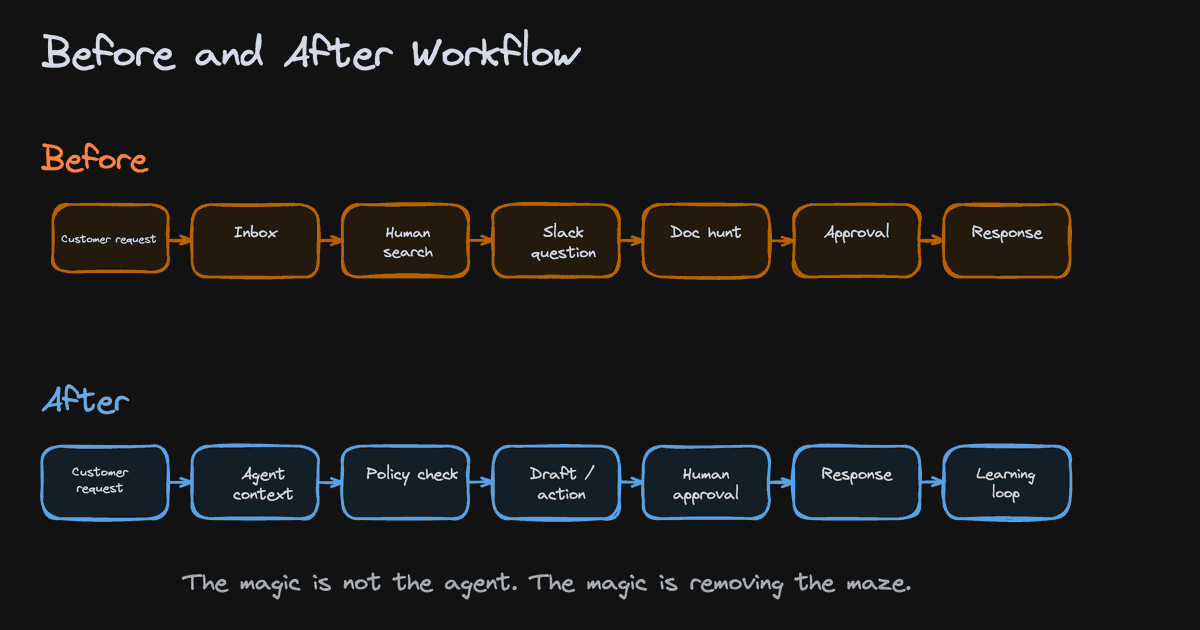
A friend asked me how to actually build a company that runs on AI agents.
I drew him 4 simple diagrams and this is what I told him:
For this to work, a few things have to be true.
- The humans move up to strategy, taste, and judgment while agents handle the execution.
- The whole business becomes readable to agents. Your data, SOPs, pricing, permissions, and decisions all live in one shared context layer.
- And you point it at the right work. Repetitive enough for an agent, complex enough that the incumbents never bothered. That's the goldmine.
In the old world, the company was the people. They held the knowledge, made the calls, did the work.
In this new world, the people become the creatives, the agents become the labor, and the company itself becomes the context layer.
That shared brain is the actual company now. The humans and the agents are just plugging into it.
Which means the most valuable thing you can build in 2026 is a business so well-documented that an agent can run it.
I see it everyday with @MeetLCA. I don't talk about it much publicly, but we've built a SWAT team for building AI-native orgs and AI-native products.
The moat is how legible your company is.
I drew it all out below.