I enjoyed the 4-week Maven course "AI Evals For Engineers & PMs" taught by @sh_reya and @HamelHusain. My biggest takeaway was the mental framework for approaching system traces. That gives me a flywheel for my personal app development. I also appreciate that the course has practical exercise along with cohort classes and a course reader.
Highly recommended! The discounted course link in comment below.
Welcome, AlphaChip!
Today, we are sharing some exciting updates on our work published in @Nature in 2021 on using reinforcement learning for ASIC chip floorplanning and layout. We’re also naming this work AlphaChip.
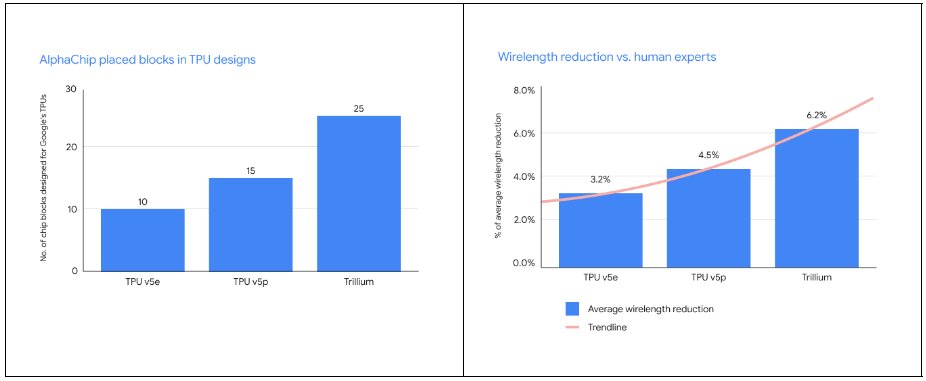
Since we first published this work, our use of this approach internally has grown significantly. It has now been used for multiple generations of TPU chips (TPU v5e, TPU v5p, and Trillium), with AlphaChip placing an increasing number of blocks and with larger wirelength reductions vs. human experts from generation to generation:
AlphaChip has also been used with excellent results for other chips across Alphabet, including Google’s Axion chip, an Arm-based general-purpose data center CPU.
In 2022, as a companion to the Nature paper, we open-sourced the code for the AlphaChip algorithms described in the Nature paper (see link below). Since then, external researchers could use this repository to pre-train on a variety of chip blocks and then apply the pre-trained model to new blocks, as was done and described in our original paper.
Today we’re also releasing a pre-trained AlphaChip checkpoint for the open source release that makes it easier for external users to get started using AlphaChip for their own chip designs.
Original Nature paper w/ wonderful joint first authors @Azaliamirh + @annadgoldie, and @mnyazgan, @joesmemory, @ESonghori, @ShenWangURC, @xylophi, @efjohnson, @pathomkar, @Azade_na, @PakJiwoo, Andy Tong, @kavyasrinivas23, @willhang_, @emretuncer, @quocleix, @JamesLaudon, @rh00, Roger Carpenter, and myself):
https://t.co/QmJA56ZKOE (PDF: https://t.co/HP7y1LhAh4)
Today’s Addendum to the paper published in Nature: https://t.co/BuGacrq57J (same authors)
AlphaChip blog post: https://t.co/oLBq1J8oXj
Open source release: https://t.co/cW1YMSHI57
Pre-trained checkpoint: https://t.co/iXtLqEjsH3
Three things we have observed in the external community are described in the Nature Addendum: (1) not doing any pre-training (circumventing the learning aspects of our method by removing its ability to learn from prior experience) (2) not training to convergence (standard practice in ML methods), and (3) using fewer computational resources than described in our Nature paper (using fewer resources is likely to harm performance, or require running for considerably longer to achieve the same performance).
Pre-training the model for it to learn the craft of chip layout and to be able to generalize to new designs is an important part of our method. The pre-training process requires some effort to perform, since one has to find representative blocks and then run a lengthy computational process to pre-train the model to be good at placing those blocks. To avoid external users having to perform this process and make it easier for the external community to use AlphaChip, today we are releasing an AlphaChip model checkpoint pre-trained on 20 TPU blocks. This will enable users to get good zero-shot performance and faster convergence for novel blocks right out of the box. (For best results, however, we continue to recommend that developers pre-train on their own in-distribution blocks, and we provide a tutorial on how to perform pre-training with our open-source repository: see the Addendum).
Many organizations have used AlphaChip as a building block for their own chip design efforts. For example, MediaTek, one of the top chip design companies in the world, extended AlphaChip to accelerate development of their most advanced chips (e.g. the Dimensity Flagship 5G used in Samsung mobile phones), while improving power, performance and chip area.
We’re very excited about the increasing impact of AlphaChip internally and externally, and we look forward to continued work in this space to make custom higher performance, more efficient, and more capable chips dramatically easier to design and build.
But seriously folks, this a short and juicy tirade in which I say:
(0) there will be superhuman AI in the future
(1) they will be under our control
(2) they will not dominate us nor kill us
(3) they will mediate all of our interactions with the digital world
(4) hence, they will need to be open platforms so that everyone can contribute to training and tuning them.
@TwitterBlue Is there a plan to have Top Articles shared in your network over the last week? My network is a bit too small and on Nuzzel I found the rolling weekly most shared articles more useful.
I teamed up with @MJA_Editor to explain that countries like Australia need to race to get the vaccine out ASAP.
Recent data shows that COVID is more deadly than we thought, and is becoming so transmissible that lockdowns may fail to stop the spread 🧵1/
https://t.co/03PSDSCnvX
Dear Media,
What’s happening with RobinHood?
A quick primer.
This is a “plumbing” issue. It is esoteric, even for those on Wall Street.
A very long thread on how the toilet is clogged.🚽🧻🪠
Read on
👇👇👇💎💎💎🚀🚀🚀👇👇👇
THREAD: Yesterday, I spoke with doctors from one of the nation’s leading academic hospitals located in a state where #COVID19 cases are increasing quickly. This is what they told me: They've been seeing *many* patients with symptoms concerning for COVID19 who need testing (1/x)