The “wedge” is helpful for early founders as a permission structure to do something narrow and real instead of big and fake.
Founders underestimate how big of a business the wedge alone can become, and overestimate how much they can / need to predict past it.
FT Exclusive: Ken Griffin’s Citadel swooped in to buy a large portion of hedge fund Situational Awareness’ $16bn public equity holdings after former OpenAI employee Leopold Aschenbrenner’s investment firm endured steep losses in the AI sell-off. https://t.co/zhSlP9yOvZ
Introducing Rook by @Hop_Aero (YC S26): an autonomous hypersonic cargo rocket that delivers 550 lbs up to 450 miles in ~15 minutes.
It launches from a standard 40-foot shipping container and lands on unprepared surfaces—no runways or fixed infrastructure required.
I think this is true - the way Holly handles remote work is being as close to the customer as possible.
Velocity comes from proximity, whether that’s the team or the customer. Having neither is no man’s land.
I have now learned that <10% of humans perform better working from home.
10-20% are as good working from home
75-80%+ perform better at the office
90% of founders/managers are better at leading in-office — 10% are capable of managing primarily remote teams
What’s your first-hand experience?
In late May, @NYCMayor launched the Commission on Government Efficiency (COGE) with a goal of making city government "work smarter, faster, and more effectively for working people."
It's the kind of challenge @TechNYC's Grid Fellowship is designed to explore. The program gives tech founders, investors, and senior executives an inside look at how New York City government works, building a pipeline of civic-minded leaders equipped with the networks and knowledge to help make it work better.
Tech:NYC Grid Fellow @YoussefKalad partnered with Holly founder @BEHellweg on a new @CrainsNewYork op-ed, arguing that modernizing New York's civil service is one of the biggest opportunities to build a more effective city government.
Read the op-ed here: https://t.co/rTwvurvdD8
In late May, @NYCMayor launched the Commission on Government Efficiency (COGE) with a goal of making city government "work smarter, faster, and more effectively for working people."
It's the kind of challenge @TechNYC's Grid Fellowship is designed to explore. The program gives tech founders, investors, and senior executives an inside look at how New York City government works, building a pipeline of civic-minded leaders equipped with the networks and knowledge to help make it work better.
Tech:NYC Grid Fellow @YoussefKalad partnered with Holly founder @BEHellweg on a new @CrainsNewYork op-ed, arguing that modernizing New York's civil service is one of the biggest opportunities to build a more effective city government.
Read the op-ed here: https://t.co/rTwvurvdD8
My boutique proposal for DC representation is to create 50 equal mini-districts in DC that map to and vote in each state, and Senators all receive residences in their respective mini-district.
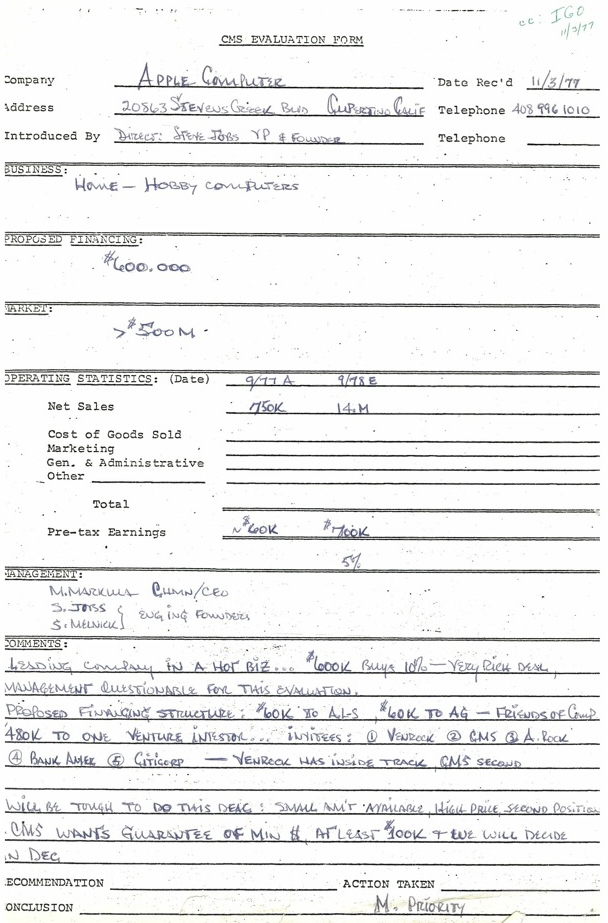
In honor of 50 years of Apple, we're sharing - for the first time ever - Don Valentine's original 1977 memo for Sequoia's investment into Apple Computer. #Apple50
Governments are the world’s largest creator of unstructured data. LLMs thrive here.
Governments are the largest sector of the US economy. The TAM is obvious.
Incumbents should be ashamed of the products they sell into government.
There’s no better place to build today.
AI for Government
@t_blom
AI has made submitting forms dramatically easier, but governments still process many of them by hand.
There’s a major opportunity for AI-native tools that modernize government operations—hard to sell, but powerful once adopted.