Will keep saying this, but software jobs aren’t going away. Agents are the single biggest form of leverage for anyone technical in history. Probably has never been a better time to be technical in terms of being able to accomplish something solo, in a team, or company.
We think that most of the world’s software has already been built and that agents will just reduce work from an existing pie. In fact, we are about to experience 100X more software than before.
Think about how many apps you regularly use that need to get better. How many legacy on prem systems that have to get replatformed for the cloud. How many SMBs never could hire developers. How many security issues are about to be uncovered and need to get patched. How many IT organizations are about to bring automation to workflows they never could have automated. How much data is about to processed and connected in most organizations. This is all what the agents will be working on.
And every one of those agents will need a person to kick them off, manage their work, orchestrate them, and get their output into a workable and useful form. That person will generally need to be technical (or become technical quickly), and this will create a huge amount of opportunity for anyone up to the task.
new model for engineering team structure in 2026:
2 people only
one pirate and one architect
the pirate's job is to move as fast as possible to develop valuable, shipped product features by vibe coding.
the architect's job is to turn the product surface discovered by the pirate into a reliable, structured machine—also by vibe coding, but at a slower, more well-reasoned pace.
every product needs a pirate but most product's only need an architect once they some form of PMF, and in that case they usually don't need one full-time. architects can work across many codebases and solve interesting technical challenges. pirates go hard on a product that they own end-to-end.
“Every function has become engineering”… so figuring out what engineering fundamentals I need to learn now would be amazing
Eg data engineering seems to be underrated to making these new apps useful / fast
would love someone at a frontier lab (or @karpathy) to record a modern CS 101.
the already-technical have grown 10 arms.
the net-new vibe coder can ship, but the fog of war is real.
this + https://t.co/Su0SOM20WH have been super helpful for leveling up my designs...
pretty impressed with /skills as a low friction high impact way to transfer domain knowledge just by knowing the right words to use
you can instantly 10x your vibecoded frontends by just learning what different ui components are called
ofc opus is creating generic slop, the only words you know are menu and button.
“As a result, Cursor is no longer primarily about writing code. It is about helping developers build the factory that creates their software”
I wonder what this will look like for software in other functions (eg GTM, Finance, Ops)?
It is hard to communicate how much programming has changed due to AI in the last 2 months: not gradually and over time in the "progress as usual" way, but specifically this last December. There are a number of asterisks but imo coding agents basically didn’t work before December and basically work since - the models have significantly higher quality, long-term coherence and tenacity and they can power through large and long tasks, well past enough that it is extremely disruptive to the default programming workflow.
Just to give an example, over the weekend I was building a local video analysis dashboard for the cameras of my home so I wrote: “Here is the local IP and username/password of my DGX Spark. Log in, set up ssh keys, set up vLLM, download and bench Qwen3-VL, set up a server endpoint to inference videos, a basic web ui dashboard, test everything, set it up with systemd, record memory notes for yourself and write up a markdown report for me”. The agent went off for ~30 minutes, ran into multiple issues, researched solutions online, resolved them one by one, wrote the code, tested it, debugged it, set up the services, and came back with the report and it was just done. I didn’t touch anything. All of this could easily have been a weekend project just 3 months ago but today it’s something you kick off and forget about for 30 minutes.
As a result, programming is becoming unrecognizable. You’re not typing computer code into an editor like the way things were since computers were invented, that era is over. You're spinning up AI agents, giving them tasks *in English* and managing and reviewing their work in parallel. The biggest prize is in figuring out how you can keep ascending the layers of abstraction to set up long-running orchestrator Claws with all of the right tools, memory and instructions that productively manage multiple parallel Code instances for you. The leverage achievable via top tier "agentic engineering" feels very high right now.
It’s not perfect, it needs high-level direction, judgement, taste, oversight, iteration and hints and ideas. It works a lot better in some scenarios than others (e.g. especially for tasks that are well-specified and where you can verify/test functionality). The key is to build intuition to decompose the task just right to hand off the parts that work and help out around the edges. But imo, this is nowhere near "business as usual" time in software.
I'm Boris and I created Claude Code. I wanted to quickly share a few tips for using Claude Code, sourced directly from the Claude Code team. The way the team uses Claude is different than how I use it. Remember: there is no one right way to use Claude Code -- everyones' setup is different. You should experiment to see what works for you!
A few random notes from claude coding quite a bit last few weeks.
Coding workflow. Given the latest lift in LLM coding capability, like many others I rapidly went from about 80% manual+autocomplete coding and 20% agents in November to 80% agent coding and 20% edits+touchups in December. i.e. I really am mostly programming in English now, a bit sheepishly telling the LLM what code to write... in words. It hurts the ego a bit but the power to operate over software in large "code actions" is just too net useful, especially once you adapt to it, configure it, learn to use it, and wrap your head around what it can and cannot do. This is easily the biggest change to my basic coding workflow in ~2 decades of programming and it happened over the course of a few weeks. I'd expect something similar to be happening to well into double digit percent of engineers out there, while the awareness of it in the general population feels well into low single digit percent.
IDEs/agent swarms/fallability. Both the "no need for IDE anymore" hype and the "agent swarm" hype is imo too much for right now. The models definitely still make mistakes and if you have any code you actually care about I would watch them like a hawk, in a nice large IDE on the side. The mistakes have changed a lot - they are not simple syntax errors anymore, they are subtle conceptual errors that a slightly sloppy, hasty junior dev might do. The most common category is that the models make wrong assumptions on your behalf and just run along with them without checking. They also don't manage their confusion, they don't seek clarifications, they don't surface inconsistencies, they don't present tradeoffs, they don't push back when they should, and they are still a little too sycophantic. Things get better in plan mode, but there is some need for a lightweight inline plan mode. They also really like to overcomplicate code and APIs, they bloat abstractions, they don't clean up dead code after themselves, etc. They will implement an inefficient, bloated, brittle construction over 1000 lines of code and it's up to you to be like "umm couldn't you just do this instead?" and they will be like "of course!" and immediately cut it down to 100 lines. They still sometimes change/remove comments and code they don't like or don't sufficiently understand as side effects, even if it is orthogonal to the task at hand. All of this happens despite a few simple attempts to fix it via instructions in CLAUDE . md. Despite all these issues, it is still a net huge improvement and it's very difficult to imagine going back to manual coding. TLDR everyone has their developing flow, my current is a small few CC sessions on the left in ghostty windows/tabs and an IDE on the right for viewing the code + manual edits.
Tenacity. It's so interesting to watch an agent relentlessly work at something. They never get tired, they never get demoralized, they just keep going and trying things where a person would have given up long ago to fight another day. It's a "feel the AGI" moment to watch it struggle with something for a long time just to come out victorious 30 minutes later. You realize that stamina is a core bottleneck to work and that with LLMs in hand it has been dramatically increased.
Speedups. It's not clear how to measure the "speedup" of LLM assistance. Certainly I feel net way faster at what I was going to do, but the main effect is that I do a lot more than I was going to do because 1) I can code up all kinds of things that just wouldn't have been worth coding before and 2) I can approach code that I couldn't work on before because of knowledge/skill issue. So certainly it's speedup, but it's possibly a lot more an expansion.
Leverage. LLMs are exceptionally good at looping until they meet specific goals and this is where most of the "feel the AGI" magic is to be found. Don't tell it what to do, give it success criteria and watch it go. Get it to write tests first and then pass them. Put it in the loop with a browser MCP. Write the naive algorithm that is very likely correct first, then ask it to optimize it while preserving correctness. Change your approach from imperative to declarative to get the agents looping longer and gain leverage.
Fun. I didn't anticipate that with agents programming feels *more* fun because a lot of the fill in the blanks drudgery is removed and what remains is the creative part. I also feel less blocked/stuck (which is not fun) and I experience a lot more courage because there's almost always a way to work hand in hand with it to make some positive progress. I have seen the opposite sentiment from other people too; LLM coding will split up engineers based on those who primarily liked coding and those who primarily liked building.
Atrophy. I've already noticed that I am slowly starting to atrophy my ability to write code manually. Generation (writing code) and discrimination (reading code) are different capabilities in the brain. Largely due to all the little mostly syntactic details involved in programming, you can review code just fine even if you struggle to write it.
Slopacolypse. I am bracing for 2026 as the year of the slopacolypse across all of github, substack, arxiv, X/instagram, and generally all digital media. We're also going to see a lot more AI hype productivity theater (is that even possible?), on the side of actual, real improvements.
Questions. A few of the questions on my mind:
- What happens to the "10X engineer" - the ratio of productivity between the mean and the max engineer? It's quite possible that this grows *a lot*.
- Armed with LLMs, do generalists increasingly outperform specialists? LLMs are a lot better at fill in the blanks (the micro) than grand strategy (the macro).
- What does LLM coding feel like in the future? Is it like playing StarCraft? Playing Factorio? Playing music?
- How much of society is bottlenecked by digital knowledge work?
TLDR Where does this leave us? LLM agent capabilities (Claude & Codex especially) have crossed some kind of threshold of coherence around December 2025 and caused a phase shift in software engineering and closely related. The intelligence part suddenly feels quite a bit ahead of all the rest of it - integrations (tools, knowledge), the necessity for new organizational workflows, processes, diffusion more generally. 2026 is going to be a high energy year as the industry metabolizes the new capability.
Deployed @openclaw in under 5 minutes on AWS free tier.
Open source personal AI. Full system access.
Interfaces through WhatsApp, Discord, Telegram.
People are rigging it to their Ray-Bans for real-time price comparisons.
One command. That's it.
"That's what I think is the most interesting thing here. I can't categorically call myself non-technical but I also can't call myself a programmer. Nor would I want to. I'm part of this new technical class and I don't know what it's called."
fun to figure this out live!
I spent a week with Riley Walz. He's an internet prankster responsible for:
- creating a fake 5 star steakhouse in NYC
- cloning GSuite to make the Epstein docs accessible
- reverse engineering government APIs to track SF parking cops and the tickets they give out
It's clear that he operates on a different level when it comes to idea generation and execution. He's a sh*t disturber that's been poking holes in the world since he was a kid.
Now, he antagonizes governments and companies daily just to make data more fun to look at. He has no agenda: he's purely just having way too much fun.
I wrote more about how he does it and why people flock to him.
https://t.co/o7I541ZEIS
First big project i've been been cooking up at @a16z... excited to share:
a16z Build
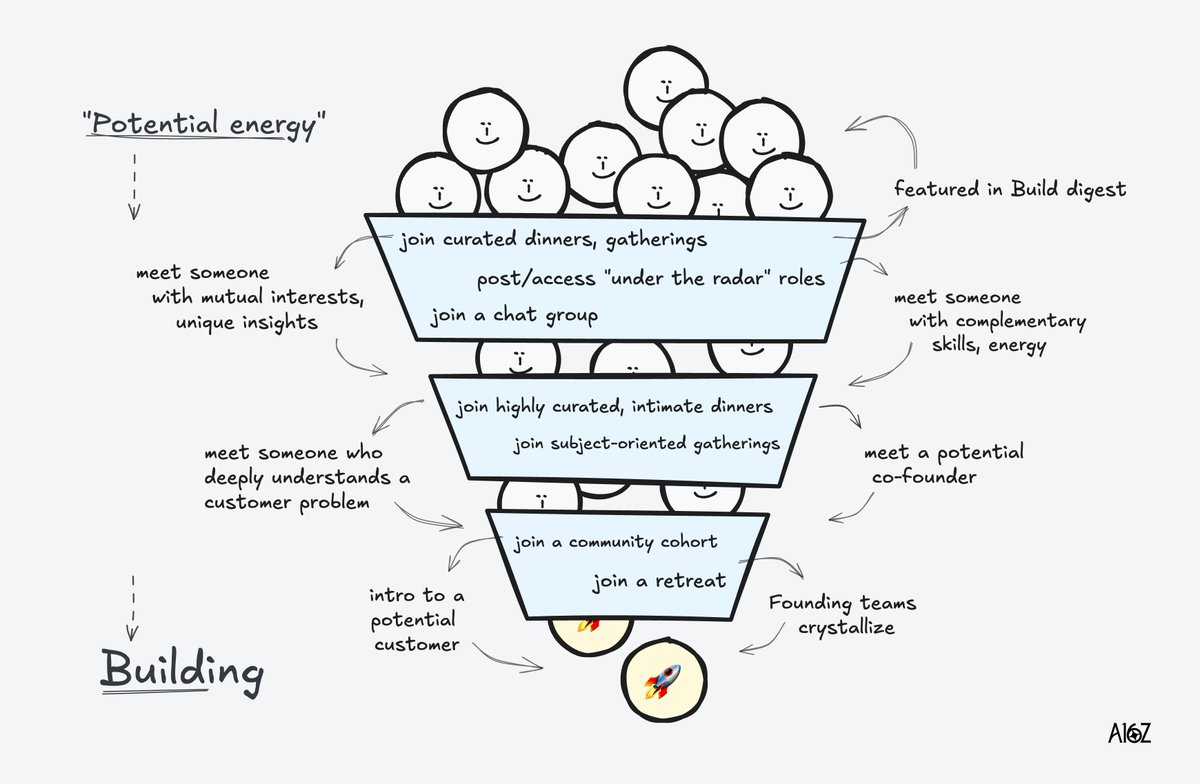
A dinner series and community for founders, technologists, and operators figuring out what they want to build next — and who they want to build it with.
Great startups don’t come from ideas alone.
There are certain conditions under which an ambitious, talented person is more likely to start a company, and have a higher chance of going on to be successful.
Some of it is serendipity... the right people in the right room, having the right conversation, at the right time.
But it’s not just chance. Startups emerge where the conditions make them more likely - in spaces where ambitious, talented people collide, swap ideas, and push each other to do more. Build exists to make those conditions far more likely.
It’s the front door to a16z for experienced talent between chapters, taking the time to think seriously about what’s next.
It’s not an accelerator, or even a structured program. There’s no curriculum, no demo day, no prescribed outcome.
Instead, we focus on one thing: creating small, repeatable environments where people with ambition, ability, and similar timing spend enough time together that trust compounds, decisions get easier.
If that's you: exploring, early, or open to joining something meaningful at the beginning, I want to hear from you.
Read more + apply: https://t.co/ZnoegCu8FV