🔥🎯➡️Thanks to Shreenivas and to Caris for the collaboration. More than 200,000 patients analyzed. Interestingly, ERBB2 mutations correlated with increased her2 ihc expression even without amplification. The HER2/ERBB2 landscape is fully defined
Understanding why the immune system succeeds—or fails—against cancer is central to improving outcomes. This study identifies a biological change linked to weaker immune responses and more aggressive cancers, offering new insight into cancer biology. https://t.co/xeepWtbHM0
Just out in @LeukemiaJnl 📣
With all hype around #RAS , We thought it’d be cool to characterize BRAF mutations in AML… led by the best collaborators in the business @lindemilesphd@AkEisfeld & teams
https://t.co/zJbcWLhcSO
Excited to highlight our newest work on an induced proximity-based targeted transcriptional repression platform termed Transcriptional Repression via Active Chemical Epigenetic Reprogramming (TRACERs)! Congrats to @CEStieger and co-authors and our @NovartisScience collaborators!! (1/9)
https://t.co/c0z00qn3s6
Had the chance to give the colorectal cancer update at Best of ASCO Los Angeles.
Always fun to summarize a year of CRC data in ~20 minutes while pretending that is a normal thing to ask of a human being.
4 takeaways (without getting into some of the really exciting drugs that are coming to CRC soon):
🔹 MSI-H CRC in complete clinical response on PD-1
Stopping at confirmed cCR looks safe. Maintenance may add toxicity without clear benefit.
🔹 BRAF V600E MSS mCRC
Encorafenib + cetuximab + chemotherapy is now a 1L standard. FOLFIRI is a great option, and FOLFOX is reasonable too. Either way, the targeted therapy backbone is here.
🔹 ctDNA / MRD
Not fully in NCCN yet, but increasingly actionable. I escalate select stage II patients, use it to frame de-escalation discussions, and strongly favor trials when possible.
🔹 Exercise
Prescribe it like we prescribe oxaliplatin.
30 min, 3x/week, ~80% max HR improves DFS/OS and is cost-saving.
CRC is moving fast. The challenge now is not just knowing the data, but figuring out how to apply it thoughtfully in clinic.
Grateful to be part of the conversation.
@TheGutOncLab@Onco_Nexus@OncoAlert@TotalHealthConf
If you didn't catch our previous Nature paper showing how Cas12a2 can selectively kill cells: https://t.co/1GbXSN2D9N, you have another chance to see this CRISPR enzyme in action, with work we did in collaboration with the Jennifer Doudna Lab: https://t.co/oIKfpmZj7B
@rrbehringer I attended the Mouse Development and Cancer Summer Course in 2012 @CSHL , and it was one of the most inspiring and educational experiences of my career.
🧬💥 Beyond gene editing to total destruction!
First author Jingkun Zeng & Nobel Laureate Jennifer Doudna (@doudnalab) at @igiberkeley, @GladstoneInst, @UCBerkeley & @UCSF just published a jaw-dropping paper in @Nature — and it rewrites what we thought CRISPR could do.
📄 "Targeting Cancer-Specific Mutations with RNA-Triggered Chromatin Shredding"
Forget fixing mutations one by one. This CRISPR-Cas12a2 system doesn't edit cancer cells — it SHREDS them. 🔬
🎯 The target? Mutant p53 — the "guardian of the genome" gone rogue in ~40–50% of ALL cancers, and 70–90% of ovarian, pancreatic & non-small cell lung cancers. Previously UNDRUGGABLE. Not anymore.
⚙️ Here's the elegant mechanism:
Cas12a2 scans for cancer-specific RNA transcripts. The moment it detects a mutant signal, it activates — then unleashes total chromatin shredding inside that cell, triggering complete cell death. 💀
Healthy cells? Left completely untouched. ✅
🤯 The precision? The system distinguished cancer from healthy cells differing by just ONE nucleotide.
🔄 And it's fully adaptable — easily reprogrammed to target new mutations as they emerge.
"Not only can this approach target the 'undruggable' cancers that we know, we can also easily and quickly adapt this to new mutations." — Jennifer Doudna
📎 https://t.co/JPYQtFzeBt
#CRISPR #CancerResearch #Cas12a2 #Undruggable #Genomics #ScienceBreakthrough @OncoAlert@oncodaily
Now online in @CD_AACR: A Foundation Model of Cancer Genotype Enables Precise Predictions of Therapeutic Response - by JungHo Kong, @zhenwang9102, @TreyIdeker, and colleagues @UCSanDiego
The RAS revolution continues!
Tango Therapeutics' new results date back to the discovery of a synthetic lethal interaction, in 2016: PRMT5 inhibition selectively kills cancer cells deficient in MTAP — about 40% of pancreatic cancer — while ~sparing normal cells
This mechanism itself is probably independent of RAS, but given RAS inhibition is the likely future foundation of therapy, Tango's PRMT5 inhibitor, Vopimetostat, was tested in combination with RevMed's RAS inhibitor, Daraxonrasib — in MTAP-deficient pancreatic cancer
Today's data come from a small number of patients, but the 6-month progression-free survival was 90% (compared, cross-trial, with Daraxonrasib alone, ~56%)
Tango Therapeutics Announces Combination of Vopimetostat and Daraxonrasib Demonstrated 92% Objective Response Rate in Pancreatic Cancer https://t.co/UlIn4Mts6o
Before @theNCI scientists discovered a drug combination that shrinks rare kidney tumors, no drugs were known to be effective for this aggressive form of kidney cancer. The results of this 10-year trial underscore the importance of studying rare cancers. https://t.co/JNeULavaB8
The science presented at #ASCO26 will shape how we treat cancer for years to come. I'm leaving Chicago grateful for this community, energized by the progress we're making together, and humbled by the dedication so many of you bring to improving the lives of patients with cancer.
Lorlatinib versus crizotinib as first-line treatment for advanced ALK-positive non-small cell lung cancer: 7-year update from the phase 3 CROWN study - Annals of Oncology https://t.co/O9OX811r02
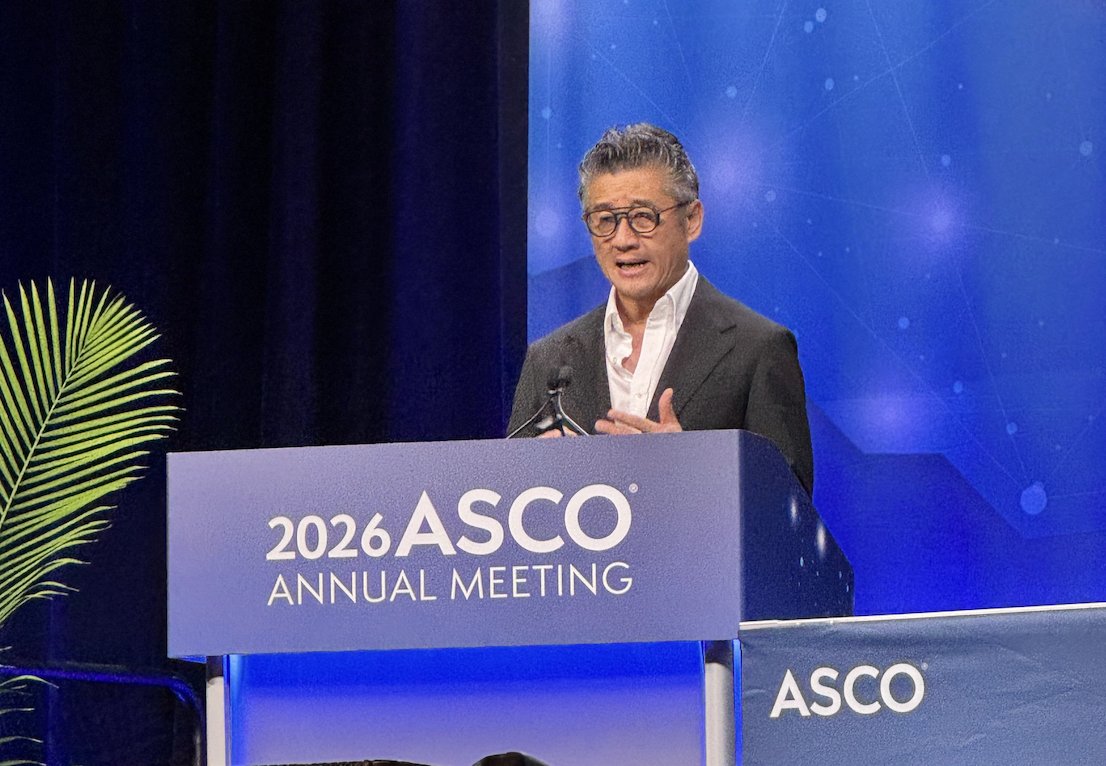
Dr. @TonyMok9 at #ASCO26 presents update on CROWN in ALK+ NSCLC. After 7y, median PFS with lorlatinib still not reached. Between years 5 and 7, only 4 progression events occurred. Unusual but fantastic to see such a tail with targeted therapy - this is truly raising the bar.