One of the core arguments of my book was that the wars in Syria and Ukraine could not be understood in isolation. They were linked through the Russia-Iran partnership. Ukraine’s strikes in the Caspian during the Iran war reinforce how interconnected all these wars have become.
Looking forward to reading this. One might argue that knowledgeable Iran scholars and analysts in Israel have never stopped making these distinctions in evaluating the politics in Iran.
One thing I hope my new book will show clearly: In the 1980s and 1990s and even a bit afterwards, Israelis understood that there were different factions inside the Iranian regime and their best bet was to strengthen the more 'moderate' factions. Netanyahu of 2009 threw all of this out and adopted a 'burn it all' approach.
Also fascinating about Reza Pahlavi: Israel had specifically rejected helping him in 1982; and in 2005; in 2023, they gave him some more public support although nothing real.
All in my new book :D
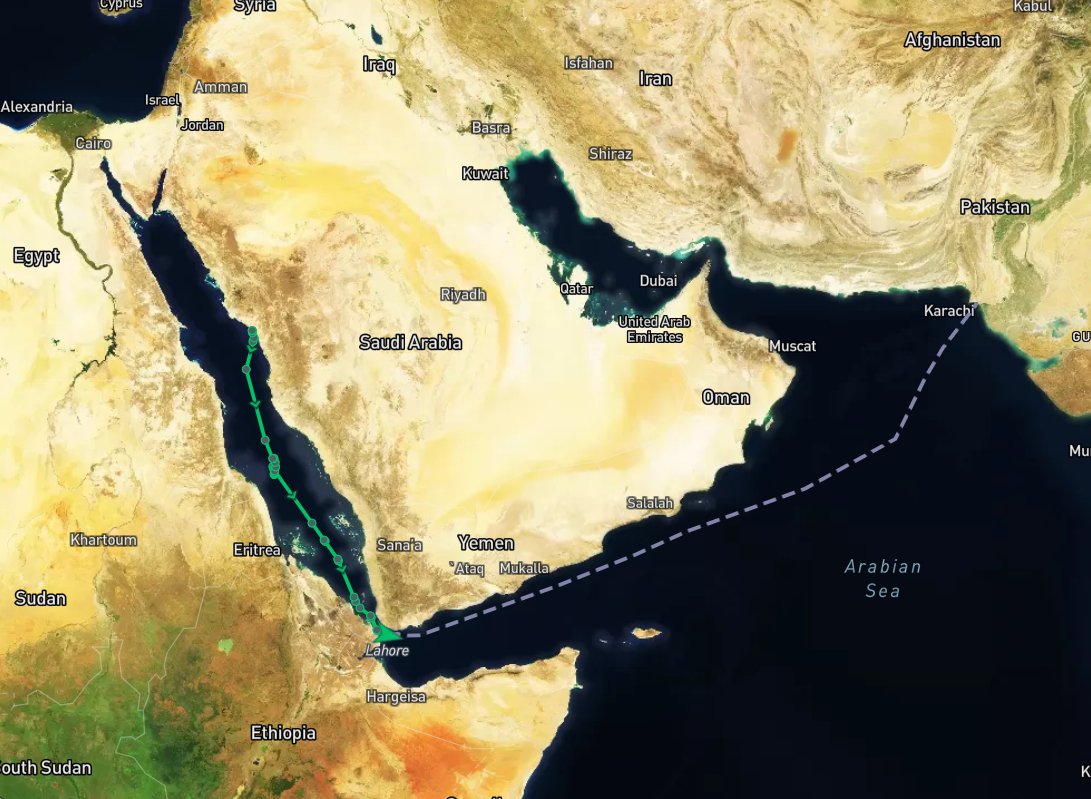
🇸🇦Saudi crude to 🇵🇰Pakistan passes Bab al-Mandeb Strait:
🔴This Pakistani tanker carrying Saudi crude stopped at sea for a few days after the Houthi blockade of Saudi oil. It has now passed the Strait.
Will #Iran and #Ukraine Enter a Direct Conflict?
🔹Ukraine’s Security Service, the SBU, said on July 25 that Ukrainian forces had struck an Iranian vessel transporting military cargo between Iran and Russia in the Caspian Sea.
🔹Later, President Volodymyr Zelensky said that Kyiv’s forces had “achieved very good results from long-range strikes in the waters of the Caspian Sea.”
🔹Iran’s Foreign Ministry said the target was a commercial vessel and that the attack had killed one sailor and injured another. It warned Kyiv that it would bear responsibility for the consequences of the operation.
🔹The episode has prompted a range of interpretations among Iranian experts and analysts.
🔹Some believe that Ukraine’s action was part of an effort by Zelensky to demonstrate both his capabilities and his value as a partner to the United States. This is particularly relevant at a time when Trump is frustrated with Washington’s NATO allies for declining to support military operations against Iran or participate in efforts to reopen the Strait of Hormuz.
🔹The prevailing view, however, is that the operation could not have taken place without at least a green light – if not direct guidance – from the U.S. and Ukraine’s other Western partners.
🔹On this basis, one group argues that the attack effectively reflects a NATO decision to participate more extensively in military operations against Iran. Rather than acting directly, however, NATO members have assigned the task to Ukraine, which has its own incentive to act against Iran because of Tehran’s military partnership with Russia.
🔹This argument has gained particular attention in light of recent statements by the NATO secretary-general regarding member states’ logistical support for U.S. military operations, the U.K. government’s agreement to allow the U.S. military to use British bases for operations against Iran, and Bulgaria’s plans to host U.S. military aircraft.
🔹Another group focuses less on NATO and more on the United States and Israel, as well as the military constraints facing both countries as they seek to expand their operations against Iran.
🔹According to this interpretation, concerns about Iran’s response to attacks on its infrastructure – and the possibility that Tehran could retaliate by targeting regional economic infrastructure – have prompted Israel and the U.S. to ask Ukraine to increase military pressure on Iran from the north on their behalf.
🔹Under this scenario, Ukraine’s next step could involve using drones or missiles to strike Iranian infrastructure directly, similar to the attacks it has carried out inside Russia in recent weeks.
🔹A third group of analysts points to the timing of the attack, which coincided with a renewed escalation in the conflict between the Houthis and Saudi Arabia.
🔹According to this argument, Iran’s indirect activation of the Bab el-Mandeb front to increase pressure on the United States has been met with an indirect American response. In other words, the Caspian front, together with the Indian Ocean – where the United States has imposed a maritime blockade on Iran – is now intended to complete a ring of economic and military pressure around the country.
🔹The validity of these interpretations will depend on whether Ukraine carries out similar operations in the future or further expands the scope of its actions. So far, remarks attributed to Ukraine’s ambassador to Israel suggest that Kyiv has decided to continue along this path.
🔹Another concern is that Ukrainian intelligence services may also become active in parallel, supporting ethnic insurgent groups against Tehran through military training, logistical assistance, and, in particular, the provision of drones. Ukraine previously pursued a similar approach in Syria against the Assad regime.
🔹For this reason, there is a degree of consensus in Tehran that Iran’s response will determine the trajectory of the confrontation and that a decisive response is required. There is considerably less agreement, however, over the precise nature of that response.
🔹Some believe that the least costly option would be to expand military cooperation with Russia. Yet such a decision is unlikely to alter the balance significantly, given Russia’s own difficulties in confronting Ukraine and Iran’s military constraints amid the ongoing war.
🔹Others argue that Iran should consider carrying out similar direct attacks against Ukraine-linked vessels in other maritime arenas, or even launching direct missile strikes against Ukrainian infrastructure if such operations continue.
🔹Such measures, however, could give NATO members a stronger incentive to participate in military action against Iran.
🔹At the political level, Iran could respond by recognizing Crimea and the Donbas as parts of Russian territory – areas whose occupation by Russia Tehran has so far declined to endorse.
🔹In any case, what is clear is that Iran’s war is becoming increasingly intertwined with two other conflicts: the Saudi-Houthi confrontation and the Russia-Ukraine war.
🔹With each passing day, the war is evolving into an increasingly complex, multidimensional, and international conflict.
With this appointment today @afrah_alzouba becomes the first ever female Foreign Minister for the Republic of Yemen.
She has an extensive political & development background, serving in Yemen’s National Dialogue as the Deputy Secretary General & then served as the head of Yemen’s executive bureau. She was appointed the Minister of Development & International Cooperation in February 2026.
Saudi's Yanbu port is still running business as usual this week, with multiple vessels actively loading.
While a few tankers did decide to pull a U-turn, others were confirmed to have pulled clean transits right through the Bab el-Mandeb Strait.
We'll have to watch how the situation develops, but don't buy into the fear mongering that Bab el-Mandeb is fully locked down or Yanbu is dead in the water. Let's see how the Houthis play their hand.
#oott #iran
Gilan provincial authorities report that the IRGC Navy in Zibakenar has been targeted in a U.S. strike. Zibakenar is a coastal town on the Caspian Sea, east of Bandar-e Anzali, and hosts the IRGC Navy’s naval academy and associated training infrastructure.
A mixed bag in the Red Sea: several tankers have U-turned and some Asian refiners are already making arrangements to pick up Saudi crude in the Mediterranean. But also a few other oil tankers have crossed the Bab el-Mandeb unharmed, and more are heading toward the chokepoint.
The strategic partnership between the United States and the United Arab Emirates is firm, complex, and multifaceted. One particularly significant point in this article is that the UAE says it is ahead of schedule in implementing its plan to invest $1.4 trillion in the United States over the next decade. Investment, technology, and security are central pillars of the partnership, but its strength and durability derive from the combination of these ties and the two countries’ routine cooperation on a wide range of global issues. https://t.co/d03nxEXNms
Pleased to be cited by @Reuters in their exclusive recent report regarding joint IRGC-Houthi malicious activities in #Yemen—after many years of After years of contributing behind the scenes to public reports and published papers.
To counter #Iran's denials regarding the smuggling of advisers and weapons through Somalia: between July and December last year—escalating heavily from September onward—the IRGC dispatched experts, advanced UAV components, and missile systems to prepare the Houthis to conduct future attacks across the Red Sea targeting international commercial shipping vessels, as well as to target the interests of Saudi Arabia and Israel. Furthermore, they supplied advanced guidance technologies for uncrewed fast boats intended for these upcoming operations.
The IRGC also ran joint training programs in both Iran and Yemen to prepare personnel on these systems. Notably, Iraqi SMGs played a key role in arranging logistics and financing to facilitate these joint initiatives.
https://t.co/AR6JjPeWLz
Hard but respectful disagree with @vali_nasr who writes “we have not been at war since 1979.”
Who is the “we”?
True, the US has not been at war with Iran, but it is a fact that since 1979 Islamic Iran effectively declared war on four fronts: against the United States, against Israel, against Western liberal modernity (think Salman Rushdie fatwa), and against the majority of the Iranian population that rejects the regime (think latest January 2026 massacre of unarmed civilians).
I explained this in my essay https://t.co/MqGNxD5YQb
How do I know? All this was calmly and without embarrassment explained to me multiple times by senior diplomats of the Islamic Republic and also during hours and years of interrogation and interaction with senior IRGC officers in and out of Evin prison.
Held a telephone conversation with my dear brother, His Royal Highness Prince Mohammed bin Salman bin Abdulaziz Al Saud, Crown Prince and Prime Minister of the Kingdom of Saudi Arabia, this morning.
I condemned, in the strongest possible terms, the Houthi militia’s attacks against Saudi oil tankers in the Red Sea. Such actions are unacceptable, violate international law, threaten freedom of navigation, and undermine regional peace and security.
I reaffirmed Pakistan’s complete solidarity with the brotherly Kingdom of Saudi Arabia and conveyed that I, together with Field Marshal Syed Asim Munir and the entire Pakistani nation, stand firmly and resolutely with the Saudi leadership and the brotherly people of the Kingdom at this critical time.
His Royal Highness Crown Prince Mohammed bin Salman and I agreed to continue working very closely to maintain regional peace, security, stability, and the uninterrupted flow of lawful maritime commerce through the Red Sea as well as the Strait of Hormuz and the wider region.
The headline on the front page of Saudi daily Asharq Al-Awsat says it all: “Saudi Arabia and America…A Nuclear Agreement that Builds a Partnership for Decades.” It’s a clear signal that despite recent tensions between Riyadh and Washington related to the #Iran war, the kingdom continues to regard the US as its indispensable military and security partner.
#SaudiArabia
مقالي: إيران تنقل المعركة إلى الكويت واليمن
🇮🇷 🇰🇼 🇾🇪
ميدانيا، شرع النظام الإيراني في تنفيذ جزء من تهديداته بتوسيع رقعة الصراع عبر إشعال جبهتين حدوديتين جديدتين:
الأولى في جنوب البحر الأحمر، من خلال التهديد بإغلاق «مضيق باب المندب» عبر الحوثيين،
والثانية في شمال الخليج العربي عبر التهديدات المباشرة وغير المسبوقة تجاه الكويت.
خطورة هذا التحول لا تقتصر على الكويت أو البحر الأحمر، بل تمتد إلى مجمل منظومة الأمن الإقليمي.
فإيران لم تعد تحصر المواجهة في أطرافها الأصلية، أي مع الولايات المتحدة وإسرائيل، وإنما باتت تنقل الصراع إلى دول الجوار والممرات الاستراتيجية.
وهذا السلوك لا يمثل رد فعل دفاعيا بقدر ما يعكس اتجاها استراتيجيا ظل المشروع العسكري الإيراني يبنيه منذ عقود، وهو قائم على توسيع النفوذ والسيطرة الجيوسياسية على الدول المحيطة.
ويستحق ما يصدر عن المؤسسات الإيرانية الاهتمام، فقد زادت حدة التهديدات ضد الكويت.
وكالة تسنيم أصدرت بيانات تشبه تماما بيانات بغداد التي سبقت الغزو العراقي للكويت عام 1990.
تتذرع طهران بالوجود العسكري الأميركي المحدود في الكويت، باعتباره مبررا للهجوم، وهو يتجاهل حقيقة أن هذا الوجود يعود إلى عقود، ويؤدي أساسا وظيفة ردعية ضد أي غزو محتمل، ولم يكن قاعدة رئيسية في العمليات الأميركية الأخيرة ضد إيران.
السؤال المطروح اليوم: كيف للكويت، ومعها دول الخليج، التعامل مع هذا التهديد؟
التحدي يتجاوز القدرات الوطنية المنفردة، ويستدعي العودة إلى مفهوم العمل الجماعي، عبر بناء جبهة إقليمية متماسكة، مدعومة بتحالف دولي يرفض أي ذرائع لتوسيع الحرب أو شرعنة الاعتداء على الدول المجاورة.
وقد لا يكون متوقعا من واشنطن، في ظل انشغالها بإدارة المواجهة العسكرية، أن تقود المبادرة الدبلوماسية، إلا أن بإمكانها رسم خطوط حمراء واضحة تؤكد أن أمن الخليج وممراته البحرية يدخل ضمن مصالحها الاستراتيجية العليا. فإيران لم تكتف بالتهديد اللفظي للكويت،
بل كررت قصفها لمنشآت المياه والكهرباء، ووسعت دائرة التهديد لتشمل البحرين أيضا.
ويبدو أن طهران تدرك أن تشديد الحصار البحري على موانئها، واحتمال اتساع العمليات الأميركية على سواحلها، قد يفقداها نفوذها على هرمز، أهم أوراق الضغط التي استخدمتها في الحرب والمفاوضات.
لذلك فهي تحاول إنتاج أوراق بديلة من بينها تحويل باب المندب إلى نقطة ابتزاز استراتيجية عبر الحوثيين، والسعي لفرض واقع أمني جديد في شمال الخليج، في محاولة تستحضر، وإن اختلفت الظروف،
بعض ملامح سياسة فرض الأمر الواقع التي اتبعها نظام صدام عام 1990.
ويلاحظ أن السلوك الإيراني بات يتكرر، إذ إنه كلما خسرت ورقة استراتيجية، سارعت إلى فتح جبهة جديدة لإعادة إنتاج أدوات الضغط والابتزاز.
ولتقليل التكلفة السياسية والقانونية، ولتجنب الظهور كدولة معتدية بصورة مباشرة، تعتمد بصورة أكبر على وكلائها، مثل الميليشيات اليمنية والعراقية.
ما احتمالات نجاح هذا التموضع الإيراني الجديد؟
الإجابة ليست سهلة، لأن تحليل السلوك الإيراني لا يمكن أن يستند فقط إلى الافتراضات العقلانية التقليدية.
فالقيادة الإيرانية تواجه أيضا معادلات داخلية معقدة، وتخشى أن يؤدي أي انطباع بالهزيمة إلى اهتزاز وضعها داخليا، بعد أن أنفقت لعقود موارد البلاد في بناء القدرات العسكرية وتمويل الحروب.
ويبدو أن الحوثيين في اليمن أوكلت إليهم مهمة تحويل باب المندب كبديل عملياتي لمضيق هرمز مع تراجع قدرة إيران على استخدام الأخير كورقة ضغط، بفعل الهجمات العسكرية الأميركية.
ومع اندفاع الحوثيين فعلا نحو تهديد الملاحة، فمن المرجح أن تجد القوى اليمنية، ومعها التحالف بقيادة السعودية، مساندة إقليمية ودولية لمنع تعطيل أحد أهم شرايين التجارة العالمية.
ولا يقتصر الرد المتوقع على البعد العسكري، بل قد يكون المجال الدبلوماسي أكثر اتساعا في هذه الجبهة تحديدا.
فالدول الكبرى المعتمدة على الملاحة في البحر الأحمر، وفي مقدمتها الصين والهند، إضافة للأوروبية، لها مصلحة مباشرة في ضمان حرية الملاحة.
ومن ثم فإن أي تحرك عسكري يستهدف إنهاء تهديد الحوثيين، قد يحظى بإجماع دولي أوسع، لأنه دفاع عن مبدأ حرية الملاحة الدولية وليس امتداداً للحرب في الخليج.
وفي جميع الأحوال، فإن بناء هذا التكتل الإقليمي والدولي لم يعد خيارا بل أصبح ضرورة استراتيجية،
ليس فقط لمواجهة التهديدات الراهنة،
وإنما أيضاً للتعامل مع أي ترتيبات قد تفرضها مخرجات الحرب مستقبلاً.
فإيران لا تسعى إلى إدارة أزمة مؤقتة فحسب، بل تحاول إعادة رسم الخريطة الاستراتيجية للمنطقة وفق سرديتها الجديدة،
بحيث تخرج من الحرب بمناطق نفوذ وقواعد اشتباك مختلفة عن التي كانت قائمة قبل الحرب.
ومن هنا، فالنقاش لم يعد يدور حول كيفية إنهاء الحرب بل حول شكل النظام الإقليمي الذي سيتشكل تالياً.
@PaperMissiles There are reports suggesting a Kepco/Westinghouse joint venture is possible, in which the Westinghouse AP-1000 is the reactor supplied instead of the APR-1400. Regulatory, safety, and security consulting would go to American companies.
🇮🇱⚡️ Israel’s Electricity Authority freezes processing of new applications to connect data centers to the power grid; AI data center demand outstripping pace of infrastructure development
https://t.co/6uQw0lYMA9
If successful, this would solidify Egypt's position as a regional energy hub
🇪🇬 Egypt in talks with @Shell@TotalEnergies@bp_plc to buy 15 to 18 cargoes of LNG per month for at least three years
https://t.co/aI6nkdfQK5