🚨 THE RISE AND FALL OF ICE OPEN NETWORK.
Do you remember when $ICE was everyone's favourite?
Millions were mining it. Everyone was talking about its potential. The vision was HUGE, and people genuinely believed they were part of something big.
But look at where we are now. 🫣
Let's talk about what happened.
ICE built a massive community with mobile mining. Then came the mainnet, the $ICE → $ION transition, Online+, monetization, Frostbite, the meme coin launchpad, Tokenized Communities...
So many things were promised.
But how many times did we hear "SOON"?
How many timelines changed?
How many times did people hear "final polish" and start waiting all over again?
At some point, you have to ask yourself: Was the problem really development, or was it the habit of promising more than could be delivered?
And the community wasn't innocent either.
Whenever someone questioned the delays, others rushed to defend the team. Criticism became FUD. Asking for accountability became a lack of belief.
Seriously, since when did supporting a project mean accepting everything without questions?
Then came the token collapse.
In April 2026, the CEO revealed over $18M in historical spending and operating costs of around $400K per month, while attributing the crisis to a service provider's exit and associated token sales.
Now think about it.
Millions of community members. Years of development. A massive vision.
Yet the project was facing a serious financial crisis.
I'm not saying the entire vision was fake. I'm saying a vision means nothing if execution can't keep up with it.
Every project has a timeline. but do ION even has a timeline??
Where is $ION Memepad?
Where is $SNIFF? Why did they delete the post after rugpul?
Where is $SNOW?
Where is Frostbite?
Where is Online+?
Where is the actual full mainnet?
Where is $ION integration on CEX?
Where are the creators?
Where are the ambassadors?
Where are the real answers to valid questions?
Where is the respect for community TIME?
Where is the accountability??
The team made promises. The community believed. Critics asked questions. And too often, those critics were treated like enemies.
That's the part people need to remember.
Because a project doesn't fall apart overnight. Sometimes, trust disappears slowly, one broken expectation at a time.
ICE had the community. ION had the opportunity. But did they deliver what people were led to expect?
Or did everyone spend too long believing that everything was just around the corner?
What's your honest opinion? 👇
Good Afternoon
A wallet can show hundreds of profitable trades.
But would you lend money to the AI agent behind them?
I've been looking at how @agenticscredit approaches this.
Every onchain trade leaves a record, but scrolling through transactions won't tell a lender how much risk an agent took to make that money.
AgenticsCredit is building a credit system around trading history, where performance and risk help determine future capital access.
I'd want to check a few things before trusting that record.
• How deep were the drawdowns?
• Were profits consistent?
• Did one lucky trade account for most of the gains?
Imagine two agents making $5,000.
One keeps losses under control. The other nearly wipes out its account before recovering.
Same profit, very different risk.
If I were evaluating those agents for funding, I'd want to see the full trading history before putting a dollar behind either one.
A chatbot answers.
An enterprise agent understands, decides, acts, and stays governed while doing it.
On Microsoft Foundry, the journey starts when a user, business application, event, or API sends a request to Foundry Agent Service.
From there, the enterprise agent runtime coordinates every layer required to complete the work safely.
↳ Identity and access confirm who the user is, which role they have, and what the agent can access.
↳ Policies and guardrails apply content safety, compliance checks, and business rules before execution.
↳ The planner interprets the goal, breaks it into tasks, and selects the next step.
↳ Session memory preserves conversation state, preferences, and relevant context.
↳ Knowledge retrieval grounds the agent using SharePoint, SQL, Fabric, Blob Storage, and Azure AI Search.
↳ MCP connectors, APIs, Logic Apps, and external tools allow the agent to interact with business systems.
↳ Model inference handles reasoning, generation, and tool decisions.
↳ Action execution enables the agent to send emails, create tickets, update CRM records, or schedule tasks.
↳ Human approval is introduced when confidence is low or the risk is high.
↳ Monitoring and tracing capture logs, telemetry, evaluations, and operational performance.
The agent can then operate through Teams, Copilot, web applications, or APIs while working across CRM, ERP, service desks, and enterprise data.
The difference is clear:
A chatbot generates text.
An enterprise agent combines trusted knowledge, controlled access, business actions, human oversight, and continuous monitoring to complete real work.
Which layer creates the biggest challenge in your enterprise agent architecture?
𝗕𝗲𝗰𝗼𝗺𝗲 𝗯𝗲𝘁𝘁𝗲𝗿 𝗮𝘁 𝗔𝗜 𝗶𝗻 𝗷𝘂𝘀𝘁 𝟭 𝗺𝗶𝗻𝘂𝘁𝗲 𝗮 𝗱𝗮𝘆. 𝗝𝗼𝗶𝗻 𝗺𝘆 𝘄𝗲𝗲𝗸𝗹𝘆 𝗻𝗲𝘄𝘀𝗹𝗲𝘁𝘁𝗲𝗿 𝘄𝗵𝗲𝗿𝗲 𝗜 𝗱𝗼𝗰𝘂𝗺𝗲𝗻𝘁 𝘁𝗵𝗲 𝗿𝗲𝗮𝗹-𝘄𝗼𝗿𝗹𝗱 𝗷𝗼𝘂𝗿𝗻𝗲𝘆 𝗼𝗳 𝗔𝗜 𝘁𝗿𝗮𝗻𝘀𝗳𝗼𝗿𝗺𝗮𝘁𝗶𝗼𝗻.
👉 𝗦𝗶𝗴𝗻 𝘂𝗽 𝗳𝗿𝗲𝗲 now → https://t.co/Kj8zW959kp
Follow @AiswaryaVenkit1 for more such insights!!
Acurast: Turning the old phone in your drawer into a computing resource
When discussing AI infrastructure, most attention is focused on building increasingly massive data centers.
Acurast takes a different approach: leveraging hardware that people already own such as that old phone sitting idle in a drawer. @Acurast
What kind of tasks is it suited for?
Training a cutting-edge model is a vastly different undertaking from classifying emails, filtering messages, or running a small decision-making model.
While phones have limitations, there is still a market for small, repetitive tasks that do not require an entire cluster of GPUs. This is where the intersection of AI and DePIN (Decentralized Physical Infrastructure Networks) becomes compelling.
Try it out yourself
Laya demos showcase decision-making models running on the CPUs of Android phones handling tasks like email categorization, chat moderation, and screening for prompt injection.
Acurast notes that each decision takes approximately 0.2–1 second. You can test it at https://t.co/nKBZiw09xe and see which device is processing your request. The development team also acknowledges certain limitations: classification errors can occur, and queues may grow longer when the volume of requests exceeds a phone’s processing capacity.
The trust challenge
If a phone belongs to someone else, how can you be sure that the device executing your task is legitimate? Acurast employs hardware-based attestation (Google Key Attestation and Apple App Attest) and monitors for revoked credentials, removing compromised or invalid devices from the pool of those eligible to receive tasks and earn rewards. @Acurast
Verification is therefore continuous, rather than occurring only when a device first joins the network. That said, the security model remains dependent on the hardware manufacturers and platform providers.
The role of ACU
ACU serves several defined functions: covering network fees, incentivizing the provision of computing power, staking, and governance. The most notable mechanism is "Staked Compute": providers lock up tokens to commit a specific amount of computing power, while ACU holders who lack hardware can delegate their tokens to these providers.
Benchmarks and "heartbeat" signals monitor capacity and availability, ensuring providers have an economic incentive to honor their commitments.
It is worth noting that the tokenomics include an annual inflation rate of 5%, with 70% of that allocated to the Staked Compute Pool. Therefore, staking rewards should not be confused with revenue generated from customers paying for computing services. While incentives can help build supply, it is the return of actual customers that truly validates the value of that supply.
Key metrics to track:
•Number of paid tasks and the rate of returning developers
•Cost per successfully completed task
•Stability under sustained load
•Growth in usage relative to token-based incentives
These metrics offer a much more meaningful picture than simply counting the number of registered devices.
How to get started?
The "Cloud Rebellion" program allows you to explore the ecosystem by completing tasks, deploying applications, and onboarding a supported device to the network. @Acurast
You earn "MIST" points which are distinct from ACU tokens. My advice: try out the demo and use a spare device before making any further investments.
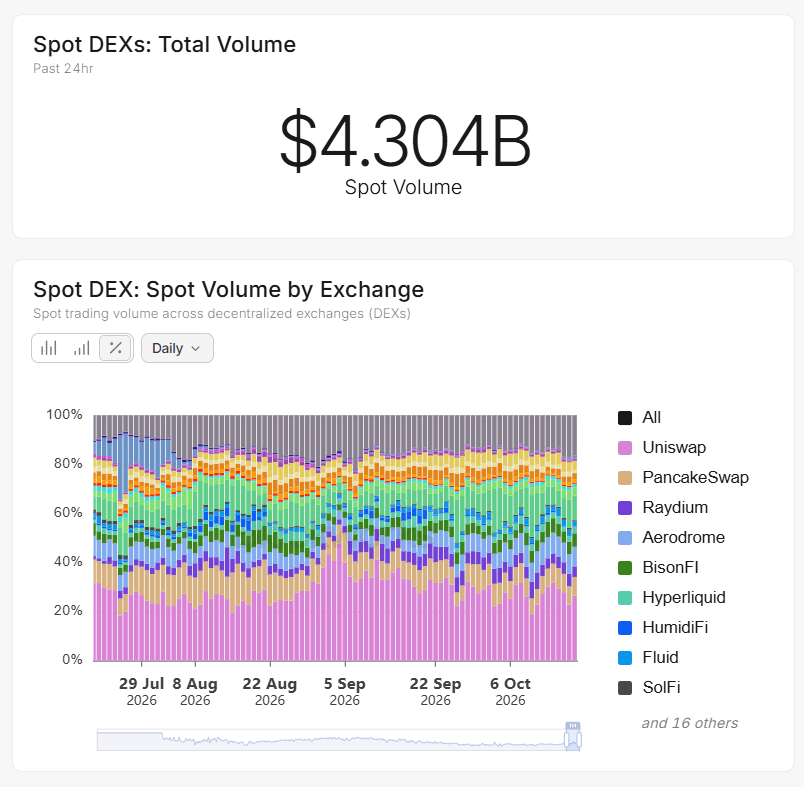
Spot DEXs market share says a lot.
This cycle, I believe we should just focus on the projects that make money. And spot DEX is the sector we can't ignore.
From this chart by @Blockworks, let's take a look at volume leaders, and how they turn fees into holder revenue.
▸ @Uniswap
- The largest share, often 30-40%, benefits from deep liquidity across EVM chains, the highest stablecoin flow (roughly 47%), and a strong brand.
- Revenue: the fee switch is active on V2/V3/V4 across multiple chains, with a portion of fees used to buy back and burn $UNI.
- Holders revenue has been running in the low-to-mid millions monthly.
▸ @PancakeSwap
- The consistent 2nd place, driven by @BNBCHAIN volume and multichain expansion.
- It has real fees and a long-running $CAKE buyback-and-burn program funded by trading fees and other products.
- Token holders benefit through supply reduction > direct staking yield.
▸ PumpSwap / @Pumpfun
- One of the strongest fee machines in crypto right now.
- $PUMP holders get direct buyback and burn. About 50% of net revenue is used to buy token on the open market and burn it.
- Cumulative buybacks is removing roughly 17% of total supply.
▸ @aeroxyz
- It has grown sharply, especially on @base, and is one of the few large DEXs that increased volume in weaker quarters.
- It captures a large share of Base activity and has been strong in tokenized stocks and stablecoin pairs.
- base:0x940181a94a35a4569e4529a3cdfb74e38fd98631 runs a true zero-leak model: essentially all protocol swap fees go to veAERO voters/holders.
▸ BisonFi (@FWDind)
- A prop AMM that has taken meaningful share on @solana. Its volume comes from competitive pricing and integration with Solana aggregators.
- A lot of the value appears to stay with the market-making side rather than flowing to a widely distributed token.
▸ @HyperliquidX
- HL shows up strongly even in the spot volume (and is far larger in perps). It benefits from the same high-performance matching engine and deep liquidity as its perps.
- Revenue is among the highest in crypto: roughly 99% of trading fees (after builder cuts) is used for buyback and burn $HYPE.
▸ @Raydium
- It remains a major Solana AMM since day one, used to dominate Solana volume in multiple memecoin seasons.
- It routes a portion of trading fees to $RAY buybacks, so holders get some value accrual, though less aggressively than Aero or Hyperliquid.
---
In short,
Uniswap wins on distribution and liquidity depth, PancakeSwap on BNB Chain dominance.
Aero on Base, Hyperliquid + PumpSwap on performance and aggressive buybacks, and BisonFi on Solana prop-AMM efficiency.
The ones with the clearest real revenue flowing to token holders right now are $HYPE, base:0x940181a94a35a4569e4529a3cdfb74e38fd98631, $PUMP, $UNI, $CAKE.
These five peptide startups raised more than $48 million:
1/ @systemlabsinc by @AdamSteinle, ex YC founder and ultramarathoner, raised $20 million from Patron Fund and Will Ventures
2/ @Noho_Labs founded by @Mazzeo raised $16 million from 8VC and Elad Gil and is JACKED
3/ The Protocole, founded by @DelphineLG and Cindy Yan, raised a $6 million seed round led by Rare Capital.
4/ @Ronan_RX. Founded by @larmbrust (2x YC founder) and @emilyrcolman, YC startup raised $3.3m. Lloyd has 6 kids so he's doing something right
5/ @FEELpeptides by @steve_brew, raised $3 million in a round led by Sugar Capital. Also jacked...
Who you betting on ? 🐎
Codex CLI 0.163.0 is out!
Highlights:
- Send follow-ups while Codex is responding to steer it immediately; interrupting a turn also stops active Code Mode cells and nested tool calls.
- /config now searches preferences across categories, applies supported settings live, and indicates which changes require a restart.
- Independent read-only tools — skill, memory, and conversation-history lookups — can now run in parallel.
- Daybreak is enabled by default for eligible accounts; codex exec can also select it with an OpenAI API key.
Complete details in thread ↓
“No fees, better spreads and more assets.”
That's what @sam_battenally just posted.
And if this is a hint at what's coming to @risextrade, it could be a pretty big deal.
First, nothing has been officially announced. This is just my interpretation of Sam's tweet and what a potential zero-fee model could mean for RISEx.
For retail traders and delta-neutral farmers, the combination sounds almost ideal:
→ Zero trading fees
→ Tighter spreads
→ More markets
→ More capital-efficient strategies
We've already seen with Lighter how powerful zero-fee trading can be.
But there's also a counterexample worth discussing: Paradex.
Despite offering zero-fee trading, Paradex hasn't managed to establish itself among the dominant perp DEXs.
From my perspective, its airdrop failed to meet expectations, and the protocol has struggled to find a clear position in an increasingly competitive market.
It's a reminder that zero fees alone don't guarantee success.
And that brings me to two important questions.
1/ What happens to points and the future airdrop?
This is probably my biggest question as an active RISEx farmer.
Early users have spent months trading, paying fees and taking execution risk to accumulate points.
If trading becomes nearly free, the economics of farming could change dramatically.
So what happens next?
- Do weekly point emissions remain unchanged?
- Will early users receive additional recognition?
- Could the points system evolve to reflect the different costs of participation?
I'm not saying early farmers deserve a guaranteed bonus.
But I do think there's an important distinction between farming when every trade costs money and farming when execution is almost free.
2/ Can a zero-fee business model scale sustainably?
Zero fees for traders doesn't mean zero costs for the protocol.
Revenue has to come from somewhere.
That could involve market-maker arrangements, premium services or other revenue streams, depending on the model.
And removing fees alone won't guarantee success.
RISEx has been growing, its product continues to improve, and the team keeps shipping.
But competing with protocols like Lighter or Variational requires more than attractive trading conditions.
It requires:
- Real user acquisition
- Deep and reliable liquidity
- Retention beyond incentives
- Sustainable revenue
We've also seen that strong technology and interesting ideas don't automatically translate into dominant market share.
My take? I'm bullish, but realistic.
I think RISEx has a genuine opportunity to become one of the leading perp DEXs.
And if zero fees, better spreads and more assets are actually on the roadmap, that would make the opportunity even more interesting.
But the real test won't be the announcement.
It'll be whether RISEx can turn cheaper trading into lasting adoption.
👽💜 KAV is the Alien of Solana, and KAV Loves Solana! ⚡
🚀 STOP JUST USING DATA - LEARN TO BUILD THE SYSTEMS THAT POWER AI!
💡 Today's KAV Tech Spotlight: Data Engineering + Vibe Coding
Ever wondered how companies turn millions of messy records into useful information?
That's where Data Engineers come in! 🧠
They build the systems that collect, clean, transform, store, and deliver data to AI applications, dashboards, and businesses.
🔥 Here's the exciting part: You can start building your own Data Platform with AI!
🛠️ Let's Build: Your First AI-Powered Data Dashboard
━━━━━━━━━━━━━━
Step 1 - Open Google AI Studio
🔗 https://t.co/onDIF6Cniz
Use Build mode to describe your application in natural language. AI can generate the interface and application code.
━━━━━━━━━━━━━━
Step 2 - Give AI This Prompt:
"Build a modern Data Analytics Platform where users can upload CSV files, automatically clean and validate data, detect missing values and duplicates, generate interactive charts, and explore business insights. Include a futuristic dashboard, search filters, and downloadable reports. Use sample data for the demo."
━━━━━━━━━━━━━━
Step 3 - Understand the Data Pipeline
📥 Collect - Import your dataset.
🧹 Transform - Clean and standardize records.
🗄️ Store - Organize information for analysis.
📊 Visualize - Create dashboards and actionable insights.
━━━━━━━━━━━━━━
Step 4 - Test and Improve
Test the results against your original data. Add error handling, secure storage, and automated processing before using real business information.
━━━━━━━━━━━━━━
Step 5 - Explore Streamlit
🔗 https://t.co/l4HFTlVsBP
An open-source Python framework for building interactive data applications.
Google AI Studio supports AI-assisted full-stack app development, while Streamlit provides another practical route for building data dashboards.
━━━━━━━━━━━━━━
🎓 Want to Become a Data Engineer?
Start learning Python, SQL, ETL/ELT pipelines, databases, cloud infrastructure, and workflow orchestration.
A structured 12-week learning plan can help you practice these skills through projects, but professional proficiency takes continued experience.
━━━━━━━━━━━━━━
💜 KAV Wisdom:
AI can help you write code faster, but understanding how data moves, transforms, and stays reliable is what makes you a real builder.
👽 The future belongs to people who don't just consume technology - they understand it and build with it.
🔥 KAVIANS, what would you build first - an AI analytics dashboard, a crypto data tracker, or a business automation platform?
#KAV #Solana #DataEngineering #VibeCoding #ArtificialIntelligence #LearnToBuild
BTC update + roundup past 3-5 days:
weaker and weaker attempts to break through 87k set us up for a dump regardless, but then we got insanely high-visibility/mindshare peak-PEAK existential fud pouring niagara falls-level gasoline on the fire, and..
market v-reversed the dump back into range within hours. market clearly doesn't want lower
then:
market kinda shaving off/thwarting attempts to go higher than 84k. people trading 1000x lev on papertrade. alts kinda resilient here on little pullbacks
no guess on LTF PA, prob some more chop, but i'm biased toward the upside here on a "if horrific apex-bad news/events/narrs couldn't dump it, what's it going to take?" heuristic.
irony: good chance we rip absolute tits later in october, and people will just remember this as "uptober" and sweep onchain getting massacred the first half under the rug, tale as old as time
So much happening at the moment especially on motion design thanks to Opus 5.5 and because Gemini 4 Argon around the corner I would like to share my though about the situation.
Porting a Claude Opus 5.5 motion graphics workflow directly to Gemini 4 Argon by renaming CLAUDE. md to GEMINI. md breaks in production because the two models have opposite architectural strengths and bottlenecks.
1. Interactive Shell Loops vs. Single-Pass Repo Synthesis Claude Opus 5.5 leads on interactive terminal tasks (66.4% vs. Argon's 57.4% on Terminal-Bench 4.0).
Claude works best when making small, iterative bash edits shot by shot. Gemini 4 Argon leads on full repository architecture (77.9% on DeepSWE v1.1 and 91.9% on Vibe Code Bench) and ships with a 1,000,000-token output ceiling.
Running Argon in a chatty trial-and-error shell loop plays straight into its weakest benchmark. Instead, push 90% of the work into a single uninterrupted generation pass where Argon outputs the physics library, dense SVG Bezier tables, procedural WAV synthesizer, and all scene files at once, followed by a single automated QA command (node checks/qa.mjs).
2. Subagent Stitching vs. Continuous Multi Scene State In code rendered video, a single 12 second scene can burn over 30,000 output tokens once internal reasoning is included. On smaller output windows, multi scene videos have to be split across subagents, and the seams frequently break because camera coordinates and spring momentum reset between files. Argon's 1M output window holds an entire 45 second, 10 scene repository in a single trajectory, allowing Scene A to hand off its exact analytical exit position and velocity directly into Scene B's entry spring.
3. Static 0.5s Contact Sheets vs. Native Video & Event Strip QA Opus 5.5 only takes text and static images. Reviewing motion requires slicing the rendered MP4 into 0.5 second PNG contact sheets with ffmpeg. At 1 frame every 0.5 seconds (every 15th frame at 30 fps), a 2 frame letter stagger or a 4 frame impact flash falls completely between the screenshots, so the model grades animations it never actually saw. Argon is built for native long video comprehension (91.7% on LVBench) and can inspect the rendered MP4 directly for optical stutter, bad spring damping, and 1 frame audio drift. When running on image only API endpoints, pair the 0.5s overview sheet with 1 frame interval event strips across every cut and flash.
4. CLI Plan Gates & Token Economics
To keep costs down and prevent premature file edits:
Enforce Gate 1 with Gemini CLI's read only /plan mode (gemini approval mode=plan) so the agent inspects your local assets and writes style_guide.md and shotlist. md before touching code.
Pin GEMINI. md, beats.json, and local reference assets in a static prefix at the top of the prompt to trigger Argon's cached input discount across all review rounds.
When a critique round fails, revert only the code (git checkout HEAD~1 -- src/ index.html) while keeping docs/review_log.md intact so the agent does not wipe its own memory and repeat the same broken fix.
claude projects just dropped.....
and it is hands-down the best way to work with Claude right now...
so i pointed it at my last 100 sessions and it found the work i keep repeating.
one prompt does three things, using your last 100 sessions:
→ finds work worth turning into a project
→ catches instructions and corrections you keep repeating
→ lists the tools that work actually needs
→ plans threads and routines to move it forward
run this with opus 5.5 in a local claude code session:
"read
[https://t.co/x5axLZwqlw](https://t.co/S0RrTgU21E)
help me prepare a Claude Project from my 100 most recent available sessions under ~/.claude/projects/.
group sessions by project and report how many you could read. use only my original messages as evidence of preferences. exclude tool results, generated summaries and quoted material. inspect commits where useful as evidence of work.
build one setup:
set up from recent work
identify recurring work or a goal spanning several sessions. choose the strongest project candidate and explain why.
write its name, goal and paste-ready project instructions. separate repo-specific guidance for CLAUDE.md. turn repeated corrections into 'Remember: …' messages.
support recommendations with exact quotes and session references. count distinct sessions, flag conflicting instructions and label inferences.
use my tools
identify the repos, files, skills and connectors this project needs. distinguish local tools from those available to cloud threads. list missing access and setup steps without exposing credentials.
make a plan
write one small first task with a clear completion check.
→ threads: define deliverables, dependencies and verification. parallelize independent work only.
→ routines: propose recurring tasks with prompts, schedules and review criteria.
→ library: list reference files to upload and outputs threads should deliver.
recommend thread model and effort settings. explain what to check about usage and auto-continue.
finish with a setup checklist and the first message to paste into the project. don't edit files, connect tools or schedule anything yet."
review the setup. run the first task. add routines once the results are useful.
thank me later