An AI Biotechnology company focused on leveraging bioinformatics, computational biology & AI to design novel drug-like molecules in the multiomics era.
UnibindMD: An integrated AI and molecular dynamics platform for de novo peptide binder design
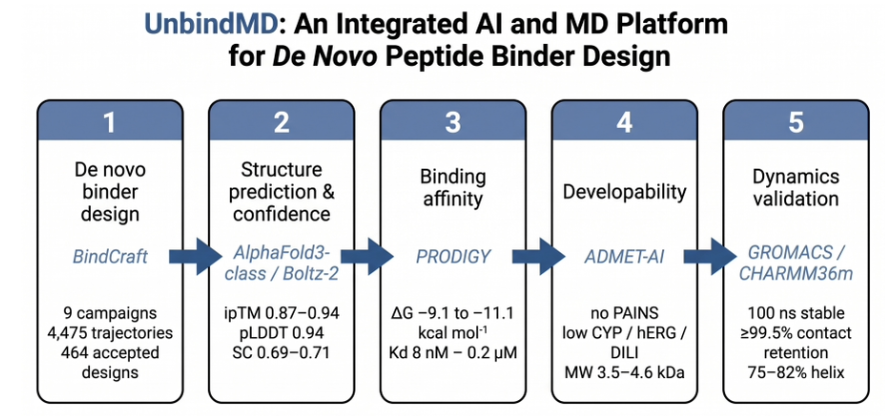
1. The paper presents UnibindMD, a target-to-lead computational workflow that tries to fix a common failure mode in DL-only binder design: confidence metrics (ipTM/pLDDT) can be self-consistent yet not physically stable, so a “high-confidence” complex may still fall apart under physics-based simulation.
2. UnibindMD chains five orthogonal stages into one platform: BindCraft for de novo peptide binder generation, AlphaFold3-class confidence assessment (plus an intended Boltz-2 cross-check), PRODIGY for binding free-energy estimates, ADMET-AI for developability screening, and explicit-solvent all-atom MD (GROMACS/CHARMM36m) for stability validation.
3. The demonstration focuses on Andes virus (ANDV), motivated by high fatality rates, a reported 2026 cruise-ship outbreak, and no approved therapeutics. Three intervention points were chosen: the viral Gn-Gc glycoprotein complex (entry; PDB 9P3I), the viral L-protein endonuclease domain (cap-snatching; PDB 6Q99), and the host VEGFR2 kinase (vascular permeability; PDB 2XIR).
4. Across nine BindCraft campaigns (4,475 trajectories), the platform produced 464 accepted peptide binders, with acceptance rates spanning 2.3–67.6% depending on target and hotspot constraints. 6Q99 was most tractable (up to 67.6% acceptance), while VEGFR2 was hardest (2.3–3.2%) but still produced the single highest-scoring designs (up to ipTM 0.94 and pLDDT 0.94).
5. A notable design takeaway is that “more hotspots” did not monotonically improve yield: over-specifying constraints could reduce acceptance. The authors suggest systematic single-hotspot scans followed by combining productive residues, rather than committing early to many-constraint campaigns.
6. Three top-ranked leads (one per target) were advanced to downstream validation. All were helical peptides with shape complementarity ~0.69–0.71, lengths 31 (Gn-Gc), 34 (6Q99), and 39 (VEGFR2), and design-stage ipTM of 0.87–0.94.
7. PRODIGY predicted nanomolar-to-submicromolar binding for these three leads: ΔG from −9.1 to −11.1 kcal/mol, corresponding to Kd ≈ 8 nM–0.2 µM, providing an affinity estimate that is separate from AlphaFold-style confidence scores.
8. ADMET-AI profiling flagged what is expected for large polar peptides (3.5–4.6 kDa; very high TPSA): negligible oral bioavailability and no BBB penetration. It reported no PAINS alerts, with generally low predicted CYP/hERG/DILI risk, while noting moderate AMES flags to monitor and typical peptide-associated BRENK/NIH alerts.
9. The strongest “orthogonal check” in this study is explicit-solvent MD: all three peptide–target complexes stayed bound over 100 ns unrestrained simulations. Reported stability included receptor Cα RMSD ≤2.6 Å, peptide fold retention (75–82% helicity), and ≥99.5% of frames preserving more than half of initial interface contacts; one system (Gn-Gc) even increased interface contacts during relaxation (221 → 288).
10. Boltz-2 (AlphaFold3-class) inference was planned as an independent structure prediction cross-check, but did not complete due to an offline environment dependency issue (missing cuequivariance_torch CUDA kernel). The paper reports this transparently as “in progress” and positions MD as the compensating independent validation step in the current results.
📜Paper: https://t.co/gcmbC4lSvN
#ComputationalBiology #ProteinDesign #PeptideDesign #MolecularDynamics #GROMACS #AlphaFold #BindCraft #ADMET #Hantavirus #AndesVirus
Trion-1: Unifying Language, Protein Sequence, and Structure with Diffusion Language Models
1 Trion-1 is presented as the first native unified tri-modal diffusion language model (dLLM) for proteins, designed to handle sequence, backbone structure, and natural language in one model while keeping instruction-following and reasoning behavior typical of modern LLMs.
2 The central bet is that protein structure is not naturally left-to-right: long-range contacts connect residues far apart in sequence. Trion-1 replaces strict autoregressive factorization with diffusion-based bidirectional (or semi-bidirectional) token interactions to enable global residue communication during generation.
3 A key engineering choice is “token-space early fusion”: the model extends a general LLM vocabulary (Qwen3) with protein sequence tokens and discretized structure tokens, so all modalities are processed by the same Transformer from layer 1 (no separate encoders, no cross-attention bridges, no modality-specific heads).
4 Structure discretization uses the DPLM2 backbone tokenizer, emphasizing (a) generative reconstruction fidelity, (b) local residue-level correspondence (tokens align to local structural context), and (c) codebook-free quantization (LFQ-style hypercube codes) so the tokenizer’s geometry can be absorbed into the shared embedding space.
5 Trion-1 unifies six “meta-capabilities” as conditional generation within one framework: folding (sequence→structure), inverse folding (structure→sequence), sequence understanding (sequence→text), structure understanding (structure→text), sequence design (text→sequence), and structure design (text→structure). The paper also highlights that these primitives can be interleaved to build more complex workflows.
6 Two generation variants isolate the effect of bidirectionality: Trion-1 (MDLM) uses fully non-causal masked diffusion over the whole context, while Trion-1 (BDLM) uses block diffusion (bidirectional within blocks, causal across blocks), providing a controlled comparison between fully non-causal and semi-causal modeling.
7 Training is staged to bridge modalities under data constraints: starting from Qwen3-4B, the model does (i) AR continual pretraining for protein knowledge (text + protein sequences + sequence-text pairs), (ii) AR-to-diffusion adaptation (A2D-CPT), then (iii) multimodal supervised fine-tuning (SFT) covering all six cross-modal directions; structure is introduced primarily at SFT due to limited structural supervision.
8 Folding results emphasize single-sample performance under strict homology control: on the PDB date split, Trion-1 (MDLM) reports TMaa 0.86 with 1 sample, compared to BioMatrix’s TMaa 0.60 at 1 sample and comparable to BioMatrix’s best-of-200 (TMaa 0.82). The paper interprets the consistent MDLM > BDLM > AR trend as evidence that non-causal context is beneficial for structure modeling.
9 Understanding and design show a “generalist” profile: on GeneralQA (481 sequence questions), Trion-1 (BDLM) reaches 62.16% accuracy, close to Claude Opus 4.7 (62.37%); on StructureMCQA (3,918 questions) using backbone-only inputs, Trion-1 (BDLM) reports 76.72% choice accuracy. For text-to-sequence design (ProteinArena), Trion-1 improves over the prior unified tri-modal baseline BioMatrix on foldability (pLDDT) and functional recovery (IPRRecovery), while still trailing a sequence-text specialized model (AMix2-dLLM) on several design metrics.
10 Analysis connects representation geometry to modeling: the learned structure-token embeddings preserve LFQ Hamming-distance topology (similarity decreases with code distance), and UMAP shows organized manifolds with some amino-acid tokens near characteristic structural neighborhoods—supporting the claim that a shared token space can align sequence–structure–language in a single embedding geometry.
📜Paper: https://t.co/AAHlr1pEaG
#ComputationalBiology #ProteinDesign #ProteinFolding #DiffusionModels #LargeLanguageModels #MultimodalAI #Bioinformatics #FoundationModels
"Koi: Evidence-Guided, Self-Calibrating Planning for Heterogeneous LLM Inference Fleets"
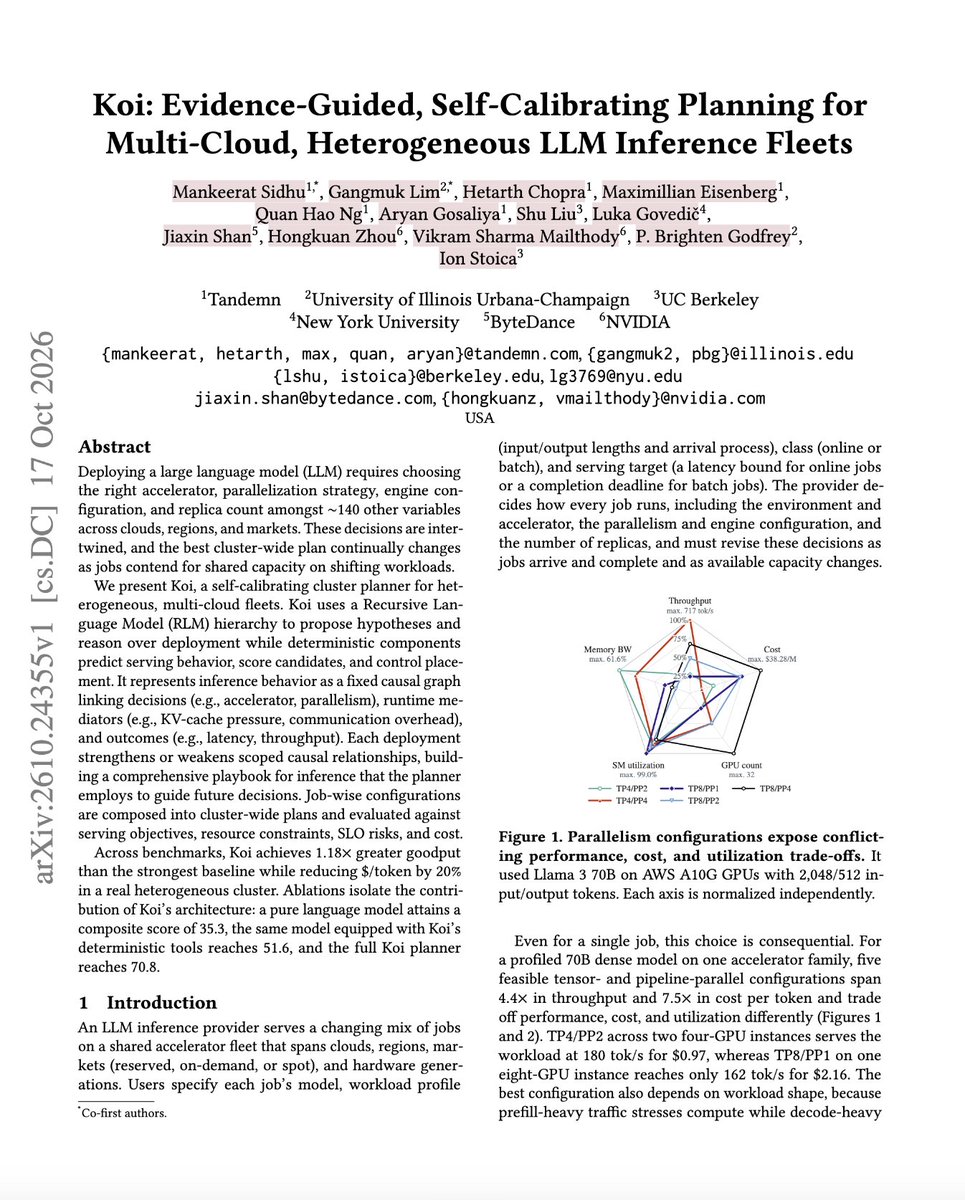
Deploying LLMs across heterogeneous GPU clusters requires jointly optimizing hardware selection, parallelism, serving configurations, and resource allocation across competing workloads. Existing approaches often optimize individual deployments or learn from end-to-end performance without identifying the underlying causes of performance differences
Koi introduces a self-calibrating planning algorithm that combines hierarchical LLM reasoning with causal modeling and deterministic optimization
It maintains a causal graph connecting deployment decisions, runtime bottlenecks, and serving outcomes. Language models propose configurations and testable hypotheses, while runtime telemetry validates or contradicts these relationships
This allows evidence from one deployment to inform future decisions across related workloads, without requiring separate experimentation
Koi effectively doubles usable cluster capacity while simultaneously lowering cost per token ~90% and increasing goodput 2.4x
https://t.co/Y0Y4f0XrxM
One of the most exciting changes I’m seeing with agentic AI in biology is who gets to use it.
Our bench scientists at Xaira—including those without coding expertise—are using X-Scientist to analyze data and design experiments, starting with a biological question in plain language.
Their biological intuition can now drive computational investigations directly, helping them explore ideas and decide what to test next.
That’s a powerful shift: more scientists turning their own questions into analyses, hypotheses, and experiments.
Do protein representations encode variant function? Diagnosing residue-level protein attributions via embedding-space gradients
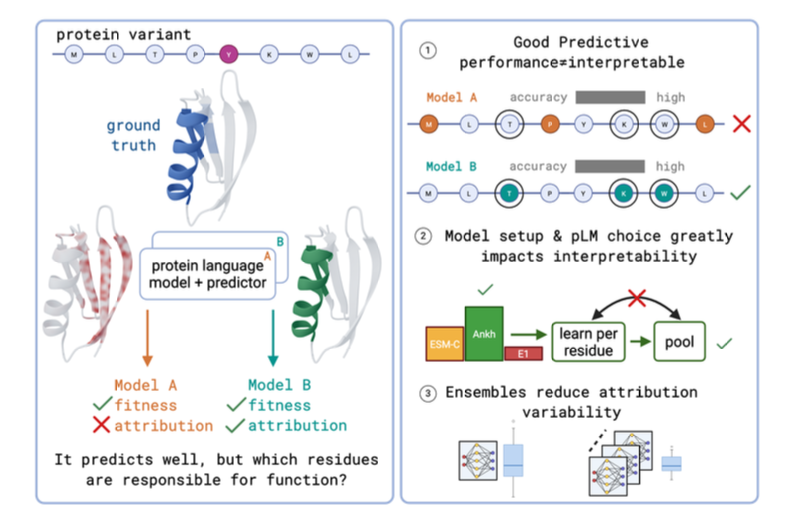
1. The paper introduces IGLOO, a benchmarking framework to test whether residue-level attributions (via Integrated Gradients on protein language model embeddings) actually recover functionally important residues, rather than merely producing plausible-looking heatmaps.
2. IGLOO’s core idea is to create synthetic fitness landscapes where per-residue “ground-truth importance” is known, enabling direct scoring of attribution fidelity. It builds 9 protein–landscape settings using 3 proteins (GB1, T4 lysozyme, p53) × 3 landscape types (additive, epistatic, nonlinear “cliff”), and systematically sweeps label noise to decouple accuracy from interpretability.
3. A central finding: predictive accuracy (held-out Spearman correlation on fitness) weakly tracks attribution quality. Models can predict variant fitness well while producing residue attributions that are near-random relative to known important sites—an explicit demonstration of the prediction–explanation fallacy in pLM-based variant effect prediction.
4. The work diagnoses why this happens using cascading parameter randomization: in common “pool-first” architectures (attention pooling on per-residue embeddings before the MLP head), attributions barely change when randomizing most of the predictor head, but collapse when randomizing the pooling layer—showing the pooling module largely determines residue-level attribution patterns.
5. A practical architectural intervention improves attribution: moving learned computation before pooling (“pool-later” via per-residue processing + pooling) substantially strengthens the link between model learning and residue attributions. In one example (GB1 additive), the correlation between attribution quality and predictive accuracy increases dramatically (Pearson r from 0.23 to 0.83).
6. Backbone choice matters for interpretability: across seven pLMs from ESM-C, Profluent E1, and Ankh families, Ankh models yield the most consistent attribution quality across landscapes, and bigger is not always better (Ankh-base can outperform Ankh-large).
7. Intermediate layers can predict “well” but attribute poorly: for Ankh-base, attribution quality collapses when using intermediate hidden states (even when prediction Spearman can reach ~0.6), while final-layer representations give the best attribution. The paper argues this may relate to scaling/normalization properties of intermediate residual streams.
8. Ensembling improves stability of interpretability: averaging attributions across independently seeded predictor heads reduces attribution variance roughly at the expected 1/sqrt(K) rate, making residue-level interpretations more reliable without major added cost.
9. Real-protein case studies mirror synthetic conclusions. On FLIP2 α-amylase splits, the split with best predictive performance does not necessarily yield best recovery of annotated functional categories; pool-later heads outperform pool-first heads for attribution across splits. On TEM-1 β-lactamase datasets, top-attributed sites show partial agreement with known functional residues, and in silico checks (stability and binding proxies) match attribution sign in ~2/3 of tested mutant–ligand combinations.
💻Code: https://t.co/M4UuIoU226
📜Paper: https://t.co/2YJV7dDhCB
#ProteinEngineering #ProteinLanguageModels #Interpretability #IntegratedGradients #DeepLearning #ComputationalBiology #MachineLearning #VariantEffectPrediction
🧬 Design proteins faster and send fewer, better candidates to the lab.
Introducing RFD4-Proteina, a new NVIDIA BioNeMo open model co-developed with @UWproteindesign.
▫️Fast: 13× faster generation than RFdiffusion3 at 200 residues
▫️ Smart: state-of-the-art across 12+ protein design tasks
▫️ Programmable: set your design inputs and use test-time compute on harder problems
Start with our binder-design tutorial https://t.co/fmS7miF1VD
@NVIDIAHealth and the Institute for Protein Design, led by Nobel laureate David Baker, just released RFD4-Proteina today at GTC Berlin, an open model that designs a protein’s sequence and structure together against a target. Apheris is a launch distribution partner. We run RFD4-Proteina on your own GPUs, inside your environment, and you can fine-tune it on your own structures and assays to design VHHs, antibodies, binders and enzymes and customize it to your chemistry.
RNAGenScape: Property-Guided, Optimized Generation of mRNA Sequences with Manifold Langevin Dynamics
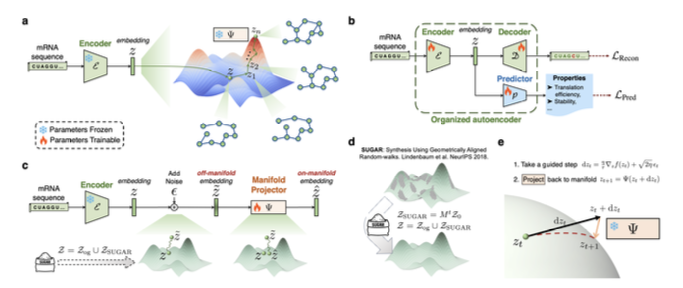
1. RNAGenScape frames mRNA design as local, iterative optimization on a learned manifold of real sequences, aiming to avoid a common failure mode of guided generators: drifting off-manifold into regions where sequences may be implausible and predictor gradients become unreliable.
2. The method’s core idea is “manifold-constrained refinement”: start from an existing mRNA, encode it, take a property-guided Langevin step (gradient + noise), then explicitly project the updated latent point back toward the learned data manifold—so intermediate steps remain decodable and close to viable sequence space.
3. Component 1 is an Organized Autoencoder (OAE): an autoencoder jointly trained with a property predictor so the latent space is both reconstructive (sequence-faithful) and property-organized (smooth property landscape for optimization). This joint objective improves both nucleotide reconstruction accuracy and property prediction correlations versus using either objective alone.
4. Component 2 is a learned manifold projector Ψ implemented as a multi-step denoising autoencoder in latent space. After each optimization step, Ψ “retracts” off-manifold updates back toward the manifold, functioning like a learned projection operator when the manifold has no analytic form.
5. To handle sparse/imbalanced mRNA datasets, RNAGenScape augments the latent manifold using SUGAR (diffusion-geometry-based “hole filling”). This enrichment stabilizes manifold learning/projection; ablations show moderate augmentation helps, while excessive augmentation can hurt.
6. Component 3 is property-guided manifold Langevin dynamics: z_{t+1} = Ψ(z_t + η/τ * ∇f(z_t) + sqrt(2η) * noise). Temperature τ trades off exploitation (gradient ascent/descent) vs exploration, while projection keeps the trajectory near training-supported regions.
7. Evaluation focuses on property optimization while preserving computational viability proxies. Across three datasets—OpenVaccine (stability), Zebrafish 5’UTR (translation efficiency), and Ribosome 5’UTR (mean ribosome load)—RNAGenScape achieves the largest median oracle-predicted gains and high success rates in both maximization and minimization directions.
8. Reported improvements versus evaluated baselines include up to 267% higher median property gain and up to 31% higher success rate, while maintaining favorable proxy metrics tied to translation and structure (e.g., fewer problematic upstream AUGs, improved Kozak-context similarity, and structure-related proxies like MFE and mean pLDDT).
9. The manifold projector is empirically critical: removing Ψ substantially reduces optimization performance, consistent with the hypothesis that unconstrained gradient updates drift into low-support latent regions where guidance degrades.
10. Practical considerations: RNAGenScape is step-efficient and competitively fast at inference (reported throughput ~0.952 samples/ms on A100, second among compared methods), and produces smooth, data-aligned optimization trajectories that can be decoded at every step; case studies visualize monotonic property improvement along manifold-respecting paths, with intermediate sequences more likely to fold cleanly in downstream structure prediction.
📜Paper: https://t.co/gGr76t63lR
#ComputationalBiology #mRNA #GenerativeAI #SequenceDesign #NeurIPS #ManifoldLearning #LangevinDynamics #Bioinformatics #SyntheticBiology #MachineLearning
Stanford researchers did it again.
They made language models 31× faster.
Right now, every major AI, from ChatGPT to Claude, writes exactly the same way. It guesses the next word. One token at a time. Left to right.
It’s like writing an essay on a typewriter while looking through a straw. It is computationally exhausting and incredibly slow.
Some labs tried to fix this with "diffusion models”, generating everything at once and polishing it over and over. But that requires massive compute and endless denoising passes.
A team from Stanford just dropped a paper that kills both methods.
It’s called "Next-Concept Modeling" (NCM).
Instead of predicting the next word, the AI predicts the next concept.
It generates text exactly how a professional writer drafts a book. Coarse to fine.
First, it generates a high-level conceptual outline of the entire sequence. Then, in parallel, it fills in the precise words and details across the whole document at once.
The results are staggering.
• Generates text up to 31x faster than current diffusion language models.
• Requires drastically fewer computing steps to reach high-quality outputs.
• Actually outperforms traditional step-by-step models on complex reasoning tasks like Sudoku.
AI is no longer blindly typing word by word, hoping the sentence makes sense when it reaches the period.
It is conceptualizing the entire thought before it opens its mouth.
Revisiting Structure-Based Filtering for AI-Designed Antibodies: Opportunities, Limits, and What Matters
1. The paper reframes a practical bottleneck in AI antibody design: generation can produce thousands of candidates, but experiments are limited—so post-generation filtering becomes the key decision problem (retain true binders while controlling false positives).
2. Using 4,184 experimentally characterized antibody–antigen pairs, the authors test whether structure-prediction outputs alone can prioritize candidates for wet-lab validation, across heterogeneous evidence sources (new display-based measurements, IgDesign SPR, and curated literature/patent affinities).
3. Two new filtering signals are introduced from predicted complex ensembles (10 seeds × 5 samples): Regional Interaction Contrast (RIC) for interface support, and Non-CDR Antibody Confidence (NAC) for antibody reliability outside CDR loops.
4. RIC targets a specific failure mode of interface-centric scoring: instead of asking “is the interface confident?”, it asks whether the predicted antigen-contact region for each CDR residue is meaningfully better supported than plausible alternative regions, and whether that contrast is reproducible across runs via PAE-based agreement.
5. NAC captures an unexpected but robust signal: average pLDDT over the antibody framework (excluding CDRs), aggregated by medians across samples and runs. Counterintuitively, confidence in the “less binding-direct” region can outperform confidence in the CDRs/interface because it is more reliably predicted.
6. Core finding: what matters depends on the filtering context.
Across-antigen filtering (one global threshold across many antigens): interface evidence dominates—RIC ranks best on AlphaFold 3 and Protenix-v2, and a geometry-based approximation (gRIC) leads for ESMFold2.
7. Within-antigen ranking (campaign-specific selection): the ordering reverses—NAC becomes the strongest signal across predictors (best average rank for AlphaFold 3 and ESMFold2; near-best for Protenix-v2), while RIC/gRIC drops substantially in rank.
8. A key nuance: NAC consistently beats whole-antibody pLDDT for within-antigen selection (reported as 23/24 predictor–measure comparisons). Removing CDRs from the confidence summary typically improves filtering, suggesting a trade-off between binding relevance (CDRs/interface) and prediction reliability (framework).
9. The paper also quantifies “how much binding signal is even present” in predictor outputs (identifiability ceiling): AlphaFold 3 coordinate-derived features separate binders vs non-binders within targets (target-macro AUC ~0.801), and adding confidence tensors improves separability (~0.827), but substantial overlap remains—limiting any downstream metric.
10. Practical implication for antibody design pipelines: use interface-support metrics like RIC to compare candidates across different antigens (portfolio triage), but use antibody reliability metrics like NAC to rank candidates within a single antigen campaign (fixed-budget testing). Also, absolute thresholds do not transfer well across antigens, so top-Q selection or per-target calibration is often necessary.
📜Paper: https://t.co/n65v0y2GM6
#AntibodyDesign #ProteinDesign #ComputationalBiology #StructuralBioinformatics #AlphaFold3 #ESMFold #ProteinFolding #Biophysics #MachineLearning #DrugDiscovery
David Baker’s team just unveiled Chaperone, an AI agent harness for protein design.
🧬 86% fewer tokens
⚡ 64% fewer GPU-hours
📈 Computational pass rate nearly doubled (6.1% → 11.7%)
Plus, a 1.32 nM cortisol binder designed in just 2 weeks.
🔗 https://t.co/v2uWTubmM8
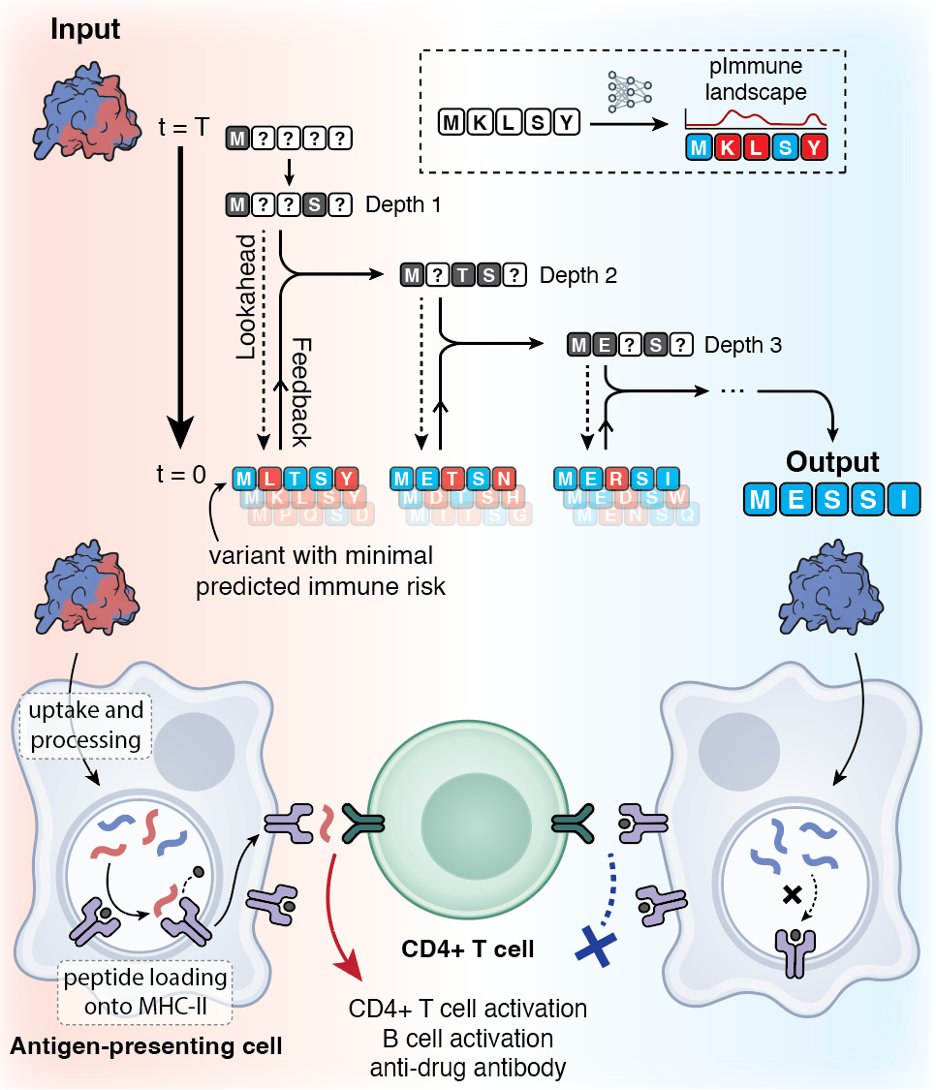
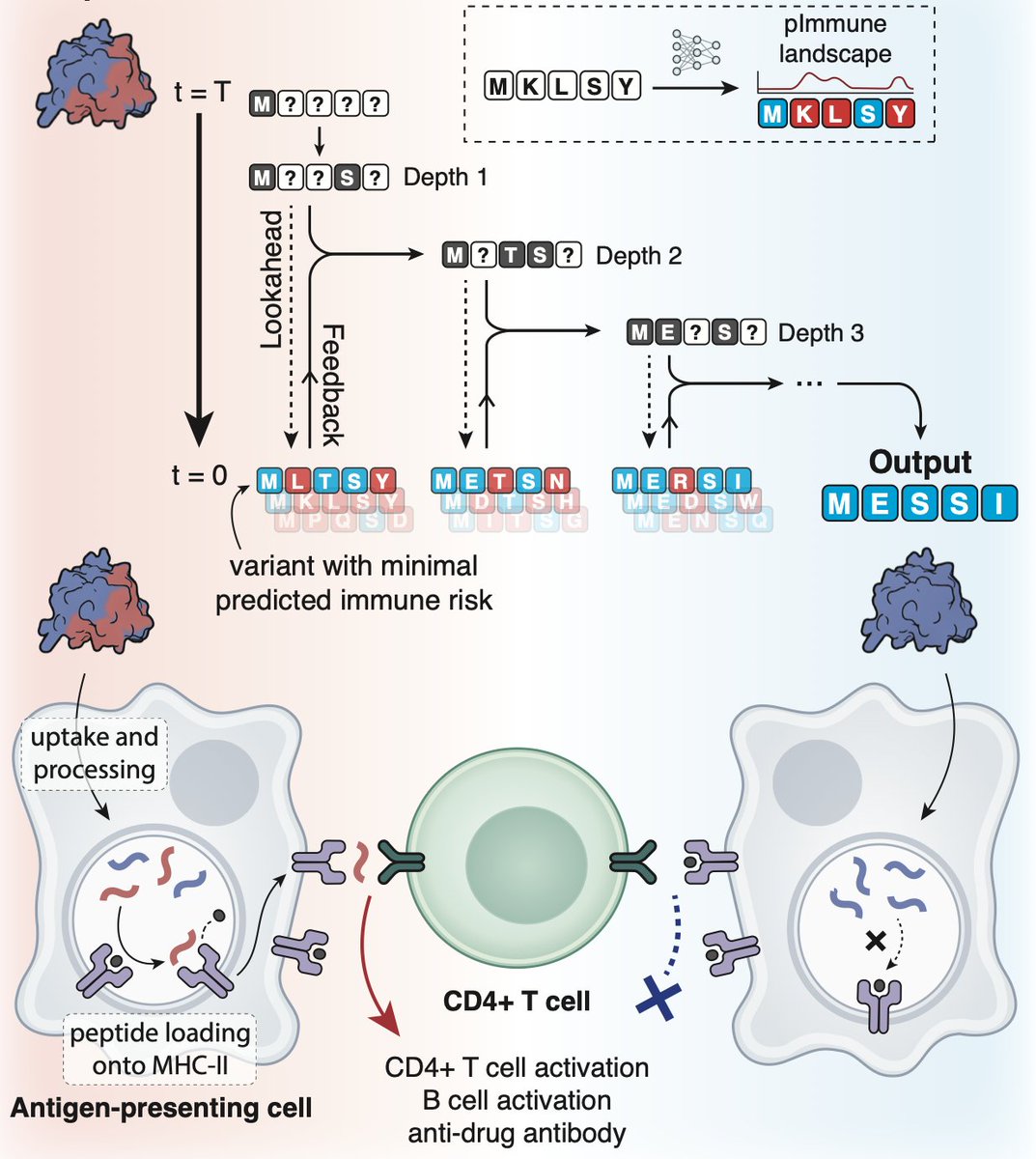
Generative protein design is transforming macromolecular drugs, but de novo designed therapeutics could still be hindered by immunogenicity in the clinics. Excited to introduce MESSI, a discrete diffusion model for generative protein deimmunization.
Can we design proteins that cut other proteins? Our de novo cysteine protease paper is out in Nature! We designed new folds that cleave peptide backbones, with activity demonstrated in mammalian cells. Paper and code 👇
https://t.co/42q6A5eJ9W
Protein Deimmunization with a Generative Diffusion Model
1. The paper introduces MESSI, a structure-conditioned discrete diffusion model that generates protein sequences predicted to preserve a given backbone while eliminating MHC class II (HLA-DR) peptide presentation risk—often down to 0 predicted epitopes for a specified allele.
2. Key technical idea: inference-time “lookahead–feedback” steering for discrete diffusion. From a partial denoising state, MESSI samples multiple full sequences (lookahead), scores whole-protein and residue-level immune risk, then “reopens” high-risk positions (masking them again) while keeping low-risk choices as generative memory (feedback), iterating to progressively lower epitope burden.
3. To enable fast closed-loop steering, the authors train an allele-specific immune-risk predictor directly on IEDB MHC-II eluted-ligand MS data (12–25 aa windows) with both window-level and residue-level supervision, producing a local risk landscape for targeted edits plus a global score for candidate selection.
4. Benchmarking vs NetMHCIIpan-4.3: the learned predictor matches ROC-AUC while better capturing residue-level risk patterns (higher Pearson correlation with ligand coverage) and is reported up to ~1,500x faster, GPU-compatible—critical for coupling to generative sampling.
5. Large-scale design tests across 211 proteins and 3 HLA-DRB1 alleles (04:01, 07:01, 15:01) show MESSI shifts the design distribution toward lower predicted immune risk while maintaining strong structural recovery (e.g., scTM > 0.7 across tested proteins), outperforming post-hoc filtering of unguided inverse folding and reducing variance seen in unconstrained ProteinMPNN designs.
6. Multi-allele proof-of-concept: MESSI can be constrained against two alleles simultaneously (DRB1*04:01 and DRB1*07:01), producing sequences with reduced risk for both, suggesting a path toward broader population coverage (while noting the scaling challenge to many alleles/loci).
7. Experimental validation 1 (enzyme): MESSI deimmunizes a de novo luciferase (LuxSit-i) by fixing 22 catalytic/pocket residues and redesigning the rest. Five variants at ~53–57% identity retain near-identical predicted folds and achieve 0 predicted epitopes for DRB1*15:01; all show detectable luminescence in cell-free expression, with one variant matching parent activity.
8. Experimental validation 2 (binder): MESSI is inserted into the BindCraft pipeline to redesign a PD-1 minibinder while fixing 57 hotspot contact residues. Four designs achieve 0 predicted epitopes (DRB1*15:01), maintain high complex confidence (iPTM > 0.9), express better in cell-free E. coli, and show measurable binding by BLI; two variants improve affinity, with a best reported Kd ~30 nM.
9. Experimental validation 3 (clinically relevant enzyme): MESSI deimmunizes uricase, motivated by ADA issues in approved rasburicase/pegloticase. Across 11 diverse uricase orthologs, designs reduce predicted epitope counts (NetMHCIIpan evaluation), sometimes to 0 (e.g., G. max and D. radiodurans), while retaining activity in IVTT Trinder assays; some variants show higher normalized activity than wild type (best S. scrofa redesign ~2.7x).
10. Discussion emphasizes MESSI as an “immunogenicity-aware inverse folding” module compatible with modern generative design, highlights future needs (DP/DQ coverage, many-allele scaling, TCR recognition/self-similarity, B-cell epitopes and aggregation/stability), and suggests personalized design against patient HLA genotypes or rotating epitope-distinct sequence reservoirs for repeat dosing.
💻Code: https://t.co/v8wLm4KthX
📜Paper: https://t.co/2Va8vFCrY4
#ProteinDesign #DiffusionModels #GenerativeAI #ComputationalBiology #Immunology #Deimmunization #MHCII #HLA #Biologics #TherapeuticProteins #InverseFolding #ProteinEngineering #DrugDevelopment
"Training Language Models to Fail Gracefully"
Due to how we use RL for LLMs, there is currently little incentive for models to admit uncertainty, preventing them to guess even when they're unlikely to succeed.
This paper GracefulRL instead trains models to prefer success over safe fallback, and safe fallback over failure. They did it by using a modified RL objective that prevents the model from collapsing into always refusing.
On AIME, it reduces incorrect answers from 79.1% to 8.9%, while sacrificing only 3.1% of correct answers. On Minesweeper, it even improves success from 67.4% to 77.4% while reducing errors.
https://t.co/0POjtcbgXz
De novo design of metalloenzymes using Metal Mer
1. The study presents Metal Mer + METALPROT, a computation-first pipeline that designs active metalloenzymes “out of the box”, and demonstrates >99% ee ketone reductions across 13 substrates without directed evolution, plus selective iron-catalyzed radical alkene difunctionalization reaching 96:4 e.r. after a single mutation.
2. Metal Mer is a structural unit that maps local backbone geometry to statistically preferred metal-coordination modes mined from the PDB, extending the van der Mer concept from protein–small-molecule interactions to protein–metal coordination.
3. The Metal Mer library captures residue- and metal-dependent coordination distributions (His/Asp/Glu/Cys; tetrahedral, octahedral, and distorted geometries), and annotates motif prevalence with a cluster score (CluScore) plus multi-residue convergence with an overlap score (OPScore).
4. METALPROT aligns candidate Metal Mers onto predefined backbones and uses a graph-based search to assemble compatible multi-residue first-shell sites, prioritizing combinations that are both statistically supported in structural data and geometrically compatible on the target scaffold.
5. The full design workflow builds diverse 4-helix and 5-helix bundle scaffolds (including non-canonical cross-sections), places metal sites via METALPROT, then iteratively designs first-shell/second-shell interactions and pocket geometry before catalytic optimization.
6. A key design choice is “restrained-product” pocket design: instead of explicitly computing a transition state, Rosetta is guided by one product enantiomer plus TS-like geometric restraints (distances/angles from literature QM), biasing the pocket toward enantioselective catalysis while reducing computational overhead.
7. For Zn-dependent hydride transfer (silane-driven ketone reduction), 17/60 designs were active and 3 exceeded 90% ee; the best variant (ZnMP-9) uses an Asp-His-His Zn site rather than the canonical 3-His motif from carbonic anhydrase, showing that productive ligand sets can differ from natural precedent.
8. Structural and biophysical validation supports design accuracy: Zn binding is 1:1 with low-µM Kd by ITC, CD confirms α-helical folding, and a crystal structure of an active design (ZnMP-25) matches the computational model closely (backbone RMSD ~0.365 Å) with clear density for Zn.
9. Pocket remodeling via partial diffusion (keeping the working metal site and nearby helices) expands substrate scope and improves selectivity on bulky, drug-like substrates; notably, steroid diketones can be reduced with high regio- and diastereoselectivity (>19:1), including selective C17 reduction of androstenedione to testosterone (single diastereomer, 74% isolated yield, no protecting groups).
10. The same framework extends to octahedral Fe centers for radical alkene trifluoromethyl-azidation: initial designs achieved ~10% yield and 70:30 e.r. (better than reported natural functional analogs before evolution), N3-attack-oriented designs improved to 85:15 e.r., and a single pocket mutation (A116V/I) raised selectivity up to 96:4 e.r. across multiple substrates; TEMPO inhibition and radical-clock experiments support a radical mechanism and highlight how pocket geometry tunes rebound vs side reactions.
📜Paper: https://t.co/OpGqAYntWc
#ProteinDesign #Metalloenzymes #ComputationalBiology #EnzymeEngineering #Biocatalysis #Rosetta #RFDiffusion #StructuralBiology #AsymmetricCatalysis #RadicalChemistry
Simplifying in silico protein evolution with minimal screening by unZipro
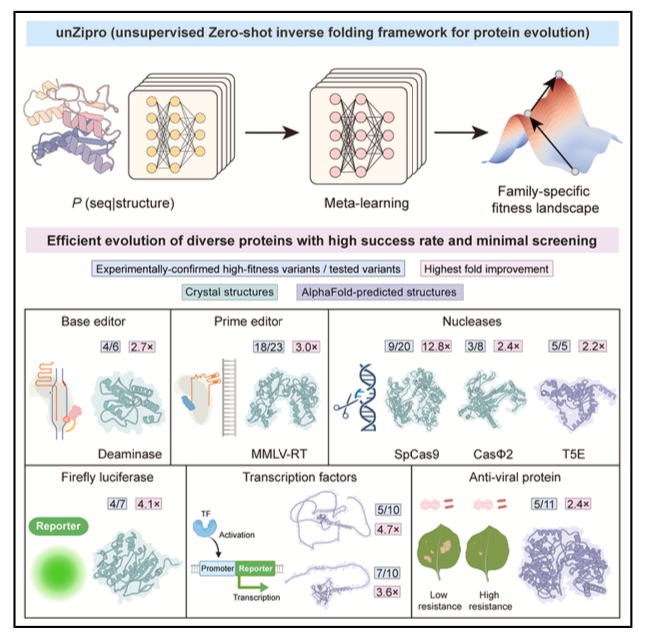
1. Qin et al. introduce unZipro, a geometric deep learning framework for zero-shot protein evolution that aims to cut experimental screening down to “top ~10” candidates while still finding high-fitness variants across diverse protein families.
2. Core idea: start with a compact structure-based inverse folding model (GNN encoder–decoder) pre-trained on 24,501 non-redundant single-chain protein structures to learn general sequence–structure constraints, then adapt it to a target protein family via homolog-guided meta-learning.
3. The “family-specific expert” concept is central: meta-transfer learning (MAML) plus homologous structures retrieved by Foldseek is used to shift a generalist inverse folding model toward a family-specific fitness landscape without using task-specific experimental labels.
4. Benchmarking on ProteinGym (217 DMS datasets; 2.46M mutations): meta-learning improves average Spearman correlation from 0.3703 (pre-trained) to 0.4163 (12.4% relative gain). unZipro outperforms several inverse-folding baselines and reaches performance comparable to large PLM-based inverse folding approaches, despite fewer parameters and less training data.
5. Practical engineering claim: unZipro prioritizes beneficial mutations with minimal wet-lab testing. Across nine protein engineering tasks, testing fewer than ten nominated variants yields an average success rate of 61% for high-fitness hits, supporting a low-screening design-build-test loop.
6. Gene editing improvements in crops are a major emphasis: for TadA8e (ABE), fine-tuned unZipro nominates 6 candidates and identifies 4 high-fitness variants (66.6% hit rate). The TadA8e T83N variant improves A-to-G editing (up to ~1.9-fold in reporter assays), boosts endogenous wheat editing across loci, and reduces genome-wide off-target A-to-G substitutions in WGS.
7. Nuclease optimization: for SpCas9, unZipro nominates 20 candidates; several improve editing, with D1180G reaching up to 12.8-fold higher Indels at a wheat target site, and no detected increase in genome-wide mutational burden or off-target edits (WGS + candidate-site checks).
8. Hypercompact CasΦ2 is upgraded further by combining unZipro-designed variants with a T5 exonuclease fusion strategy. The T5E(Y58F)-CasΦ2(Y356F) fusion yields 1.8- to 27.9-fold increases over CasΦ2 across wheat loci (up to 85% Indels at one site), and the headline result reports up to 28-fold gain for T5E-CasΦ2 fusion variants.
9. Prime editing: unZipro leverages two structural states of the PE complex (initiation vs elongation) to nominate MMLV-RT mutations; 70% (7/10) and 86.7% (13/15) of tested mutations improve PEmax activity in wheat protoplast reporters. A rational combination strategy (structure + conformational state + co-evolutionary coupling) yields PEmax(R253K/T246H), named PEUltra, with up to 2.2-fold improvement over ePPEplus at endogenous wheat sites and high efficiency in transgenics.
10. Beyond editors, unZipro is shown on non-enzymes and plant proteins using AlphaFold3 structures: firefly luciferase activity is improved (e.g., M164I gives ~4.1-fold); rice TFs (OsPHR2, OsNAC3) show high hit rates for enhanced transcriptional activation; and barley methionine synthase HvMS1 variants increase methionine and confer stronger broad-spectrum antiviral effects against both PVX (RNA virus) and BSCTV (DNA virus) in Nicotiana benthamiana.
💻Code: https://t.co/PBnkvciw70
📜Paper: https://t.co/i9XT5uTnCF
#ProteinEngineering #MachineLearning #GeometricDeepLearning #InverseFolding #MetaLearning #CRISPR #BaseEditing #PrimeEditing #PlantBiotech #ComputationalBiology
Programming Biological Behavior with AI-Guided de Novo Protein Design
1. The review argues that AI-guided de novo protein design is ready to move beyond “single binder vs single target” and toward bottom-up construction of protein reaction networks that generate emergent behaviors (signal amplification, decision-making, error correction).
2. It frames recent AI advances as a shift in what is “easy”: designers can now often specify a target and desired binding site/epitope and let models generate candidate binders directly, with experimental hit rates frequently high enough to test tens to hundreds of designs rather than thousands.
3. The piece summarizes the current binder-design toolbox and why it matters for systems engineering: diffusion-based methods (e.g., RFdiffusion, Chroma) and hallucination-style approaches (e.g., BindCraft) can generate diverse folds and binders, and newer all-atom generative models aim for tighter atomic control over interfaces.
4. A key message is that binder design is strong but not “solved,” especially for difficult interfaces: polar binding sites (hydrogen-bond geometry constraints), loop-mediated recognition (e.g., antibody CDR-like problems), and flexible targets often still require large design sets and careful filtering or iterative refinement.
5. The review highlights progress on binders to intrinsically disordered proteins/regions (IDPs/IDRs), emphasizing two emerging strategies: modular repeat/scaffold approaches that recognize segments and recombine them, and flexible diffusion approaches that allow induced fit and stabilization of secondary structure (e.g., β-strand-like binding modes).
6. It spotlights the next frontier: de novo recognition beyond proteins, including small molecules, nucleic acids, and post-translational modifications (PTMs). The authors stress that these problems demand sub-Å accuracy and are limited by smaller/less diverse training data than protein-protein complexes.
7. For small molecules and PTMs, the review contrasts two workflows: (a) generative all-atom models that build binding sites around ligands without predefining pockets (often requiring large experimental screening), and (b) more guided approaches that start from specified interactions and iteratively optimize (less scalable but can reduce experimental burden).
8. For DNA binding, it highlights recent progress toward sequence-specific de novo DNA-binding proteins, including the idea of actively screening off-target interactions computationally (e.g., using structure prediction tools) to improve specificity—an enabling step toward synthetic transcription factors and programmable gene regulation.
9. The authors emphasize that programmable assembly is a route to systems behavior: de novo binders fused to designed oligomeric scaffolds can tune geometry/valency of receptor clustering, enabling systematic probing of how spatial organization controls signaling outputs and how to decouple/re-couple pleiotropic pathways.
10. A central bottleneck for truly network-level design is dynamics: many desired behaviors require designed conformational landscapes and controllable switching. The review points to early successes in designing intradomain conformational changes and argues that better datasets and physics-aware generative models are needed to robustly program kinetics, multi-step functions, and non-equilibrium behavior.
11. The review uses concrete multi-component examples to illustrate “network thinking”: facilitated dissociation systems that tune off-rates across orders of magnitude; chemically induced dimerization (CID) concepts predicting distinct dose-response shapes (ratchet-like vs molecular-glue-like); and phosphorylation-triggered de novo switches as building blocks for synthetic signaling.
12. Looking forward, it proposes two big opportunities: a “de novo binderome” enabling proteome-scale, site- and state-specific perturbations for systems biology, and fully de novo bio-orthogonal signaling pathways with predictable behavior and minimal crosstalk—both hinging on improved dynamics, all-atom accuracy, and quantitative functional datasets.
📜Paper: https://t.co/qmbrrdu0mR
#ProteinDesign #DeNovoProteins #GenerativeAI #SyntheticBiology #ComputationalBiology #SystemsBiology #ProteinEngineering #AIinBiology