the creator of C++ just explained why most developers will never become senior - and it has nothing to do with years of experience
> AI code is trained on legacy patterns - accepting it blindly is a mid move
> 90%+ of memory bugs come from old coding habits, not the language itself
> static typing isn't annoying overhead - it's what lets you design instead of debug
> if you only know one language, you're a hobbyist, not a professional
> seniors solve real problems - juniors build tools to scratch their own itch
> the same principles apply whether you're writing web apps or autonomous agents - clean architecture over clever hacks
the man whose language powers every OS, browser, and trading system alive
if you're trying to level up, save this interview
My biggest takeaways from Claude Code's Head of Product @_catwu:
1. Anthropic’s product development timelines have gone from six months to one month, sometimes one week, sometimes one day. Part of this acceleration is access to the latest models (i.e. Mythos). Another is shipping new products into “research preview,” making clear it's early, experimental, and might not be supported forever. Another is an evergreen "launch room "where engineers post ready features and marketing turns around announcements the next day.
2. The PM role is shifting from coordinating multi-month roadmaps to enabling teams to ship daily. As Cat puts it, “There should be less emphasis on making sure you are aligning your multi-quarter roadmaps with your partner teams and more emphasis on, OK, how can we figure out the fastest way to get something out the door?”
3. The most efficient shipping unit is an engineer with great product taste. On Cat’s team, many engineers go end-to-end—from seeing user feedback on Twitter to shipping a product by the end of the week—without a PM involved. Also, almost all the PMs on the Claude Code team have either been engineers or ship code themselves, and the designers have been front-end engineers. The roles are merging, and the most valuable skill is product taste, not job title.
4. Build products that are on the edge of working. Claude Code’s code review product failed multiple times because earlier models weren’t accurate enough. But because the prototype was already built, they could swap in Opus 4.5 and 4.6 and immediately test whether the gap was closed. Teams that wait for the model to be ready will always be a cycle behind.
5. The most underrated skill for building AI products is asking the model to introspect on its own mistakes. Cat regularly asks the model why it made an unexpected decision. The model will explain that something in the system prompt was confusing, or that it delegated verification to a subagent that didn’t check its work. This reveals what misled the model so the team can fix the harness.
6. Every model release forces their team to revisit existing products and audit their system prompt to remove features the model no longer needs. Claude Code’s to-do list was a crutch for earlier models that couldn’t track their own work. With Opus 4, the model handles it natively. Features built as scaffolding for weaker models become debt when the model catches up—so the team actively strips them.
7. Anthropic employees build custom internal tools instead of buying SaaS products. A sales team member built a web app that pulls from Salesforce, Gong, and call notes to auto-customize pitch decks—work that used to take 20 to 30 minutes now takes seconds. Their core stack is Claude Code, Cowork, and Slack. No Notion, no Linear, no Figma.
8. People underestimate how much Claude’s personality contributes to its success. As Cat describes it, “When you reflect on everyone you’ve worked with, there’s just some people where you’re like, I really like their energy, their vibe.” Claude is designed to be low-ego, positive, competent, and earnest—qualities that make it feel like a great coworker, not just a tool. This isn’t cosmetic; it’s what makes people want to use Claude for hours every day. The team has a dedicated person, Amanda, who “molds Claude’s character,” and it’s one of the hardest roles at the company because success is so subjective.
9. The future of work is managing fleets of AI agents, not doing the work yourself. Cat sees a clear progression: first, individual tasks become successful. Then people start running multiple tasks at the same time (multi-Clauding). Next, people will run 50 or 100 tasks simultaneously, which will require new infrastructure—remote execution, better interfaces for managing tasks, agents that fully verify their work, and self-improving systems that incorporate feedback. The human role shifts from doing the work to knowing which tasks to look into, verifying outputs, and giving feedback that makes the system better over time.
10. Hire people who lean into chaos and face every challenge with a smile. At Anthropic, there are weeks when a P0 on Sunday becomes a P00 by Monday and a P000 by Monday afternoon. If you get too stressed about any one thing, you’ll burn out. Their team looks for people who can look at a hard challenge and say, “Wow, that’s gonna be hard. But I’m excited to tackle it and I’m gonna do the best that I possibly can.” This mindset—optimism, resilience, and comfort with constant change—is increasingly essential as the pace of AI development accelerates.
Don't miss the full conversation: https://t.co/1wOUHcdYQN
Day 83/365 of GPU Programming
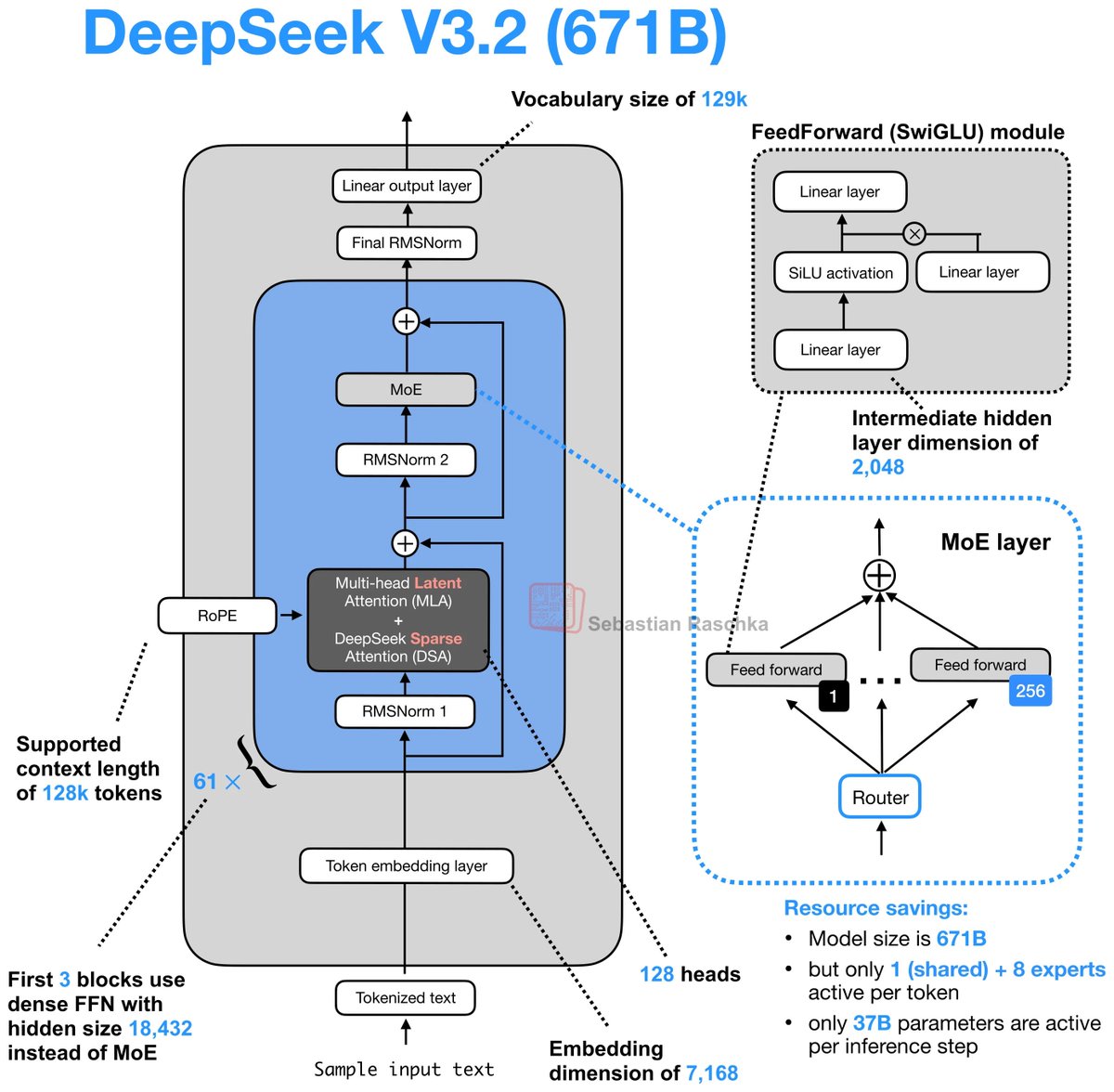
Looking at DeepSeek's Multi-Head Latent Attention today. The last part of the AMD challenge series is to optimize an MLA decode kernel for MI355X where the absorbed Q and compressed KV cache are given and your task is to do the attention computation.
A resource that really helped internalize what MLA does was @rasbt's incredible visual guide to attention variants in LLMs (luckily he posted that last week!), which covers everything from MHA to GQA to MLA to SWA, et cetera. If there's one place to get a visual intuition for recent attention mechanisms, it's this blog post.
@jbhuang0604's video on MQA, GQA,MLA and DSA was the best conceptual intro I found on the topic and progressively builds up the ideas from first principles.
The Welch Labs analysis of MLA is a great watch as well. Beautiful visualization of the changes DeepSeek made for MLA.
Tried out a few kernels once I had a basic understanding of MLA and I think I'm slowly getting more comfortable with at least analyzing kernels.
@jarredsumner That's pretty cool although since the API doesn't allow you to control/persist the salt doing a 1:1 reproduction between Bun vs Node.js API isn't doable much.
Regardless, great stuff to see in Bun. I also wrote about this here: https://t.co/qp0xunybIR
Goal of the tournament already? 😎 Here are the best 5 goals of Day 7 & 8 ✍️ Which one gave you chills? ⬇️
🎖Bianca Bazaliu 🇷🇴
2. Viktoria Györi-Lukacs 🇭🇺
3. Alina Grijseels 🇩🇪
4. Louise Burgaard 🇩🇰
5. Nataša Ljepoja 🇸🇮
#ehfeuro2022 | #playwithheart
Of the defunct NewSQL companies, DeepDB (@deepdatabase) was the most puzzling. It was supposed to be a drop-in replacement for InnoDB. They made wild claims about their engine's performance and ability to use AI to optimize itself (this was back in 2014).
Flutter is the default choice for future Ubuntu apps.
@kenvandine, Engineering Manager, is here to tell you about some of Canonical's contributions to Flutter at #FlutterEngage.
Watch 👉 https://t.co/kc1tFBlMJh
8 years ago I spent the day in Singapore with my hero Kevin Kelly, then he told me it was his 60th birthday. Today he posted this must-read gem: https://t.co/Fj77LMWgHR
One of the simplest product development practices is to keep a decision log for technical debt; human memory is fragile, projects rotate staff, and cognitive biases are real. A decision log helps maintaining knowledge and learn from earlier choices.