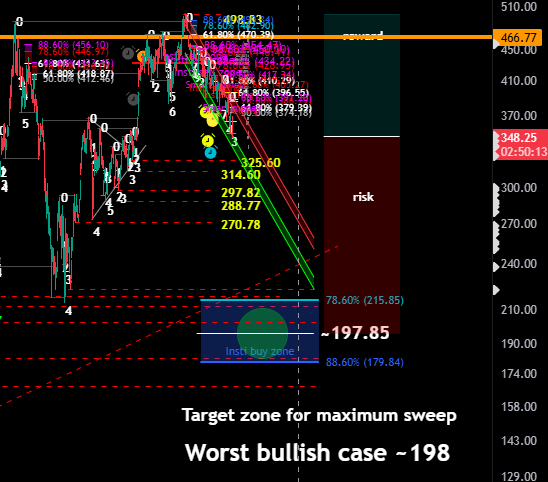
Update: 6 months later.
$325.60 seems reasonable for a minority sweep in the short term. A relief rally should be expected, but still below $400.
Depending on broad market SPY/QQQ, further weaknesses would help to drag $TSLA to take out the stop levels at $270.78.
Reward to risk will get attractive at those levels.
My worst bullish case has been raised to $198, target landing zone for maximum sweep. This is black swan event, probably <10-20% probability.
Accumulation should complete by 3 Nov 2026, US midterm elections.
2027 will be incredible.
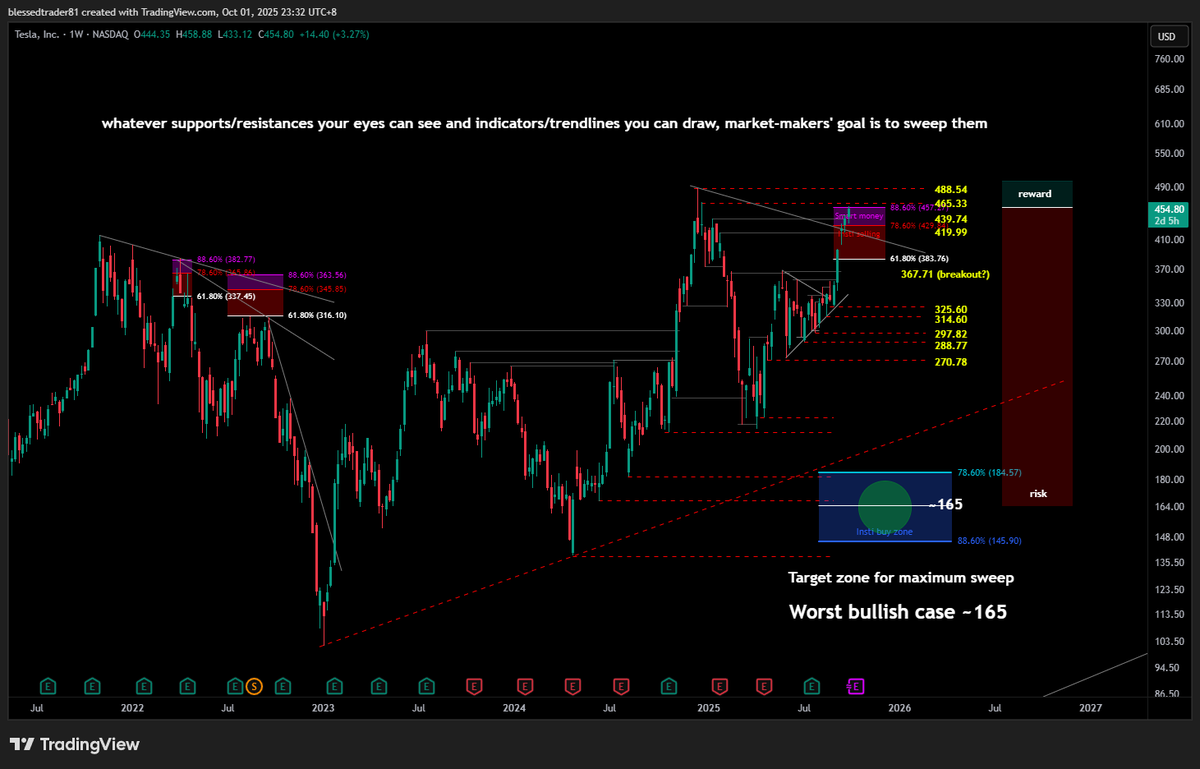
Update: $TSLA Worst bullish case ~165 (higher low) for a majority liquidity sweep by market-makers
Floor price to revise up if ATH $488 is broken.
Hypothetically, if $TSLA goes to $600 and retrace 50% (Tesla is capable of doing that), $300 is still within reach.
However, if $TSLA does a parabolic breakout like in 2020-2021, this theory would collapse.
If Elon Musk is the best resource allocator of our time, why SpaceX ipo now?
Maybe it is another liquidity event, akin to him selling his Tesla shares (on twitter poll, to buy twitter, to pay tax) near peaks back then.
However, he also bought $1b worth of Tesla shares at ~$390 last Sept (tiny amount in comparison).
You NEED to listen to me right now.
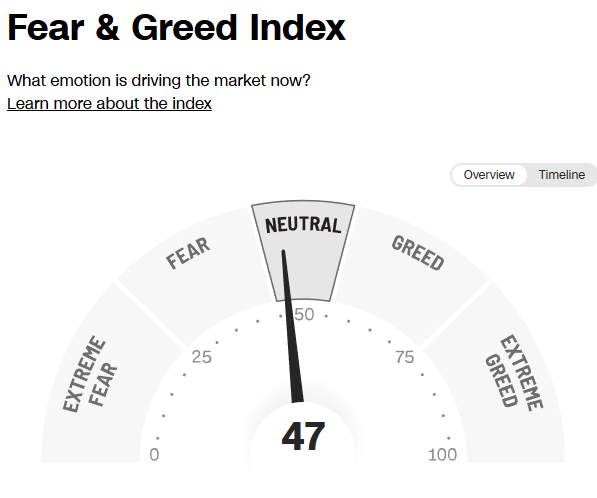
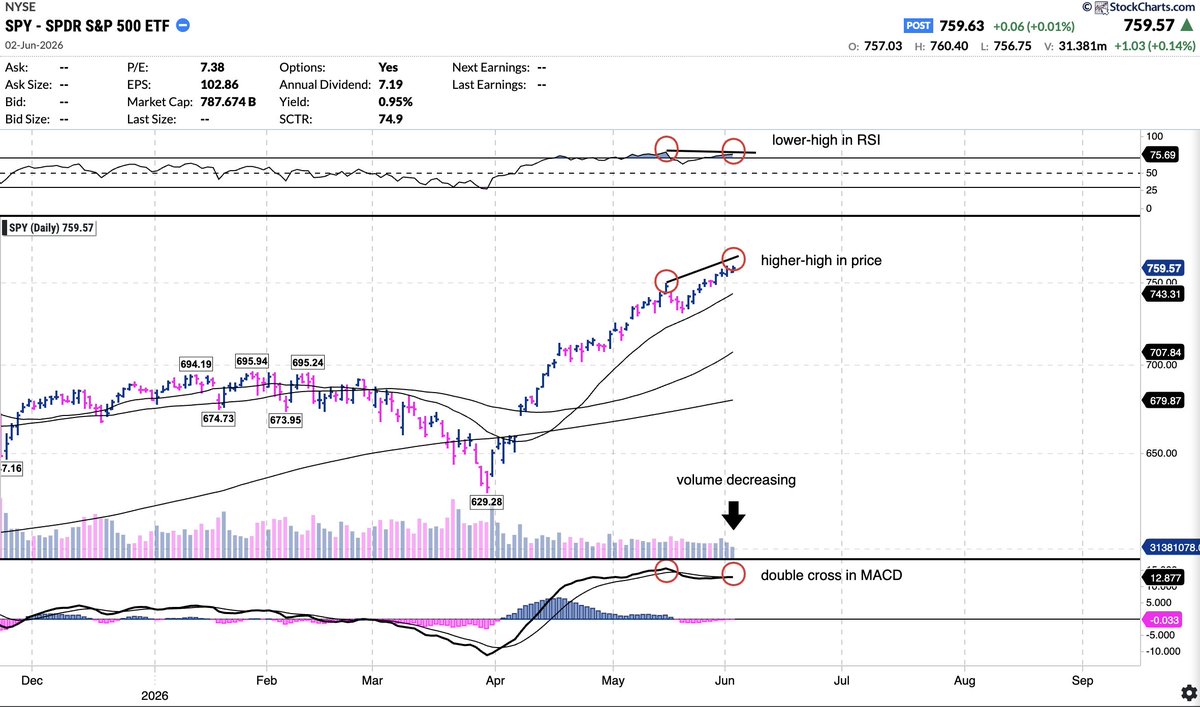
We are in LATE-cycle territory for the overall markets / $SPY.
Bearish divergences are forming with EACH new marginal high.
VOLUME is drying up, candles are getting smaller. This is HESITATION from the bulls.
Momentum is starting to FADE.
Markets will STILL keep going up long-term, but SHORT-TERM, we're in the 8th - 9th inning.
I expect a 5% HEALTHY pull-back.
What should you do?!
1. Keep your AI-winners!!!! Trim 20% to lock-in GAINS, never sell fully. They are WINNERS for a reason
2. Look for CONTRARIAN buys. The stocks that have been LAGGING. They will go down LESS, or even outperform.
3. BALANCE your portfolio with AI leaders + AI laggards + defensives!!!!
All you need to do is SURVIVE, and you will be rewarded with the BIGGEST bull-run in history over the next 5 years.
- Keep companies and consider trimming 20% like $ARM, $NBIS, $MRVL, $MU, etc.
- Slowly positions in companies like $CRWV, etc.
- Build positions in lagging companies like $NOW, $NKE, etc.
- Build defensives like $WMT, etc.
Get ready to buy amazing companies like $AMZN, $GOOGL, and many many others soon.
Shiller PE ratio at TMT Bubble top!
Buy & hold in US stocks unlikely to deliver good returns over the next decade. Buy & sell likely to do much better.
On watch for a lost 10-12 year period with big index-level drawdowns (similar to 2000-2012)
The S&P 500 gained 10.7% through the first five months of 2026, putting it on pace for a 15%+ gain for a fourth year in a row. The only other time the benchmark achieved the feat was the five-year streak from 1995-99.
The longer the rally continues, the more it resembles the late-1990s bull. Both were fueled by a revolutionary technology that triggered capex spending and productivity gains.
There are key differences, including demographics, consumer sentiment, and geopolitics, just to name a few.
While the debate over how well the current market fits the 1990s analog is fascinating, the relevant question here is whether the current rally will come to an end.
Two triggers of the 2000 bear market – rising inflation and technical divergences – are in play but not at bull-breaking levels currently.
The S&P 500 roughly followed its midterm year average pattern through February before diverging during the March selloff and April-May rebound (chart). Events in the Middle East likely brought some of the typical midterm year weakness forward.
History suggests additional weakness is possible, especially late in Q3 amid election angst. As the outcome has becomes less uncertain, the market has tended to enter a year-end rally. Point-to-point, the S&P 500 has risen 4.7% in the second half of midterm years, on average, which is the final input into our S&P target.
Given the historically overbought condition of the Technology sector, a Tech-led mean-reversion pullback could align with the midterm pattern however, midterm years often end on a high note.
https://t.co/JXzFFTmMtn
https://t.co/FfBnR93ojq
https://t.co/TFyCpPHZis
Mark Zuckerberg tells @sama the best piece of advice Peter Thiel ever gave him:
“In a world that’s changing so quickly, the biggest risk you can take is not taking any risk.”
Via @ycombinator