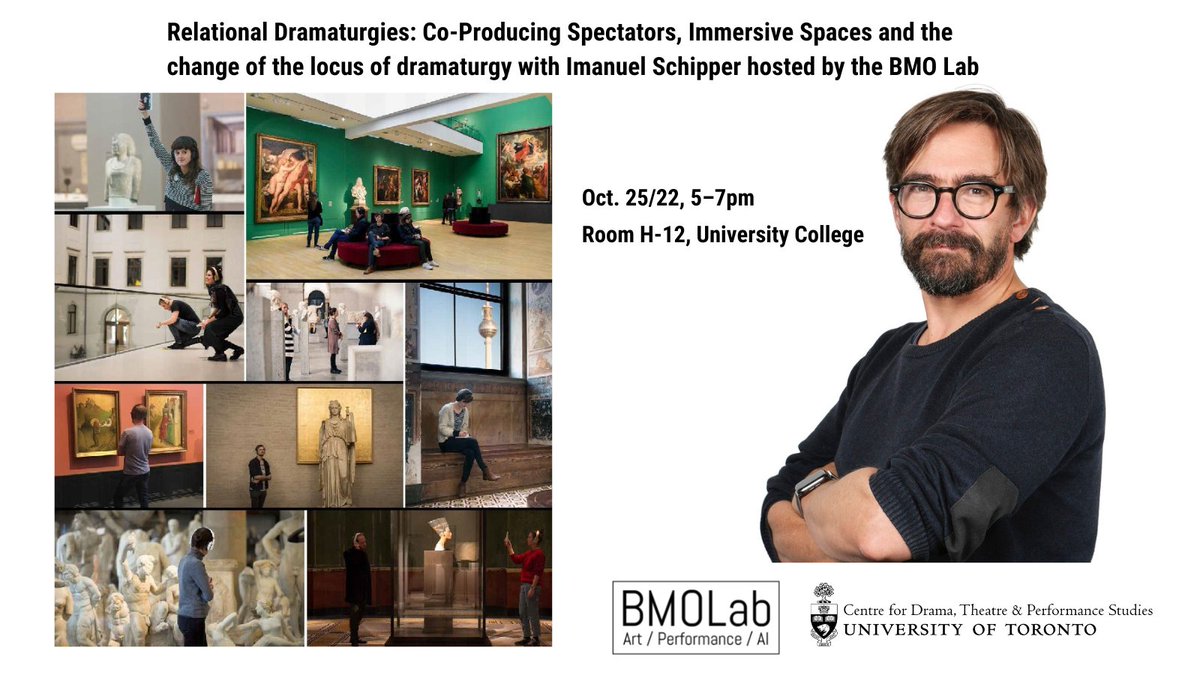
Join #CDTPS@bmo_lab's Performance Capture lecture series with special guest Imanuel Schipper on Oct 25, 5-7pm who will discuss Relational Dramaturgies: Co-Producing Spectators, Immersive Spaces and the Change of the Locus of Dramaturgy.
Visit https://t.co/44EGc94nk7
#BMOLabUofT
We have a full, exciting day of #AI discussions ahead. Today's guests include @ghadfield, @jeffclune, @DMulliganUCB, & @mrtz. Also, a special performance by @Drokeby & @bmo_lab. We start at 12:00 EDT. See you there!
Last-chance to register ➡️ https://t.co/TQrfg7acvx
#TorontoSRI
The Bard gets fresh! The Performers-In-Residence at @bmo_lab are exploring ways of combining language models like GPT-2 & live performance. #AbsolutelyInterdisciplinary attendees can watch a Shakespearean performance directed by @Drokeby.
Register ➡️ https://t.co/TQrfg7acvx
Creative technology job alert: Visualization + Creative Code at DeepMind (London), developing tools to explore, play with, and understand AI: https://t.co/oMqK18SNHg (deadline June 11)
Watch our first of three presentation from the Canadian Stage BMO Lab performers in residency as part of Can Stage’s festivsl of Ideas and Creation.
Today we look at using AI text generation in performance.
https://t.co/j5ZeHOpJaG
While developing my own art and research practice for the past decade, I’ve seen the value of moving beyond the seeming contradictions of science in the arts; of seeing them as obstacles, But instead as unique sites for invention, growth, and transformation.
Hybridity rejects false binaries. I believe that by engaging practices that connect scientific and cultural fields, we’re able to better adapt to the rapidly changing conditions of living on an interconnected, damaged planet. And hopefully change it for the better.
recording, toes to the tide
gray lines traced by lead
the contours of life
vivid in memory
scrawled indecipherable
scarlet, blue, orange
tide covers the shore
color covers the page
life observed, flourishes
Save the dates! This January 14-17, we're hosting "ART && CODE: Homemade"—a free online festival of casual talks by creators who explore poignant new approaches to combining everyday materials, craft languages, and cutting-edge computation! https://t.co/yzvI4sr2LO
https://t.co/YTMIICncvE uses BigGAN-PyTorch trained on Places 365. But the method is broadly useful with other models.
It turns out that a small batch of user-sorted images is enough to train a classifier and find a corresponding, perceptually meaningful, latent direction.