AMD acquired MEXT today, to target is one of the hardest problems in AI infrastructure right now. Memory, not compute, is a constraint that keeps showing up in large deployments, and DRAM has become the scarcest and most expensive part of the server.
MEXT built a software approach called Predictive Memory. An AI engine learns how a workload touches memory, offloads cold pages to flash that costs a fraction of DRAM, then predicts and restores those pages before the application needs them. The company has reported roughly 50% lower infrastructure cost and 2 to 4x more usable memory capacity.
@AMD is buying this software tool to extend the value of the compute it already sells, not another silicon play. If those efficiency numbers hold across real production workloads, it sharpens the performance per dollar story AMD is pushing in the data center, and that is exactly what deserves independent testing. (@Signal_65)
Pancreatic cancer has one of the most suppressive tumor microenvironments in oncology.
But two pancreatic cancer results dropped today. Both matter.
1. BioNTech mRNA neoantigen vaccine: nearly all responders still alive at 6 years. 98% of induced T cells were de novo — the immune system learned to see a cancer it had always been blind to.
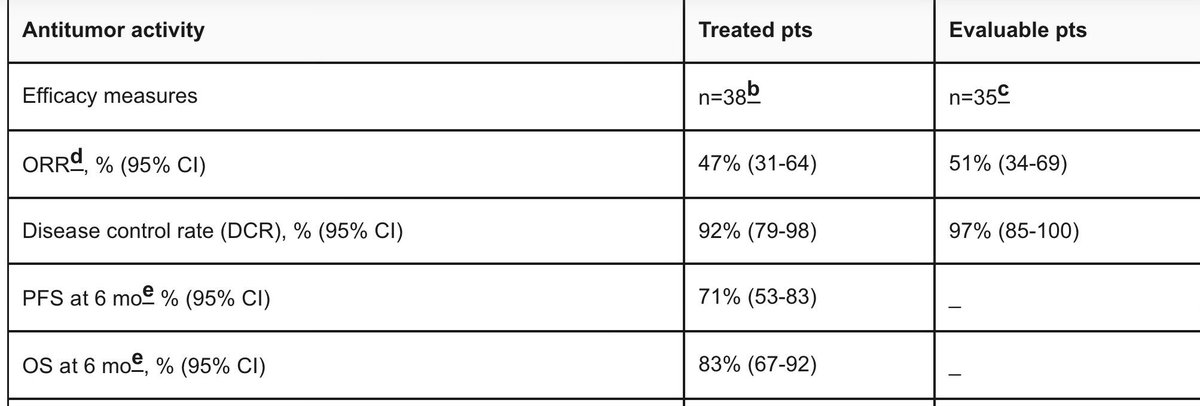
2. Daraxonrasib: 47% ORR, 92% disease control as first-line monotherapy. KRAS G12D, undruggable for 40 years, finally has a drug.
Different mechanisms. Same disease. Both working.
<13% of patients survive 5 years. That number is about to change.
great day for science! 🔥
No one understands WHAT IS REALLY going on in the economy and stocks regarding the announcements the past 10 days. I will explain the ramifications of all this 📉🫶🏼❤️ Here we go...
Right now, the market is freaking out about something it should actually be celebrating. 🎉
You keep hearing the same headline:
$AMZN $200B in capex
$GOOGL $180B
$META $125–135B
And Wall Street’s reaction is basically: “Too much spending. Bad for earnings. Bad for stock price.” 😡
They’re missing the entire point.
Here’s what most investors are thinking:
“All that money could’ve gone to share buybacks. That would instantly boost EPS. Why waste it on capex?”
But stop and think for a second. What does a share buyback actually do for the real economy?
Almost NOTHING!
It’s financial engineering. It makes earnings per share look better on paper, but it doesn’t create jobs, infrastructure, innovation, or growth.
The money basically disappears into the capital markets.
Now compare that to $200 billion in capex.
People hear that number and imagine it vanishing into some corporate black hole.
That is the opposite of what happens.
When Amazon says “we’re spending $200B,” that money flows everywhere.
It goes to:
– chip designers 📟
– semiconductor manufacturers 💾
– data center builders ⚙️
– construction companies 🏗️
– electricians ⚡
– engineers 👷🏻♂️
– logistics firms 🚚
– truck drivers 🚛
– railroads 🚂
– ports 🏗️
– suppliers 🛠️
– local communities 👷🏻♀️
This isn’t Monopoly money. It’s real economic activity. Take something like TSMC building new facilities in the U.S.
Have you ever seen one of these plants go up? It looks like an NFL stadium being built – except it lasts for YEARS. 💰💰💰
Thousands of workers.
Tons of suppliers.
Entire regional economies are getting lifted.
And that’s just one layer.
All those chips need to be manufactured, shipped, installed, maintained.
Servers need cooling systems, networking, power grids.
Data centers don’t magically appear.
This is economic stimulus on a massive scale.
When companies spend on buybacks, the impact is narrow and financial.
When they spend on capex, the impact is broad and real.
That money ends up in companies’ pockets, workers’ pockets, and eventually consumer pockets.
Which then gets spent again.
That’s how GROWTH cycles actually happen. 📈
So while the market is obsessing over short-term margins and EPS optics, something much bigger is taking place underneath.
We’re entering a multi-year investment cycle led by the biggest, strongest companies in the world.
And that is overwhelmingly positive for the economy.
The panic you’re seeing right now is the market being drama as to be expected.
The long-term implications of this spending spree are not.
Understand the difference.
Ignore the noise.
Follow where the real money is going. 💵
Agency > Intelligence
I had this intuitively wrong for decades, I think due to a pervasive cultural veneration of intelligence, various entertainment/media, obsession with IQ etc. Agency is significantly more powerful and significantly more scarce. Are you hiring for agency? Are we educating for agency? Are you acting as if you had 10X agency?
Grok explanation is ~close:
“Agency, as a personality trait, refers to an individual's capacity to take initiative, make decisions, and exert control over their actions and environment. It’s about being proactive rather than reactive—someone with high agency doesn’t just let life happen to them; they shape it. Think of it as a blend of self-efficacy, determination, and a sense of ownership over one’s path.
People with strong agency tend to set goals and pursue them with confidence, even in the face of obstacles. They’re the type to say, “I’ll figure it out,” and then actually do it. On the flip side, someone low in agency might feel more like a passenger in their own life, waiting for external forces—like luck, other people, or circumstances—to dictate what happens next.
It’s not quite the same as assertiveness or ambition, though it can overlap. Agency is quieter, more internal—it’s the belief that you *can* act, paired with the will to follow through. Psychologists often tie it to concepts like locus of control: high-agency folks lean toward an internal locus, feeling they steer their fate, while low-agency folks might lean external, seeing life as something that happens *to* them.”
If you struggle with impulse control, do this 10x a day to make your brain stronger:
+ notice the impulse to check your phone
+ deny the request
+ wait 10 min before opening
Start with 10 reps a day and you’ll feel:
+ heightened will power
+ stronger self mastery
+ deeper self-respect
People check their phones ~150x daily.
And spend 4 hrs 30 min/day.
The Addiction Economy, who is your invisible enemy, has hijacked your reward system.
The anticipation of a notification spikes dopamine in your nucleus accumbens, activating craving while reducing activity in the prefrontal cortex, the brain region responsible for your executive control.
Each capitulation trades your sovereignty for sedation.
Every time you resist an impulse, it’s like a rep in the gym for your brain. This will strengthen the dorsolateral prefrontal cortex, the part of your brain responsible for discipline and delayed gratification.
A great first step to reclaim yourself.
BofA estimates global data center spending will rise 25% YoY to $506 billion this year, while maintaining >20% YoY growth for the next three years.
$NVDA $AMD $AVGO
As a 30 year subscriber, I hope @TheEconomist will pardon me for posting the start and end of this week's brilliant Charlemagne @spignal about Europe as the land of th free. (With my apologies, but it so good it will certainly drive some subscriber growth!)
The thing about Europe: it’s the actual land of the free now
The thing about Europe, the sneerers say, is that it is over-regulated. Mounds of red tape and punitive taxes mean there are no trillion-dollar entrepreneurial ventures in France or Germany to match Amazon, Google or Tesla. But that is not all Europe is lacking. Also absent from the continent are the broligarchs who sit atop such behemoths, some of whom have a tighter grip on power than on reality. There are thus no European Rasputins pumping untold millions into political campaigns, getting pride of place at leaders’ inaugurations or their own new-minted government departments to run. There are few unicorns in Europe, alas, and too little innovation. That said, there are absolutely no tech executives boasting on social media of spending their weekends feeding bits of the state “into the wood chipper”.
The thing about Europe is that it is indecisive, too slow to act. Every crisis requires multiple summits of the European Union’s national leaders, often quibbling late into the night. The boring processes of rule by consensus can slow the eu to a crawl: it took four days and four nights of haggling to agree on the bloc’s latest seven-year budget, in 2020. Then again, the European state apparatus does not arbitrarily shut down every few years when political agreement over funding proves elusive, leaving millions of public employees on furlough and basic services unavailable for days or weeks. Consensus rule also means that the petulant policy tweets of one misguided politician—125% tariffs on China, anyone?—do not result in global stockmarkets being sent into a tailspin. The eu’s top brass are unelected and sometimes unaccountable. Still, they would not dare be photographed playing a round of golf after having wiped out the savings of millions of their compatriots.
The thing about Europe is it freeloads on defence, not spending enough on its armed forces to single-handedly fend off threats. This will continue to be true for a long time, even as defence budgets are hiked across most of the continent. But it also reflects a different understanding of what “defence” means. For one, nobody in Europe—outside Russia, at least—is even casually implying they will invade other countries. There is no Brussels quip about turning an unwilling neighbour into “our 28th state” (on the contrary, many of the eu’s neighbours are desperate to join the club). Nor do European vice-presidents fly uninvited to places they are seeking to annex, on the pretext that their spouse wants to watch a sledge race. Europe may have scrimped on intelligence-gathering, but its various leaders do know the identity of the aggressor who initiated the fighting in Ukraine (hint: it is not Ukraine). Many foresaw the pitfalls of invading Iraq a while back.
--Three missing paragraphs here--
The thing about Europe is it is naive, the only global trading bloc attached to moral norms. It insists on complying with the edicts of the World Trade Organisation, say, or doing its part to cut carbon emissions. It is not a place that demands allies come crawling to it begging for “favours” on tariffs.
The thing about Europe is that it is like an open-air museum, yesterday’s continent. Is its model even sustainable? A good question—one that presupposes the European model is worth defending. It is a place blessed with walkable cities, long life expectancies and vaccinated kids who do not need to be trained to dodge school shooters. Charlemagne’s realm is a place of many flaws, lots of them enduring. But in their own plodding way, Europeans have created a place where they are guaranteed rights to what others yearn for: life, liberty, and the pursuit of happiness. ■
@GeopolRomania@CG_Romania Firma x din vest cu contract cu firma y din vest isi deschide locatie in Romania pentru forta de munca, cum anume sa raporteze profit in Romania?