There are two types of software vulnerabilities being exposed in the AI age:
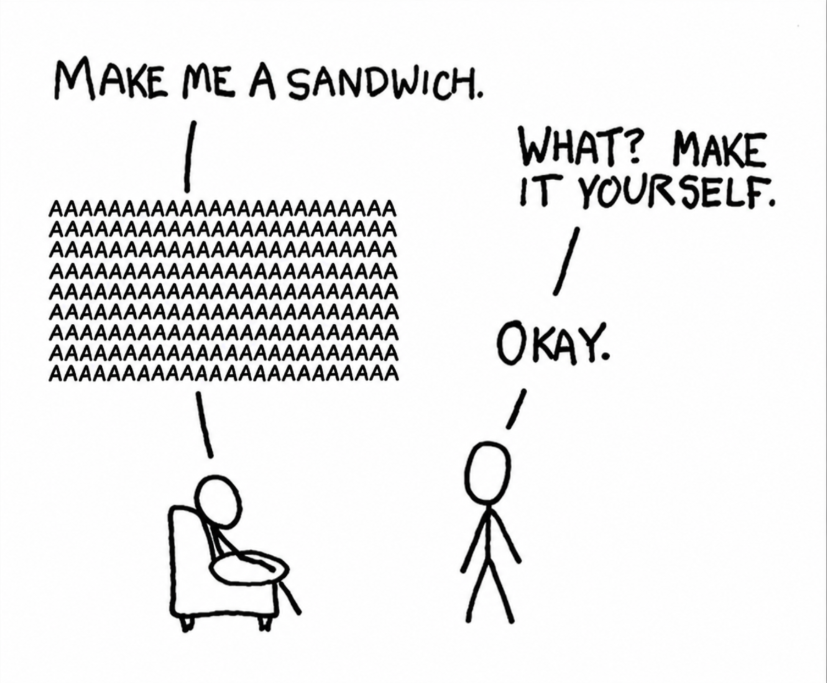
1. AAAAAAAAAAAAAAAAAAAAAAAAAAAAAAAAAAAAAAAAAAAAAAAAAAAAAAAAAAAAAAAAAAAAAAAAAAAAAAAAAAAAAAAAAAAAAAAAAAAAAAAAAAAAAAAAAAAAAAAAAAAAAAAAAAAAAAAAAAAAAAAAAAAAAAAAAAAAAAAAAAAAAAAAAAAAAAAAAAAAAAAAAAAAAAAAAAA
2. 4
3. Off by Ones
Java4Shell Vulnerability Explained in Simple Way : Part 1
Let's understand it from a Java developer's perspective, starting with Base64.
Java4Shell (CVE-2026-114938) is a newly disclosed vulnerability in OpenJDK's built-in Base64 decoder.
First, what is Base64?
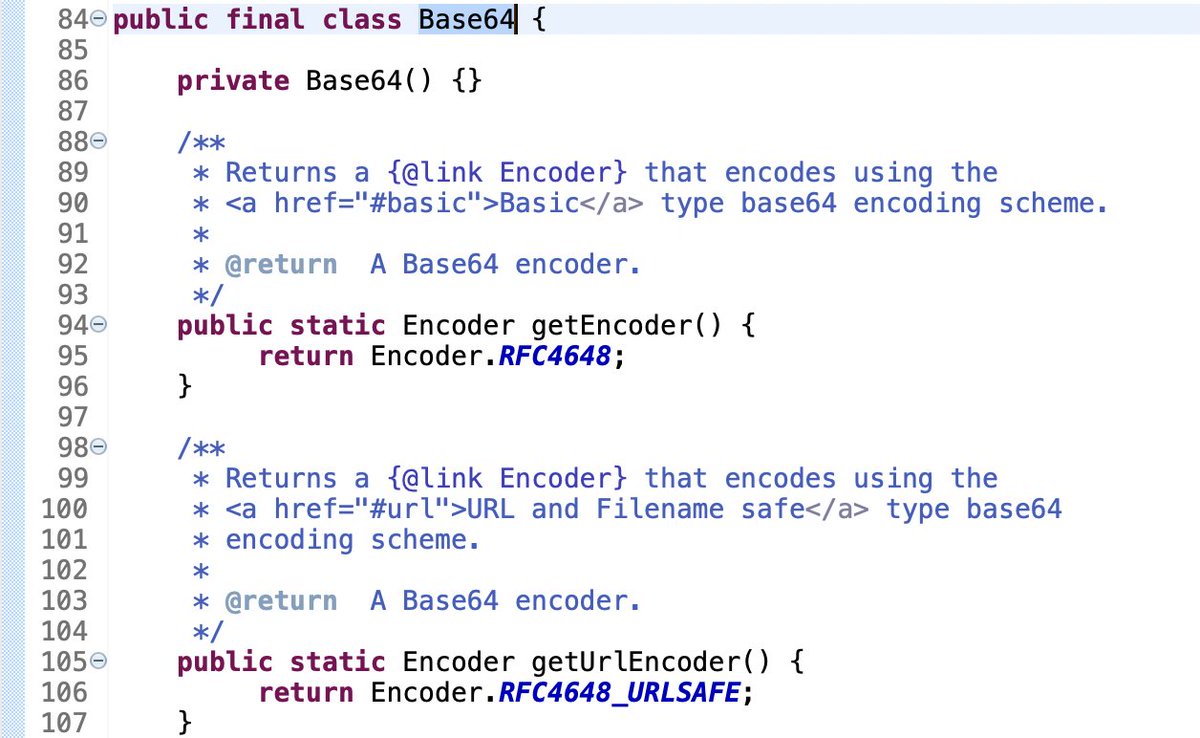
Java provides a built-in Base64 utility class in the java.util package.
Base64 is a utility final class in Java. It has a private constructor and provides static factory methods to obtain its Encoder and Decoder instances.
It provides static Encoder and Decoder classes, whose instances are immutable and thread-safe.
When sending data in an HTTP request, we sometimes use Base64 encoding to represent data in a text-friendly format.
For example, HTTP Basic Authentication uses Base64-encoded credentials.
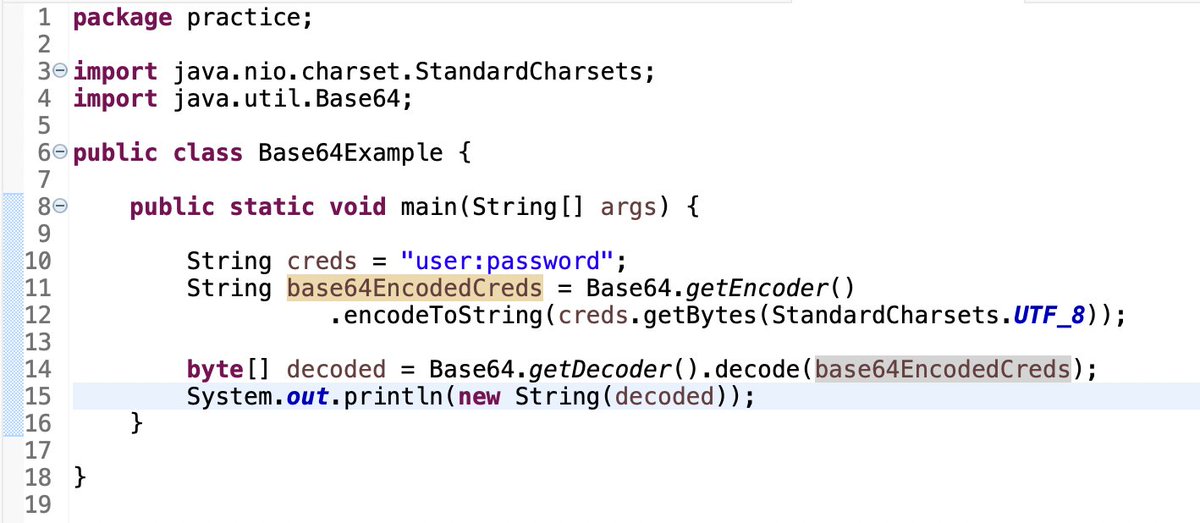
Let's see a Java example.
String creds = "user:password";
String base64EncodedCreds = Base64.getEncoder()
.encodeToString(creds.getBytes(StandardCharsets.UTF_8));
System.out.println(base64EncodedCreds);
Output: dXNlcjpwYXNzd29yZA==
To decode it:
byte[] decoded = Base64.getDecoder().decode(input);
System.out.println(new String(decoded));
Output: user:password
Important: Base64 is encoding, not encryption. It does not protect sensitive data by itself.
Where does Java4Shell come into the picture?
Java-based applications frequently decode Base64 input received from HTTP requests, authentication headers, tokens and file uploads.
The vulnerability exists in the implementation of:
Base64.getDecoder().decode(input);
Normally, the decoder does following:
Accepts Base64 input.
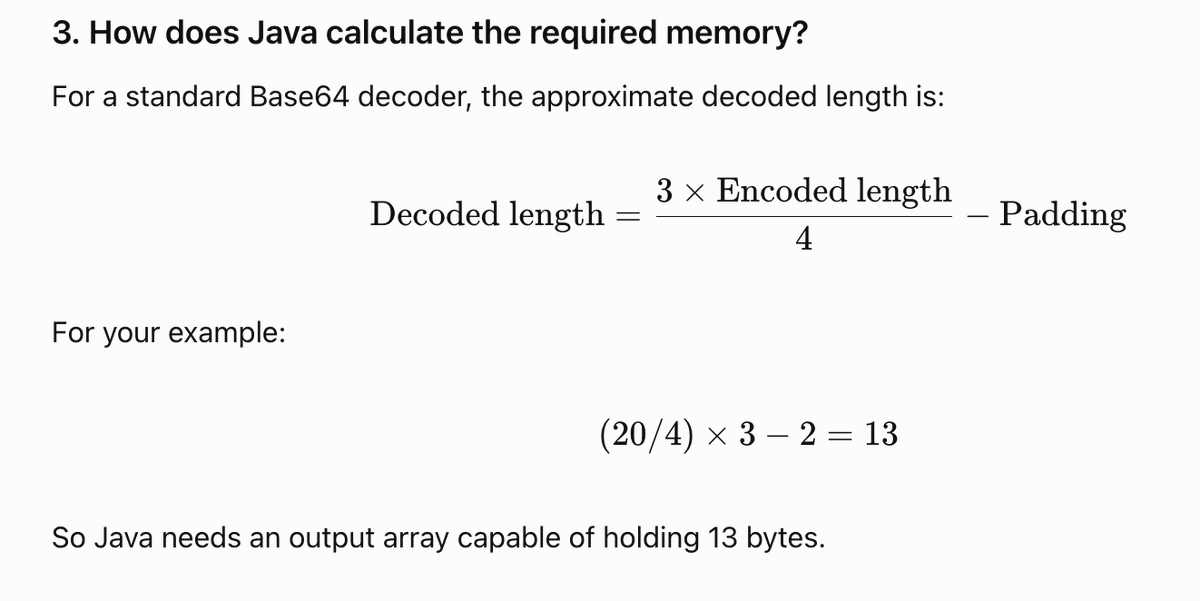
Calculates the required output size.
Allocates a byte array.
Decodes the input and writes the resulting bytes into that array.
What is the actual problem?
Java uses hardware-specific optimisations to make Base64 decoding faster.
On certain x86-64 processors, the JVM uses AVX-512 VBMI instructions for accelerated decoding.
Under a particular malformed, padded Base64 input condition, the optimised decoder incorrectly handles the final part of the input.
As a result, it can write beyond the allocated output array.
This is called a heap-based buffer overflow.
Why does Base64 padding matter here?
Base64 converts every 3 input bytes (24 bits) into 4 Base64 characters (6 bits each).
Padding (=) is used when the final input group contains fewer than 3 bytes.
For example:
3 input bytes → 4 Base64 characters
2 input bytes → 3 characters + =
1 input byte → 2 characters + ==
The vulnerability involves incorrect handling of certain malformed inputs in this final padded section.
What can happen because of this?
Writing beyond an allocated array can corrupt adjacent heap memory. Depending on the circumstances, this may result in:
JVM crashes and Denial of Service (DoS) and sensitive memory disclosure.
And that is what makes this vulnerability serious.
In Part 2, let's understand how this memory corruption could potentially lead to Remote Code Execution (RCE)
I'm a firm believer that everything you can want to know about a business you can learn from their bathrooms.
A great example of this is Barnes and Noble. B&N maintains a facade of being an upmarket bookstore that is welcoming and accessible. But, their bathrooms are gross and poorly located and marked. Their bathrooms are gross because they either make their underpaid retail employees clean them at open and close or they contract cut rate outside janitorial services on an insufficient schedule. Underpaid employees who wanted to be around books and then find themselves wiping/mopping up piss and shit are going to be as recalcitrant as possible every time they have to pull bathroom duty. The floor looks like it hasn't seen a mop in three or four days because it hasn't. They're poorly located and marked because they want you to walk the whole store looking for it and then walk though their highest margin non-book items once you do.
Just underneath the surface of this bookstore is a cost cutting company on razor thin margins that treats its employees as disposable and isn't detail oriented on delivering the upmarket customer experience they try and sell in their branding. Their bathrooms tell you this.
If you go into a busy establishment and their bathrooms are clean and well maintained, you know that company is well managed and well run with happy employees. The quality of the amenities in the bathroom tells you what their target market is. The size and location of those bathrooms tells you both the intentionality of their interior design and how they want to manage customer flow, which in turn tells you what their actual retail model is.
The Raspberry Pi 5 16GB now costs $385.
Raspberry Pi co-founder Eben Upton announced today that the 16GB Pi 5 goes up by $80, and the 16GB Compute Module 5 variants go up by $40. The reason is the same memory crunch that has pushed DRAM prices up across the industry for two years. Upton wrote that "a lack of alternative supply for 16GB DRAM, compounded by other ongoing component shortages" left them no choice.
This is the board that started as a $35 computer for classrooms and tinkerers. Raspberry Pi is avoiding blanket increases: the 16GB Raspberry Pi 500+ keyboard computer keeps its price, and Upton is nudging people to buy only the memory they need. He also warned about resellers using the shortage to sell at inflated prices and pointed buyers to Approved Resellers.
The company says it looks "forward to rolling back our price increases when memory costs fall once again."
The Japanese government has spoken to the US government about the Trump's use of anime characters:
“Such use requires permission from the copyright holder. We have conveyed this to the U.S. side multiple times through diplomatic channels.”
Job interviews are fucking ridiculous. 😂
“Where do you see yourself in five years?”
Hopefully somewhere I don’t have to answer this question ever again.
“Why do you want to work for us?”
Because my landlord refuses to accept good vibes and positive affirmations as rent.
“What’s your biggest weakness?”
Trying to keep a straight face when people ask me questions like these.
“Why should we hire you?”
Because you need someone to do the job, and I need money to survive. Seems like we could save each other a lot of time here.
“Tell me about a time you faced a challenge.”
I’m sitting in front of you, pretending these questions are normal while trying to secure my financial survival.
“Why did you leave your last job?”
Because apparently wanting better pay and less stress is no longer considered a valid career move.
And my personal favorite: “Do you have any questions for us?”
Yes. How much does it pay, how bad is the management, and how quickly can I use my PTO?
We're all adults pretending this isn't a transaction. You need labor, I need a paycheck. Can we please stop acting like this is a first date? 💀😂
Global TLS Intermediate CA incident: We’ve updated our incident page with how it happened, who is affected (one US customer ecosystem), what’s not affected, and what we’re putting in place. We will publish the root cause once our investigation is complete.
👉https://t.co/Ykzuwh34j0
Today silly shenanigans:
- PHP2shell, leak, bad stuff
- Something about Railway?
- The number 4 is a valid cert
- NodeJS and something about broccoli?
- LiteLLM supply chain attack
- GitLab CVSS 10
- OpenCode leaking API keys
What does this all mean? Idk
So basically, today PHP got two critical bugs that let anyone run code on your server without even logging in, which is bad, and then the details leaked before the patch was even out, which is worse, and it works on WordPress and MediaWiki and Magento and Joomla and Laravel, and Censys says like 1.5 million servers are running a version with no fix, so the NSA was like "take your system offline," and the FBI was like "take your system offline," and CISA and the UK and CERT-EU were all like "take your system offline," and then the Prime Minister of Japan, the actual Prime Minister, posted at 5:55 in the morning telling 48.8 million people to take their system offline, so everyone took their system offline, like the Dutch cybersecurity agency took its own website offline, and the Dutch parliament went offline, and the Port of Rotterdam went offline, and Finland and France and Denmark started pulling government sites, and Wikipedia went down, and https://t.co/QlOXb3COq3 went down, and Asana and GOG and Something Awful went down, and the University of Vienna's webmail went down for some reason, and that's just PHP. Because GitLab also dropped a CVSS 10.0, which is the highest score they give out, for a bug that's been there since 2014, so that's every self-hosted GitLab for twelve years, and then LiteLLM 1.107.0 got hijacked and shipped a credential stealer and a remote access trojan in every single wheel and the Docker images, including latest, and you didn't even have to import it, just installing it was enough, and it's the second time this year, and then Railway paused every deployment on the entire platform because someone got into the environment variables, so now everyone has to rotate every secret they've ever stored there, and TiDB Cloud said someone was walking around inside with stolen credentials for basically a month and an extortion group says they took 10.6 terabytes, and Zeabur got breached for the second time in two months and is just shutting down, like the whole company, and Node.js patched remote code execution and a TLS bypass, and CISA says Plex is being actively exploited, and someone took over 300 Tor exit relays to steal SSH passwords, and SafePay ransomware has hit over 600 critical infrastructure orgs, and India's biggest bank filed a data loss incident, and Japan has been in an official state of emergency in cyberspace since October 9, which honestly explains the 5:55 AM post. Oh, and eMudhra, a certificate authority that's issued over 60 million certificates, whose entire job is proving websites are who they say they are, was supposed to be using private keys that are random numbers over a hundred digits long, and one of them was 4. Just 4. And the others were like 66 and 237. Anyway, it's Wednesday.