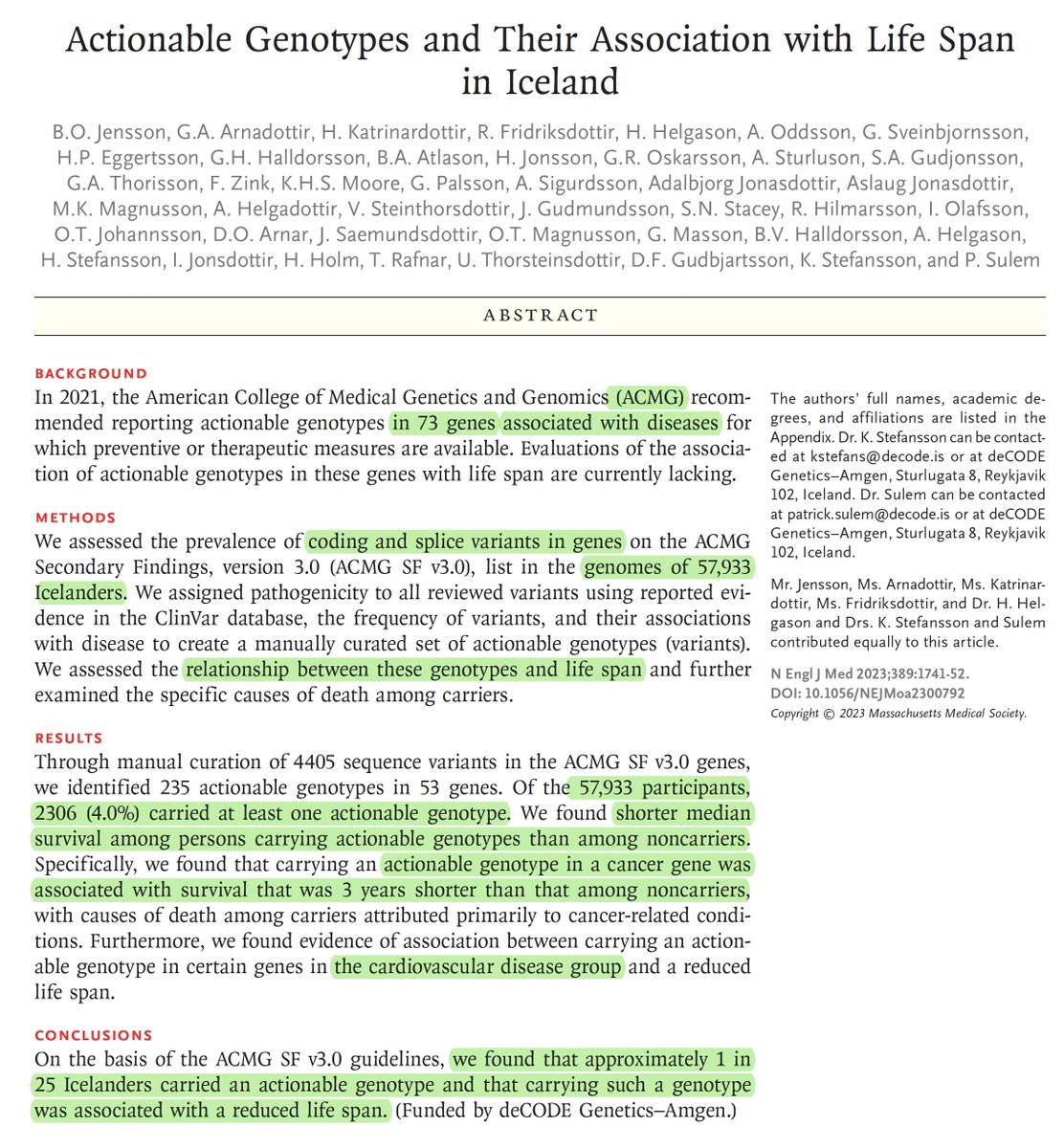
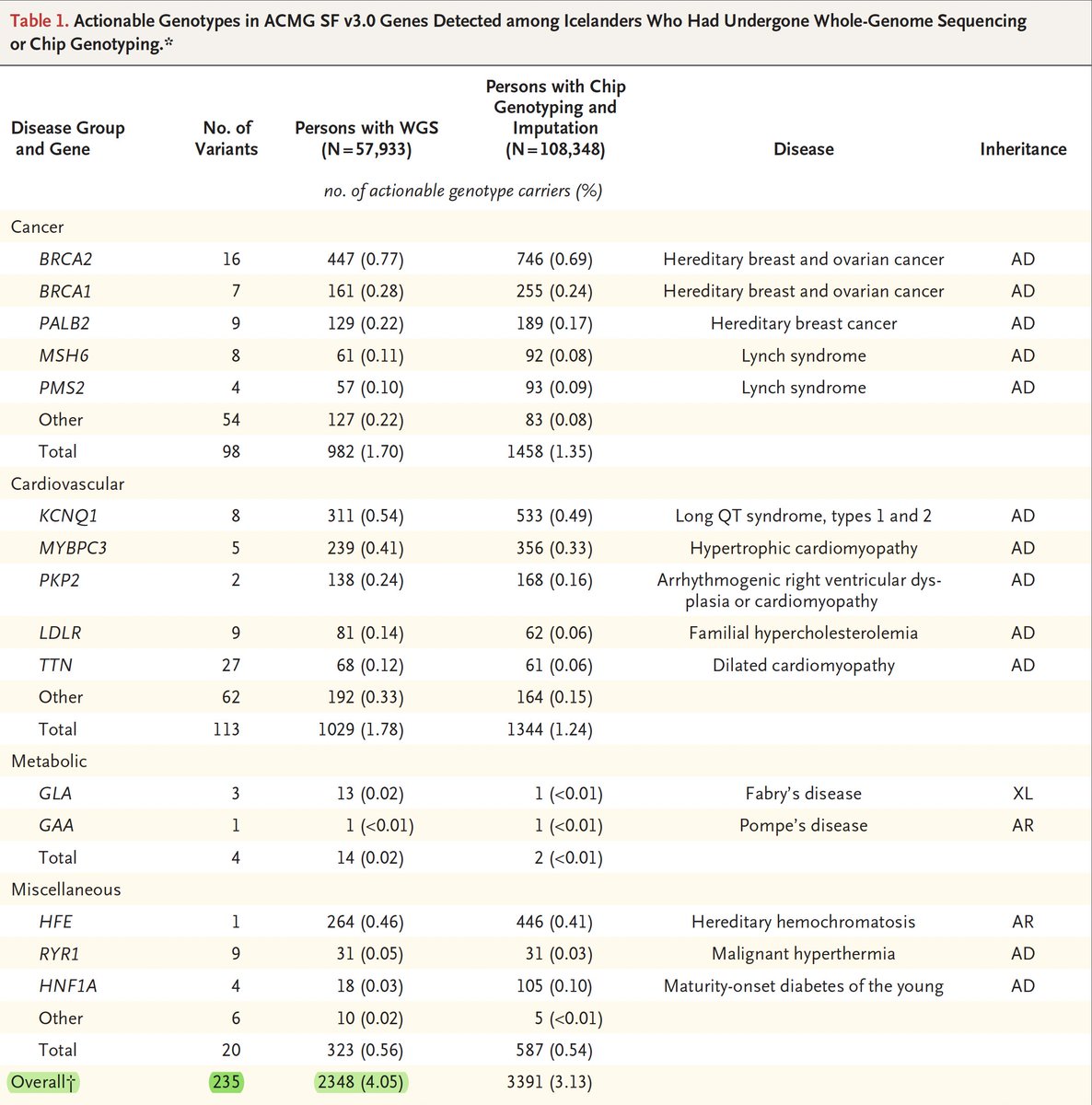
Proud to announce that our study on actionable genotypes and their association with life span using WGS data from 57,933 Icelanders has been published in @NEJM. @GudnyAnna@RunFridriksd@hanleygubrick@patsule https://t.co/ZaRIbDzANU 1/8
Happy to report that our paper “Gene-based burden tests of rare germline variants identify six cancer susceptibility genes” has now been published in Nature Genetics: https://t.co/wqLzCFDQhX
https://t.co/r0vyJ6u1H0
@NatureGenet
Sort of shows the amazing power of genetics and the still remarkably limited impact of pop health approaches using it. This is the effect of using WGS to identify pathological variables on pop level mortality. Not massive! But for those individuals who carry e.g. BRCA2, huge!
4% of the ~60k Icelanders whole genome sequenced by the deCODE carried an actionable genotype and died earlier than non-carriers; the difference was driven mainly by the cancer group.
Jensson, Arnadottir, Katrinardottir, Fridriksdottir, Helgason, Stefansson, Sulem et al. NEJM
https://t.co/lOHFHTnB0R
New @NEJM
4% of ~58,000 individuals assessed carried an *actionable* gene variant that is linked with reduced lifespan, such as BRCA2 with associated reduced lifespan by 7 years and 7-fold risk of dying from various cancers
https://t.co/CwSuV7FJqI
A new study examines the relationship of pathogenic and likely pathogenic variants for which preventive or therapeutic measures are available to life span and specific causes of death. Read the full study results: https://t.co/iXKWlsekEZ
Proud to announce that our study on actionable genotypes and their association with life span using WGS data from 57,933 Icelanders has been published in @NEJM. @GudnyAnna@RunFridriksd@hanleygubrick@patsule https://t.co/ZaRIbDzANU 1/8
Carriers of cancer-predisposing genotypes were more likely to have the relevant cancer listed as a cause of death on their death certificate. BRCA2 carriers had a seven-fold risk of dying from breast, ovarian or pancreatic cancer compared to the remainder of the population. 7/8
Delighted to report that our paper on "Sequence variants affecting the genome-wide rate of germline microsatellite mutations" is now out in @NatureComms, https://t.co/VPWTq86r1A. Thread below: 1/7
Happy to present our paper on the discovery of a new intellectual disability syndrome gene, CPSF3, by using the deficit of carriers of homozygous missense variants in the Icelandic population https://t.co/NAGtkXGkCf
@asmundurhreinn @bryojen@BjornssonL@patsule