SERV is the agentic reasoning engine solving exactly this - for enterprises, financial institutions, banks and even governments deploying AI in production.
The next frontier is reasoning compression. Cheaper models reduce the cost of intelligence, but they do not solve the cost of decision-making.
Most business decisions are not about raw IQ. They are about applying the right process, policy, workflow, or rulebook reliably.
That is where unbounded inference wastes money.
SERV Reasoning makes reasoning bounded and machine-readable, so models spend fewer tokens getting to reliable decisions.
Better performance per dollar, not just cheaper tokens.
Already live with the UAE government and a fast-growing number of enterprises, financial institutions and startups across many industries in our private beta (inc. banking, compliance, security, health, robotics, among many others).
Pretty insane to see 600k+ views on this article about a relatively little known project
I'll tell you why I wrote it, and it wasn't for any financial incentive (the team didn't ask me to write it, and I hold only a small amount of the token)
If you've followed my posts, I've been consistently writing about the unsustainable costs of intelligence that enterprises are facing
Demand for intelligence is near infinite, but only when there is ROI
If everyone tokenmaxxes with the most expensive models with the highest levels of reasoning, most use cases won't find ROI
What happens if we don't find ROI?
If enterprises don't find ROI, we start to see an unwind of the AI trade which has massive implications across financial markets and the global economy
We NEED for enterprises to find ROI, and soon
So that means we need to highlight more solutions that enable enterprises to get better intelligence-per-dollar spend, and get them adopted
I've been doing a LOT of research on this topic and posted a playbook for enterprises to reduce costs a few days ago (will link it in replies)
And I found this project OpenServ that has a solution called SERV Reasoning just hiding in plain sight, and in crypto of all places
That's what made me write about it, and I was naturally skeptical about it when I began (bc crypto)
I'm glad many people found this article helpful, let's keep the cost optimization dialogue going
what's crazy about zcash is that it's performing this well in the face of widespread fake news attacks (no, network was not down at all)
and one of the coldest crypto markets in a long time
it hasn't even experienced a bull market yet
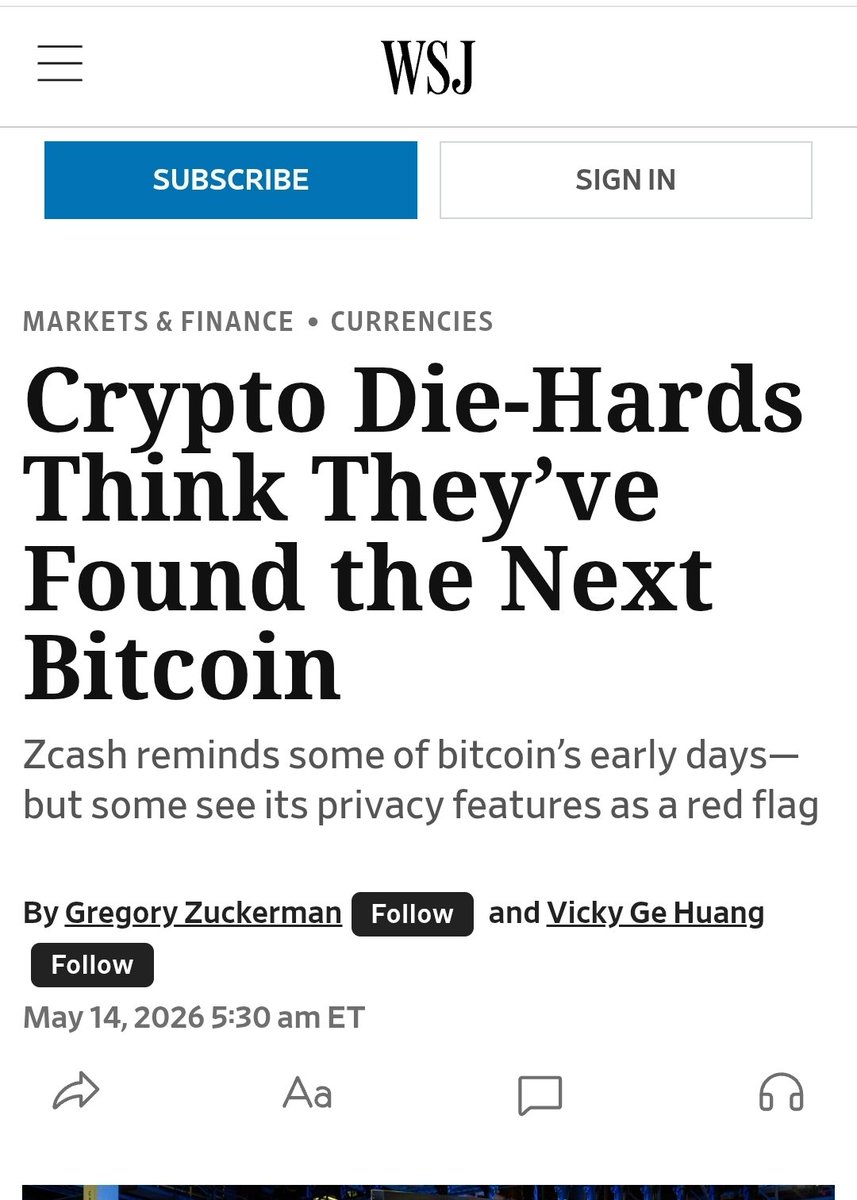
I meme a lot but i actually do think this pair continues to go up, zcash currently trades at lower than 1/100th of bitcoin's total valuation w/ better quantum resistant properties while privacy is becoming a popular narrative
concerns w/ saylor as key man risk also materializing
should be closer to 1/10th valuation, which would be ~.1zec per btc
INTERVIEW: Why $NEAR is Growing: The AI-Native Money Thesis - Intents, Privacy, & Tokenomics | @sal_ternullo@NEARProtocol is showing up more and more
- Integrated in @zodl_app, right before the $ZEC explosion
- Used in @AskVenice to create private AI inferece
- @infinex uses Near Intents for creating a unified wallet
What's going on over at @NEARProtocol, and how does Near adoption impact $NEAR?
@sal_ternullo, CEO of @svrn_ai, joins us to explain why he thinks the original NEAR thesis finally coming into focus.
They dig into NEAR Intents, AI money, tokenomics, privacy, fee capture, agentic commerce, and why SVRN is trying to commercialize the NEAR ecosystem rather than simply hold the asset.
[TIMESTAMPS]
0:00 Intro
2:23 Why NEAR is Everywhere Lately
3:58 Pivot or Return to Roots?
7:41 The “AI Money” Thesis
9:54 Intents, Zashi, and Real Product Market Fit
11:38 Tokenomics, Buybacks, and Value Accrual
14:45 NEAR’s Different Approach From Ethereum
18:00 Fees, Scaling, and First-Party Apps
23:04 Cross-Chain Liquidity as NEAR’s Moat
28:27 The Contrarian Investor Case for NEAR
31:43 Privacy, Enterprises, and AI Agents
39:38 What SVRN Is Building for NEAR
46:00 Investor Sentiment and Final Thoughts
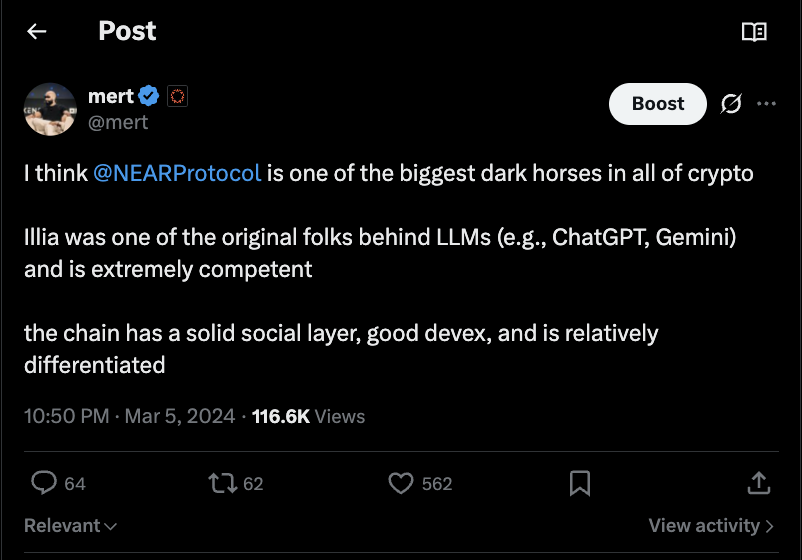
I'm not directly involved with near unlike zec & sol, but I've been consistent that it's obviously underrated given what it can do for a while
so it's satisfying to see a vibe shift around it
if they nail their gtm, decrease distractions, and increase focus, this could be fun
what you're discounting here is that $ZEC has gone through 10 years of accumulation, by the most long-term aligned people in crypto
cannot compare to altcoins that go 10x on launch in < 1 year with large VC supply overhang & mostly retail perps moonboys
refer to chart below