Die Expert(inn)en haben das iranische Atomprogramm nur verschieden interpretiert, es kommt drauf an, es zu beenden. Der Rest ist „Meinung Wahn Gesellschaft“ ...
Als E3 sind wir uns einig, dass Iran niemals in den Besitz einer Atomwaffe gelangen darf. Der #Snapback ist nicht das Ende der Diplomatie. Er kann der Beginn einer neuen Phase von Verhandlungen sein. Es ist an Iran, sich einer diplomatischen Lösung nicht länger zu verweigern. 1/2
🆘 SOS IRAN 🆘
The regime arrested Benyamin Naghdi, a monarchist Iranian athlete, then paraded him in forced-confession propaganda.
This is what dictators do before something “happens.”
Say his name.
Share.
Don’t let them disappear him.
#BenyaminNaghdi#بنیامین_نقدی #SOSIran
OUR NEW: Comprehensive Analysis of Iranian Nuclear Facilities Targeted During the Recent War, the Second Phase of the Iran War
I want to share our comprehensive report detailing and providing high-resolution satellite imagery of the nuclear related facilities that Israel and the United States targeted and destroyed during the Iran war that lasted from February 28 to a ceasefire on April 7/8, 2026. The Institute could identify at least six nuclear sites that were attacked. Three other sites that were attacked could be nuclear-related, but there is not enough information to be certain. In total, six to nine sites were recently attacked that were nuclear related.
Four of the 33 images in the report are attached. Their figure captions are at the end of this post.
The Israeli priority in the second phase of the war appears to have been more on further degrading Iran’s ability to make the nuclear weapon itself, a process called nuclear weaponization. Some of these targeted weaponization sites were revealed publicly for the first time, shedding new light onto the extent of Iran's nuclear weapons related work. Of the six to nine sites mentioned above, four to seven of them, or almost all of them, were directly related to making the nuclear weapon itself or possibly related in that way. A total of five nuclear weaponization-related sites were attacked in June 2025. In both phases of the war, a grand total of nine to twelve sites involved in developing and building nuclear weapons were targeted.
Attacks in phase two have further set back Iran’s ability to make nuclear weapons. Recent media reports of the U.S. intelligence community finding that the second phase of the war did not set back timelines for Iran to build nuclear weapons do not accord with the visible damage of nuclear weaponization facilities and require both more explanation and scrutiny.
The attacks deserve credit for significantly increasing both the time needed to finish a nuclear weapon and the chance of failure if tried. While the new Iranian regime is widely perceived as more motivated to decide to make nuclear weapons, its means to do so are severely degraded as is its confidence in trying. While before the June 2025 war Iran could have broken out and built a non-missile deliverable nuclear weapon with almost 100 percent certainty in less than six months, it will face a much more difficult struggle towards success if it tries in the coming months, and the probability of succeeding, whether it be in nine months, one year, or two years, is now much less technically certain, and significantly less than 100 percent. That real risk of failing to successfully build a nuclear weapon may be a deterrent against deciding to try.
Read the full imagery report here: https://t.co/hoz4B2OLOq…
Captions of the four images of attacked sites from left to right
1) Min-Zadayi is a previously unknown site suspected to play a key role in Iran’s attempt to reconstitute nuclear weapons capabilities post-June 2025. A close up of the hillside crater and smaller craters on a nearby concrete surface, apparently a roof for a partially buried area.
2) The two newly targeted buildings are close to the previously targeted (June 2025) SPND Mojdeh site and connected by footpaths. All three are involved in nuclear wespons development.
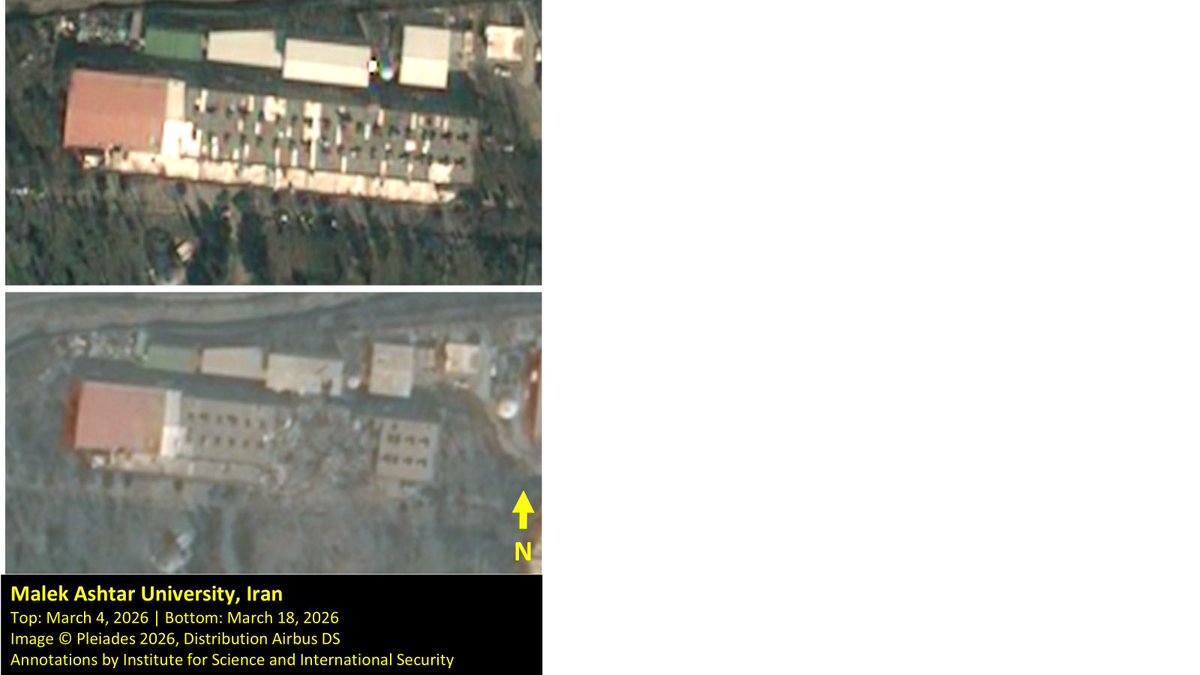
3) Before and after view of the large workshop building at Malek Ashtar University that was destroyed by an Israeli airstrike.
4) Before and after view of the destroyed engineering-laboratory building connected to Malek Ashtar University and the Mojdeh Site.
I recently saw a revival of an old JCPOA propaganda talking point that the JCPOA was the most extensive/intrusive verification regime ever negotiated. Surprised that this exaggeration would be dredged up. The denuclearization and verification arrangements covering Iraq after the 1991 Gulf War were both more extensive and intrusive, by far. No one doubts today that under that arrangement, Iraq completely denuclearized, and its many undeclared nuclear materials and activities were found by the inspectors.
In contrast, the JCPOA had particular failings on verification. It did verify the hell out of declared programs but failed to find the undeclared uranium and activities that is known to exist. It did not provide the leverage or even advocate for the IAEA to go out and show the existence of undeclared materials or ensure their absence. In the JCPOA, the P5 tended to see the IAEA’s mandate to seek a complete nuclear declaration as potentially rocking the boat on the JCPOA. Moreover, the JCPOA in practice provided no effective leverage to address the issue of a well-documented lack of a complete Iranian nuclear declaration or to ensure the presence or absence of undeclared nuclear materials and activities.
Freed of constraints, and with a new Director General, the IAEA did post-JCPOA identify undeclared uranium and activities that were there during the whole period of the JCPOA.
The IAEA finding grew out of the information in the Nuclear Archive, revealed in 2018, in the months before the US left the JCPOA. Would the IAEA have acted on the new information in the Nuclear Archive that was key to the its findings on undeclared material and activities, if the JCPOA had continued? Very unclear. The IAEA was very slow to act in any case. And when the archive was revealed the JCPOA parrots quickly cawed “Nothing new.” How wrong they were, but it was a clear message to the IAEA not to rock the boat. It likely took the US leaving the JCPOA for the IAEA to have the headroom to act on the information in the archives.
The world has moved beyond the JCPOA; it is archaic, hardly a comparative benchmark. Already, the wars have accomplished what the JCPOA never could; Iran is no longer enriching. And Iran’s remaining enriched uranium stocks are bottled up in caves, and its nuclear weaponization capabilities, untouched by the JCPOA, are in ruins. Under the JCPOA, Iran would today be increasing its enrichment capacity and safe in keeping its nuclear weaponization materials and activities free of that bothersome IAEA meddling.
But the struggle to stop Iran’s nuclear weapons ambitions and efforts is not finished. The remnants remaining in Iran are dangerous and unverified. Rebuilding, while time consuming, can be done. In that effort, any new nuclear deal should rhyme with the 1991 Iraqi verified denuclearization arrangement, not the JCPOA.
Don’t Confuse Knowledge with Know-How when Discussing the Killing of Scientists in Iran’s Nuclear Weapon Program
There appears to be a misunderstanding about the difference between knowledge and know-how, as evidenced in some recent media characterizations about the destruction of parts of Iran’s nuclear weaponization program and the killing of its key scientists, some the Oppenheimers of its nuclear weaponization program. Killing knowledge is not possible, but know-how can be eliminated, and that has been an important target of Israel in the wars against Iran.
The difference is important. Knowledge is theoretical understanding. Know-how is the practical knowledge, expertise, or tacit ability required to perform a task, create a product, or build a nuclear weapon effectively. In other words, how to do something. It is acquired through experience rather than formal education. It includes non-public techniques and secrets that offer an advantage.

One can read a book on how to build a bridge, but if that person had only such knowledge, would you hire that person to actually build it?
What Israel did was kill know-how about building nuclear weapons. That is hard to replace.
☢️ Three essential nuclear demands Iran must accept to maintain the cease-fire and in a negotiated settlement:
1) Timetable to allow in a team to retrieve and eliminate all enriched uranium stocks.
2) Commitment to a permanent and total ban on enrichment.
3) Agreement to cooperate with an IAEA investigation dismantling all nuclear weapons assets.
Otherwise, no deal, @POTUS should resume the strikes.
@VP@JDVance@SteveWitkoff@jaredkushner
More here:
🚨Missing from many ceasefire assessments: the Iranian people.
I fear for those detained since the Jan protests. This regime will move to settle scores fast. The pause only vindicates a sad truism: the longest suffering victims of the Islamic Republic are the Iranian people.
Iran’s first of its 10 point plan in English: A binding guarantee that the U.S. and allies will not strike Iran again
But in Iran’s Farsi version, a key phrase is tacked onto its first point namely the acceptance of Iran’s uranium enrichment.
So, Iran’s English version of its 10 point plan makes no mention of nuclear, but its Farsi version, likely approved by the leadership, reiterates the same unacceptable enrichment condition.
On the other hand, US first four points
1. Dismantle all major nuclear facilities
2. End all uranium enrichment on Iranian soil
3. Transfer enriched uranium stockpiles out of Iran
4. Accept intrusive international inspections everywhere
These will be tough negotiations, made even harder by Iran’s other non-starter demands. The ceasefire may only be a brief interlude between military conflicts.
There is work ahead.
A negotiated settlement must include the full, permanent, and verified dismantlement of all nuclear weapons infrastructure in Iran, supported by unhindered IAEA access and investigation.
The enriched uranium and HEU, all facilities including possible Pickaxe Mtn and Esfahan enrichment plants, centrifuges and their manufacture, documentation, equipment, and reoriented scientists.
Anything less means the regime will lie, reconstitute, and go for nukes ASAP.
@POTUS@VP@SecRubio@SteveWitkoff@jaredkushner
Been listening with 🙄 to people who know little about Iran’s nuclear program or its efforts to get nuclear weapons assert how Iran made a mistake by not “choosing” to build nuclear weapons. Israel attacked in June 2025 in large part because it saw that Iran was too close to deciding to build them. The effort over the last 25 years has been to prevent Iran from building nuclear weapons, despite Iran wanting to and trying to. That effort has worked remarkably well, and the recent wars, regardless of one’s thought on them, have seriously set back Iran’s nuclear weapons capabilities, both in terms of hardware and personnel. The struggle to prevent Iran getting nuclear weapons is not yet over and that should be the focus, to remove the last vestiges of Iran’s enrichment and nuclear weaponization programs, not giving any credence to Monday morning quarterbacking by people who didn’t even see the game.
Nuke sites I’m tracking as having taken hits during this conflict:
Weaponization-linked:
❌ Malek Ashtar University site
❌ Minzadehei compound
❌ Taleghan 2
❌ Mojdeh building
Enrichment or conversion-linked:
❌ Esfahan assets/control areas
❌ Natanz entrances
❌ Natanz enrichment site(?)
❌ Pickaxe Mtn vehicle
"We have a president talking like an imperialist maniac and yet nothing seems real." Sam Harris on Trump's Cuba comments and the collective trance we've all been put in.